

Key Takeaways
A machine can beat a world champion without thinking like one
A startling reversal. In 1985, twenty-two-year-old Garry Kasparov played thirty-two computers at once and won every game. Twelve years later, IBM’s Deep Blue defeated him in a match watched around the world. It could evaluate up to 200 million chess positions per second, but its victory did not mean it had acquired a humanlike mind. It had mastered a narrow task through specialized hardware and calculation.
Performance is not understanding. The chess contest exposed a recurring confusion: if a machine produces a result associated with intelligence, people assume it reached that result by thinking as humans do. Deep Blue showed that task performance and humanlike understanding are separate questions. A machine can surpass us at a skill without possessing the wider capacities we associate with a mind.
What's striking is how quickly a dramatic benchmark becomes a claim about the whole mind. Chess made the distinction unusually visible because the result was clear, while the machine's method was radically unlike a person's. The same caution applies whenever a system excels at a measurable task: success establishes capability within that test, not general understanding. Yet the reverse mistake is also possible. Dismissing machine competence because it lacks human experience overlooks real consequences when a narrow tool is deployed in consequential settings.
Build around unlike strengths instead of forcing machines to imitate people
Different routes to a move. Kasparov describes Moravec's paradox as the mismatch between human and machine strengths: machines can calculate vast numbers of possibilities, while people are better at recognizing patterns and applying context. Human players quickly narrow a position to a few plausible moves, then calculate. Claude Shannon called exhaustive search Type A and selective search Type B. Early researchers favored humanlike selectivity, but efficient brute-force search, improved by alpha-beta pruning, ultimately made chess machines formidable.
Intuition is not magic. Kasparov recalls Mikhail Tal's story of struggling to calculate a sacrifice until his thoughts wandered to how one might pull a hippopotamus from a swamp. The distraction helped him recognize that calculation alone would not settle the position. Human intuition can leap beyond a formal search, though it can also mislead. Machines and people contribute different, imperfect forms of judgment.
This is a useful correction to the instinct to treat human cognition as the blueprint for every intelligent tool. In chess, brute-force search succeeded precisely because the machine did not need to imitate a player's experience. The strongest general lesson is architectural: choose a method suited to the task, rather than assuming humanlike process is the goal. The limit is equally important. Chess has fixed rules and a visible outcome, so its winning computational strategy cannot automatically be transferred to domains where context, values, and ambiguous goals matter.
Question the habits your last victory rewarded
Success can harden into habit. Kasparov calls this the gravity of past success: achievements can make a person less willing to change the methods that produced them. In his 2000 title match against Vladimir Kramnik, Kasparov kept pushing into positions that suited his own attacking style, although Kramnik had prepared to make those positions uncomfortable. Kasparov lost the match without winning a game.
Expertise needs revision. Chess technology created a similar test. Databases let players examine thousands of games quickly, giving those who adapted a practical edge. Some established players resisted the new tools and fell down the rankings, while younger players absorbed them into training. The lesson is not to abandon experience, but to keep testing whether familiar methods still fit changed conditions.
The Kramnik match turns a familiar organizational problem into a personal one: competence can reinforce the very assumptions that eventually become liabilities. In strategy, past success is evidence, but it is not proof that a method remains optimal after an opponent or environment changes. The useful discipline is to ask what current evidence would make a trusted approach fail. Adaptation should not mean chasing every novelty, however. Change is valuable when it responds to altered conditions, not merely because it is new.
Automation moves forward, but its costs land unevenly on workers
There is no simple return. Automatic elevators existed decades before riders accepted them. A 1945 strike by New York elevator operators, whose union had about 17,000 members in 1920, helped force a change; industry publicity then helped people accept operator-free elevators. The transition improved convenience and safety, but workers lost livelihoods. Kasparov uses this history to challenge the idea that society can preserve every old job by slowing technology.
Progress needs preparation. Automation has eliminated or transformed work in factories, offices, and services. New occupations have appeared, but telling displaced workers simply to retrain ignores the cost and uncertainty of that transition. Kasparov argues that societies should prepare people for emerging work instead of trying to recreate obsolete roles. The benefits of productivity do not automatically reach those who bear the disruption.
The elevator example captures an important distinction: eventual public acceptance does not make a transition painless or fair. Aggregate gains in safety and productivity can coexist with concentrated losses for workers, especially when new roles require different training or are located elsewhere. That tension makes workforce preparation a practical obligation, not a slogan. The argument against trying to freeze technology is persuasive, but it does not settle who should pay for retraining, income support, or relocation. Those are political choices, not automatic by-products of innovation.
Fair AI contests require transparency when one side cannot inspect the other
An opaque opponent. In the 1997 rematch, IBM withheld Deep Blue's recent games and resisted releasing logs that could explain its choices. The machine also experienced interruptions that required operator involvement. After Kasparov resigned game two, his team found a line that could have forced a draw, although later analysis showed the position remained close to winning with best play. The discovery did not erase his mistake, but it intensified his uncertainty about what the machine could do.
A distinction matters. Kasparov eventually concluded that Deep Blue had not cheated. His criticism was that secrecy and unequal access undermined the match as a scientific experiment. When one participant can inspect the other but not be inspected in return, suspicion becomes hard to separate from evidence.
This episode shows that trust is part of a technical system's operating environment. A black box may still produce valid results, but when stakes are high, outsiders need ways to distinguish ordinary failure from intervention, malfunction, or uneven rules. Independent logs and clear procedures are not ceremonial extras; they make performance interpretable. At the same time, opacity does not prove misconduct. Kasparov's own misjudgment in game two demonstrates why procedural concerns and claims about what caused an outcome must be kept distinct.
The best human-machine teams win through coordination, not raw horsepower
Partnership changed the contest. In 1998, Kasparov and Veselin Topalov played Advanced Chess, with each player allowed to consult a computer during the game. Their six-game match ended level, 3-3. A month earlier, Kasparov had beaten Topalov 4-0 in rapid chess without computer assistance. The engine helped with calculation, leaving the humans to guide strategy, but using the tool well was itself a new skill.
Process can beat components. In a 2005 online freestyle tournament, teams could combine human players and computers. The winner was not a Grandmaster with the strongest equipment, but two American amateurs using three computers effectively. Kasparov's conclusion was that a weaker human with a machine and a better process could outperform stronger players with worse coordination. The partnership, not either component alone, determined the result.
The freestyle result shifts attention from what a tool can do to how a group organizes its use. That insight applies wherever human judgment and computation must interact: access to powerful software is not the same as knowing when to consult it, how to compare its outputs, or who makes the final call. The result does not show that expertise is unnecessary. It shows that expertise can be wasted by a poor workflow, while a disciplined process can help less experienced users extract more from the same capability.
Use engines to interrogate your reasoning, not replace it
An answer is not a lesson. Kasparov's young chess students often justified moves by saying they were standard theory or the computer's preferred choice. When asked why, they could not explain the position. A database or engine can identify a strong move, but copying it does not create understanding. Players who follow opening lines blindly can become lost when an opponent varies or their memorized sequence ends.
Keep the thinking muscle active. Kasparov points to Magnus Carlsen as a player who uses engines without treating them as oracles. The tool can test analysis, catch tactical errors, and make preparation more efficient. The human still needs to understand why a suggestion works and whether it fits the actual opponent and position. Used this way, technology can strengthen judgment instead of substituting for it.
The distinction between receiving an answer and acquiring a mental model is central to effective learning. External tools can reduce the effort spent on lookup or routine checking, leaving more attention for explanation and transfer. But if the user skips that work, competence may remain attached to the tool rather than becoming portable. This is not a case for rejecting assistance. It is a case for building explanation into its use: ask what assumptions support a recommendation, what would change it, and when it might fail.
Put human purpose and accountable uses at the center of AI policy
Tools do not choose ends. Kasparov argues that technology can raise living standards and expand human capability, but it can also disrupt jobs and expose private information. He gives more weight to present concerns such as automation, surveillance, and autonomous weapons than to distant scenarios of superintelligent machines taking control. The practical question is not only what a system can do, but who sets its goals and who is answerable for its effects.
Keep ambition in the picture. Intelligent tools can take over routine work and support creativity, analysis, and discovery. But progress does not decide what society should value. Kasparov's closing challenge is to create new goals and fields of activity, while taking responsibility for how powerful systems are deployed. Fear alone does not prepare people; neither does optimism without safeguards.
The strongest part of this position is its focus on agency: technical capability does not determine social purpose, and choices about deployment remain open to governance. The emphasis on near-term harms also helps prevent dramatic speculation from crowding out concrete questions about workers, privacy, and control. A further complication is that purpose is rarely shared equally. Companies, governments, workers, and users can want different outcomes from the same system. Accountability therefore requires more than human oversight in principle; it requires clarity about whose interests shape the objectives and who can challenge them.
Analysis
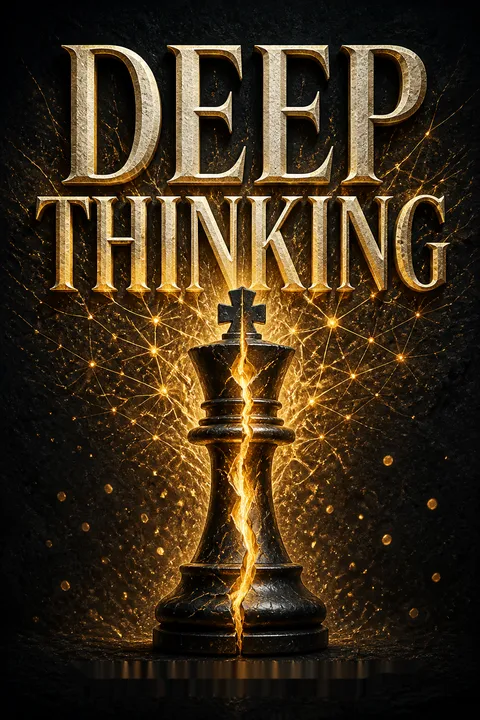
Deep Thinking is part memoir, part history of computing, and part argument about how people should relate to technology. Its organizing device is Kasparov's changing position: first he defeats weak machines, then becomes the public face of their advance, loses to Deep Blue, and finally tests collaboration. That narrative keeps a broad subject grounded in a concrete competition.
The book's most durable distinction is between a machine's performance and the process behind it. Chess gave researchers a bounded task with measurable outcomes, yet the path to machine mastery was not a replica of human thought. This unsettles the assumption that success at an intelligent task reveals a humanlike mind. It also warns against the opposite error, treating nonhuman methods as somehow unreal when they produce consequential results.
Kasparov's account of the 1997 match adds an institutional dimension. His own resignation and subsequent doubts expose how stress, incomplete information, and technical opacity can distort judgment. His eventual conclusion that Deep Blue did not cheat is significant, but it does not vindicate the match as a model of scientific openness. The episode shows why confidence in a result depends partly on whether others can examine how it was produced.
The book's optimism about automation is compelling when it rejects nostalgia for obsolete work and urges people to create new challenges. Its weaker point is that technological gains do not automatically compensate those who lose jobs or control. That gap is not a refutation of progress, but it makes policy and distribution central rather than secondary.
The most productive synthesis is neither human supremacy nor machine replacement. Machines contribute speed, recall, and search; people contribute contextual judgment, interpretation, and the choice of ends. Those strengths are not fixed, and the partnership depends on process. The book's practical challenge is therefore to develop tools while also developing the institutions, skills, and habits that let people use them well.
Review Summary
Deep Thinking explores Kasparov's famous chess matches against IBM's Deep Blue, offering insights into AI, chess, and human cognition. While some readers found it insightful and well-written, others felt it focused too heavily on chess or Kasparov's personal grievances. The book discusses the implications of AI for society, emphasizing the potential for human-machine collaboration rather than competition. Many reviewers appreciated Kasparov's perspective on technology and its impact on human creativity, though some found parts of the book less engaging or repetitive.
People Also Read



Glossary
Moravec's paradox
Uneven human and machine strengthsThe observation that computers can perform tasks associated with advanced calculation, such as chess search, while struggling with abilities humans acquire effortlessly, including perception, movement, and context. In Kasparov's account, it also highlights the reverse pattern: human pattern recognition and strategic intuition can complement machine calculation.
Type A
Exhaustive move searchClaude Shannon's label for a chess-program strategy that searches broadly through possible moves and evaluates the resulting positions. Early researchers doubted it could work because chess branches into an enormous number of continuations. More efficient search methods and faster hardware eventually made this approach highly successful.
Type B
Selective move searchClaude Shannon's label for a chess-program strategy that narrows attention to a small set of promising moves before searching those lines more deeply. It resembles how experienced humans select candidate moves using pattern recognition. Early programmers hoped this would be more efficient than exhaustive search, but choosing the right moves proved difficult.
alpha-beta pruning
Cuts unpromising search branchesA search technique used in chess programs to stop analyzing branches that cannot improve on a stronger option already found. By pruning these unpromising possibilities, a program can examine more relevant positions at greater depth. Its success helped make brute-force chess search practical and powerful.
Advanced Chess
Human play with computer assistanceA chess format introduced by Kasparov in which each player may consult chess software during the game. The experiment was intended to combine human strategic judgment with machine calculation. It showed that access to an engine changes the skills required: players must decide what to ask, how to interpret analysis, and when to rely on their own understanding.
Kasparov's law
Process can outweigh raw strengthA label applied to Kasparov's conclusion from freestyle chess competitions: a less-skilled human team with computers and a more effective process can outperform stronger people or machines using their capabilities less effectively. It is a lesson about coordination and workflow, not a universal mathematical law.
opening book
Stored chess opening movesA database of established opening moves that a chess program can follow before it begins calculating independently. Opening books let machines reach familiar positions quickly and avoid spending search time on well-studied early play. Their weakness is dependence on the accuracy and suitability of the stored lines.
gravity of past success
Success-induced resistance to changeKasparov's term for the way achievements can make people or organizations cling to methods that previously worked. Past success can reduce curiosity about changing conditions and make adaptation feel unnecessary or threatening. Kasparov connects the idea to his defeat by Vladimir Kramnik, when he failed to shift away from positions that suited his own style.
tablebases
Solved chess endgame positionsComputer-generated databases that contain the best result and moves for every possible position with a limited number of pieces. Rather than calculate each continuation, a chess program can consult the stored solution once its search reaches one of these positions. Tablebases revealed precise endgame outcomes that had eluded even elite human players.
FAQ
What's Deep Thinking: Where Machine Intelligence Ends and Human Creativity Begins about?
- Human-Machine Interaction: The book explores the evolving relationship between human intelligence and artificial intelligence, focusing on chess as a key example.
- Kasparov's Experiences: Garry Kasparov shares his personal journey and experiences competing against IBM's Deep Blue, providing insights into the challenges and triumphs of facing a machine.
- Philosophical Themes: It delves into broader themes of creativity, decision-making, and the implications of AI in society, questioning what it means to be human in a technologically advanced world.
Why should I read Deep Thinking by Garry Kasparov?
- Unique Perspective: Kasparov offers a firsthand account of his historic matches against Deep Blue, providing insights not found in typical chess literature.
- Relevance to AI: The book addresses ongoing discussions about AI's role in society and its impact on human creativity, making it timely and relevant.
- Inspiration for Innovators: Kasparov's reflections on adapting to challenges posed by machines can inspire readers to embrace change and innovation in various fields.
What are the key takeaways of Deep Thinking?
- Human Creativity vs. Machine Calculation: Kasparov emphasizes the differences between human intuition and machine logic, particularly in chess.
- Collaboration Over Competition: He advocates for a future where humans and machines work together, enhancing each other's strengths through concepts like "Advanced Chess."
- Understanding AI Limitations: The book highlights AI's limitations in understanding context and making nuanced decisions, underscoring the importance of human insight.
What are the best quotes from Deep Thinking and what do they mean?
- “Challenge yourselves and you will challenge the world.”: A motivational call to action, encouraging readers to push their boundaries and embrace challenges.
- “If you can’t beat ’em, join ’em.”: Reflects Kasparov's shift from viewing machines as adversaries to seeing them as collaborators, emphasizing adaptation to technological advancements.
- “The highest art of the chess player lies in not allowing your opponent to show you what he can do.”: Highlights the importance of controlling the game and limiting the opponent's options.
How does Garry Kasparov describe the evolution of chess machines in Deep Thinking?
- Early Development: Kasparov outlines the initial attempts to create chess-playing machines, noting their reliance on brute force calculations.
- Technological Advancements: He details how improvements in hardware and software led to significant enhancements in machine play, including specialized chips and algorithms.
- Deep Blue's Impact: Kasparov reflects on his matches against Deep Blue, marking a turning point in human-machine relations and the culmination of decades of research.
What is "Advanced Chess" as mentioned in Deep Thinking?
- Concept Overview: Advanced Chess is a format where human players use chess engines as partners, combining human creativity with machine calculation.
- Experimentation and Results: Kasparov conducted experiments with Advanced Chess, observing innovative strategies and high-quality play resulting from human-machine collaboration.
- Future Implications: The concept serves as a metaphor for potential human-machine collaboration in various fields, leading to new opportunities and advancements.
How did Kasparov feel during his matches with Deep Blue?
- Shock and Disbelief: Kasparov experienced shock at Deep Blue's capabilities, especially after losing the first game.
- Frustration and Pressure: The pressure of the matches weighed heavily on him, leading to feelings of exhaustion and demoralization.
- Determination to Adapt: Despite challenges, Kasparov remained determined to adapt his strategies, recognizing the need to target Deep Blue's weaknesses.
What strategies did Kasparov use against Deep Blue?
- Anti-Computer Strategy: He employed quieter openings to avoid sharp tactical positions where Deep Blue excelled.
- Psychological Warfare: Kasparov used unexpected moves to unsettle Deep Blue, such as playing the Reti Opening.
- Adaptation and Learning: He adapted his approach based on Deep Blue's play, focusing on targeting its weaknesses and avoiding its strengths.
How did Deep Blue change between the first and second matches?
- Improved Evaluation Functions: Deep Blue's evaluation functions were upgraded, allowing it to play more strategically.
- Increased Speed and Power: Its processing power was doubled, enabling it to analyze more positions per second.
- Human-Like Moves: Deep Blue began to exhibit more human-like strategic play, surprising Kasparov with its understanding of positional factors.
How does Deep Thinking address the psychological aspects of playing against machines?
- Unique Challenges: Kasparov discusses the psychological tension of competing against a machine, which lacks human emotions and vulnerabilities.
- Impact on Performance: The presence of a machine can lead to over-calculation and second-guessing, affecting a player's decision-making process.
- Human vs. Machine Dynamics: The asymmetry of competition alters the traditional chess experience, creating a unique challenge for players.
What lessons does Kasparov draw from his matches with Deep Blue?
- Embracing Change: Kasparov emphasizes the importance of adapting to new technologies and challenges, advocating for innovation.
- Understanding Limitations: He learned about AI's limitations in creativity and intuition, recognizing the depth of human thought.
- Collaboration as Key: Kasparov concludes that the future lies in human-machine collaboration, leading to advancements in various fields.
What does Garry Kasparov believe about the future of AI and humans?
- Collaboration is Key: Kasparov advocates for a future where humans and machines collaborate rather than compete.
- Human Creativity Matters: He believes human creativity and intuition remain essential, even in an age of advanced AI.
- Cautious Optimism: While acknowledging AI challenges, Kasparov remains optimistic about technology enhancing human capabilities.
About the Author


Download PDF
Download EPUB
.epub digital book format is ideal for reading ebooks on phones, tablets, and e-readers.








