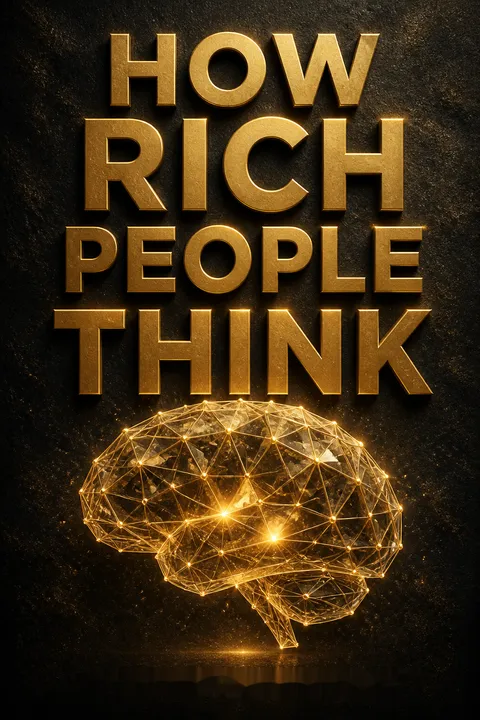


Key Takeaways
Audit the beliefs behind your money habits, then turn better beliefs into action.
Beliefs shape behavior. Siebold presents wealth first as a way of thinking. After beginning his research as a broke college student, he says 26 years of interviewing wealthy people changed his assumptions about money and, in turn, his actions and financial results. Across the book’s many contrasts, his central sequence is consistent: beliefs influence choices, choices become habits, and habits shape outcomes. Believing wealth is possible, he argues, makes a person more likely to seek opportunities instead of defaulting to fear or resignation.
Mindset is a starting point. The practical invitation is to examine inherited ideas about money, such as “wanting to be rich is selfish,” and ask whether they help or hinder. Siebold does not offer evidence that changing beliefs alone guarantees wealth. His stronger, more useful point is that beliefs can affect which actions a person is willing to attempt and persist with.
The book’s emphasis on belief has a clear connection to self-efficacy, the sense that one can influence outcomes through one’s actions. That expectation can encourage learning, persistence, and a willingness to notice opportunities. The crucial word is “can”: confidence is not a substitute for skill, resources, or a viable market. A useful test is whether a new belief produces observable behavior, such as acquiring a relevant skill or testing an idea, rather than merely a more optimistic story about the future.
Stop pricing your future by hours; solve problems that can scale.
Move beyond linear earnings. Siebold calls earning more by working more hours “linear thinking.” He contrasts it with “non-linear thinking,” which looks for ways an idea, service, team, or investment can create value beyond one person’s labor. His recurring example is the difference between being paid for individual effort and building a business that serves many customers through other people’s contributions. In his view, larger, well-solved problems can produce larger rewards because more people benefit.
Think in multipliers. The book’s metaphor is that one worker operates a machine while an owner gains from its output. Applied carefully, the lesson is to ask whether expertise can be packaged, shared, or supported by a team. Not every job can scale, and not every idea deserves investment. The point is to look for leverage, not to dismiss paid work.
This is the book’s sharpest economic distinction. A salary usually links income to labor and time, while ownership, reusable products, intellectual property, or a team can separate output from one person’s hours. In business terms, that is a shift from selling inputs to building productive capacity. Still, scale is not automatic: it requires demand, execution, and often capital. The framework is most useful as a question about how value travels, not as a promise that a clever idea will produce unlimited income.
Grow earning power before treating penny-pinching as a complete wealth plan.
Income and restraint differ. Siebold argues that people can become so focused on saving small amounts that they neglect the larger opportunity to increase what they earn. He does not say saving and investing are useless. Rather, he recommends building income through valuable work, investing a portion, and spending what remains. In his account, solving useful problems is the main wealth engine, while investments can help money continue working after it is earned.
Match advice to circumstances. The book challenges generic advice to cut expenses as if every household could save its way out of low income. Its alternative is to develop skills, pursue better opportunities, and consider ways to earn more. That emphasis is especially relevant when income is the binding constraint. It does not erase the need to budget, manage debt, or maintain emergency savings.
The distinction between earning more and spending less matters because the two levers have different limits. Expense reductions can help quickly, but they cannot be cut below zero; income has more room to grow, though not equally for everyone. Personal finance also depends on stability: savings can prevent a setback from becoming a crisis and provide capital for future choices. The book is right to resist a one-size-fits-all austerity lecture, but its emphasis on earning should complement sound financial safeguards, not replace them.
Use teams, mentors, and targeted learning to multiply your abilities.
Build beyond solo effort. Siebold sees wealth creation as a team activity. Employees, partners, contractors, and advisers can contribute skills and capacity that one person does not possess. He argues that successful leaders may trade personal credit for better results, since a growing enterprise depends on shared work rather than individual recognition.
Learn what the goal requires. The book distinguishes broad formal education from “specific knowledge,” meaning expertise directly useful for a particular problem or opportunity. It recommends studying people who have achieved relevant results, learning through books and seminars, and seeking mentors or coaches. These routes can be more targeted than accumulating credentials without a clear purpose. The point is not to reject school, but to choose learning for its practical usefulness and combine it with relationships that can help put it to work.
This advice brings together human capital and social capital: what a person knows, and the relationships through which knowledge, collaboration, and opportunity move. Teams can also correct individual blind spots, provided their members bring genuinely different expertise and can disagree safely. Mentorship is most useful when it offers concrete feedback rather than proximity to status. The book sometimes treats association with wealthy people as a shortcut; a more durable principle is to seek people who are capable, generous with knowledge, and engaged in work relevant to the goal.
Choose useful work you can sustain, then become exceptionally good at it.
Let interest fuel effort. Siebold contrasts working only for a paycheck with work that also offers fulfillment. He reports that many wealthy people he interviewed became more successful when they found work they loved, because genuine interest kept their attention on problems and possibilities. His advice is not simply to pursue pleasure; it is to combine interests and abilities with work that creates value for others.
Passion needs a market. The book’s ideal is work that a person finds meaningful and can do well enough that others will pay for it. That requires competence, persistence, and a way to reach customers or employers. Siebold presents enjoyment as a source of sustained effort, not a guarantee of income. A practical first move is to investigate whether people already pay for the kind of work that attracts you, and what skills distinguish the strongest practitioners.
The connection to intrinsic motivation is useful: people often persist more readily when work offers interest, autonomy, or a sense of purpose. But passion is not a business model, and enjoyment can grow through mastery rather than appear before a career begins. The strongest version of the idea is a three-part fit: work that matters to the person, skills that can be developed, and demand from others. This keeps “follow your passion” from becoming a risky instruction to ignore income, obligations, or evidence.
Take risks you can survive, and treat setbacks as information.
Action beats waiting. Siebold contrasts a “lottery mentality,” in which people hope for a lucky rescue, with taking sustained action on an idea or goal. He says the wealthy he interviewed often experienced failures and losses but remained willing to try again. In his account, optimism helped them interpret setbacks as part of the process rather than proof that success was impossible. He also describes wealthy interviewees who suffered substantial losses during the 2008 to 2010 downturn and believed they could rebuild.
Calculate the downside. The useful lesson is not to gamble recklessly. Siebold’s emphasis on calculated risk points toward learning the likely costs, testing an idea, and deciding how much loss is manageable. Persistence matters, but so does recognizing when evidence says to change direction. Confidence can support recovery; it cannot make every venture sound.
The book usefully separates a failed attempt from a permanent verdict on a person’s ability. That resembles learning-oriented approaches in which mistakes provide feedback, provided the feedback is actually examined. Its confidence in recovery, however, can understate unequal access to savings, credit, and second chances. A resilient strategy protects the capacity to try again: limit exposure, test assumptions early, and preserve essentials. Optimism is most powerful when paired with a plan for what happens if the optimistic outcome does not arrive.
Set a defined financial target, then build a plan you control.
Turn ambition into a target. Siebold says wealthy thinkers focus their energy on specific goals, while others may express broad wishes without deadlines. He reports that only 3% of goals in surveys he conducted were specific enough to generate substantial effort. His recommendation is to write down a financial objective and a timeframe, then identify actions that could move it forward. The number is his reported finding, not a general measure of everyone’s goal-setting.
Begin without a rescue fantasy. The book repeatedly urges readers to stop waiting for a boss, government, family member, or lucky break to solve their financial problems. Its self-reliance theme is about taking responsibility for the next move, whether that means improving work performance, starting a side business, or learning a new skill. Plans can change as circumstances and evidence change; action does not require pretending that every outcome is under personal control.
A clear target can focus attention and make progress easier to evaluate. Goal-setting becomes more effective when the target is paired with concrete behaviors and feedback, rather than treated as a wish that exerts magic on events. The book’s self-reliance message can help counter passivity, but it risks implying that hardship mainly reflects defective beliefs. Economic conditions, caregiving duties, discrimination, health, and access to opportunity also shape results. Personal agency is real, but it operates within constraints that deserve to be named rather than moralized away.
Use money to buy options, not to demand happiness.
Separate wealth from mood. Siebold argues that money can make life easier without guaranteeing happiness. He describes wealth as a way to gain control over time, leave an unhealthy job, support family, access better services, and pursue interests. It can also fund charitable giving or projects that matter to the owner. These are concrete forms of choice, not proof that money resolves every human problem.
Know what money cannot do. The book warns against expecting a larger bank balance to produce lasting happiness. Its example is that a sudden abundance can feel exciting at first, then become ordinary. This supports a more practical question than “Will wealth make me happy?”: which problems could money solve, and which needs require something else? A financial plan is stronger when it names both the freedom it seeks and the limits of what money can provide.
This is a more careful account of wealth than the book’s more sweeping claims. Money can expand options and reduce certain material pressures, while the emotional benefit of any single improvement may fade as it becomes normal. That distinction helps explain why income, security, autonomy, relationships, and meaning should not be treated as interchangeable. The book is also right that money can buy access to services unavailable to others. That fact points not only to personal opportunity, but to questions about unequal access and the institutions that distribute essential resources.
Teach children financial agency by modeling how money is earned, used, and invested.
Make money discussable. Siebold argues that children absorb financial attitudes from what adults say and do. Parents who treat money as shameful or mysterious may pass on fear without intending to. He recommends explaining how income comes from useful work, how money can be saved or invested, and how it can support goals or help others. In the book’s examples, financial learning happens through family conversations and visible behavior, not only through formal lessons.
Teach judgment, not a script. The aim is not to promise children that wealth is guaranteed or that one career suits everyone. It is to help them question inherited assumptions, understand trade-offs, and develop confidence in learning unfamiliar skills. Parents can model this by discussing decisions in age-appropriate terms, including mistakes and uncertainty. Financial capability is more than optimism: it includes practical knowledge, patience, and an ethical understanding of how money affects other people.
This intergenerational point is among the book’s most actionable. Children learn from the household’s emotional climate as well as from explicit instruction: whether money is discussed calmly, used to control others, or treated as a source of constant dread. Practical conversations can make financial choices less mysterious and help young people build judgment before the stakes are high. The book’s language of “unlimited” beliefs needs care, though. Confidence is valuable when joined to accurate information, realistic expectations, and respect for the different opportunities children may encounter.
Analysis
How Rich People Think is a self-help and business book arranged as 100 short contrasts between “middle class” and “world class” thinking. Its core claim is that beliefs about money influence behavior, and that people can improve their financial prospects by adopting habits associated with wealthy interviewees: solving valuable problems, seeking leverage, learning continuously, building teams, taking calculated risks, and acting with greater confidence. Siebold frames the argument through his own path from a broke student to a millionaire and his reported 26 years of interviews. The structure is memorable because the repeated either-or comparisons make the thesis easy to scan, but it also creates repetition. Many chapters restate a smaller set of ideas: abundance over scarcity, earning over worrying, action over waiting, and opportunity over perceived safety.
The strongest contribution is a shift in attention from mere thrift to value creation. A person who improves a scarce skill, serves more customers, or builds a team may have more potential to raise income than someone focused only on small reductions in spending. The book also usefully distinguishes money from happiness: money can provide time, options, and access, without guaranteeing emotional well-being. Its emphasis on self-education and financial discussion with children offers practical ways to challenge inherited silence around money.
The main weakness is evidential. The author’s interviews and observations offer vivid examples, but they do not establish that wealthy people generally think in the ways described, or that adopting those beliefs reliably produces wealth. The contrasts can also make structural realities disappear. Education, health, family resources, discrimination, market conditions, and plain luck affect who can take risks and recover from failure. Some advice, especially around borrowing or business ownership, would be dangerous if read as a universal prescription.
The most defensible reading is therefore neither “mindset creates wealth” nor “mindset does not matter.” Beliefs can influence attention, persistence, and choices, while financial outcomes also depend on skills, institutions, resources, and timing. The book is most useful as a prompt to examine assumptions and search for concrete ways to create value, not as proof that wealth is simply a matter of thinking differently.
Review Summary
How Rich People Think received mixed reviews. Many readers found it insightful, praising its comparison of middle-class and world-class thinking. They appreciated the focus on mindset and problem-solving for wealth creation. However, some criticized the lack of statistical evidence and repetitive content. Critics argued it oversimplified wealth acquisition and ignored systemic factors. The book's format of 100 short chapters with action steps and book recommendations was generally well-received. Overall, readers found value in challenging their beliefs about money, though some questioned the author's perspective.
People Also Read






Glossary
linear thinking
Earnings tied to hoursIn Siebold’s usage, linear thinking treats income as closely connected to time and individual labor. The typical example is the belief that earning more requires working more hours or getting a raise. The book contrasts this approach with seeking ways to create value through ideas, teams, or investments that can produce results beyond one person’s direct effort.
non-linear thinking
Value beyond personal laborSiebold uses non-linear thinking for approaches to earning that are not limited to a direct exchange of hours for pay. It includes finding solutions that can serve many people, using teams or resources to extend an idea, and looking for ways money can generate further returns. The term describes the book’s contrast with income tied strictly to one person’s time.
world-class thinking
Wealth-oriented beliefs and choicesThe book’s name for the mindset Siebold associates with wealthy, high-performing people. It includes seeing wealth as possible, focusing on valuable problems, accepting calculated risk, learning from setbacks, and using teams or leverage. It is an interpretive label for a cluster of beliefs and behaviors, not a formal psychological diagnosis or a guarantee of financial success.
prosperity consciousness
An abundance-oriented outlookSiebold’s term for viewing opportunity and wealth as expandable rather than fixed and scarce. In the book, this outlook encourages people to focus on ideas, solutions, and ways to create value rather than on fear of losing money. It is presented as a mindset that can affect behavior, not as evidence that resources are literally unlimited or equally accessible.
lack consciousness
A scarcity-oriented outlookSiebold’s term for a mindset dominated by fear that money and opportunity are scarce. He associates it with excessive worry, reluctance to take risks, and a focus on protecting small gains rather than creating new value. The book contrasts it with prosperity consciousness, while the practical effects of scarcity can also reflect real financial hardship, not merely a belief.
FAQ
What's "How Rich People Think" about?
- Focus on Thinking: "How Rich People Think" by Steve Siebold is centered around the idea that wealth is not just about money but about the mindset and thinking patterns that lead to financial success.
- Comparison of Mindsets: The book contrasts the thinking of the "middle class" with the "world class," highlighting how the rich think differently about money, opportunities, and success.
- Lessons from the Wealthy: Siebold shares insights from interviews with some of the richest people in the world, offering lessons on how to adopt a wealth-oriented mindset.
Why should I read "How Rich People Think"?
- Mindset Shift: The book provides a roadmap for shifting your mindset from scarcity to abundance, which is crucial for financial success.
- Practical Advice: It offers practical strategies and action steps that can be implemented to start thinking and acting like the wealthy.
- Inspiration and Motivation: Reading about the philosophies and habits of successful people can inspire and motivate you to pursue your financial goals with renewed vigor.
What are the key takeaways of "How Rich People Think"?
- Focus on Earning: The wealthy focus on earning and creating wealth rather than just saving and protecting what they have.
- Non-linear Thinking: Rich people think about money in non-linear terms, leveraging ideas and opportunities rather than trading time for money.
- Leverage and Risk: The rich use leverage and are not afraid to take calculated risks, understanding that wealth creation often involves stepping out of comfort zones.
How does Steve Siebold define the difference between middle class and world class thinking?
- Fear vs. Abundance: Middle-class thinking is often driven by fear and scarcity, while world-class thinking operates from a mindset of abundance and opportunity.
- Linear vs. Non-linear: The middle class tends to think in linear terms, equating time with money, whereas the world class sees money as a result of creative and strategic thinking.
- Security vs. Freedom: Middle-class individuals often seek security, while the world class prioritizes freedom and the opportunities that wealth can provide.
What are some specific methods or advice from "How Rich People Think"?
- Think Big: Siebold advises readers to think big and set high financial expectations, as this mindset can lead to greater success.
- Leverage Relationships: Building a network and leveraging relationships is crucial for wealth creation, as it opens doors to new opportunities.
- Continuous Learning: The wealthy prioritize education and self-improvement, constantly seeking knowledge that can help them grow their wealth.
What are the best quotes from "How Rich People Think" and what do they mean?
- "Money is power, and you ought to be reasonably ambitious to have it." This quote emphasizes the importance of ambition in acquiring wealth and the power that money can bring.
- "Money never starts the idea; it is the idea that starts the money." It highlights the concept that wealth is generated from ideas and innovation, not just from having money.
- "Wealth is the product of a man’s capacity to think." This underscores the book's central theme that thinking and mindset are the true drivers of wealth.
How does "How Rich People Think" suggest handling financial risks?
- Calculated Risks: The book suggests that the wealthy are not afraid to take calculated risks, understanding that these are necessary for significant financial gains.
- Leverage: Rich people use leverage to maximize their returns, whether through investments, relationships, or business opportunities.
- Resilience: The wealthy are confident in their ability to recover from financial setbacks, which allows them to take risks that others might avoid.
What role does education play in "How Rich People Think"?
- Specific Knowledge: Siebold emphasizes the importance of acquiring specific knowledge that can be directly applied to wealth creation, rather than just formal education.
- Lifelong Learning: The wealthy are committed to lifelong learning, constantly seeking new information and skills that can enhance their financial success.
- Practical Application: Education is seen as a tool for practical application, with a focus on learning from those who have already achieved financial success.
How does "How Rich People Think" address the concept of money and happiness?
- Money and Freedom: The book suggests that while money may not directly buy happiness, it provides the freedom and opportunities that can lead to a more fulfilling life.
- Happiness Beyond Wealth: Siebold notes that the wealthy understand that happiness comes from within and is not solely dependent on financial status.
- Peace of Mind: Financial security can reduce stress and provide peace of mind, contributing to overall well-being.
What does "How Rich People Think" say about the relationship between money and health?
- Access to Healthcare: The wealthy have better access to world-class healthcare, which can significantly impact their health and longevity.
- Stress Reduction: Financial security reduces stress, which is a major factor in maintaining good health.
- Preventive Measures: With wealth, individuals can afford preventive measures and alternative treatments that may not be accessible to the middle class.
How does "How Rich People Think" suggest building a network for success?
- Strategic Networking: The book advises building a network of influential and successful individuals who can provide opportunities and support.
- Value Exchange: Networking is seen as a value exchange, where both parties benefit from the relationship.
- Long-term Relationships: Building long-term relationships is crucial, as they can lead to unexpected opportunities and collaborations.
What are some common misconceptions about wealth addressed in "How Rich People Think"?
- Wealth and Corruption: The book challenges the belief that money leads to corruption, suggesting instead that a lack of money is more likely to cause unethical behavior.
- Rich People and Happiness: It addresses the misconception that rich people are unhappy, highlighting that wealth can provide freedom and opportunities for fulfillment.
- Money and Intelligence: Siebold argues that intelligence is not the primary factor in wealth creation; rather, it's about mindset and strategic thinking.
About the Author
Other books by Steve Siebold

Download PDF
Download EPUB
.epub digital book format is ideal for reading ebooks on phones, tablets, and e-readers.








