

Key Takeaways
Stop treating exhaustion as the price of a selective-college application
A different route. Kara’s counselor warned that Bs and a modest course load would rule out Stanford. Kara applied to 21 schools and was admitted to 20, including Stanford and MIT. Instead of stacking clubs and advanced courses, she built a technology-based health curriculum through a community organization. Her story challenges the assumption that busyness itself impresses admissions readers. The book’s central promise is that a less frantic life can produce stronger applications by making room for distinctive work.
Keep the academic floor. The strategy is not a substitute for grades and test scores. Newport argues that they remain the main admissions threshold: extracurricular distinction can strengthen an application once an applicant shows readiness for the school’s academic demands. The stories demonstrate possibility, not a guarantee of admission.
The useful provocation is aimed at the equation of suffering with seriousness. Kara’s case shows how a calmer schedule can make room for work with real substance, rather than merely making life more pleasant. But a collection of success stories cannot establish how often this route works, and highly selective admissions are unpredictable. The sound lesson is not to expect a curriculum or a lucky break to overcome any transcript. It is to stop confusing visible effort with meaningful evidence of ability.
Protect open hours so chance encounters can grow into serious pursuits
Free time has a job. The Law of Underscheduling means leaving substantial uncommitted time, then using it to explore, relax, and notice what holds attention. A study by leisure researcher Linda Caldwell found that middle-school students who completed a six-lesson program on using free time showed greater interest, initiative, and well-being than they had six months earlier. The point is not simply to have fewer obligations. It is to create room for curiosity to emerge.
Make room for luck. Jessica’s old interest in entrepreneurship returned after a chance meeting with a technology founder on vacation. Because she had kept her schedule open, she could follow up, visit Silicon Valley, meet people in the field, and begin writing about what she learned. An open calendar cannot guarantee a lucky encounter, but it makes a response possible.
This is a practical account of exploration: exposure creates options, while discretionary time lets a person pursue the options that prove absorbing. The approach also resists premature specialization, which can turn a teenager’s first guess about an interest into a long-term obligation. Still, unstructured time does not automatically become discovery. Some students need prompts, supportive adults, or access to local activities to get beyond passive screen time. The advice works best when freedom is paired with a few deliberate invitations to explore.
Follow what you choose to do when nobody is grading you
Interest beats the label. Newport replaces the vague admissions word “passion” with interestingness: having ideas and knowledge that make someone worth listening to. He links it to a deep interest, meaning a pursuit a student returns to voluntarily and eagerly when free to choose. His quick test is to imagine a Saturday morning without obligations. Would the activity still appeal?
Interest can grow. Olivia did not begin as a horseshoe-crab expert. A strong chemistry project led her to volunteer at a university marine lab, where she first spent long hours measuring seaweed movement on video. Later, she analyzed crab movements against tide data and learned to discuss research with confidence. Jessica’s blog similarly grew from reflection on a failed business into sustained reading, writing, and contact with entrepreneurs. Neither began with a polished admissions plan.
The Saturday-morning test shifts attention from what looks impressive to what a person repeatedly chooses, a useful distinction when activities can be performed for external approval. The stories also show that genuine interest need not arrive as instant enthusiasm: Olivia’s repetitive first assignment became meaningful as she saw its connection to real research. That is a valuable corrective to the myth of effortless passion. The test is a clue, not a verdict. A new pursuit can be awkward or tedious before its appeal becomes clear.
Make schoolwork efficient enough to reclaim your evenings
Work with a finish line. Newport’s ideal student workweek means completing ordinary weekday work by dinner and working only one half-day on the weekend. His “student workday” gives each day a firm stopping point, separating concentrated work from genuinely free time. To reduce study hours, he favors organized notes that capture big ideas, active recall by explaining material without looking, and a three-day sequence for papers: research, draft, then edit.
Protect concentration. He recommends studying in a quiet place, keeping online distractions away, and breaking work into focused blocks. A calendar check two weeks before each major deadline helps divide preparation into manageable sessions. These methods are meant to replace haphazard rereading and last-minute marathons, not to excuse neglecting schoolwork. Students should adjust the schedule to their actual workload and learning needs.
The strongest part of this advice is its focus on work quality rather than hours endured. Explaining ideas from memory makes gaps visible, while separating planning, drafting, and editing reduces the mental switching that makes assignments feel endless. The proposed schedule is an ambitious target, however, not a universal standard. Course demands, home responsibilities, and learning differences vary. A useful adaptation is to protect a realistic daily stopping point and refine study methods, rather than treating a specific clock time as proof of success.
Concentrate your effort until one pursuit makes you recognizable
Depth earns attention. The Law of Focus advises building skill in one serious extracurricular pursuit instead of dividing energy among unrelated activities. Newport explains this with the Superstar Effect: small differences in perceived standing can produce outsized rewards when people choose among many alternatives. He applies the idea to admissions, where the student who stands out in one field may be more memorable than a capable student who is merely involved in several.
Michael’s narrow lane. Michael devoted his extracurricular effort to sustainability. He first helped convert a golf cart to run on used cooking oil, then pursued a grant-funded solar installation at school, and later organized an Earth Day event. Local press covered the solar project. Michael took one AP course during junior year and accepted a 3.6 GPA, while keeping time for regular hikes. Stanford admitted him. His focused work gave his application a clear identity.
A recognizable specialty helps an admissions reader make sense of an application, and sustained work can produce a richer record than a string of short commitments. The idea also explains why a focused student may seem more compelling without appearing constantly busy. Yet the Superstar Effect describes competition for limited attention, not a fair or predictable admissions formula. A student cannot control who else applies or what an admissions office values in a given year. Focus is most defensible when it builds real competence, not merely a marketable label.
Build one skill that attracts the next opportunity
Advantages compound. The Matthew Effect describes a process in which an early advantage attracts further opportunities, which then strengthen the original advantage. Kevin, a Boy Scout from age twelve, developed practical leadership by organizing younger scouts. At school, classmates sought his help in math, teachers trusted him with responsibility, and he became a baseball captain and peer mentor. He later won several school awards, including recognition as the most outstanding male graduate, and gained a strong recommendation for Georgetown.
Make competence portable. Kevin was not the top student in every subject or the best athlete. His leadership skill transferred across settings, so each role helped him demonstrate the same underlying strength. Newport calls the resulting chain of related accomplishments complementary accomplishments. The practical lesson is to choose work that builds a capability others can see and use, then accept related responsibilities that deepen it.
This account clarifies why a focused path can produce more than a single impressive line on a résumé: skills travel, and trust can compound. It also makes the process less magical. Kevin’s awards followed observable behavior, such as helping classmates and coordinating groups. The caution is that cumulative advantage can reward access as well as ability. A student with an early mentor or established organization may receive chances unavailable to peers. The practical response is to seek environments where a useful skill can be practiced and recognized, not to assume opportunity arrives evenly.
Remove résumé filler before it dilutes your strongest signal
More can look less. Newport calls the weak version of an activity list the Laundry List: many commitments that any reasonably diligent student could reproduce. His Activity Andy test asks whether an ordinary student could join simply by signing up and showing up. If so, the activity may consume time without distinguishing its owner. He also discusses countersignaling, the idea that a strong candidate can sometimes signal confidence by not piling on conventional proof, while a less-established candidate may rely on more visible signals.
Keep what matters. This is not an order to quit every club. Newport explicitly allows activities kept for friendship or because they express core values, even if they are not rare. The target is the performative clutter: roles chosen only because they might look good. A short list centered on meaningful work can tell a clearer story than a crowded inventory.
The insight is about signal quality, not minimalism for its own sake. A crowded list can obscure what a student actually cares about, while selective commitments invite a reader to look more closely at the strongest work. But countersignaling is easy to misapply: a sparse résumé is not inherently evidence of confidence, and admissions readers may interpret missing activity differently across contexts. The reliable move is to remove commitments that add little to the student’s life or learning, while keeping those that matter even when they are not impressive on paper.
Choose accomplishments whose path outsiders cannot easily picture
Mystery creates impact. The Failed-Simulation Effect is Newport’s name for the extra impressiveness people feel when they cannot mentally reconstruct how someone achieved something. A band performance is easy to imagine: practice, rehearsal, and a gig. A bestselling book written by a teenager is harder to explain, so it can command more attention even if the work was not harder. Maneesh wrote a computer-game programming guide at about two hours a week over two years; it became a bestseller and led to television appearances.
Unusual is not enough. The accomplishment must still show real ability. Simply joining an obscure club or taking a quirky lesson does not create substance. The book’s examples include students who built curricula, changed classroom practice, or established a visible record in a field. Their route was difficult for outsiders to picture, but the result was concrete and credible.
The concept separates perceived impressiveness from effort, a useful lens for understanding why familiar achievements can feel ordinary even when they demand discipline. It also warns against assuming that unusualness alone is valuable: a hard-to-explain claim needs credible evidence behind it. There is a strategic tension here. Designing a project primarily to confuse or dazzle an audience can become another form of résumé gaming. The healthier aim is work that solves a real problem or produces something useful, with its distinctive path as a by-product.
Earn trust inside a community, then expand your work step by step
Start inside the system. Newport’s innovation strategy begins with a closed community: a familiar institution whose inner workings outsiders do not understand. A student should enter by meeting a real need, do dependable small tasks, and learn how the organization operates before proposing a larger project. Kate began as a classroom aide, earned trust at a charter school, then developed a study-skills program and researched reading practices at several schools. Her findings influenced how her school taught reading, and Princeton admitted her.
Map the route. Newport recommends studying how other young people moved from modest beginnings to distinctive accomplishments. An innovation map records each step, what made it possible, and the work involved. Once a viable idea emerges, simplify its description so the result is easy to understand and remember. The path is patient: enter, contribute, learn, and then build on each completed project.
This is the book’s most grounded account of innovation because it replaces the fantasy of a sudden brilliant idea with access, reliability, and accumulated knowledge. It also treats institutions as collaborators rather than scenery for a student’s personal ambition. The route depends on a community being willing to admit a newcomer, so access is not guaranteed. Students can improve their odds by offering specific help and beginning with modest responsibilities, while organizations benefit when they make room for genuine contribution rather than using young volunteers as decoration.
Analysis
The book’s deepest argument is not simply that students should do less. It is that impressive work often depends on a sequence of conditions that conventional admissions culture obscures: unclaimed time, genuine curiosity, sustained attention, access to people who know a field, and the patience to turn small contributions into larger ones. The three-part progression from exploration to focus to innovation is therefore a developmental model. Students first encounter possibilities, then build competence in a promising direction, then earn the trust and opportunity to make a distinctive contribution.
Its strongest stories make achievement look less like innate genius and more like accumulated access and follow-through. Olivia’s lab work, Kevin’s scouting leadership, and Kate’s classroom role begin modestly. Each becomes consequential through relationships, repeated practice, and an organization able to use the student’s contribution. This is more humane than the usual image of a teenager manufacturing a perfect résumé, and it offers parents a reason to protect sleep and unstructured time without abandoning ambition.
The evidence has limits. The examples are selected successful cases, so they cannot show how often the same strategy fails or establish that relaxed schedules caused admissions success. Admissions choices depend on academic readiness, institutional priorities, context, and chance. Several cited figures and the admissions climate come from around 2008 to 2010; they should not be treated as current benchmarks. The book’s language of becoming a standout can also reproduce the competition it criticizes if every interest is judged by its admissions payoff.
The most durable application is broader than college entry: preserve enough time to explore, commit when curiosity survives contact with real work, learn from practitioners, and choose projects that help others. Selective admission may follow, but a more interesting and sustainable student life is the outcome most directly within reach.
Review Summary
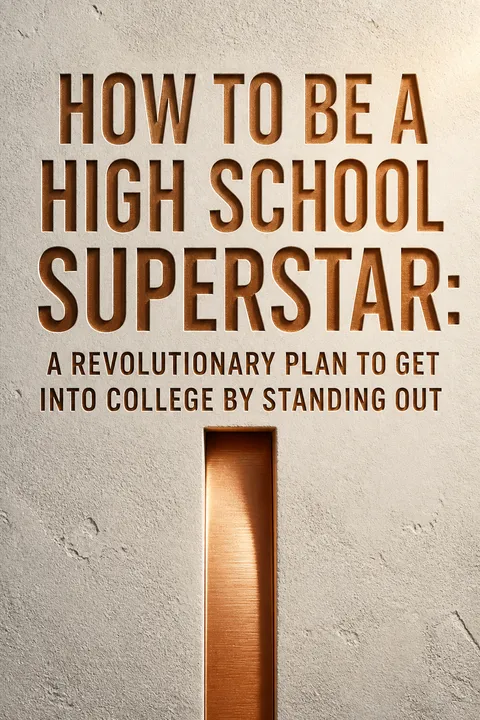
How to Be a High School Superstar offers a counterintuitive approach to college admissions, advocating for less stress and more focus on developing genuine interests. Reviewers appreciate Newport's advice on underscheduling, pursuing quality over quantity in activities, and cultivating uniqueness. The book encourages students to explore passions deeply rather than padding resumes with superficial accomplishments. While some readers found certain examples unrealistic, many praised the book's potential to reduce anxiety and foster a more meaningful high school experience.
People Also Read






Glossary
The Law of Underscheduling
Reserve time for explorationA strategy of keeping substantial free time in a student’s schedule and using it to encounter new ideas, activities, and people. The goal is not idleness for its own sake. Open time allows a student to notice what genuinely holds attention and follow it far enough for a sustained interest to develop.
deep interest
A voluntarily sustained pursuitA pursuit a student returns to willingly and eagerly when obligations are absent. It is distinguished from an activity chosen mainly to enhance an application or satisfy expectations. The book suggests using the Saturday-morning test: when a student has free time and no demands, does this activity still feel worth choosing?
Interestingness Hypothesis
Interest develops engaging substanceNewport’s account of how admissions officers’ vague search for passion can be understood more concretely. A student becomes interesting by developing ideas, knowledge, and perspective through a deep interest, rather than by merely logging time in an activity. The hypothesis emphasizes the person an activity helps create, not the activity’s résumé-friendly appearance.
The Student Workday
A firm daily work cutoffA routine that defines a clear time when schoolwork ends for the day. Work is concentrated before the cutoff, while the remaining hours are kept genuinely free for rest, relationships, or exploration. Newport argues that a firm boundary can reduce distracted half-working and make students more attentive while they are working.
The Superstar Effect
Small differences, outsized rewardsAn economic pattern in which the person perceived as best in a field receives a disproportionately large share of attention or reward, even when the difference in ability from close competitors is modest. Newport applies this model to admissions, arguing that focused distinction in one pursuit can attract more attention than competence spread across several activities.
The Matthew Effect
Advantages accumulate over timeA self-reinforcing process in which an initial advantage brings recognition, resources, or opportunities that create further advantage. In the book, Kevin’s early leadership practice through scouting helped him earn later roles, trust, awards, and recommendations. The term is attributed to sociologist Robert K. Merton’s account of cumulative recognition in science.
countersignaling
Restraint can signal confidenceA signaling strategy in which someone with strong credentials may communicate confidence by avoiding excessive displays of conventional proof. Newport uses it to explain why an overloaded activity list can sometimes appear less compelling than a concise record of substantive work. The idea does not mean that sparse applications automatically look strong.
The Failed-Simulation Effect
Unclear paths feel impressiveNewport’s term for the heightened impression created when an observer cannot mentally reconstruct the steps behind an accomplishment. A familiar activity may seem less remarkable because its process is easy to imagine. A teenager publishing a book or influencing a school curriculum can feel more impressive because the route to that result is less obvious.
closed community
Familiar institution, hidden workingsA group or institution whose purpose is recognizable to outsiders but whose procedures and opportunities are not. Schools, nonprofits, and publishing are examples in the book. Such communities can support distinctive projects when a student first contributes reliably, learns how the group works, and earns trust before proposing larger changes.
innovation map
Trace steps behind achievementA record of the steps that carried a young person from an initial opportunity to a significant accomplishment. Each step identifies what enabled it and what work it required. Newport uses the method to make impressive outcomes less mysterious and to reveal practical routes that can be adapted to another student’s circumstances.
FAQ
What's How to Be a High School Superstar about?
- Revolutionary Approach: The book offers a new perspective on high school life and college admissions, focusing on standing out without stress.
- Relaxed Superstar Concept: Introduces "relaxed superstars," students who achieve impressive results while enjoying a balanced high school experience.
- Three Key Laws: It outlines three laws—The Law of Underscheduling, The Law of Focus, and The Law of Innovation—to guide students.
Why should I read How to Be a High School Superstar?
- Stress Reduction: Provides strategies to reduce stress while achieving college admissions goals.
- Unique Insights: Shares insider stories of students who succeeded without sacrificing happiness.
- Practical Advice: Offers actionable advice to implement the relaxed superstar philosophy.
What are the key takeaways of How to Be a High School Superstar?
- Underscheduling Importance: Emphasizes the value of free time to explore interests over a packed schedule.
- Focus on One Interest: Advocates mastering one serious interest for greater impact.
- Pursue Unique Projects: Encourages engaging in genuinely interesting projects rather than time-consuming ones.
What is the Law of Underscheduling in How to Be a High School Superstar?
- Free Time Priority: Suggests prioritizing free time to explore interests and passions.
- Avoid Overcommitment: Challenges the idea that more activities equal better prospects.
- Foundation for Success: Serves as the foundation for a balanced and successful high school life.
How does the Law of Focus work in How to Be a High School Superstar?
- Master One Interest: Encourages dedicating time to mastering a single serious interest.
- Quality Over Quantity: Focus on one area leads to greater achievements and appeal to admissions officers.
- Long-Term Fulfillment: Promotes a fulfilling high school experience by deepening expertise.
What is the Law of Innovation in How to Be a High School Superstar?
- Unique Accomplishments: Suggests pursuing projects that are hard to explain but allow for creativity.
- Stand Out from Peers: Helps differentiate students by showcasing unique interests.
- Encourages Authenticity: Emphasizes genuine engagement in projects over resume-building.
What is the Superstar Effect mentioned in How to Be a High School Superstar?
- Disproportionate Rewards: Describes how top performers receive significantly more recognition.
- College Admissions Context: Excelling in a specific area can make students stand out more.
- Valedictorian Example: Being valedictorian can significantly increase admission chances.
How does the Matthew Effect relate to college admissions in How to Be a High School Superstar?
- Accumulation of Advantages: Initial advantages lead to more opportunities over time.
- Implications for Students: Focusing on one pursuit can lead to scholarships and leadership roles.
- Real-Life Application: Examples illustrate how focus leads to impressive outcomes.
What is the Failed-Simulation Effect in How to Be a High School Superstar?
- Impressiveness of the Unexplained: Accomplishments that are hard to explain are seen as impressive.
- Examples in Admissions: Unique projects are more impressive than common activities.
- Key to Innovation: Encourages choosing projects that are innovative and hard to replicate.
How can I apply the relaxed superstar philosophy from How to Be a High School Superstar?
- Create Free Time: Restructure your schedule to explore interests without constant commitments.
- Focus on Interests: Dedicate time to mastering one or two serious interests.
- Engage in Unique Projects: Pursue projects that genuinely excite you, even if unconventional.
What are some examples of relaxed superstars in How to Be a High School Superstar?
- Kara's Journey: Focused on interests and maintained a manageable course load, leading to acceptances at top schools.
- Michael's Sustainability Projects: Dedicated time to environmental projects, showcasing focus and innovation.
- Olivia's Marine Biology: Developed a deep interest in marine biology, leading to significant accomplishments.
What are the best quotes from How to Be a High School Superstar and what do they mean?
- Stand Out Without Burnout: Highlights achieving success while maintaining balance.
- Genuinely Interesting Life: Emphasizes pursuing authentic interests over resume-building.
- Stress Reduction Strategy: Couples stress reduction with improved admissions chances.
About the Author
Other books by Cal Newport







Download PDF
Download EPUB
.epub digital book format is ideal for reading ebooks on phones, tablets, and e-readers.








