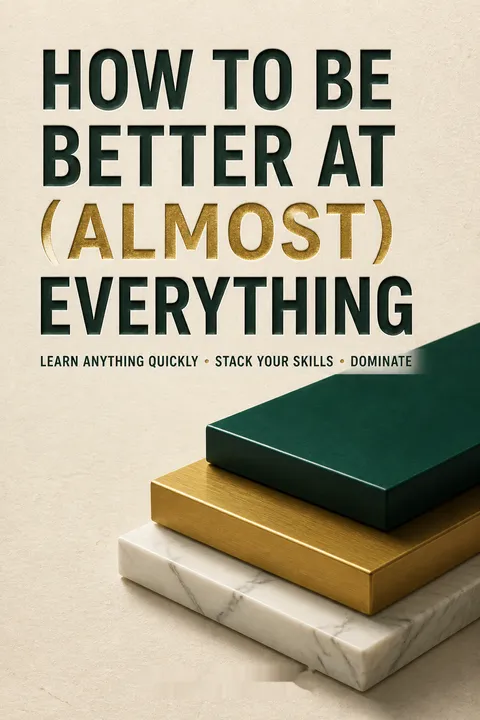


Key Takeaways
Combine useful skills instead of auditioning for world-class mastery.
A better route to distinction. Skill stacking means combining several abilities into a distinctive, useful package. Flynn’s guitar story shows the difference: he practiced for hours to master flashy solos, but classmates preferred songs they could sing along to. A peer who could both play and sing attracted more attention, despite weaker technical guitar skills. The lesson was not to abandon guitar, but to add abilities that made it more valuable to other people.
Flynn later combined fitness, writing, and business skills. Few competitors could match that exact mix, even if they surpassed him in one area. The stack gave him ways to create work, reach an audience, and earn a living without being the best at any single skill.
What's striking is that this reframes competition: advantage can come from the intersection of capabilities, not the peak of one. That idea fits creative work especially well, where technical skill must meet communication, judgment, and an audience's needs. But breadth alone is not a strategy. A collection of unrelated talents becomes valuable only when the combination solves a recognizable problem or produces something distinctive. Specialists remain essential in fields that demand exceptional depth, so the practical question is not whether to specialize, but where additional skills create leverage.
Earn expressive freedom by practicing under limits you choose.
Ability expands choice. Flynn distinguishes freedom to choose among options from freedom gained by developing the ability to act. He calls the first freedom of indifference, and the second freedom for excellence. A person may be free to play guitar, speak French, or do a pull-up in the first sense, yet lack the skill to do any of them. Practice requires giving up some immediate options, such as spending that hour elsewhere, to gain real capabilities.
For Flynn, discipline is not simply obedience. It is choosing routines that make meaningful action possible. The point is not to follow restrictions for their own sake, but to use deliberate limits to become able to create, perform, and contribute in ways that were previously unavailable.
This distinction connects self-discipline with agency: a practiced musician has more expressive choices than someone who refuses the constraints of learning an instrument. It also clarifies why autonomy alone can feel empty when a person has few developed capacities. Still, chosen limits are not automatically liberating. A rigid routine can narrow life if it serves an inherited expectation rather than a valued purpose. The useful test is whether a constraint builds a capability the person actually wants, and whether it remains open to revision.
Focus briefly, reach useful competence, then move your effort elsewhere.
Rotate your emphasis. Short-Term Specialization is Flynn’s method for building breadth without trying to learn everything at once. Choose one priority, give it concentrated practice, and maintain other abilities at a lower level. His meditation coach challenged him to make anxiety reduction a real priority rather than squeezing meditation in whenever convenient. Flynn focused on it, improved his wellbeing, and kept other parts of life from collapsing.
The Rule of 80 Percent is a stopping heuristic, not a precise measurement: once a skill is good enough for the goal, further effort may be less valuable than developing another ability. Flynn uses the example of someone with a very strong bench press who still lacks general fitness. More progress on the bench is not the missing ingredient; the next useful skill may be nutrition, running, or mobility.
This approach treats attention as a budget and acknowledges opportunity cost: improving one area often means slower progress elsewhere. It also avoids the fantasy of making maximum progress on every front simultaneously. The 80 percent threshold is best read as a prompt to reassess, not a universal cutoff. Some professions require deep expertise, and skills differ in how quickly they fade when practice stops. A sensible rotation therefore depends on the goal, the cost of losing a skill, and how much further mastery actually contributes.
Practice the outcome you want, not a warehouse of techniques.
Let the goal direct practice. Integration > Isolation means learning a skill within the context where it will be used, while temporarily separating a difficult piece when needed. Someone learning a song should practice the chords in that song, at its tempo, rather than collect obscure chords without a musical purpose. If a transition keeps failing, isolate it, practice it, and return it to the full song as soon as it works.
The same logic applies beyond music. Flynn’s business coach emphasized attracting attention, making sales, and keeping customers as core business tasks. A new business owner could spend endless time polishing a website, but if the goal is revenue, that work may matter less than learning to explain an offer or serve existing customers.
The strength of this principle is its focus on transfer: practice is most useful when it prepares someone for the performance they actually care about. It resembles learning by doing, with targeted drills used to repair specific bottlenecks. Yet context alone is not always enough. Beginners may need foundational exercises before they can perform the whole task, and complex skills can require concepts that are not immediately visible in practice. The key is to connect isolated work back to a real outcome rather than mistaking drill completion for progress.
Increase difficulty gradually without letting quality collapse.
Make repetition demanding. Repetition and Resistance is Flynn’s claim that improvement requires both practicing the target skill and increasing its challenge over time. Repeating the same push-up routine may establish a habit, but progress can stall unless the task becomes harder through more repetitions, added load, greater frequency, or another relevant change. The form of resistance should fit the aim: heavier pull-ups can build strength, while more repetitions can develop endurance.
Difficulty should test capacity without turning the work into careless performance. Flynn advises adjusting the challenge while preserving sound technique, whether the task is lifting, writing, or playing music. A writer might move from a short draft to a longer one, or attempt a new style, rather than merely producing more pages at the same level.
The general insight is that routine creates exposure, while a well-chosen challenge creates a reason to adapt. This is useful far beyond physical training because it asks whether practice is stretching a real limitation. The caution is that difficulty is not identical to learning: excessive strain can reinforce errors, invite injury, or make practice unsustainable. Feedback matters. Progress is better judged by improved performance under slightly harder conditions than by discomfort alone.
Build from core capacities, personal interests, and practical gaps.
Assemble skills in layers. Flynn calls broadly useful foundations metaskills. His examples are discipline, focus, logic, persuasion, and faith. They support many pursuits: focus helps someone stay with a task, logic helps assess claims, and persuasion helps communicate a position. He argues that these capacities can be developed through practice rather than treated as fixed personality traits.
A skill stack also includes interest skills, the activities a person wants to pursue, and need-based skills, the abilities required to make those interests useful to others. A guitar player might love performing, then learn promotion or teaching to reach an audience. Flynn’s own path joined fitness and writing with business skills. The layers need not be mastered in a fixed order, but together they help turn interest into productive work.
The layered model is useful because it separates what helps almost anyone from what makes a particular life distinctive and what makes it workable in the world. It also resists the false choice between passion and practicality. The inclusion of faith is more personal and philosophical than the other metaskills, and readers may interpret that foundation differently. Even so, the broader point holds: skills need an orienting purpose, and transferable capacities can make specialized interests easier to develop and share.
Sell a solution people want, not merely a skill you possess.
Translate ability into value. Flynn presents a value proposition as an explanation of how an offer helps someone. Saying that a person knows martial arts is not enough to make the skill compelling; showing a parent how lessons could help a child facing bullying makes the benefit clearer. The skill is the provider’s capability, while the value proposition connects that capability to another person’s problem or desire.
Flynn studied fitness entrepreneurs and found that many relied on abilities he had not yet developed, including advertising, copywriting, and sales. A musician friend built an audience by teaching popular songs online before promoting original albums. This approach gave people something they already wanted, established trust, and created a path toward the musician’s own work.
This is a practical account of how exchange depends on perceived value, not the seller’s affection for a product. It encourages creators to observe what people already seek and to explain benefits in concrete terms. The ethical boundary matters: persuading someone to buy is not proof that the offer genuinely helps them. A durable business must align audience demand with real delivery, rather than manufacture insecurity or dress up a weak product in persuasive language.
Stop researching when you already know enough to begin practicing.
Trade information for action. Flynn calls intentional restraint a low-information diet: seek only the information needed to take the next useful step, then put it to work. When he first explored fitness, he spent hours reading articles and watching videos. Some information helped, but consumption eventually crowded out training. A person can know many exercise principles and still fail to get stronger without lifting; watching handstand tutorials is not the same as practicing handstands.
Use a clear goal to decide what to learn next. If a skill attempt reveals a specific gap, seek information that addresses it. Otherwise, keep practicing, track what happens, and let experience expose the next question. Flynn also recommends tracking work and outcomes because records reveal progress and make avoidance harder to disguise.
Information can feel productive because it is tidy, low-risk, and easy to accumulate. Practice is messier: it produces visible mistakes and demands judgment. The low-information approach is a useful corrective when learning has become a substitute for doing, especially when the next action is already clear. It should not become an excuse to ignore safety, sound instruction, or genuine uncertainty. The aim is not less knowledge for its own sake, but a shorter path from knowledge to tested capability.
Choose skills for the good they let you create, not applause.
Measure a life by its activity. Flynn draws on Aristotle and Aquinas to argue that fulfillment comes less from collecting rewards than from engaging in worthwhile activities and becoming a better person through them. He describes reaching a financial milestone before age twenty-seven and enjoying expensive purchases, yet finding that the satisfaction faded. Achievement had not supplied the enduring sense of purpose he expected.
His grandfather offered a different model: a modest life marked by faith, family attention, and service to others. His funeral drew a large crowd, a sign of the relationships he had built. Flynn’s conclusion is that money, recognition, and skill can matter, but their value depends partly on what they enable and how they shape a person. The stack is not the destination; it is a means of doing worthwhile work.
The distinction between acquiring rewards and practicing meaningful activity echoes a long tradition of thinking about flourishing as something enacted over time, not purchased in a single achievement. It also gives the book’s commercial advice a moral direction: earning a living can coexist with service, but income alone cannot certify that the work is good. The account is grounded in Flynn’s religious philosophy, which not every reader will share. Its broader invitation is still accessible: assess success by both what gets made and what kind of relationships and character the making supports.
Analysis
Flynn’s central proposal is not that breadth beats depth in every circumstance. It is that most people overestimate the returns of competing to become exceptional in one narrow area, while underestimating the advantage of combining several competent abilities. His own progression from technically ambitious guitarist to fitness writer and entrepreneur gives the argument a narrative spine: disappointment becomes evidence that excellence is not only about performance, but also about audience, usefulness, and opportunity.
The book’s strongest practical contribution is its sequence for learning. Choose a meaningful target, concentrate effort on a limited number of skills, stop polishing abilities that already serve the goal, practice in context, and raise the challenge without sacrificing quality. This is more precise than simply praising curiosity. It explains how breadth can be built without becoming scattered, and why the generalist must sometimes work like a specialist for a season.
The argument is less convincing when it treats specialization as a broadly avoidable trap. Deep expertise can be essential where errors are costly, knowledge is cumulative, or a role requires rare technical judgment. The Rule of 80 Percent cannot identify a universal stopping point, and the author’s examples of fitness or business do not establish that every field rewards the same balance. Skill combinations also do not automatically create market value; their usefulness depends on the problem they solve and the quality of the work.
The most durable reading is therefore conditional: develop enough depth to contribute credibly, then look for adjacent capacities that make the contribution more effective, legible, or independent. The book also insists that such competence needs an ethical direction. Its account of happiness as worthwhile activity challenges the idea that income and recognition are reliable measures of a good life. That philosophical premise, especially its religious grounding, is not shared by every reader, but it usefully prevents skill acquisition from becoming an endless contest for status. The method is strongest when breadth serves both real contribution and a life the learner actually values.
Review Summary
How to Be Better at (Almost) Everything received mixed reviews. Some praised its approach to generalism and skill-stacking, finding it practical and motivating. Others criticized its repetitive content, religious overtones, and disjointed structure. Positive reviews appreciated Flynn's casual writing style and insights on developing multiple skills. Negative reviews found the book poorly organized, overly preachy, and lacking depth. Many felt the useful content could have been condensed into a shorter format. Overall, opinions were divided on the book's value and effectiveness as a self-help guide.
People Also Read





Glossary
Skill stacking
Combining complementary abilitiesThe practice of developing several useful skills and combining them into a distinctive capability. The goal is not to become the best at each component, but to create an effective combination that few others offer. In the book, fitness, writing, and business skills combine to help Flynn build an audience and earn a living.
Short-Term Specialization
Focused skill development in phasesA way to build broad competence by concentrating on one or a small number of skills for a period, while maintaining other abilities at a lower level. Once the priority skill is useful enough for the person’s aims, attention shifts to another. The approach accepts temporary trade-offs rather than expecting equal progress everywhere at once.
Rule of 80 Percent
A heuristic for switching skillsFlynn’s informal guideline for deciding when further improvement in one area may no longer justify the time it requires. The 80 percent figure is not meant as a precise measurement. It signals that once a skill is sufficiently strong for the current objective, the learner should consider investing effort in a different, more limiting skill.
Integration > Isolation
Connect drills to real performanceA practice principle that favors learning skills in the context where they will be used. Difficult elements can be isolated temporarily for focused work, but they should be returned to the full task as soon as possible. The intended outcome determines which techniques deserve practice and prevents learning exercises merely for their own sake.
Repetition and Resistance
Practice with increasing challengeFlynn’s principle that skill improves through repeated work combined with progressively greater demands. In physical training, resistance might mean more weight or repetitions. In writing or music, it could mean handling a harder form, longer assignment, or faster tempo. The challenge should increase while the quality of the work remains adequate.
Metaskills
Foundational skills useful across pursuitsBroad capacities that can support many different goals rather than belonging to one specialized field. Flynn identifies discipline, focus, logic, persuasion, and faith as examples. They form a foundation for personal interests and practical abilities, helping a person learn, communicate, and direct skills toward a purpose.
Freedom for excellence
Freedom gained through developed abilityThe capacity to act, express oneself, or pursue meaningful goals because one has developed the necessary skills and habits. It differs from simply being free to choose among options. Learning an instrument, language, or physical ability requires effort and self-imposed limits, yet those limits can expand what a person is able to do.
Need-Based Skills
Skills that make interests viableAbilities acquired to bridge the gap between a personal interest and making a living from it. They depend on the person’s goal and the audience or market involved. A musician might need teaching, promotion, or sales skills, for instance, so that musical ability can reach people and support a sustainable livelihood.
low-information diet
Limit research, increase practiceFlynn’s name for deliberately reducing information consumption when it has begun to displace action. The learner gathers enough knowledge to begin safely and sensibly, practices, and seeks further information when a real obstacle appears. The aim is not to reject learning, but to prevent research from becoming an imitation of progress.
FAQ
What's "How to Be Better at Almost Everything" about?
- Generalism over Specialization: The book advocates for becoming a generalist, which means being good at many things rather than the best at one.
- Skill Stacking: It introduces the concept of skill stacking, where combining multiple skills can create a unique and competitive advantage.
- Practical Guidance: The book provides practical advice on how to learn new skills quickly and effectively.
- Philosophical Insights: It also delves into philosophical discussions about freedom, happiness, and the pursuit of excellence.
Why should I read "How to Be Better at Almost Everything"?
- Broaden Your Skillset: If you're looking to expand your abilities across various domains, this book offers a roadmap.
- Achieve Success Differently: It challenges the traditional notion of success through specialization, offering a fresh perspective.
- Practical Tips: The book is filled with actionable advice on how to improve your learning process and skill acquisition.
- Philosophical Depth: It provides a deeper understanding of how generalism can lead to a more fulfilling life.
What are the key takeaways of "How to Be Better at Almost Everything"?
- Skill Stacking is Key: Combining multiple skills can be more powerful than mastering one.
- Short-Term Specialization: Focus on one or two skills at a time to improve efficiently.
- 80% Rule: Aim to be 80% good at a skill, which is often sufficient for success.
- Integration Over Isolation: Practice skills in the context of real-world applications.
What is the "Skill Stacking" method in "How to Be Better at Almost Everything"?
- Combining Skills: Skill stacking involves combining various skills to create a unique and competitive advantage.
- Versatility Over Mastery: It emphasizes being versatile rather than being a master of one skill.
- Practical Application: The method encourages applying skills in real-world scenarios to maximize their utility.
- Creative Problem Solving: By stacking skills, you can approach problems from multiple angles, enhancing creativity and effectiveness.
How does "How to Be Better at Almost Everything" define generalism?
- Better Than Most: Generalism is about being better than most people at most things, even if you're not the best at any one thing.
- Skill Versatility: It involves having a broad skill set that can be applied in various contexts.
- Competitive Edge: Generalists can often outperform specialists in diverse and dynamic environments.
- Fulfillment and Success: The book argues that generalism leads to a more fulfilling and successful life.
What are the "Five Key Principles" in "How to Be Better at Almost Everything"?
- Skill Stacking > Specialization: Focus on combining skills rather than mastering one.
- Short-Term Specialization: Temporarily focus on one skill to improve it quickly.
- The Rule of 80 Percent: Aim to be 80% proficient in a skill, which is often enough.
- Integration > Isolation: Practice skills in real-world contexts rather than in isolation.
- Repetition and Resistance: Use repetition and increasing difficulty to improve skills.
How does "How to Be Better at Almost Everything" suggest practicing skills?
- Short-Term Focus: Concentrate on one or two skills at a time for efficient improvement.
- Real-World Application: Practice skills in the context of their real-world use.
- Incremental Challenges: Gradually increase the difficulty of practice to build proficiency.
- Consistent Repetition: Regular practice is essential for skill development.
What role does "freedom" play in "How to Be Better at Almost Everything"?
- Freedom of Excellence: The book discusses the freedom to pursue excellence through skill development.
- Self-Expression: Skills provide the freedom to express oneself creatively and effectively.
- Discipline Equals Freedom: Discipline in skill acquisition leads to greater freedom in life choices.
- Philosophical Insight: The book explores how freedom is intertwined with the pursuit of generalism.
What are the "Metaskills" mentioned in "How to Be Better at Almost Everything"?
- Foundational Skills: Metaskills are fundamental skills that are universally beneficial, such as focus and logic.
- Skill Development: They serve as the foundation for developing other skills effectively.
- Universal Application: Metaskills are applicable across various domains and enhance overall competence.
- Personal Growth: Developing metaskills contributes to personal and professional growth.
What are some of the best quotes from "How to Be Better at Almost Everything" and what do they mean?
- "Skill stacking lays a foundation for success that gives you a chance at a thriving, meaningful, productive, and independent existence." This quote emphasizes the power of combining skills to create a unique advantage.
- "The greatest opportunities present themselves to those who are preoccupied not with excelling at one skill but with being just good enough at the right combination of abilities." It highlights the value of versatility over specialization.
- "Happiness is found by engaging in good activities, and that’s what being a generalist is." This quote connects the pursuit of generalism with personal fulfillment and happiness.
How does "How to Be Better at Almost Everything" address the concept of happiness?
- Engaging in Good Activities: Happiness is linked to engaging in activities that are genuinely good and fulfilling.
- Skill Development: Developing a broad range of skills contributes to a sense of accomplishment and joy.
- Philosophical Perspective: The book explores happiness from a philosophical standpoint, emphasizing the importance of meaningful pursuits.
- Life Fulfillment: Generalism is presented as a path to achieving a well-rounded and satisfying life.
What are the "Skills You May Need" according to "How to Be Better at Almost Everything"?
- Need-Based Skills: These are skills required to bridge the gap between personal interests and professional success.
- Market Relevance: They help position your skills in a way that is attractive to others, especially in a business context.
- Adaptability: Need-based skills enhance your ability to adapt and thrive in various environments.
- Practical Application: The book provides guidance on identifying and developing these skills to achieve your goals.
Download PDF
Download EPUB
.epub digital book format is ideal for reading ebooks on phones, tablets, and e-readers.








