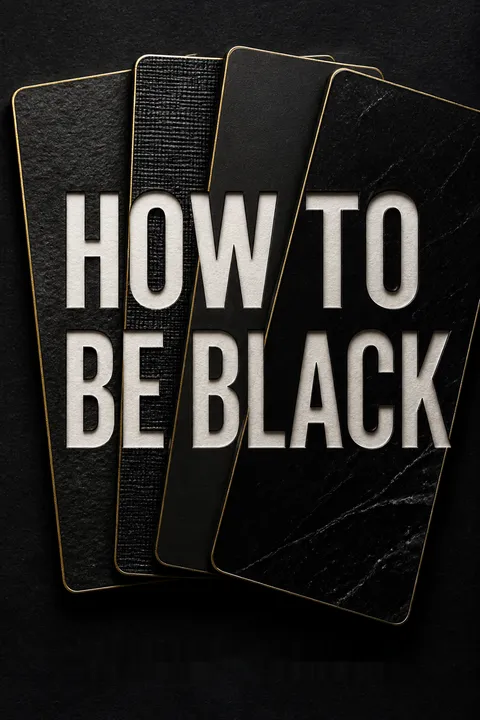


Key Takeaways
Treat blackness as lived identity, not a checklist of cultural tests.
The checklist is the joke. The book opens by mocking the idea that Black History Month can be properly observed through a few token gestures: watch a certain television channel, learn a famous name, or acquire a Black friend. The joke targets a broader habit: reducing a vast range of people to a small set of recognizable traits. The author’s own life includes experiences that fit familiar stereotypes and many that do not, from growing up amid Washington’s drug violence to studying at Harvard and loving computers, camping, and classical music.
Difference is the point. The book’s deliberately impossible promise, how to be Black, exposes the limits of any single recipe. Blackness is not a test that one person can pass for everyone else. The stories and interviews instead show how identity changes with family, place, history, and circumstance.
What's striking is how the opening parody turns a familiar cultural ritual into a diagnostic tool. Token gestures offer the comfort of completion: a person can feel informed without examining how race shapes daily life. Social psychology distinguishes knowing facts about a group from seeing its members as varied individuals; this book insists on the second task. Its humor makes that distinction memorable, though humor can let readers dismiss the discomfort as mere awkwardness. The deeper challenge is not to memorize better etiquette, but to notice when a supposedly universal image of Black life excludes the actual people standing nearby.
Let ancestry inform identity without turning it into an authenticity contest.
A name can open a debate. Thurston’s parents gave him Baratunde, a name derived from the Yoruba name Babatunde, despite having no known Nigerian family lineage. To many non-Black people, it marked him as unmistakably Black. Some Nigerians, however, challenged the name and treated it as evidence that African Americans lacked a legitimate connection to African culture. The same name could therefore invite curiosity, recognition, or rejection, depending on who was judging it.
Identity changes by context. The Black Panel’s members describe being read differently at school, among family, in the media, and across national borders. One person can be considered not Black enough by one group and too Black by another. These conflicts reveal how identity is both personally lived and socially interpreted, not a credential that others can reliably certify.
This story illustrates boundary work: the everyday process by which communities decide who belongs and which symbols count as authentic. Names, accents, and cultural practices can carry real histories, but they can also become gatekeeping tools. The author’s experience suggests a productive distinction between cultural connection and cultural ownership. A person can honor an ancestry without claiming that it erases another history or grants authority over everyone who shares it. The challenge is to make room for diasporic ties while taking seriously the specific meanings that cultural practices hold for people who inherit them directly.
Give children many mirrors, not one script for who they can become.
A mother built range. Thurston’s mother raised him amid danger in Washington, DC, while deliberately filling his life with alternatives. She enrolled him in music, martial arts, camping, hiking, and an all-Black Boy Scout troop. She taught him African geography and Black history, encouraged him to question authority, and kept him busy enough to avoid the neighborhood’s growing drug trade.
Two educations, deliberately. She sent him to Sidwell Friends, an elite, mostly white school, and enrolled him at the same time in Ankobia, an Afrocentric rites-of-passage program for Black boys. Sidwell exposed him to powerful institutions and broad academic resources. Ankobia offered Black history, practical skills, physical training, and cultural grounding. Neither setting was treated as the whole truth. Together, they helped him move between worlds without being confined to either one.
The mother’s approach resembles educational pluralism: children gain resilience when they encounter multiple ways of understanding themselves and the world. Thurston’s contrasting schools provide more than a tidy balance between two cultures. They show that preparation for life requires both access to institutions and the ability to question the assumptions those institutions carry. The approach is demanding, and it rests on the unusual effort of one parent navigating cost, safety, and opportunity. Its wider lesson is not that every child needs two formal programs, but that no single environment should be allowed to define the limits of a child’s possible self.
Notice when a room drafts you as its unpaid race expert.
One colleague becomes the whole group. Thurston describes the Black Friend as a Black person expected to translate Black life for white friends, answer awkward questions, and prevent misunderstandings. He extends the satire to work and media. The Black Employee is hired for a stated role, then informally expected to represent Black people, reassure the company about its diversity, and enliven office events. A media guest may be asked to explain any issue involving a Black person, as though one voice could stand for millions.
The labor is real. The book’s comic manuals expose how these expectations consume time and emotional energy. A colleague’s question about a Black president, for instance, may seem addressed to one employee while actually inviting that employee to validate or correct everyone else’s assumptions.
These roles can be understood through emotional labor, the work of managing one’s reactions and relationships to meet other people’s expectations. The satire makes a hidden job description visible, especially the pressure to be patient, knowledgeable, and reassuring while still doing one’s actual work. Cross-cultural explanation can be generous and valuable when it is freely chosen. It becomes inequitable when one person is treated as an always-available representative. A useful distinction is whether the conversation includes reciprocity: are other people also doing the work of learning, or is the burden quietly assigned to the person in the minority?
Use humor to expose racial scripts, not to make them harmless.
Comedy opens the door. The book’s imagined advice manuals exaggerate racial expectations until their absurdity becomes hard to miss. A Black office worker is supposedly responsible for the company’s diversity image, its holiday-party dancing, and even its fruit choices. The humor also punctures the idea that a Black person should speak for all Black people, whether on television or in a casual conversation.
The joke has a target. Thurston’s satire aims at systems and assumptions, not at proving that racial discomfort is unimportant. The Black Panel members use comedy, performance, blogging, and video to make difficult ideas accessible. Their work shows how laughter can lower the fear of saying the wrong thing enough for a more honest conversation to begin, while still leaving the underlying issue on the table.
Satire is especially effective when a social rule is so normalized that direct description sounds exaggerated. By extending the rule to an absurd extreme, the joke makes its hidden logic easier to inspect. That is a form of analytical distance, not an escape from seriousness. Still, humor has a risk: audiences may enjoy recognizing the caricature and then assume recognition itself counts as change. The stronger use of comedy is as an opening move. It invites attention, then asks what behavior, institutional norm, or allocation of responsibility remains once the laughter fades.
Reject post-racial comfort when unequal treatment remains visible.
A symbol is not a solution. Barack Obama’s election inspired claims that the United States had moved beyond race. The author and the Black Panel reject that conclusion. Obama was judged both insufficiently Black and dangerously Black, while being expected to symbolize racial reconciliation without seeming to advocate too directly for Black communities. His presidency showed that a historic first can alter expectations without making racial conflict disappear.
The evidence is personal and political. Panel member Cheryl Contee describes being paid $20,000 less than a white man who reported to her, as well as discrimination in her social life. Other panelists recall racist insults close to Obama’s election. The point is not that the country made no progress, but that a milestone cannot substitute for examining unequal treatment that persists in ordinary workplaces and public life.
The book distinguishes symbolic representation from material change. Representation matters: seeing someone cross a previously closed threshold can reshape what people imagine possible. But a symbol cannot, by itself, redistribute income, remove bias, or repair institutions. This distinction is useful beyond race, since the presence of one person from an underrepresented group can be mistaken for proof that a system is fair. The panel’s experiences make that inference difficult to sustain. A more rigorous measure of progress asks both who has access to visible roles and how power, resources, and everyday treatment are distributed.
Teach Black history as both an account of harm and a record of agency.
A fuller story changes the frame. The book argues for New Black History, a more complete account of Black people’s lives and their role in shaping the United States. A curriculum that focuses only on enslavement, oppression, and exclusion can leave Black children with a story of permanent defeat. A curriculum that celebrates ancient greatness while avoiding painful history is incomplete in the opposite direction.
History includes the making of America. The author’s family stories include a great-grandfather born in Virginia in 1870 who taught himself to read, and a grandmother who became the first Black clerk in the US Supreme Court building. These lives sit alongside the violence and constraints their family endured. The book argues that Black struggle also pushed the nation closer to ideals of freedom and equality that the country claimed before it fully practiced them.
Historical education shapes more than factual knowledge. It influences who appears capable of action, whose labor counts, and whether a nation’s ideals seem real or merely rhetorical. The book’s paired emphasis on harm and agency resists two familiar distortions: a story of progress without injustice, and a story of injustice without Black creativity or resistance. Family histories can make national abstractions tangible, though no single family can represent an entire population. The strongest curriculum would use personal stories as entry points, then connect them to institutions, movements, and disagreements that reveal how history was made.
Make the work of racial justice a shared civic responsibility.
The burden should spread. The book calls this Distributed Struggle: sharing responsibility for confronting racism instead of expecting Black people to carry the work alone. Thurston imagines handing off a symbolic torch representing racism to white Americans, who have often treated the issue as someone else’s problem. The point is not that Black people should stop describing their experiences, but that others must take responsibility for understanding and changing the conditions that produce them.
Solidarity crosses group lines. The Black Panel also argues that people facing discrimination should pay attention to one another’s struggles. Thurston’s example is a chain of mutual support, with each community standing beside another rather than focusing only on its own cause. The approach treats justice as connected work, while recognizing that different groups experience distinct histories and barriers.
Distributed responsibility addresses a basic collective-action problem: people most harmed by an injustice are often expected to spend the most effort correcting it. Sharing the work can free attention and energy while making change more durable, because institutions respond to broader coalitions. The book’s call for cross-group solidarity also counters the temptation to rank suffering as a competition. Yet solidarity should not require pretending that every struggle is identical or assigning marginalized communities a new obligation to rescue one another. A coalition is strongest when it combines mutual concern with specific knowledge of each group’s circumstances.
Expand blackness by making room for lives stereotypes cannot predict.
Practice can widen belonging. The Center for Experimental Blackness is the book’s proposal for a less restrictive idea of Black identity. Its members describe Black people who love technology, travel, environmental sustainability, classical music, or activities stereotyped as non-Black. These interests do not weaken identity. They become part of the culture when people live them and share their stories.
Experience can complete a circle. In 1995, Thurston traveled to Senegal, visited Goree Island, a site connected to the transatlantic slave trade, and encountered both contemporary Senegalese life and the weight of history. The journey did not make him more Black, he explains, but gave him a feeling of connection he had not known was missing. The book closes by urging people to create new images of Black life rather than wait for others to grant permission.
This vision treats culture as something people inherit and make, rather than a sealed inventory of approved behaviors. That is a powerful answer to stereotype: more visibility for varied lives expands what future generations can recognize as possible. Thurston’s Senegal journey also suggests that belonging can involve exploration without requiring a single origin story to resolve every question. The proposal has a practical challenge, however. Celebrating individual freedom is not enough if media, schools, and institutions keep circulating narrow images. Personal experimentation matters most when people also help those new images travel.
Analysis
How to Be Black is a comic memoir built as a deliberately impossible instruction manual. Its central argument is that Blackness cannot be reduced to one set of tastes, experiences, political positions, or credentials. The joke of the title becomes a method: each mock guide exposes the expectations placed on Black people, from being treated as a cultural ambassador to being asked to reassure an institution about its diversity.
The memoir’s personal arc gives this argument emotional weight. Thurston moves between a dangerous Washington neighborhood, his mother’s Afrocentric education, an elite private school, Harvard, and a journey to Senegal. These settings do not resolve into a simple story of escape or assimilation. Instead, each reveals a different way identity is read, performed, protected, or challenged. The interviews with the Black Panel widen the frame and prevent one life from standing in for everyone, while also showing how disagreements within Black communities can be as consequential as outside stereotypes.
The book’s strongest analytical move is its attention to role assignment. The Black Friend, Black Employee, and media spokesperson are comic inventions, but they name real forms of unpaid explanatory and emotional labor. Satire makes these roles legible without turning the book into a lecture. Its limit is also visible: a reader can enjoy the jokes and leave the underlying allocation of responsibility untouched. The book therefore works best when humor is treated as an entry point to scrutiny, not as a substitute for it.
Its closing vision links fuller history, shared responsibility for racial justice, and broader permission to define Black life. This is not a claim that race will vanish if people become more open-minded. It is a case for making race less restrictive and less unequally consequential. The result is both a memoir of one unusually varied life and an argument against demanding that any single life explain a whole people.
Review Summary
How to Be Black is a humorous yet insightful book that explores racial identity in America through personal anecdotes and satire. Readers found it entertaining, educational, and thought-provoking, praising Thurston's wit and ability to address sensitive topics with humor. Many appreciated the inclusion of diverse perspectives from the "Black Panel." While some felt certain sections lagged or relied too heavily on comedy, most found the book accessible and enlightening. The audiobook version received particular praise for Thurston's narration and the inclusion of interview recordings.
People Also Read


Glossary
The Black Friend
Unofficial racial ambassadorA satirical role for a Black person expected to explain Black culture to non-Black friends, answer racial questions, and prevent misunderstandings. Thurston also presents this person as a mediator between communities, while showing the cost of assigning one individual responsibility for other people’s education and comfort.
The Black Employee
Workplace race representativeThurston’s comic name for the additional, unofficial duties often placed on a Black worker alongside the job they were hired to do. These duties can include representing Black people, reassuring the company about diversity, and participating in workplace social life in ways that make colleagues comfortable.
New Black History
A fuller historical accountThe book’s proposed approach to teaching Black history as a complete and honest story. It includes slavery, discrimination, and their lasting harms, while also recognizing Black agency, achievement, resistance, and the role Black people played in shaping American ideals and institutions.
Distributed Struggle
Shared justice workThe book’s proposal to spread responsibility for confronting racism across society rather than placing most of the burden on Black people. It also encourages solidarity across communities facing discrimination, while allowing each group’s history and specific circumstances to remain distinct.
The Center for Experimental Blackness
Open-ended Black identityThurston’s proposed space for exploring Black identity beyond restrictive expectations. It makes room for varied interests, lifestyles, and cultural influences, including activities often stereotyped as non-Black. The idea treats Blackness as something people can actively shape through the lives they lead and the stories they share.
Open Source Blackness
Many people shaping cultureThe book’s description of Black identity as open to contributions from many people rather than controlled by a single authority or fixed rulebook. Individual choices and creative work add to the range of what Blackness can mean, challenging both outside stereotypes and restrictive expectations within Black communities.
Inter-Negro Spectrum of Hostility
Workplace relationship scaleA humorous framework for describing possible relationships between Black colleagues, ranging from supportive and easygoing to competitive or disengaged. Thurston uses it to parody the pressure placed on Black employees when there are few people of color in a workplace and each person’s behavior can seem unusually consequential.
Nigerian Name Backlash
Disputes over name authenticityThurston’s term for recurring criticism from Nigerians who challenge his use of Baratunde, a name derived from a Yoruba name, because he has no known Nigerian family lineage. The experience illustrates how a name can signal connection to some audiences while becoming a point of cultural gatekeeping for others.
FAQ
What's "How to Be Black" about?
- Exploration of Black Identity: "How to Be Black" by Baratunde Thurston is a humorous and insightful exploration of black identity in America. It delves into personal experiences and societal expectations.
- Satirical Guide: The book is structured as a satirical guide, offering comedic advice on navigating various aspects of black life, from being the black friend to the black employee.
- Cultural Commentary: It provides cultural commentary on race relations, stereotypes, and the evolving concept of blackness, using humor to address serious topics.
Why should I read "How to Be Black"?
- Humor and Insight: The book combines humor with insightful commentary, making it an engaging read that tackles complex issues in an accessible way.
- Personal Stories: Thurston shares personal anecdotes that offer a unique perspective on growing up black in America, providing both entertainment and education.
- Broader Understanding: It encourages readers to think critically about race, identity, and the societal structures that influence them, fostering a deeper understanding of these issues.
What are the key takeaways of "How to Be Black"?
- Complexity of Blackness: Black identity is multifaceted and cannot be reduced to stereotypes or singular narratives.
- Role of Humor: Humor can be a powerful tool for discussing and understanding race and identity.
- Cultural Influence: Black culture has significantly shaped American society, and understanding this influence is crucial for addressing racial issues.
What are the best quotes from "How to Be Black" and what do they mean?
- "Be not afraid of blackness." This quote, a play on Shakespeare, sets the tone for embracing black identity without fear or apology.
- "You are about to learn how to be The Black Friend." This highlights the societal expectation placed on black individuals to represent their race in predominantly white spaces.
- "The ideas of blackness that make it into mainstream thought exclude too much of the full range of who black people are." It critiques the limited and often negative portrayals of blackness in media and society.
How does Baratunde Thurston use humor in "How to Be Black"?
- Satirical Approach: Thurston uses satire to address serious topics, making them more approachable and engaging for readers.
- Relatable Anecdotes: Personal stories are infused with humor, allowing readers to connect with the experiences while reflecting on broader societal issues.
- Challenging Stereotypes: Humor is used to challenge and deconstruct stereotypes, encouraging readers to question their own assumptions about race.
What is the "Black Friend" concept in "How to Be Black"?
- Cultural Translator: The Black Friend is portrayed as a cultural translator, helping non-black individuals understand black culture and experiences.
- Social Role: It highlights the social role black individuals often play in predominantly white spaces, where they are expected to represent their entire race.
- Diplomatic Buffer: The Black Friend acts as a buffer, preventing misunderstandings and fostering better interracial relations.
How does "How to Be Black" address the concept of blackness?
- Dynamic Identity: The book presents blackness as a dynamic and evolving identity, shaped by personal experiences and societal influences.
- Beyond Stereotypes: It emphasizes that blackness cannot be confined to stereotypes or singular narratives, advocating for a broader understanding.
- Cultural Richness: Thurston highlights the cultural richness and diversity within the black community, challenging monolithic portrayals.
What is the "Inter-Negro Spectrum of Hostility" in "How to Be Black"?
- Workplace Dynamics: This concept explores the dynamics between black employees in predominantly white workplaces, ranging from supportive to competitive interactions.
- Chill to Nemesis: It describes a spectrum from "The Chill One," who is supportive, to "The Nemesis," who feels threatened by other black employees.
- Navigating Relationships: Understanding this spectrum helps black employees navigate relationships and alliances in the workplace.
How does "How to Be Black" discuss the idea of a "Post-Racial America"?
- Critique of the Concept: The book critiques the notion of a post-racial America, arguing that racial issues are still prevalent and unresolved.
- Media Creation: Thurston suggests that the idea of post-racial America is a media creation, not reflective of the lived experiences of many black individuals.
- Ongoing Struggle: It emphasizes the ongoing struggle for racial equality and the need for continued dialogue and action.
What is the "Grand Unified Theory of Blackness" in "How to Be Black"?
- New Black History: It advocates for a more complete and honest teaching of black history, highlighting contributions and struggles.
- Distributed Struggle: The theory suggests spreading the burden of fighting oppression across society, not just within the black community.
- Experimental Blackness: Encourages embracing diverse and eclectic expressions of black identity, breaking free from traditional constraints.
How does "How to Be Black" address the role of black leadership?
- Transition in Leadership: The book discusses the transition from the Civil Rights generation to a new generation of black leaders with different experiences.
- Critique of Existing Leadership: It critiques existing black leadership for being slow to adapt to new challenges and voices.
- Empowerment of New Voices: Thurston emphasizes the importance of empowering new voices and perspectives within the black community.
What is the significance of the "How to Be The Angry Negro" chapter in "How to Be Black"?
- Channeling Anger: This chapter explores the role of anger in addressing racial injustices and the stereotype of the "angry black person."
- Historical Context: It places black anger in a historical context, acknowledging the long-standing grievances and systemic issues.
- Constructive Use: Thurston suggests that anger can be a constructive force for change when channeled effectively and strategically.
Download PDF
Download EPUB
.epub digital book format is ideal for reading ebooks on phones, tablets, and e-readers.








