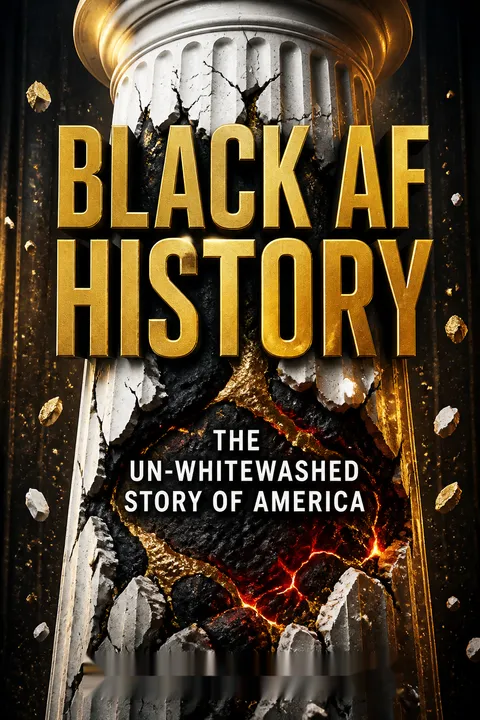


Key Takeaways
Read history as a contest over whose humanity gets centered.
The frame shapes the facts. Harriot opens with his family’s home library, where Black thinkers such as W. E. B. Du Bois and Carter G. Woodson offered a different starting point from schoolbook history. The issue is not simply that Black people were omitted. It is that a white-centered account can make colonizers complicated individuals while reducing Africans and Indigenous peoples to anonymous categories.
Check the storyteller. Harriot’s uncle corrected family anecdotes, teaching him to compare accounts rather than accept the most familiar version. The author applies that habit to America’s founding: the same events look different when conquest, stolen labor, and Black life occupy the center. His approach is a challenge to treat historical narratives as interpretations shaped by power, not as neutral lists of dates and heroes.
What's striking is the shift from asking whether a story includes Black people to asking what its structure makes visible. That is a useful test for any national history: whose motives receive explanation, and whose experience is reduced to background? Family storytelling also models a form of historical method, where memory becomes a lead to verify rather than evidence to accept uncritically. The approach is powerful, though a corrective account also needs careful sourcing and room for disagreement. Replacing one tidy national myth with another would reproduce the very problem the book identifies.
America’s founding story begins with conquest, extraction, and labor, not providence.
Jamestown was no triumphal start. Harriot portrays the first English colony as badly prepared, dependent on Powhatan food, and close to collapse. The settlers failed to find the riches they expected, and evidence indicates some survived the starving period by eating the dead. The author contrasts this with accounts that cast colonization as a heroic national beginning while leaving Indigenous sovereignty out of frame.
Labor changed the colony’s prospects. In 1619, English privateers brought Africans stolen from a Portuguese slave ship to Virginia. Harriot argues that their forced labor helped make tobacco cultivation profitable and the struggling colony viable. He also stresses that African people were present in the Americas before 1619, including free and enslaved Africans in Spanish expeditions. The familiar date marks a development in English Virginia, not the beginning of Black life in the Americas.
The colony’s near failure makes a useful point about state formation: ideals do not build institutions by themselves. Food, labor, capital, and force do. The chapter asks readers to examine how later origin stories distribute credit, especially when the people whose work sustained a project are written out of its founding. At the same time, the story of Jamestown is not the whole origin of the United States. It is one case in a larger and varied history of Indigenous societies, European empires, and African presence across the Americas.
Credit Black expertise for building the wealth and culture called American.
Knowledge was stolen with labor. South Carolina planters struggled to grow food until enslaved Africans cultivated rice, drawing on diverse agricultural knowledge from West Africa. The work required skill in water control, planting, processing, and toolmaking. Women performed much of this labor, and their expertise helped turn rice into a major export. The planters profited from knowledge they had neither developed nor initially understood.
A people made culture under coercion. Harriot traces Gullah-Geechee language, foodways, and community life to Africans who adapted practices from different regions and the Caribbean to create something new in the Lowcountry. The book also recovers figures such as Mansa Musa, whose Mali empire supported cities, scholarship, and trade while much of Europe was struggling. These stories place African achievement inside world history, not at its margins.
This account broadens the meaning of contribution. Expertise is not only a patent, a written record, or an invention credited to a named individual. It can be embodied in agricultural practice, language, food, and institutions that survive despite the conditions that produced them. That broader lens helps explain why cultural history and economic history belong together. A caution is useful: claims about the origins of particular foods or words can be complex and contested. Their significance does not depend on every origin story being simple or singular.
Treat escape, sabotage, and revolt as politics, not evidence of passivity.
Resistance took many forms. Harriot rejects the idea that enslaved people waited for emancipation. Some slowed work or damaged tools; some escaped to maroon communities, including settlements in the Great Dismal Swamp; others organized revolts. The 1739 Stono uprising, led by Jemmy, began with a small group seeking freedom in Spanish Florida and grew as others joined. Its suppression brought harsher laws restricting movement, education, gathering, and independent labor.
Freedom was a constant objective. The book also recalls the 1811 German Coast uprising in Louisiana and the Haitian Revolution, where enslaved people defeated European powers and founded an independent Black state. Harriot uses the false medical diagnosis drapetomania, invented to pathologize enslaved people who fled, to expose how authorities reframed a demand for liberty as illness. Resistance was not one tactic or one moment. It was a continuing effort to claim human agency.
The reframing matters because archives often preserve the state’s description of an act more readily than the actors’ own goals. Naming revolt as political action makes those goals legible, while attention to everyday refusal keeps history from equating resistance only with spectacular violence. It also avoids turning enslaved people into a single heroic type: people faced different risks, choices, and constraints. A fuller account can honor collective resistance without implying that every individual had the same options or that revolt alone could dismantle a vast system.
Black people helped break slavery, then built institutions before power was seized back.
Self-emancipation altered the war. During the American Revolution, enslaved people chose sides according to which offered a chance of freedom. During the Civil War, escapees withdrew labor from the Confederacy, supplied Union forces with intelligence, and enlisted as soldiers. Robert Smalls commandeered a Confederate vessel and delivered it to Union forces. Harriot draws on Du Bois’s idea of a general strike: mass withdrawal of enslaved labor weakened the Southern economy and helped turn a war to preserve the Union into a war that ended slavery.
Freedom briefly changed daily life. After emancipation, Black communities built schools, churches, farms, and political organizations. Sherman’s 1865 order set aside land for freed people, but President Andrew Johnson reversed the policy and restored much of it to former enslavers. Reconstruction brought Black officeholders and voting rights, yet white terror and federal retreat dismantled much of that fragile political power.
The account resists a familiar imbalance: presidents and generals receive credit for emancipation, while enslaved people appear only as its beneficiaries. It instead treats their actions as consequential military and economic choices. Reconstruction adds an institutional lesson: legal rights have limited force without enforcement, security, and material resources. The phrase general strike captures collective withdrawal, but it should not obscure the varied and often involuntary ways Black people were caught up in wartime change. Agency and constraint operate together, not as opposites.
See Black faith as a shelter, school, and organizing infrastructure.
Religion was adapted, not merely imposed. Enslavers used Christian teaching to defend bondage and sometimes circulated edited Bibles that removed passages likely to encourage liberation. Yet African Americans reshaped Christian practice through African traditions and, in some communities, Muslim beliefs. Harriot describes spirituals, prayer, and worship as ways to preserve memory, sustain hope, and communicate within hostile conditions.
Congregations did practical work. After the Revolution, Black churches became centers for mutual aid, education, political organization, and community life. Richard Allen and Absalom Jones helped establish Philadelphia’s Free African Society, which offered services beyond worship; Allen later founded the African Methodist Episcopal Church. Literacy classes and schools grew from this organizing. The book’s account of Onesimus, an enslaved African whose smallpox inoculation knowledge helped Cotton Mather and other colonists, further shows how Black knowledge could be vital even when Black people were denied authority.
The church appears here not as a private refuge separate from politics, but as social infrastructure: a place to share information, teach, coordinate aid, and build leadership. That perspective helps explain why authorities repeatedly tried to restrict Black gatherings and literacy. It also makes room for religious innovation rather than treating African American belief as a simple copy of white Christianity. The tradition was not uniform, however. Christian, Muslim, African-derived, and secular forms of community coexisted, and no single institution represented every Black person.
Put Black women back at the center of civil rights history.
The movement was built before its famous speeches. Ida B. Wells investigated lynching, challenged false accusations, and used data and journalism to confront public excuses for racial terror. Ella Baker helped build the Student Nonviolent Coordinating Committee around youth leadership and grassroots participation. Mary Church Terrell fought segregation in Washington, while Amelia Boynton organized voting education and helped make Selma a center of action.
The bus protest had many protagonists. Claudette Colvin, Aurelia Browder, Susie McDonald, Mary Louise Smith, and Jeanetta Reese were among the Black women arrested for defying Montgomery’s bus segregation. Their cases helped produce the legal challenge that ended it. Rosa Parks’s deliberate protest mattered, but it did not begin the struggle. Harriot shows how public memory often simplifies campaigns by elevating a few visible figures and obscuring the organizers, litigants, and strategists who made change possible.
This recovery changes the model of leadership from lone heroism to distributed work: research, legal strategy, fundraising, training, logistics, and public risk. It also exposes how gender shaped who could speak for a movement and whose labor was remembered. The result is a more realistic account of collective action, not a claim that every prominent male leader was irrelevant. A movement needs public symbols, but symbols become misleading when they replace the network that made them effective.
Track how white supremacy adapts when Black people gain rights.
Violence and law worked together. After Reconstruction, white supremacist groups attacked Black voters and leaders, while Black Codes and later Jim Crow laws constrained work, education, movement, and political participation. The Lost Cause, a postwar mythology that recast the Confederacy as noble and minimized slavery, spread through monuments, schoolbooks, and civic organizations. Harriot presents these stories as part of the struggle over who would define the nation’s past.
Surveillance targeted coalition, too. The book follows federal scrutiny of Black organizers from Marcus Garvey to Fred Hampton. COINTELPRO was an FBI program that sought to disrupt political groups, including Black nationalist organizations; leaked files revealed efforts to prevent coalitions and discredit leaders. Harriot also challenges the caricature of Black resistance as criminal, noting that armed self-defense and peaceful protest could coexist as distinct responses to violence and exclusion.
The chapter’s central insight is about adaptation: when one route to racial control becomes harder, institutions and political actors can seek another through law, memory, policing, or surveillance. That makes historical comparison useful, provided it does not flatten every era into an identical system. The distinction between protest strategy and personal self-defense is especially clarifying. It prevents nonviolence from being misrepresented as universal passivity, while still leaving room to debate when armed protection is effective, risky, or politically costly.
Follow the money from redlining to prison labor and inherited inequality.
Freedom without wealth can remain precarious. After emancipation, Black Codes criminalized unemployment and other ordinary activities, helping states lease imprisoned Black people to private businesses. The Thirteenth Amendment abolished slavery but retained an exception for forced labor as punishment for a crime. Harriot connects that loophole to convict leasing and argues that later mass incarceration continued to extract labor while disproportionately targeting Black communities.
Public policy also transferred wealth. Federal housing maps in the 1930s marked Black neighborhoods as risky, restricting access to mortgages and investment. Harriot links redlining to lower home values, weaker school funding, and the racial wealth gap. He cites a 2016 comparison in which the typical white family held about $171,000 in net wealth, against roughly $17,150 for the typical Black family. The point is cumulative advantage, not a claim that every present-day outcome has one cause.
Following money reveals how inequality can persist without an explicit law declaring one race inferior. Credit, property values, school resources, and access to work can transmit earlier exclusions across generations. This is a stronger explanation than attributing disparities to individual behavior alone, because it asks how opportunity is allocated. The causal chain still needs careful analysis: neighborhoods and institutions change, and not every gap can be assigned to a single policy. Structural explanations are most persuasive when they specify mechanisms and test them against evidence.
Read party labels through racial coalitions, not timeless moral identities.
Parties changed as coalitions changed. The early Democratic Party defended slavery and segregation, while Republicans emerged in opposition to slavery’s expansion. But neither label carried a permanent moral meaning. Black voters supported Republicans during Reconstruction, then increasingly backed Democrats as the parties’ alignments shifted in the twentieth century. Southern Democrats opposed civil rights legislation, while politicians in both parties responded to regional racial politics.
The Southern Strategy made the shift explicit. Harriot traces Republican gains in the South to campaigns that used coded appeals about states’ rights, crime, and social order after civil rights victories. He argues that party names can obscure a more enduring division over racial power. The book does not present Democrats as uncomplicated allies: it notes their own limits and the whiteness of much party leadership. The lesson is to examine policies, coalitions, and voting patterns rather than inherit a party’s self-description.
This history is a useful antidote to political memory that treats parties as fixed characters in a moral fable. Electoral coalitions change, and politicians adapt language to preserve support without repeating yesterday’s vocabulary. The account also cautions against assuming that a party’s diverse voters control its institutions. Its sharpest claims invite comparison across elections and regions: party realignment is real, but it is not a single switch flipped at one moment, nor does it erase continuities within either party.
Treat reparations as repayment for accumulated public and private theft.
The claim reaches beyond slavery. Harriot presents reparations as compensation for unpaid labor and for the policies that denied Black Americans equal access to land, housing, education, and political rights. His examples include Black taxpayers in South Carolina supporting better-resourced white schools and Black veterans excluded in practice from benefits promised by the G.I. Bill. The wealth gap is framed as the accumulated result of unequal rules, not merely different individual choices.
The remedy is contested, not simple. The book recalls earlier campaigns, including Callie Guy House’s organizing for pensions for formerly enslaved people, and notes that governments have compensated other groups for specific harms. It leaves open hard questions: who qualifies, which harms count, and whether payment should address labor, discrimination, or their combined effects. For Harriot, the existence of these questions is a reason to design policy carefully, not to pretend the debt never existed.
The strongest version of the case treats reparations as a policy question about repair, not inherited personal guilt. That distinction shifts debate toward responsibility: which institutions benefited, what harms can be documented, and what forms of remedy could reduce their continuing effects? Cash payments are only one possible instrument; education, housing, land, and public investment also raise questions of repair. Any workable proposal must address eligibility and measurement transparently, while avoiding the false choice between acknowledging historical debt and improving conditions for everyone.
Analysis
Black AF History is a sweeping counter-history of the United States, organized less as a neutral chronology than as an argument about power: who is recognized as a founder, whose labor counts as expertise, and how racial hierarchy survives formal changes in law. Harriot’s central method is to move the narrative’s point of view. Jamestown looks different when Powhatan sovereignty and the colony’s dependence on others are foregrounded. The Civil War changes meaning when enslaved people’s self-emancipation is treated as a force that shaped military outcomes. Reconstruction becomes an experiment in Black institution-building, not merely a transition between wars.
The book’s storytelling is unusually effective because it joins archival history to family memory, humor, food, music, and local speech. These details do not function only as decoration. They demonstrate that history is also preserved in communities and practices rarely centered in official records. The recurring family fact-checking motif offers a useful model: stories deserve both affection and verification. The author’s voice also refuses the sterile distance that can make violence feel abstract, while using satire to reveal the absurdity of racist justifications.
Its most valuable analytical contribution is the insistence on continuity without sameness. Slavery, Black Codes, convict leasing, redlining, segregation, mass incarceration, and political surveillance are connected in the book through mechanisms of control and extraction. That connection helps readers see why abolition or civil rights legislation alone cannot instantly erase accumulated disadvantage. Yet historical analogy needs precision. Similar outcomes do not prove identical causes, and some of Harriot’s provocative claims compress disputed histories into punchy conclusions. Readers should distinguish documented events, the author’s interpretation of their significance, and rhetorical emphasis. The book is strongest when its vivid narrative opens a question that primary records and further scholarship can deepen. Its ultimate challenge is not simply to add Black figures to familiar history, but to ask how the familiar story changes when Black people are treated as makers of America rather than evidence about it.
Review Summary
Black AF History is praised for its engaging, humorous approach to often painful historical truths. Readers appreciate Harriot's ability to blend personal anecdotes, pop culture references, and well-researched facts to create an accessible narrative. Many found the book eye-opening, highlighting overlooked aspects of American history from a Black perspective. While some criticized the writing style as overly casual or distracting, most reviewers found it refreshing and effective in making complex topics digestible. The book is widely recommended as essential reading for understanding the full scope of American history.
People Also Read






Glossary
double-consciousness
self-perception through othersA term W. E. B. Du Bois uses for the strain of seeing oneself both from one’s own perspective and through the judgment of a society that devalues Blackness. In the book, it describes the conflict of being Black and American in a nation whose dominant story often treats those identities as incompatible.
drapetomania
false diagnosis of escapeA racist pseudo-diagnosis proposed by physician Samuel Cartwright in 1851 to describe enslaved people who fled bondage. Harriot uses the term to show how defenders of slavery recast a rational desire for freedom as mental illness, making resistance appear to be a defect in the oppressed rather than a response to oppression.
maroons
self-liberated community membersPeople who escaped enslavement and formed independent communities, often in difficult-to-reach terrain. In the book, maroon settlements in swamps and forests show that escape could involve building a lasting alternative to plantation control, supported through hunting, farming, trade, and relationships with enslaved people nearby.
task system
work measured by assigned tasksA labor arrangement used on some Lowcountry plantations in which enslaved people were assigned a defined amount of work. After completing it, they could use remaining time for their own gardens, clothing, or commerce. The arrangement did not make them free, but it shaped daily life and helped sustain distinctive Black communities and practices.
Gullah-Geechee
Lowcountry Black cultureA distinctive African American culture formed in the Sea Islands and coastal Lowcountry from the knowledge, languages, and traditions of Africans from multiple regions, alongside Caribbean and English influences. Harriot highlights its language, food, agricultural knowledge, and cultural continuity as evidence of creation and adaptation under enslavement.
general strike
collective labor withdrawalHistorian W. E. B. Du Bois’s interpretation of enslaved people’s mass flight from plantations during the Civil War. By withdrawing labor from the Confederacy and joining Union lines, they undermined the Southern economy and helped transform the conflict. Harriot uses this idea to emphasize Black action in emancipation.
Lost Cause
Confederate redemption mythologyA post-Civil War ideology that portrayed the Confederacy as honorable, minimized slavery’s role in secession, and romanticized the antebellum South. Harriot describes how organizations, monuments, and textbooks helped spread this account, shaping public memory and obscuring the Confederacy’s defense of slavery.
COINTELPRO
FBI disruption programThe FBI’s counterintelligence program used to monitor and disrupt political organizations and movements. The book focuses on its targeting of Black organizers and nationalist groups, including efforts to weaken coalitions, discredit leaders, and prevent organizations from gaining public legitimacy.
redlining
racially graded credit exclusionA housing and lending practice in which areas marked as financially risky were denied access to mortgages and investment. Federal maps in the 1930s classified Black neighborhoods as hazardous, including some affluent areas. Harriot connects the policy to enduring differences in home value, school resources, and household wealth.
Southern Strategy
coded appeal to white votersA Republican electoral approach, especially associated with the late twentieth century, that appealed to white voters in the South through coded messages about states’ rights, crime, and social order after civil rights gains. Harriot presents it as part of the political realignment that reshaped party coalitions without always using explicit racist language.
Download PDF
Download EPUB
.epub digital book format is ideal for reading ebooks on phones, tablets, and e-readers.








