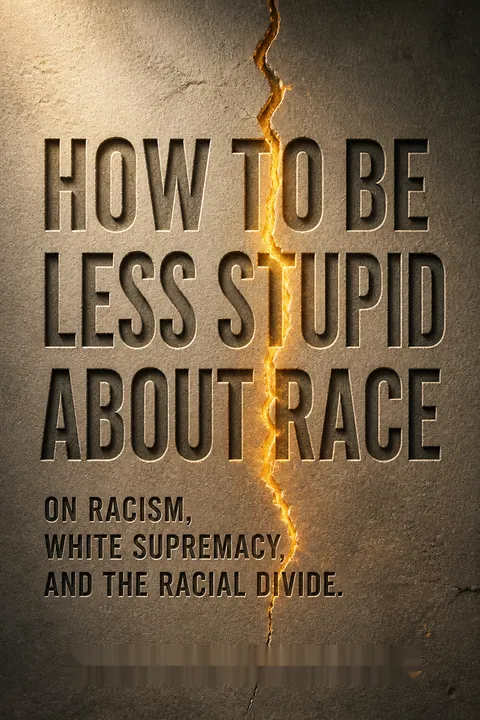


Key Takeaways
Treat racial ignorance as a product of power, not a personal quirk
Ignorance is taught. Fleming uses racial stupidity to describe distorted, ahistorical, or superficial ideas about race, including denying racial oppression. She argues that these beliefs are not simply private misunderstandings: schools, media, politics, and everyday life repeatedly teach people to misread how society works. Her own story gives the idea a human scale. As a child, she saw herself as gifted and exceptional, but had little language for the racism and inequality shaping her world. Formal study helped her connect personal experiences to larger patterns.
Conversation needs preparation. The Starbucks Race Together campaign urged baristas to discuss race without supplying training or guidance. Later, a Philadelphia store’s discriminatory treatment of two Black customers showed why open conversation alone cannot substitute for institutional change. The book’s point is not to avoid discussing race, but to learn enough to discuss racism accurately.
What's striking is the book's shift from ignorance as a personal flaw to ignorance as a social outcome. That move resembles research on epistemic injustice, where some groups' knowledge is routinely discounted while dominant accounts gain authority. It also changes the remedy: reading and self-reflection matter, but so do curricula, workplace practices, and media habits. The Starbucks example makes a useful distinction between visibility and competence. Still, structured education is not a cure by itself. People can learn accurate terminology while preserving unequal arrangements, so knowledge needs to be tested against practice.
Follow power through laws and institutions, not just personal prejudice
Systems outlast intentions. Fleming distinguishes individual bias from systemic racism, the collective practices and institutional arrangements that disadvantage people based on perceived race. White supremacy, in her account, is not limited to extremists. It describes the political, economic, and social dominance attached to being classified as white. Race itself is not a biological ranking of human groups. It is a historically created classification that has been used to rationalize domination and unequal access to resources.
History lives in policy. Critical race theory, an interdisciplinary tradition that developed among legal scholars after the civil rights era, examines how law and institutions reproduce racial hierarchy. For example, the Naturalization Act of 1790 limited citizenship to free white people, while later land policies distributed vast resources largely to white settlers. Such histories help explain why present inequalities cannot be understood only by asking whether an individual intended harm.
The institutional lens is powerful because it directs attention toward outcomes, rules, and accumulated advantage rather than making racism depend on proving private animus. It fits a broader sociological insight: organizations can produce unequal results through routine procedures, even when no single decision-maker controls the whole pattern. The challenge is to keep institutional analysis concrete. Naming a system can clarify causation, but it can also become so broad that every disparity appears to confirm the same explanation. Careful comparisons, historical evidence, and attention to specific mechanisms strengthen the argument.
Make Black women's experiences central to any account of oppression
Specificity reveals the structure. At a gathering about women’s solidarity, comedian Jessica Williams tried to explain how racism and sexism shape Black women’s lives. Salma Hayek and Shirley MacLaine answered with advice to look beyond identity and victimhood. Fleming reads the exchange as an example of how Black women’s accounts can be dismissed even in spaces devoted to women’s rights. The omission is not merely discourteous: it leaves key forms of power unexamined.
Intersectionality maps overlap. Developed by legal scholar Kimberlé Crenshaw, intersectionality examines how systems such as racism and sexism combine, rather than treating them as separate problems. The Combahee River Collective, a Black lesbian feminist group, had already linked racial, gender, and class oppression in its political work. The term misogynoir, coined by Moya Bailey, names the particular anti-Black racism and sexism directed at Black women and girls.
The section treats lived experience as a source of social knowledge, not as a substitute for analysis. People positioned where several forms of exclusion meet can notice failures in theories that treat race, gender, sexuality, or class as independent variables. That insight has practical value in research design and public policy: a broad category such as women may hide sharply different risks. At the same time, no identity guarantees a single perspective. Centering Black women means attending to varied experiences, including those of trans, disabled, queer, and working-class women, rather than turning a diverse group into a new stereotype.
Judge political change by redistributed power, not symbolic representation
A historic image is not a policy. Fleming recounts her own excitement as a young Obama campaign spokesperson in Paris. The election of a Black president felt transformative, and she initially treated his rise as evidence of racial progress. She later argues that a leader’s identity cannot establish that institutions have changed. In her account, Obama combined racial inclusion with policies that accommodated corporate power and avoided direct challenges to white supremacy.
Look past the branding. The book uses neoliberalism to describe a political approach that prioritizes markets, deregulation, competition, and individual responsibility, often benefiting corporations and wealthy people. Fleming points to Obama’s conciliatory racial rhetoric and his administration’s use of drone warfare as evidence that inspiring symbolism can coexist with harmful policy. Her broader warning is that both major parties can use minority representation and inclusive language while leaving concentrated power largely intact.
This argument usefully separates descriptive representation, who holds office, from substantive representation, whose interests policy serves. A visible breakthrough can expand what citizens imagine possible, yet it does not guarantee a shift in budgets, legal protections, or control over institutions. The analysis is strongest when it asks readers to examine policy consequences rather than infer virtue from identity or rhetoric. Its more debatable move is attributing political choices primarily to accommodation of white supremacy. That interpretation deserves scrutiny alongside other explanations, including electoral constraints and competing policy goals, without losing sight of measurable effects.
See Trump's racism as an eruption of old American arrangements
The past did not vanish. Fleming argues that Trump was not an alien arrival in an otherwise nonracist political system. She places his public racial hostility within a longer history that includes the federal government’s discrimination case against his real-estate company and presidents’ support for racial exclusion. The book also recalls the incarceration of more than 100,000 Japanese Americans during World War II, despite no evidence that the group posed the security threat used to justify the policy.
Support crossed class lines. Fleming challenges accounts that blame Trump’s election mainly on economically anxious white workers. She notes that Trump won support among white voters across income and education levels, and argues that racial resentment helped drive that coalition. Her analysis does not deny economic insecurity. It asks why hardship among white voters is treated as decisive while the conditions of poor and working-class people of color receive less political attention.
The historical comparison disrupts the comforting story that democratic institutions are usually neutral and become dangerous only under an exceptional leader. It also cautions against reducing political behavior to economic interest: people can support policies that materially disadvantage them when status and group belonging are at stake. Still, historical continuity should not erase differences in degree or form. A president's rhetoric, administrative choices, and institutional constraints can matter in distinctive ways. The useful question is not whether a leader is normal or abnormal, but which older arrangements are being revived, and what new capacities or harms accompany them.
Interrogate who the news portrays as dangerous, innocent, or poor
News frames train perception. Fleming draws on Ida B. Wells, the Black journalist who investigated lynching and challenged fabricated stories used to justify mob violence. Wells showed how reporting could turn racist accusations into public permission for terror. The book argues that contemporary news can similarly distort social reality by presenting people of color as criminals more often than the evidence warrants, while giving white people more sympathetic treatment.
The imbalance is measurable. A study of New York City television news cited by Fleming found that Black people made up 51 percent of arrests but 75 percent of criminal perpetrators shown in coverage. Another study found that media reports disproportionately depicted poor people as Black, despite the larger share of poor Americans who were white. Such patterns influence public judgment about crime and social spending, even when the reporting presents itself as objective.
The strongest point is that media influence operates through repeated selection, not only explicit slurs or editorial endorsements. Viewers learn associations through which people appear as threats, victims, experts, or ordinary citizens. This connects to cognitive research showing that repeated pairings can make social categories feel naturally linked to particular traits. The critique also invites a useful discipline: compare coverage with underlying data and ask whose account is missing. However, a distorted pattern does not prove that every journalist intends to promote racism. Institutional incentives, sourcing routines, and newsroom composition can reproduce bias without a coordinated plan.
Practice interracial intimacy without asking it to absolve society
Affection is not a policy. Fleming challenges the claim that interracial love can heal racism by itself. Love may offer comfort, trust, and motivation to confront injustice, but it cannot erase unequal institutions or historical harm. She also emphasizes that interracial relationships are not automatically antiracist. Desire, friendship, and family ties can coexist with racist assumptions, unequal power, or silence about discrimination.
Intimacy takes work. Fleming describes learning to speak with her biracial partner about racial harm without assuming their experiences are identical. That work required listening, trust, and help from a couples counselor. She also discusses research on Brazilian families in which lighter-skinned children could receive more affection and investment than darker-skinned siblings. The example shows how racial hierarchy can enter even the intimate spaces that people often imagine as beyond politics.
This account avoids two easy errors: treating interracial relationships as proof that racism has ended, and treating partners' racial identities as a reliable measure of their politics. Social psychology's contact hypothesis offers a helpful extension: contact is more likely to reduce prejudice when people meet as equals, cooperate toward shared goals, and receive support for sustained interaction. Intimacy alone does not guarantee those conditions. The book's emphasis on conversation and accountability makes love politically meaningful without making it magical. A further test is whether private understanding connects to action in workplaces, families, and institutions.
Turn racial literacy into sustained collective action, not a quick fix
Learning is a beginning. Fleming calls racial literacy the ability to recognize how race and racism shape history, institutions, relationships, and personal assumptions. She offers no promise that racism will disappear within one lifetime. Instead, she argues that uncertainty about the end point is no reason to abandon efforts to reduce harm and build more just communities.
Make knowledge practical. Her recommendations include examining one's racial socialization, studying local histories, discussing racism with young people, challenging racist conduct, joining antiracist organizations, amplifying and paying marginalized experts, and shifting resources toward excluded communities. She also urges readers to choose work suited to their abilities rather than attempting to solve every problem at once. Education matters, but it must connect to organizing and changes in how resources and authority are distributed.
The closing framework resists both despair and the promise of a simple checklist. Its strongest practical distinction is between awareness and intervention: reflection helps people see patterns, while collective work can alter the policies and resource flows that sustain them. This resembles the difference between individual behavior change and institutional design in public health. A useful safeguard is to ask what changed beyond personal understanding. Did a group revise a rule, redirect funding, or make decision-making more accountable? Without such tests, racial literacy can become an identity badge rather than a practice with consequences.
Analysis
Fleming's book works as public sociology through a deliberate combination of memoir, satire, historical argument, and political critique. Its narrative engine is the author's own delayed recognition: a high-achieving Black scholar can study race for years and still lack a framework for seeing white supremacy as a system. That admission makes the book's central claim more persuasive than a purely abstract lecture would be. Racial ignorance is not simply a shortage of facts. It is produced and rewarded by institutions that teach selective histories, privilege dominant interpretations, and detach present inequalities from their origins.
The book's most useful conceptual move is to change the unit of analysis. Instead of asking only whether a person harbors prejudice, it asks how law, wealth, media, and political language organize advantage across time. Intersectionality deepens that method by showing how a supposedly universal account of racism can leave Black women, queer people, and other marginalized groups out of view. The sections on Obama, Trump, and the press then show how representation and explicit rhetoric can differ while institutional arrangements persist. The method has a productive tension. Fleming's sharp, comic polemic makes evasions difficult to hide, but the same force can compress distinctions between motives, outcomes, and institutions. In particular, claims about political actors' strategic intent are harder to establish than claims about policy effects. Readers can preserve the book's structural insight while asking for evidence at each level: what was said, what rule changed, who benefited, and what historical mechanism connects the two?
The book is most valuable when read not as a final taxonomy of who is racist, but as training in how to notice and investigate racial power. Its practical challenge is to move from recognition toward institutional change, while remaining attentive to the people whose experiences conventional accounts have excluded.
Review Summary
How to Be Less Stupid About Race receives mostly positive reviews for its insightful examination of racism and white supremacy. Readers appreciate Fleming's personal anecdotes, academic research, and calls to action. Many find it eye-opening and challenging, praising its accessible writing style and comprehensive approach. Some criticize the author's tone and language, while others feel certain arguments lack substantiation. Overall, reviewers recommend it as an important read for those seeking to understand and combat systemic racism, though a few suggest other books as better introductions to the topic.
People Also Read






Glossary
racial stupidity
distorted racial understandingFleming's term for illogical, ahistorical, or socially inaccurate claims about race and racism. It includes denial of racial oppression, beliefs in inherent racial superiority, and superficial descriptions that hide how racial domination works. The term describes a widespread social condition produced by living in a racist society, not merely an individual's lack of intelligence.
systemic racism
collective racial disadvantageCollective practices and representations that disadvantage people based on perceived race. Unlike individual prejudice, systemic racism operates through interconnected institutions, policies, and routines. It can persist without every member of a dominant group expressing racist beliefs or intending harm, because its effects are reproduced through the organization of power and resources.
white supremacy
white group dominanceFleming uses this term to mean the social, political, and economic dominance of people socially defined as white. It refers not only to extremist organizations, but also to institutional arrangements and cultural practices that protect racial hierarchy and direct resources toward white people. The book traces its modern forms to colonialism, slavery, and racial ideology.
critical race theory
study of racial powerAn interdisciplinary field that developed among legal scholars in the aftermath of the civil rights movement. Critical race theory examines how racism persists through law and social institutions, challenges claims that society has become color-blind, and connects racial inequality with other forms of domination. It combines structural analysis with attention to history and the experiences of people of color.
epistemology of ignorance
organized production of not-knowingA concept associated in the book with philosopher Charles Mills. It describes how racial power produces distorted understandings of the social world, then allows those distortions to pass as credible knowledge. Ignorance is not merely missing information: it can be maintained through selective history, denial, and institutions that make racial domination difficult to recognize.
intersectionality
overlapping systems of powerA Black feminist approach, developed in legal scholarship by Kimberlé Crenshaw, to understanding how systems such as racism and sexism interact. It shows why treating each form of discrimination separately can make people facing multiple forms of disadvantage invisible. The concept also applies to linked systems of power involving class, sexuality, gender identity, and other social positions.
misogynoir
anti-Black gendered hostilityA term introduced by scholar Moya Bailey for the particular forms of racism and sexism directed at Black women and girls. It names how anti-Blackness and misogyny combine in popular culture and public life to stigmatize, pathologize, or devalue them. The term emphasizes that their experiences are not always captured by broader categories of racism or sexism.
white racial frame
racialized interpretive lensSociologist Joe Feagin's term for the interconnected stereotypes, beliefs, images, emotions, and habits through which people interpret racial groups. Fleming uses it to explain how positive assumptions about whiteness and negative assumptions about people of color become embedded in everyday life and institutions, shaping behavior even when individuals claim to be color-blind.
two-faced racism
public denial, private racismA pattern identified by researchers Leslie Picca and Joe Feagin in which white people present themselves as nonracist in public while expressing or tolerating racist ideas in predominantly white private settings. The concept highlights how the pressure to appear respectable can change where racism is expressed without eliminating the underlying beliefs or behavior.
colorblind racism
racial hierarchy without racial languageA contemporary form of racism that avoids explicit claims of biological superiority while denying the importance of race and explaining inequality in ways that preserve white dominance. It often relies on coded language, appeals to individual choice, or claims that discrimination is over. The result is a public appearance of nonracism alongside continuing racial inequality.
neoliberalism
market-first political programA political and economic approach that emphasizes markets, deregulation, competition, and individual responsibility. Fleming argues that politicians can pair this agenda with inclusive language or minority representation while prioritizing corporate and wealthy interests. In her account, this combination can divert attention from structural inequality and limit the material reach of symbolic inclusion.
stereotype threat
stereotype-induced performance pressureSocial psychologist Claude Steele's term for the risk that awareness of a negative stereotype about one's group can undermine performance in a situation where that stereotype is relevant. Fleming uses the idea to explain why a parent might try to shield a child from harmful racial expectations, while also arguing that children need age-appropriate tools to understand racism.
African American Privilege
exceptional treatment abroadFleming's term for advantages some African Americans experience outside the United States, particularly when a host society treats them warmly while denying comparable recognition or access to its own racialized populations. She uses her experience in France to show how such treatment can also serve a national story that minimizes local racism by comparison with the United States.
FAQ
What's How to Be Less Stupid about Race about?
- Focus on Racial Ignorance: The book examines the widespread racial ignorance in American society, highlighting how individuals are socialized into harmful beliefs about race.
- Critical Race Theory: It introduces critical race theory as a tool to understand systemic racism and white supremacy, emphasizing that racism is a system of power, not just individual prejudice.
- Personal Journey: Author Crystal Marie Fleming shares her transformation from racial naiveté to a critic of white supremacy, using humor, memoir, and empirical evidence.
Why should I read How to Be Less Stupid about Race?
- Educational Value: The book offers a clear education on race, racism, and white supremacy, making complex issues accessible to readers.
- Engaging Style: Fleming's humor and personal anecdotes make the book engaging and relatable, enhancing the learning experience.
- Call to Action: It encourages readers to confront their racial ignorance and provides steps to become more racially literate and active in fighting racial oppression.
What are the key takeaways of How to Be Less Stupid about Race?
- Racial Stupidity Defined: Fleming describes "racial stupidity" as illogical or inaccurate claims about race, highlighting its prevalence.
- Systemic Racism: The book emphasizes that racism is systemic, embedded in institutions, and not just about individual attitudes.
- Listening to Black Women: It stresses the importance of centering black women's voices in discussions about race for their critical insights.
What are the best quotes from How to Be Less Stupid about Race and what do they mean?
- “We are surrounded by racial stupidity.”: This quote underscores the book's argument about the pervasive racial ignorance in society.
- “Racism is systemic, pervasive, and embedded within the core of all of our major institutions.”: It highlights that racism is a structural issue requiring collective action.
- “Listen to Black women.”: This call to action emphasizes the need to prioritize black women's experiences and insights in racial discussions.
What is critical race theory as discussed in How to Be Less Stupid about Race?
- Framework for Understanding: CRT is presented as essential for understanding systemic racism and how laws and institutions perpetuate racial inequalities.
- Historical Context: It emerged post-civil rights movement to address persistent racism after de jure segregation ended.
- Intersectionality: The book discusses intersectionality within CRT, showing how racism intersects with other oppressions like sexism and classism.
How does How to Be Less Stupid about Race address the Obama era?
- Racial Politics Under Obama: Fleming critiques Obama's administration, noting that while symbolic of progress, it often failed to tackle systemic racism.
- Postracial Myth: The book challenges the myth that racism was overcome with Obama's election, highlighting ongoing racial issues.
- Critique of Neoliberalism: It points out how Obama's policies often favored corporate interests over marginalized communities, perpetuating inequalities.
What is colorblind racism as defined in How to Be Less Stupid about Race?
- Denial of Racism: Colorblind racism is the belief that ignoring race eliminates racism, which actually perpetuates ignorance and systemic inequalities.
- Subtle Forms of Racism: It allows racist attitudes to persist without overt acknowledgment, often through coded language.
- Impact on Social Justice: This approach undermines efforts for racial justice by failing to address discrimination's root causes.
How does How to Be Less Stupid about Race define systemic racism?
- Collective Practices: Systemic racism involves practices and representations disadvantaging certain racial groups, beyond individual prejudice.
- Institutionalized Power: It is embedded in institutions, laws, and policies, making it a pervasive societal issue.
- Historical Context: Fleming links systemic racism to historical injustices, showing how past actions shape current inequalities.
What steps does How to Be Less Stupid about Race suggest for becoming racially literate?
- Education and Awareness: Readers are encouraged to learn about racism's history and realities, emphasizing critical thinking.
- Engagement with Diverse Voices: Actively listening to marginalized communities, especially black women, is crucial for understanding racial issues.
- Challenging Racial Ignorance: The book urges confronting personal racial ignorance and engaging in difficult conversations about race.
How does How to Be Less Stupid about Race critique the media's portrayal of race?
- Misrepresentation of Issues: Mainstream media often misrepresents racial issues, focusing on individual acts rather than systemic problems.
- Normalization of Racism: The media normalizes racist narratives and stereotypes, contributing to public ignorance about systemic racism.
- Call for Accountability: Fleming calls for media outlets to provide accurate, nuanced representations of race and racism.
How does How to Be Less Stupid about Race connect racism to other forms of oppression?
- Intersectionality: The book uses intersectionality to show how racism intersects with other oppressions like sexism and classism.
- Collective Struggles: Addressing racism requires acknowledging its links to other social justice issues, advocating for equality and justice for all marginalized groups.
- Empowerment through Solidarity: It encourages building coalitions among different movements to amplify voices and create significant change.
What role does humor play in How to Be Less Stupid about Race?
- Coping Mechanism: Humor is used to address serious topics, making difficult conversations more accessible and engaging.
- Critique of Racist Humor: Fleming critiques the normalization of racist jokes, highlighting their role in perpetuating stereotypes.
- Encouraging Reflection: Humor invites readers to reflect on their responses to racial jokes, challenging complicity in racist discourse.
Download PDF
Download EPUB
.epub digital book format is ideal for reading ebooks on phones, tablets, and e-readers.








