

Key Takeaways
Use near-light-speed travel to arrive in Earth's future younger than everyone else
Motion changes elapsed time. Relativity predicts that a clock moving rapidly accumulates less time than a clock left behind. In the Hafele-Keating experiment, atomic clocks flown around the world ended up 59 nanoseconds behind clocks on the ground. At everyday speeds the effect is tiny, but it grows sharply as a spacecraft approaches the speed of light.
The twins make the leap vivid. In Davies's example, Sally travels to a star 10 light-years away at 99 percent of light speed and returns. Earth records a little over 20 years; Sally experiences fewer than three. She arrives in Earth's future, much younger than her twin Sam. This is established physics, though the energy and engineering demands make human journeys impractical today.
What's striking is that this is not a loophole in time so much as a measurable difference between two paths through spacetime. Modern satellite navigation depends on correcting for relativistic clock differences, which makes the same physics useful without requiring a starship. The twin story can make the traveler seem privileged, but the age gap is not an illusion or a faulty clock: each person genuinely experiences a different duration. The practical barrier is not whether the effect exists, but whether a craft can reach and survive the required speeds.
Stop treating "now" as a cosmic timestamp shared by every observer
Distant simultaneity is not absolute. To compare events far apart, observers use signals, and those signals take time to arrive. Relativity adds a deeper complication: observers moving differently disagree about how to account for that travel time. They can therefore disagree about which distant event is happening at the same moment as an event here.
Distance magnifies the disagreement. Across Earth, the difference is too small for ordinary life. For Mars, it can amount to minutes; across the Milky Way, competing definitions of simultaneity can differ by as much as 100,000 years. This does not mean people can reverse the order of events that could have influenced one another. It means a single universal present cannot be defined for the whole cosmos.
This is a useful distinction between what feels immediate and what physics can define. Human beings experience a shared present because everyday distances and speeds make disagreements negligible, not because the universe supplies a master clock. The idea also cautions against turning relativity into a sweeping metaphysical conclusion: the absence of a universal present does not, by itself, settle every question about whether past and future are equally real. It establishes that simultaneity across distance depends on an observer's motion.
Use gravity's clock slowdown as a one-way route into Earth's future
Gravity changes clock rates. General relativity predicts that clocks deeper in a gravitational field tick more slowly than clocks farther away. Near Earth the effect is small: the book estimates that Earth’s gravity makes clocks lose about one microsecond every 300 years. More accurate clocks can detect even the tiny difference between the top and bottom of a building.
Neutron stars offer a stronger timewarp. These collapsed stellar remnants pack more mass than the Sun into a body roughly the size of a city. A clock at the surface of a typical neutron star would run about 30 percent slower than one on Earth. Seven years there would correspond to about ten years passing here. This would carry a visitor into Earth's future, not back into the past.
Gravity's effect on time is a reminder that timekeeping is local to physical conditions, not merely a matter of choosing a better clock. The principle is built into practical technologies such as satellite navigation, where altitude changes clock rates enough to require correction. A neutron star dramatizes the effect, but it is a hostile and remote environment, not a realistic destination. The comparison also helps separate a genuine relativistic time difference from the familiar feeling that time passes quickly or slowly.
Reach the past only if spacetime offers a global shortcut
Past travel requires more than speed. Ordinary motion and gravity can make a traveler arrive in the future sooner than others, but neither lets that traveler turn around and reach an earlier date. In general relativity, however, some mathematical descriptions of spacetime contain closed paths that return to an earlier time. Such a path is often called a closed timelike curve: a route through spacetime that loops back to its own past.
Rotation can twist the route. W. J. van Stockum found a time-loop solution involving an infinitely long, rapidly rotating cylinder, while Kurt Gödel found one in a rotating-universe model. These setups are highly unrealistic. A more intuitive proposal is a wormhole, a tunnel connecting distant locations so that a traveler can take a shortcut that light travelling through ordinary space cannot match.
The crucial distinction is between outrunning light locally and taking a route that wins globally. Relativity forbids ordinary objects from crossing the local light barrier, while curved spacetime can alter which route is shortest or fastest between distant events. This is why the proposals are intellectually interesting without licensing faster-than-light travel in the everyday sense. Their mathematical existence demonstrates that a theory permits certain geometries; it does not demonstrate that nature can produce or sustain those geometries.
A traversable wormhole needs negative energy to keep its throat open
A tunnel must stay open. A wormhole is a proposed tunnel through spacetime, and its narrow middle is called the throat. The familiar black-hole version does not work as a passage: its throat closes too quickly, and its intense gravity can destroy anything falling in. Kip Thorne and colleagues asked what kind of matter could hold open a safer, traversable wormhole. Ordinary matter and light would make it collapse. The required ingredient is negative energy, a state with less energy than the chosen vacuum reference, whose gravitational effect can be repulsive.
Quantum physics allows tiny examples. In the Casimir effect, closely spaced metal plates alter the quantum activity between them, creating a minute negative-energy state and a measurable force between the plates. That establishes a physical example, not a supply large enough to build a human-sized tunnel.
The Casimir effect is a compelling bridge between abstract quantum theory and a proposed cosmic machine: the vacuum is not simply an inert nothing. But demonstrating a small negative-energy effect is very different from accumulating enough to stabilize a wormhole. That scale gap is central, not a minor engineering detail. The distinction also prevents a common misreading: negative energy here does not mean a convenient fuel that can be extracted without cost. Its existence is constrained by the physical system that produces it.
Treat the proposed wormhole factory as a physics thought experiment, not blueprint
The imagined factory has four stages. Davies sketches a speculative route from quantum-scale spacetime fluctuations to a time machine:
1. A collider creates an extremely hot quark-gluon plasma.
2. An imploder compresses it toward Planck-scale conditions, where gravity could become strongly affected.
3. An inflator uses negative energy to enlarge and stabilize a tiny wormhole.
4. A differentiator makes one mouth age differently from the other, creating a time gap.
The numbers expose the gulf. The proposed compression would raise the plasma's temperature by roughly 19 orders of magnitude. Lasers and rapidly moving mirrors might help generate negative energy, but Davies cites an estimate that a one-metre wormhole would require negative energy comparable to Jupiter's mass. The sequence is a way to ask what physics permits, not a practical construction plan.
The factory's value lies in making hidden assumptions visible. Each stage translates a grand claim, “build a time machine,” into a separate physical bottleneck: creating extreme conditions, controlling spacetime, supplying exotic energy, and maintaining a clock difference. This resembles systems engineering, where a proposal can fail because one indispensable component is unavailable even when the rest is imaginable. The numbers matter because they distinguish theoretical possibility from technological plausibility. A clean sequence of steps should not be mistaken for evidence that any step is achievable.
Past travel may allow causal loops, but not contradictions in one history
A loop need not be a contradiction. The classic problem is the traveler who goes back and prevents their own existence. If the traveler succeeds, there would be no traveler to make the trip. Davies distinguishes changing the past from affecting it: a causal loop can be strange yet logically consistent if its events fit together without contradiction.
Billiards make the problem concrete. In a proposed wormhole game, a ball enters a pocket, emerges earlier, and hits its younger self. A collision that prevents the ball from entering the pocket would create an inconsistent story. But a self-consistent collision can instead nudge the ball into the pocket, producing the very event that caused the collision. Thorne's analysis found that more than one self-consistent sequence may be possible, so the laws may not specify a unique outcome.
This is a valuable separation of logical consistency from intuitive plausibility. A causal loop can be coherent without having an ordinary first cause, much as a circular explanation can satisfy its own conditions without explaining where its contents originated. The billiard example also reveals a subtler issue: avoiding contradiction does not automatically restore predictability. If several consistent outcomes are allowed, a theory may need an additional rule to say which occurs. Consistency is necessary for a model, but it is not the whole story.
The multiverse multiplies histories to sidestep paradoxes, not prove time travel
Parallel histories offer another escape. In the many-universes interpretation of quantum mechanics, each possible quantum outcome is treated as real in a different branch of a vast collection of realities. Applied to the ancestor paradox, a traveler could affect a version of the past in one branch without erasing the history of the branch they came from.
The price is a larger reality. This approach replaces a contradiction within one history with multiple histories that coexist. It also appears in the book's information loop: a professor reads a future theorem, brings it to the past, and helps cause its publication, leaving no clear original source for the idea. Parallel branches can make such stories consistent, but the interpretation itself is disputed, and it does not establish that a working time machine exists.
The multiverse proposal is powerful because it treats quantum mechanics as more than a calculator of probabilities: alternative outcomes become parts of reality. That move can dissolve certain time-travel contradictions, but it shifts the explanatory burden rather than making it disappear. It raises questions about what counts as a branch, how branches relate, and whether the interpretation produces testable differences. A reader can recognize its conceptual appeal while keeping two claims separate: an interpretation may accommodate time travel in a model, but it is not experimental evidence for time travel.
Quantum effects may wreck time machines, but chronology protection remains unproven
The vacuum may resist time loops. Stephen Hawking's chronology protection conjecture proposes that physical processes prevent travel into the past. One suggested mechanism appears near a chronology horizon, the boundary of a region where causal loops become possible. Virtual particles may circulate through paths that nearly close in time, causing their energy to grow without limit and generating gravity strong enough to destroy the machine.
The calculation is not decisive. The book emphasizes that physicists lack a complete theory of quantum gravity for such extreme conditions. Other obstacles include whether negative energy can be controlled and whether matter or radiation would destabilize a wormhole. These concerns are serious, but they do not amount to a proof that every time machine is impossible. The conjecture remains a proposed safeguard, not a settled law.
Chronology protection is attractive because it links a philosophical discomfort, paradoxical histories, to a physical mechanism that could be tested in principle. The proposed quantum feedback also illustrates a recurring theme in modern physics: a classical spacetime can look well behaved until quantum effects become important near its limits. Still, an appealing mechanism is not a demonstrated mechanism. Without a complete theory that combines quantum physics and gravity, confidence should remain calibrated: the conjecture organizes a research question, but cannot yet close it.
Reversing the universe is not the same as traveling to yesterday
A reversed movie is not a time machine. Reversing time would mean physical processes running in the opposite direction, such as gas molecules gathering into a corner rather than spreading through a room. With only a dozen molecules, such a gathering could happen by chance. With the enormous number in a room, the wait would be far longer than the age of the universe.
Observers would reverse too. If every process, including brain activity and memory, ran backward, people would not watch the cosmos replaying history in reverse. Their experience would reverse along with everything else. Time travel, by contrast, means a traveler follows a route to an earlier event while the surrounding world continues along its ordinary history. The two ideas sound similar but describe different physical situations.
This distinction prevents a tempting category error. A reversed process concerns the behavior of an entire physical system; travel to the past concerns a path that reconnects with an earlier event. The molecular example also shows why microscopic reversibility does not imply that familiar macroscopic events routinely run backward. Probability and scale matter. The point is not that reverse evolution is logically impossible, but that the statistical odds for a roomful of matter to spontaneously retrace its history are effectively negligible.
Study impossible machines to expose where relativity and quantum theory collide
A machine can be useful before it exists. Davies presents time travel as a thought experiment that pushes physical theories into extreme conditions. Galileo used imagined falling-body scenarios to reason about motion; Einstein's thought experiments helped clarify relativity; and the Schrödinger cat puzzle exposed tensions in how quantum mechanics is interpreted. Time-machine proposals serve a similar purpose by asking what happens when curved spacetime, quantum uncertainty, and causality meet.
The payoff is conceptual, not practical. A wormhole may never be engineered, yet the questions it raises matter for theories of gravity and the quantum vacuum. A genuine contradiction would signal a problem in the assumptions or the theory. A surprising but consistent result, by contrast, may reveal that everyday intuitions about time are too narrow.
The strongest case for studying time machines does not depend on believing one can be built. Extreme thought experiments act as stress tests: they force theories that work separately to confront one another in regimes where their assumptions may fail. This is especially useful when direct experiments are unavailable, as with quantum gravity. The method has a limit, however. Mathematical consistency can reveal what follows from a theory, but nature must still decide whether that theory describes the world. Speculation becomes science when its assumptions and consequences are made explicit.
Analysis
Davies builds the argument in widening circles. First, he replaces the everyday idea of one universal time with relativity's measurable differences between clocks. That establishes a modest but genuine form of travel into the future. Next, he asks whether general relativity's more unusual spacetime geometries could connect events in the past. Wormholes become the leading proposal, not because they are known to exist, but because they offer a way to join distant places and create a time difference between their mouths.
The book's most useful discipline is its repeated distinction between mathematical permission and physical feasibility. Einstein's equations admit models with time loops, yet several rely on idealized conditions, such as an infinitely long rotating cylinder or a rotating universe. Traversable wormholes add further requirements: stability, survivable tidal forces, and negative energy in quantities far beyond demonstrated control. The four-stage factory makes these gaps legible, but its ordered steps risk making the unknown sound more engineered than it is. Its value is diagnostic, not predictive.
The paradoxes reveal that chronology is not the only issue. A time loop might be logically consistent and still leave physics unable to select a unique outcome. A many-universes interpretation can redistribute contradictions across histories, but it carries its own interpretive costs. Chronology protection offers a physical veto, yet the proposed quantum instability remains unresolved without a complete account of quantum gravity. Davies is most persuasive when presenting these as competing research problems rather than settled answers.
One further caution follows from relativity itself: the lack of a universal present does not alone prove that past and future exist in precisely the same sense as the present. The book motivates that broader picture, but the physics of simultaneity and the metaphysics of time are not identical questions. Its durable achievement is to show why time travel is a serious theoretical probe even if no machine is ever built. The topic tests where our strongest theories meet, and where they may stop being adequate.
Review Summary
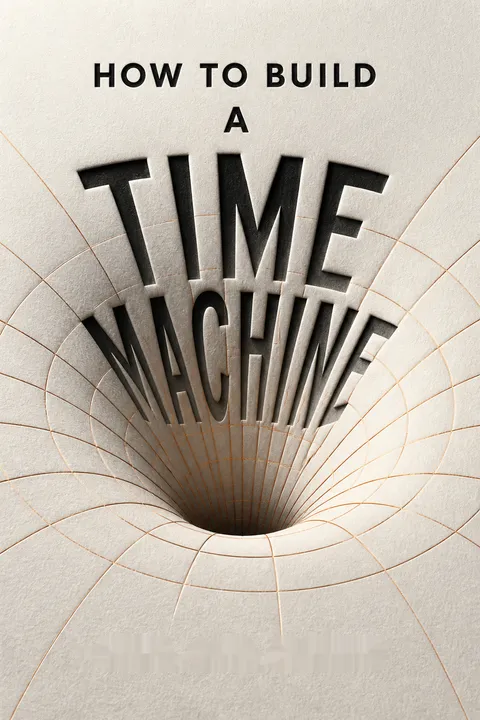
How to Build a Time Machine explores the theoretical possibilities of time travel through physics concepts like wormholes and relativity. Readers appreciate Davies' clear explanations of complex ideas, though some find parts confusing. The book discusses both forward and backward time travel, addressing paradoxes and technological challenges. While not a practical guide, it offers an accessible introduction to the science behind time travel. Reviews are generally positive, praising Davies' writing style and the book's thought-provoking content, though some note it doesn't add much new to the topic.
Glossary
time dilation effect
motion slows elapsed timeThe difference in elapsed time measured by observers whose motion differs. In special relativity, a rapidly moving clock accumulates less time than a clock at rest relative to the observer making the comparison. The effect has been measured with precise clocks and grows substantially as speed approaches the speed of light.
closed timelike curve
a path looping into its pastA possible path through spacetime that returns to an event in its own past. Some mathematical solutions of general relativity permit such paths, which would allow backward time travel. Their existence in equations does not show that nature can create the required conditions or that a traveler could safely follow the path.
wormhole
a tunnel through spacetimeA hypothetical connection between distant regions of spacetime. In the book's proposed time machine, one mouth of a wormhole could be made to age differently from the other, creating a time difference between its ends. Many wormhole solutions are not traversable, and a stable passage may require negative energy.
negative energy
energy below a vacuum referenceA quantum state whose energy is lower than that assigned to a chosen reference vacuum. In the book's wormhole proposal, negative energy could produce a repulsive gravitational effect that counteracts the collapse of the throat. The Casimir effect provides a small physical example, but not the enormous supply a macroscopic wormhole might require.
spacetime foam
quantum-scale spacetime fluctuationsJohn Wheeler's name for the proposed chaotic structure of spacetime at extremely small, Planck-scale distances. Quantum uncertainty could make space fluctuate into temporary structures, including virtual wormholes. Davies describes an advanced civilization harvesting and enlarging one as a speculative route to creating a permanent wormhole.
chronology horizon
boundary where time loops beginThe boundary between ordinary spacetime and a region where paths through time can loop back into the past. The book discusses a proposed instability near this boundary: quantum particles may circulate along nearly closed paths, increasing their energy and producing gravitational effects that could disrupt a time machine.
chronology protection conjecture
nature prevents travel into the pastStephen Hawking's conjecture that physical laws prevent the formation of conditions that permit backward time travel. One proposed explanation is that quantum effects near a chronology horizon become large enough to destroy a would-be time machine. The conjecture is not a proved theorem, and its proposed mechanisms remain uncertain.
many-universes interpretation of quantum mechanics
all quantum outcomes are realAn interpretation of quantum mechanics in which alternative outcomes of quantum events occur in different branches of reality rather than only one outcome becoming actual. In time-travel discussions, separate branches can allow a traveler to alter one history without erasing the history from which the traveler came. The interpretation is debated and does not establish that time travel occurs.
Hafele-Keating experiment
airborne atomic clock comparisonA 1971 experiment in which physicists Joe Hafele and Richard Keating flew accurate atomic clocks around the world and compared them with clocks kept on the ground. The airborne clocks ended up 59 nanoseconds behind the ground clocks, in agreement with the relativistic prediction for the experiment. It provided a direct measurement of differences in elapsed time.
FAQ
What's "How to Build a Time Machine" by Paul C.W. Davies about?
- Exploration of Time Travel: The book delves into the scientific possibilities of time travel, examining both theoretical and practical aspects.
- Scientific Theories: It discusses key scientific theories, including Einstein's theory of relativity, and how they relate to the concept of time travel.
- Wormholes and Black Holes: The book explores the role of wormholes and black holes as potential gateways for time travel.
- Philosophical and Paradoxical Implications: It also addresses the philosophical questions and paradoxes that arise from the concept of traveling through time.
Why should I read "How to Build a Time Machine"?
- Scientific Insight: Gain a deeper understanding of complex scientific theories related to time and space.
- Engaging Exploration: The book offers an engaging exploration of a topic that has fascinated both scientists and science fiction enthusiasts.
- Thought-Provoking Questions: It raises thought-provoking questions about the nature of time and reality.
- Interdisciplinary Approach: The book combines physics, philosophy, and science fiction, appealing to a wide range of interests.
What are the key takeaways of "How to Build a Time Machine"?
- Time is Elastic: Time can be stretched and shrunk, depending on speed and gravity, as explained by Einstein's theory of relativity.
- Wormholes as Time Machines: Wormholes could theoretically be used as time machines, allowing travel between different points in time.
- Paradoxes and Challenges: Time travel presents numerous paradoxes and challenges, such as the potential for causal loops and the need for exotic matter.
- Scientific and Philosophical Implications: The book highlights the scientific and philosophical implications of time travel, encouraging readers to think critically about the nature of time.
What are the best quotes from "How to Build a Time Machine" and what do they mean?
- "Time is elastic." This quote encapsulates the idea that time is not fixed and can be altered by speed and gravity, challenging our traditional understanding of time.
- "The universe is not only queerer than we think, it is queerer than we can think." This quote, borrowed from J.B.S. Haldane, suggests that the universe's complexities may be beyond human comprehension.
- "Let there be no naked singularities!" This quote refers to Roger Penrose's cosmic censorship hypothesis, which posits that singularities should not be exposed to the universe, maintaining cosmic order.
- "Making the universe safe for historians." This quote from Stephen Hawking's chronology protection conjecture humorously suggests that time travel should not disrupt historical events.
How does Paul C.W. Davies explain time travel in "How to Build a Time Machine"?
- Relativity and Time Dilation: Davies explains how Einstein's theory of relativity allows for time dilation, where time can slow down or speed up depending on speed and gravity.
- Wormholes as Shortcuts: He discusses the concept of wormholes as potential shortcuts through space-time, which could theoretically allow for time travel.
- Exotic Matter and Antigravity: The book explores the need for exotic matter with negative energy to stabilize wormholes and make time travel feasible.
- Paradoxes and Consistency: Davies addresses the paradoxes of time travel, such as causal loops, and the need for self-consistent histories.
What is the significance of wormholes in "How to Build a Time Machine"?
- Potential Time Machines: Wormholes are presented as potential time machines that could connect different points in time and space.
- Stabilization with Exotic Matter: The book explains that wormholes would require exotic matter with negative energy to remain open and traversable.
- Connection to Black Holes: Wormholes are related to black holes, as both involve extreme gravitational effects and space-time curvature.
- Scientific and Fictional Interest: Wormholes have captured the imagination of both scientists and science fiction writers as a means of achieving time travel.
How does "How to Build a Time Machine" address time travel paradoxes?
- Causal Loops: The book discusses causal loops, where events in the past and future are interconnected, potentially leading to paradoxes.
- Self-Consistency Principle: Davies explores the idea that time travel must adhere to a self-consistency principle, where actions in the past do not create contradictions.
- Parallel Universes: The concept of parallel universes is considered as a possible solution to time travel paradoxes, allowing for multiple realities.
- Philosophical Implications: The book delves into the philosophical implications of time travel paradoxes, questioning the nature of free will and causality.
What role does Einstein's theory of relativity play in "How to Build a Time Machine"?
- Foundation for Time Travel: Einstein's theory of relativity provides the scientific foundation for the possibility of time travel, particularly through time dilation.
- Elastic Nature of Time: The theory introduces the concept of time as elastic, capable of being stretched or shrunk by speed and gravity.
- Light Barrier: Relativity establishes the light barrier, which cannot be crossed by ordinary matter, but suggests that wormholes might offer a way around it.
- Impact on Space-Time: The theory's impact on our understanding of space-time is crucial for exploring the potential of wormholes and black holes as time travel mechanisms.
How does "How to Build a Time Machine" explore the concept of negative energy?
- Antigravity and Stabilization: Negative energy is essential for creating antigravity effects needed to stabilize wormholes for time travel.
- Casimir Effect: The book discusses the Casimir effect as a method of generating negative energy through quantum vacuum fluctuations.
- Exotic Matter: Negative energy is associated with exotic matter, which is theorized to have properties that could counteract gravitational collapse.
- Challenges and Possibilities: While negative energy presents challenges, it also opens possibilities for advanced technologies and time travel.
What are the scientific challenges of building a time machine according to "How to Build a Time Machine"?
- Energy Requirements: The energy required to create and stabilize a wormhole is immense, posing a significant challenge to current technology.
- Exotic Matter: The need for exotic matter with negative energy is a major hurdle, as it has not been observed in large quantities.
- Quantum Effects: Quantum effects, such as the behavior of the quantum vacuum near a wormhole, could disrupt time travel attempts.
- Chronology Protection: The possibility of a chronology protection mechanism, as suggested by Stephen Hawking, could prevent time travel from being realized.
How does "How to Build a Time Machine" relate to science fiction?
- Inspiration from Fiction: The book draws inspiration from science fiction, using concepts like wormholes and time machines that are popular in the genre.
- Scientific Basis for Fictional Ideas: It provides a scientific basis for ideas often explored in science fiction, such as faster-than-light travel and parallel universes.
- Exploration of Paradoxes: The book explores paradoxes commonly found in science fiction, such as changing the past and meeting one's younger self.
- Interdisciplinary Appeal: By bridging science and fiction, the book appeals to readers interested in both scientific inquiry and imaginative storytelling.
What philosophical questions does "How to Build a Time Machine" raise?
- Nature of Time: The book raises questions about the nature of time, including whether the past, present, and future are equally real.
- Free Will and Determinism: It explores the implications of time travel for free will and determinism, questioning whether actions in the past can be changed.
- Causality and Reality: The book examines the nature of causality and reality, particularly in the context of quantum mechanics and parallel universes.
- Existence of Multiple Realities: The possibility of multiple realities or parallel universes challenges traditional notions of a single, objective reality.
About the Author
Other books by Paul C.W. Davies


Download PDF
Download EPUB
.epub digital book format is ideal for reading ebooks on phones, tablets, and e-readers.








