

Key Takeaways
Treat failure as a map of preventable mistakes, not a verdict.
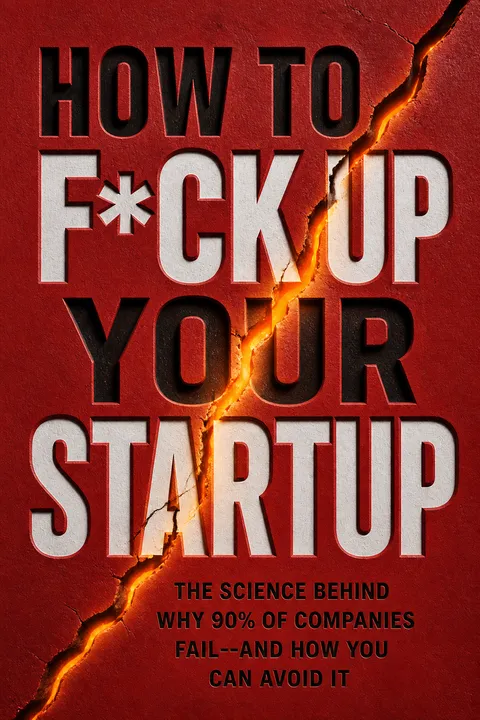
Failure is specific. Kim Hvidkjaer defines a startup “f ckup” as neglecting an action that could have prevented a significant mistake. His own story makes the cost concrete: after reaching millionaire status on paper, he lost much of his wealth during the 2007 to 2009 crash, partly because he had spotted trouble but failed to act. The book draws on his analysis of more than 160,000 failed companies and interviews with founders to identify recurring mistakes.
Survival beats appearances. Startup failure rates vary with industry, geography, and how a startup is defined, so the familiar 90 percent figure is a warning, not a precise forecast. Hvidkjaer’s Rule Zero of Startups is to keep the company alive long enough to learn. That means studying failures, acknowledging problems early, and correcting course instead of protecting a “crushing it” image.
The useful shift is from failure as a character judgment to failure as an observable process. That resembles safety engineering, where investigators look for interacting system weaknesses rather than blaming a single operator. The approach is especially valuable because startup culture rewards confident success stories, which can hide how many similar bets failed. Still, a large collection of company postmortems does not by itself establish which mistake caused a closure. The book is strongest as a diagnostic guide: it helps founders ask sharper questions, while leaving room to test whether a warning applies to their particular market.
Choose work you can endure, then stop scattering your attention.
Interest fuels endurance. Passion alone cannot make a business viable, but founders need enough sustained curiosity to learn an industry and stay engaged when work becomes difficult. NewsTilt, a journalism platform backed by Y Combinator, closed within months. Co-founder Paul Biggar later acknowledged that he and his partner did not care deeply about journalism or spend much time understanding it. By contrast, being passionate about a crowded market is not proof of opportunity: designer Don Charlton pursued content management systems despite hundreds of competitors.
Protect your scarce focus. Hvidkjaer’s Toilet Test asks whether a startup idea regularly occupies the founder’s thoughts. It can expose a passing whim, but it is a personal screen, not market validation. His own plate-spinning across ventures contributed to neglecting important work. Biggar was also finishing a PhD, preparing a wedding, and launching NewsTilt at once. A not-to-do list, experienced mentors, and complementary partners can help keep ambition from becoming fragmentation.
This advice connects motivation to attention, two resources that are easy to confuse with enthusiasm. Deep familiarity can make customer needs legible, while a crowded calendar prevents even a strong idea from receiving sustained execution. The useful nuance is that passion should be a source of energy, not a substitute for evidence. A founder can love a field and still mistake personal fascination for a paying market. The Toilet Test is memorable precisely because it is simple, but its frequency criterion may favor obsessive thinking over considered judgment. It works best as a prompt for reflection, followed by customer conversations.
Prove customers have a painful problem before building your clever solution.
Start with the pain. The Business Model Canvas is a one-page map of how a company creates and earns value, including its customers, offer, costs, and revenue. Hvidkjaer urges founders to use it to expose weak assumptions before committing heavily. A Tier 1 problem, in the book’s terminology, is painful enough that customers will prioritize solving it and pay for help. Teaforia’s Wi-Fi tea maker cost about $1,000 but did not brew better tea than a kettle. Juicero’s expensive machine pressed juice pouches that customers could squeeze by hand.
Test before scaling. Ask potential customers what they currently do, what frustrates them, and whether they have a budget for a better option. Then test a Minimal Viable Product, a usable early version with only essential features, and learn from real users. The MoSCoW Method sorts features into must-have, should-have, could-have, and not-now categories. Testing should have deadlines: endless research can become another way to avoid discovering that the idea needs work.
This is the entrepreneurial version of falsifiability: a business idea should expose itself to evidence that could prove it wrong. Customer interviews and early prototypes make assumptions visible while they are still cheap to change. The distinction between an irritating inconvenience and an urgent problem is particularly useful because novelty can seduce builders into inventing demand. Yet stated interest is not the same as purchase behavior. A prototype that attracts praise may still lack viable pricing, repeat use, or distribution. The strongest test therefore combines what customers say with what they actually try, pay for, and return to.
Build a business that can survive without one customer, platform, or funding round.
Reduce single points of failure. A Single Point of Failure is one dependency whose loss can cripple the whole company. Shockwaved relied on advertising agencies to reach brands; when the agency market weakened, the company had few alternative routes to clients. Lookery depended on Facebook’s platform and struggled when Facebook changed its design. Founders should examine dependence on major customers, suppliers, platforms, and partners, then create alternatives where practical.
Make money legible. Funding is not evidence that customers want the product. Pearl Automation raised $50 million but struggled to sell an expensive rear-view camera. Hvidkjaer recommends tracking fixed and variable costs, customer acquisition costs, churn, and runway, while bringing in competent accounting help. A cap table records ownership and dilution across funding rounds; founders need to understand it before signing. Bootstrapping can preserve control and force cost discipline, although outside capital may be necessary when it supports demonstrated demand or sound expansion.
Resilience here is a portfolio problem: a company is safer when revenue, distribution, and knowledge do not all hinge on one relationship. The idea resembles redundancy in infrastructure, where backup capacity can prevent a local disruption from becoming a system-wide failure. Funding discipline complements that design because money can postpone, rather than resolve, a weak business model. There is a tradeoff, however. Diversification can dilute focus, and bootstrapping can constrain investment in markets where speed matters. The practical goal is not independence from every partner or investor. It is knowing which dependency would be fatal and having a credible response.
Make one valuable product better through small releases, not grand reveals.
Name the actual product. FNAC means Feature, Not A Company: a set of attractive functions that still lacks a sustainable business. WeWork described itself as a technology company, although its core offer was shared office space. The distinction matters because investors and customers judge the economics of the real product, not its branding. Simplicity can reveal what users value. Burbn began as a crowded app with many features; its founders narrowed it to mobile photo sharing and relaunched it as Instagram.
Release in learning loops. Moz founder Rand Fishkin pushed for a large launch of a complex analytics suite, despite concerns about its scope. The release disappointed customers and consumed development resources. Smaller, regular releases let a company learn without staking as much on a single launch. Outsourcing can help with non-core work, but handing off the core product without the expertise to manage it makes feedback and changes costly. Borrow proven tools and practices, but adapt them to the company’s needs.
The principle aligns product development with evolutionary learning: small experiments preserve the ability to revise a design as evidence accumulates. A large launch can create a high-stakes moment in which internal momentum outruns customer understanding. The FNAC warning also clarifies why feature lists and impressive demonstrations are weak proxies for a company: they omit willingness to pay, repeat use, and delivery costs. There are cases where a coordinated launch matters, especially when network effects or regulation shape adoption. Even then, staged testing can reduce uncertainty about usability, reliability, and operational readiness before the full commitment.
Keep sales running when delivery gets busy; revenue is evidence, not vanity.
Sales cannot be occasional. When the dot-com bubble burst, Shockwaved lost work from agency clients. Hvidkjaer had no structured sales process and had stopped prospecting while busy delivering projects. The result was a sudden revenue gap. A sales funnel tracks how potential customers move from first contact toward purchase; a customer relationship management system records interactions, follow-ups, and opportunities. Together, they make it less likely that leads disappear when the founder gets distracted.
Measure meaningful movement. Track conversion at each stage, sales-cycle length, customer acquisition cost, repeat purchases, and churn. A full calendar or high website traffic can feel encouraging without paying the bills. Sales also tests product-market fit: whether a specific group values the offer enough to buy it. Avoid custom work that turns every sale into a different product, and price to cover real costs while matching how customers perceive value. Revenue need not arrive immediately, but a credible path to it matters from the start.
A sales system is organizational memory. It protects customer commitments from the limits of any one founder’s attention and turns scattered conversations into a process that can be inspected and improved. This fits a broader feedback principle: revenue is not merely an accounting result but evidence about whether an offer meets a need at a viable price. However, not all revenue is healthy. One-off custom contracts can distort a product, and a sale acquired at a loss may worsen the business. The relevant question is not simply whether customers pay, but whether repeatable sales contribute to sustainable economics.
Build a team whose skills, incentives, and accountability fit the company.
Match people to the work. A founding team should combine complementary abilities and shared direction, rather than simply collect impressive résumés. Vitoto, a mobile video startup, assembled an expensive senior team whose needs exceeded its resources. Hvidkjaer’s own administrative oversight failed when he left company finances to a partner who was not equipped to manage them. A co-founder can provide challenge and accountability, but choosing the wrong one may be worse than operating alone. Work together before committing, clarify responsibilities, and agree on goals.
Build the organization deliberately. Hire for the company’s actual needs, establish clear ownership of outcomes, and measure commitments without burying a small team in process. Diverse perspectives can reveal blind spots that a homogeneous team misses, as the backlash against Pinky Gloves illustrated: its male founders built a product for menstruating women without adequately consulting them. Founders should also be willing to reconsider their own role. A company’s needs change as it grows, and the best early CEO may not be the best leader at every stage.
Team design is not just a question of talent; it is a question of fit between capabilities, incentives, and the task at hand. This is why diversity can improve more than representation: varied lived experience can make assumptions visible before a product reaches customers. Yet diversity alone does not guarantee better decisions. Teams need structures that let dissent surface and influence choices, rather than treating difference as a box to check. Accountability matters for the same reason. Clear ownership enables autonomy, while excessive measurement can make creative work brittle. The challenge is to create enough structure for reliability without smothering initiative.
Grow at the pace your customers, cash, and operations can actually support.
Change for a reason. A pivot is a significant shift in a company’s direction. It can rescue a business when evidence shows the current offer is wrong, but a pivot without research can discard what already works. Yelp moved from an email recommendation service toward user reviews after users showed interest. By contrast, Wanful abandoned a personalized gift service for general e-commerce and entered a tougher competitive arena. Before changing direction, test the new offer and check that it still uses strengths the company can execute.
Scale what works. Rapid hiring and complex systems can outrun demand. Zynga hired aggressively, promoted inexperienced managers, and spent heavily on its own data centers, then later closed facilities and cut staff. Supercell moved toward small, independent teams supported by management rather than tightly controlled. Founders should distinguish essential work from distractions, simplify operations, and monitor customer experience as volume rises. Growth is useful only when the business can serve new customers reliably and afford the cost of doing so.
Growth is often treated as proof of success, but it is more accurately a stress test. New customers expose weaknesses in support, hiring, infrastructure, and decision-making that a small operation can conceal. The book’s emphasis on pacing is therefore a form of capacity planning: expand only when the system can absorb the added load. Still, excessive caution can also surrender a market to faster competitors. The right pace depends on the cost of delay, the reversibility of investment, and the evidence of demand. A measured pilot can help distinguish disciplined restraint from fear disguised as prudence.
Forecast several futures, then know when perseverance becomes denial.
Look beyond the next budget. Hvidkjaer’s Provable, Probable, and Possible futures separate what is strongly supported from what is likely and what merely might happen. A modified Johari window sorts risks by whether the company knows about them and understands them. PESTLE prompts review of political, economic, social, technological, legal, and environmental forces. Kodak had invented an early digital camera but remained focused on film as photography changed. Regularly revisiting assumptions can make emerging threats easier to see.
Set conditions for continuing. Persistence matters, but so does deciding when a business no longer merits more time or money. Set measurable goals and deadlines, then assess progress against them rather than relying only on hope or exhaustion. Rovio released dozens of games before Angry Birds became its breakthrough; that story supports patience, not endless spending without evidence. Rule Zero also means protecting the founder: avoid risking everything, take mental health seriously, and remember that a company can end without the person’s life or future ending with it.
Scenario planning is most useful when it keeps options open, not when it pretends to eliminate uncertainty. The three futures encourage founders to distinguish evidence from speculation, while external-environment scanning broadens attention beyond familiar competitors. Kodak illustrates the cost of ignoring a visible technological shift, although hindsight makes the correct choice look clearer than it was at the time. Persistence and quitting require the same discipline: predefined milestones reduce the influence of sunk costs, but rigid thresholds can miss delayed adoption or changing conditions. A periodic review should combine data, judgment, and the founder’s capacity to continue safely.
Analysis
The book’s central contribution is a practical reframing of startup failure. Rather than treating closure as a single event caused by lack of cash, it presents failure as a chain of often preventable omissions: founders neglect customers, postpone sales, overbuild products, accept fragile dependencies, or fail to match resources to growth. Its recurring cases make the chain vivid. Hvidkjaer’s own story, moving from apparent wealth to financial collapse, gives the advice a personal stake and shows why identifying a risk is not enough if no one acts on it.
The structure resembles a field guide more than a single theory. It follows a venture from founder readiness through business design, research, funding, product, organization, sales, and growth, then adds foresight and recovery. This makes the book easy to consult, although its many named mistakes sometimes divide connected problems into separate labels. Poor research, weak product-market fit, and absent sales, for example, can all describe different moments in one failure loop.
The evidence is persuasive as pattern recognition, not as causal proof. The author describes a large, heterogeneous compilation of failed companies and uses many postmortems, but the source text does not provide enough methodological detail to determine how cases were selected, how failure was defined, or whether each error was more common than comparable success practices. The widely repeated 90 percent rate is also explicitly variable across places, sectors, and time periods. Anecdotes illuminate mechanisms, but famous companies can make lessons seem more general than they are.
The most productive reading is therefore operational rather than predictive. Use the book to generate questions, build cheap tests, track customer behavior, and set decision deadlines. Its strongest tension is between moving quickly and avoiding premature commitment. That tension is not a flaw to erase. It is the central managerial problem: learn fast, preserve room to adapt, and avoid betting the company on assumptions that have not met reality.
Review Summary
How to F*ck Up Your Startup receives overwhelmingly positive reviews, with readers praising its practical advice and unique approach to entrepreneurship. Many appreciate the author's focus on common mistakes and how to avoid them. Readers find the book insightful, motivational, and a valuable resource for both aspiring and experienced entrepreneurs. Some reviewers note that the content is sometimes tech-industry focused, but still applicable to various business types. A few critics mention that certain sections are high-level or could benefit from more depth, but overall, the book is highly recommended for its actionable insights and engaging style.
People Also Read




Glossary
Rule Zero of Startups
Protect the venture’s survivalHvidkjaer’s highest-priority startup principle is to keep the company alive long enough to learn and respond. It does not mean continuing at any cost. It means managing cash, risk, and personal strain so that preventable mistakes do not end the venture before its core assumptions have been tested.
f*ckup
Preventable neglect with consequencesThe book uses this term for a significant mistake caused by neglecting an action that could have prevented it. It distinguishes avoidable errors from ordinary imperfections and unforeseeable bad luck. A company’s collapse may result from several such omissions combining, rather than from one isolated decision.
Toilet Test
Screen for persistent founder interestA personal test for whether a startup idea holds a founder’s attention consistently. The founder asks whether the idea returns to mind throughout ordinary days, rather than appearing as a passing thought. The test is meant to filter fleeting ideas, not to prove that customers need the product or that the business can make money.
Business Model Canvas
Map how a business creates valueA visual, single-page planning tool for laying out a company’s essential business logic. It connects the value offered and customer groups with channels, relationships, revenue, activities, resources, partners, and costs. The book recommends using it early to reveal gaps and revise assumptions before investing in a lengthy plan.
Tier 1 problem
A problem customers will pay to solveA problem serious enough that the intended customers care about resolving it and are willing to devote money or effort to a solution. The book contrasts urgent pain with a minor inconvenience. Founders are encouraged to verify both the problem’s importance and the existence of a budget before building a product.
Minimal Viable Product (MVP)
A testable early productA version of a product with enough functionality to be used or tested by its intended customers. Its purpose is to gather feedback and assess whether the core idea has value before a larger launch. The book warns against both skipping this step and delaying indefinitely while trying to perfect the product.
MoSCoW Method
Prioritize product featuresA feature-prioritization method that groups proposed functions into must-have, should-have, could-have, and will-not-have categories. The book applies it to MVP development, helping teams focus limited time on essential functionality and defer attractive but nonessential additions.
Single Point of Failure (SPOF)
One dependency that can halt operationsA person, platform, customer, supplier, or system whose failure could disrupt the entire company. The book applies the idea to startups dependent on one distribution platform or client, and to organizations lacking oversight over a powerful individual. Identifying a SPOF helps founders decide where to create alternatives or safeguards.
Feature, Not A Company (FNAC)
A feature without a viable businessA startup idea that may offer an appealing function or customer experience but does not yet amount to a sustainable company. The concept asks whether the offering can generate enough value and revenue to support an independent business. It also cautions against confusing a product, marketing campaign, or brand experience with the business itself.
Ground Zero Exercise
Rebuild the ideal organization on paperA periodic review in which a founder imagines restarting the company with its current resources but without its existing staff. The founder identifies the roles needed now, compares that ideal structure with the actual team, and considers hiring or role changes. The exercise is designed to reveal missing or redundant capacity.
Provable, Probable, Possible futures
Sort forecasts by confidenceA framework for considering futures in increasing order of uncertainty. Provable futures are strongly supported by current evidence, probable futures are likely given what is known, and possible futures might occur but have weaker support. The book recommends starting with the most certain conditions and reasoning outward rather than beginning with speculation.
Johari window
Sort knowns and unknownsA framework originally developed to describe awareness between people and adapted in the book to examine business risks. It distinguishes what is known and understood, known but not understood, understood but not recognized, and neither known nor understood. The categories help teams identify blind spots while accepting that some uncertainty remains.
PESTLE
Scan the external business environmentA framework for reviewing political, economic, social, technological, legal, and environmental forces that may affect a company. The book uses it as a structured prompt for future planning, helping founders look beyond immediate customers and competitors. It is intended to support practical forecasting, not endless analysis.
FAQ
What's How to Fck Up Your Startup* about?
- Focus on Failures: The book delves into why 90% of startups fail, offering insights on avoiding these pitfalls.
- Practical Guidance: Kim Hvidkjaer provides actionable advice based on research and personal experiences in the startup world.
- Real-World Examples: It uses case studies of failed startups to illustrate common mistakes, making the content relatable and applicable.
Why should I read How to Fck Up Your Startup*?
- Learn from Mistakes: The book encourages viewing failures as learning opportunities, fostering resilience and adaptability.
- Comprehensive Coverage: It covers a wide range of topics, from attitude to funding, ensuring a well-rounded understanding of startup challenges.
- Engaging Style: Hvidkjaer’s humorous and thought-provoking writing makes complex concepts accessible and engaging.
What are the key takeaways of How to Fck Up Your Startup*?
- Embrace Failure: Failure is an inevitable part of entrepreneurship, and analyzing it can lead to better decision-making.
- Customer Focus: Knowing and engaging with customers early can shape your product and ensure market fit.
- Simplicity is Key: Avoid overcomplicating your business model; a straightforward approach resonates better with customers and investors.
What are the best quotes from How to Fck Up Your Startup* and what do they mean?
- "Don’t die.": Emphasizes the importance of survival and well-being in the startup journey.
- "You have more startups in you.": Encourages resilience and the belief in starting anew with lessons learned.
- "Make haste slowly.": Advises against rushing growth, focusing instead on strategic and sustainable planning.
What are some common fckups discussed in How to Fck Up Your Startup?
- Attitude F*ckups: Includes issues like impostor syndrome and lone-wolf syndrome, which can hinder startup growth.
- Business Model F*ckups: Discusses poor planning and entering unsuitable industries, leading to a lack of direction.
- Funding F*ckups: Highlights dangers like getting funded too early and poor budgeting, crucial for startup survival.
What is the FNAC concept in How to Fck Up Your Startup*?
- Feature, Not a Company: Refers to startups focusing on a single feature rather than a sustainable business model.
- Value Importance: Startups must provide real value to succeed, avoiding being seen as just a feature.
- Avoiding FNAC: Ensure a robust business model that generates revenue, differentiating from competitors.
How does How to Fck Up Your Startup* define a f*ckup?
- Neglect of Action: Defined as neglect leading to significant, preventable mistakes, highlighting proactive decision-making.
- Cumulative Nature: Multiple f*ckups often combine to cause a startup's downfall, requiring early recognition and action.
- Learning Opportunity: Encourages viewing f*ckups as learning opportunities, fostering resilience and adaptability.
What is the Toilet Test mentioned in How to Fck Up Your Startup*?
- Idea Assessment: Evaluates if a startup idea is worth pursuing based on how often it occupies your thoughts.
- Daily Reflection: Frequent thoughts about the idea indicate strong passion and commitment.
- Encouraging Action: Motivates entrepreneurs to act on ideas rather than letting them stagnate.
How does How to Fck Up Your Startup* suggest handling impostor syndrome?
- Recognizing Doubt: Acknowledging self-doubt is the first step toward overcoming impostor syndrome.
- Positive Mindset: Adopting a positive mindset and affirming capabilities can build confidence.
- Celebrate Victories: Celebrating achievements, big or small, helps combat feelings of inadequacy.
What is the significance of market research in How to Fck Up Your Startup*?
- Foundation for Success: Market research is critical for understanding the market landscape and making informed decisions.
- Avoiding Pitfalls: Awareness of pitfalls like doppelganger danger helps navigate the market effectively.
- Customer-Centric Approach: Engaging with customers to validate ideas ensures market fit and refines offerings.
What specific methods does How to Fck Up Your Startup* recommend for avoiding common pitfalls?
- 80 Percent = 100 Percent Rule: Being 80% satisfied with decisions prevents analysis paralysis and encourages timely action.
- Ground Zero Exercise: Imagining firing everyone to reassess necessary roles helps align the team with company goals.
- PESTLE Framework: Evaluates external factors impacting the business, aiding in strategic planning and predictions.
How can I apply the lessons from How to Fck Up Your Startup* to my own business?
- Conduct Regular Reviews: Routine evaluations of strategies and outcomes help identify improvement areas.
- Prioritize Customer Feedback: Incorporating feedback into product development ensures resonance with the target market.
- Embrace a Growth Mindset: Viewing failures as growth opportunities encourages calculated risks and learning.
Download PDF
Download EPUB
.epub digital book format is ideal for reading ebooks on phones, tablets, and e-readers.








