

Key Takeaways
Persuasion works by activating motives people already have, not overriding them.
Start with the motive. Weinschenk organizes persuasion around seven drivers: belonging, habits, personal stories, rewards, instincts, mastery, and mental shortcuts. The point is not to apply every tactic at once. It is to identify what matters to the person, then shape the request and its setting to fit. A team may respond to shared identity; a learner may care more about mastering a skill than earning a prize; someone facing a simple choice may follow a familiar cue without much thought.
Influence has limits. The book argues that people cannot simply be made to act against every desire or value. Persuasion can make an action more appealing or easier to begin, but it does not give the persuader control. Weinschenk’s ethical boundary is practical: present an offer honestly, connect it to real needs, and do not deceive people or encourage harm.
The useful shift is from asking, “How can this person be pushed?” to asking, “What would make this action meaningful or easy for this person?” That framing helps managers, teachers, and designers build conditions for choice rather than merely apply pressure. It also invites a necessary test: whose goal does the tactic serve? A method that increases action is not automatically beneficial. The book’s emphasis on honest fit provides a standard for distinguishing helpful persuasion from exploitation, though real situations often require more than the persuader’s own judgment of what counts as helpful.
Make the requested action feel like membership, not a chore.
Identity changes effort. The need to belong can make even a modest connection motivating. In research discussed by the book, students who believed they shared a birthday with a partner worked harder together. Words can cue this group identity: asking whether someone wants to be “a voter” frames voting as part of who they are, rather than a one-time task. Showing accurate evidence that other people already do the behavior can also help, especially when people are unsure what to do.
Connection is social proof. Shared activity, visible enthusiasm, and a trusted or familiar person making the request can build rapport. But social proof can misfire: telling new students that many peers violate alcohol rules may make the behavior seem normal. The book also reports that competition can motivate more when the field is small, while its broad claims about gender and competition should be treated cautiously.
Belonging is more than a pleasant extra. It can change how people interpret an action: participation becomes evidence that they are part of a valued group. That is why a well-chosen identity cue or an honest peer comparison can outperform a lecture about individual responsibility. The danger is that group norms can reinforce harmful conduct as easily as helpful conduct. Social proof should therefore describe the norm an organization wants to strengthen, and the evidence should be accurate. Identity language is most constructive when it offers people a genuine community, not a label they are pressured to accept.
Attach small behaviors to existing cues until they run without deliberation.
Use the habit loop. A habit is an automatic routine linked to a cue and a reward. To encourage a new behavior, find a dependable cue, make the routine small, and provide a reason to repeat it. Weinschenk describes using an existing morning medication routine as an anchor for drinking water. The medication already happened reliably, so the added behavior had a natural prompt.
Reduce decisions at the start. Her Couch to 5K example illustrates three supports: gradual increases in difficulty, few decisions once the session begins, and visible progress. The app supplied instructions and showed how far the runner had come. These conditions helped a new activity become easier to repeat. The book also cites research finding that habit formation averaged 66 days, with a wide range; a tiny routine may take hold quickly, but that is not a promise that complex behaviors change in a week.
Anchoring a behavior to an established routine is a way of borrowing reliability from something already in place. It is especially useful when the target action is concrete and repeatable. The approach also clarifies why vague intentions often fail: they require people to remember and decide at the moment of action. Still, an anchor cannot solve every obstacle. If the routine is unpleasant, inaccessible, or too large, a prompt alone will not make it sustainable. Progress displays and reduced choices help, but the person’s willingness and circumstances remain central.
Change behavior by giving people a story they can live consistently.
Self-stories guide choices. People often act in ways that fit their understanding of who they are. Weinschenk tells how she had built an identity around being strong enough to manage crises. During a difficult period, she revised that story to include asking others for help. When she told a colleague what was wrong, the colleague offered a room and practical support. The changed self-description opened the way to different actions.
Start with a small step. In a study described by Timothy Wilson, struggling students heard older students explain how early academic problems improved with effort and help. After about 30 minutes of these stories, students earned better grades the following year and were less likely to leave college. Small commitments can also help people build a related identity: a modest public action may make a larger action feel consistent. Writing a commitment by hand can strengthen that sense of ownership.
Stories make abstract change personally imaginable. A statistic can describe improvement; a peer’s account can suggest, “Someone like me can recover from this setback.” That difference matters in education, health, and organizational change, where identity can either trap people in a pattern or make a new response seem plausible. The approach works best when the story leaves room for agency rather than prescribing a personality. There is also a boundary: a persuasive narrative should not imply that structural obstacles disappear if someone simply adopts a better self-story.
Match rewards to the behavior, then change the schedule deliberately.
Rewards shape repetition. A reinforcement is anything that increases a behavior for a particular person. The book distinguishes several schedules. Rewarding every successful attempt can help establish a new behavior, but stopping that reward may cause the behavior to fade. Variable rewards, delivered unpredictably after different numbers of actions, can keep a behavior going; this is the principle behind slot machines. Variable time-based checks can encourage steady behavior without demanding constant action. Fixed rewards after a set number of actions often create a burst, followed by a lull.
Timing and fit matter. A reward only works if the recipient values it, and it should follow the behavior closely enough to be connected to it. Punishment is different from negative reinforcement: punishment aims to reduce a behavior, while negative reinforcement increases behavior by removing something unpleasant. A daycare that charged parents for late pickups saw lateness increase, apparently because the fee made it feel like a paid service rather than a burden on staff.
The strongest practical lesson is diagnostic: a reward is not inherently motivating, and the same reward can mean different things to different people. Reinforcement can be effective for routine tasks or short-term behavior, but it may not create genuine interest in complex work. The daycare example also shows how incentives can redefine a social situation. Before adding a penalty or prize, it is worth asking what meaning the arrangement communicates, and whether it supports the desired behavior after the incentive is gone.
Use loss and scarcity carefully because they seize attention faster than gains.
Threats grab the old brain. The book describes people as especially alert to danger and potential loss. In a card experiment, participants’ bodies reacted to risky decks before they could explain why those decks were disadvantageous. The lesson is that people may sense a problem before they can articulate it. Messages about illness or danger can also prompt immediate action, while fear of losing something already experienced can make people reluctant to give it up.
Scarcity raises perceived value. In one cookie study, people rated identical cookies as better when only a few remained, especially when a fuller supply had just dwindled. Limited quantities and deadlines can therefore increase urgency, but they can also create pressure. The book notes that fear-based messages may strengthen loyalty to one’s own group while reducing sympathy for outsiders. A good mood and a sense of safety, by contrast, can help people consider something unfamiliar.
Loss framing explains why “avoid this harm” can move people more quickly than “gain this benefit.” It is useful in public health or safety communication when the risk is real and the audience needs to act. Scarcity can likewise help people notice a genuine constraint. Yet these mechanisms are easy to abuse: manufactured urgency can crowd out deliberation, and fear can narrow concern to one’s own group. Responsible use requires truthful stakes, a clear action people can take, and enough context to prevent alarm from substituting for understanding.
For difficult work, build mastery through autonomy, challenge, and useful feedback.
Make progress rewarding. Mastery is the internal drive to improve a skill or understand something better. It is especially useful when a task requires learning, not just routine compliance. In a study discussed in the book, children who expected a certificate for drawing later drew less than children who received an unexpected certificate or none at all. The point is not that rewards always fail, but that an expected reward can shift attention away from the activity itself.
Set the right conditions. A task should be challenging enough to engage people, but not so difficult that progress seems impossible. Give them some control over how they work, allow mistakes, and offer clear, concise feedback that explains what to adjust. A flow state, in which attention is absorbed by a task, is more likely when the goal is clear, feedback is available, and interruptions are limited.
Mastery offers a stronger basis for sustained effort than external prizes when the work itself involves learning. Autonomy matters because motivation cannot be fully outsourced to a supervisor; people need room to take ownership of the route. The distinction between helpful struggle and pointless obstruction is crucial. Difficulty supports mastery only when people can see a path to improvement and receive useful feedback. Otherwise, what looks like a motivating challenge from the outside may simply feel like a setup for failure.
Shape the first impression, because fast thinking fills gaps with shortcuts.
Fast thinking is the default. Weinschenk draws on the distinction between automatic, intuitive thinking and slower, effortful analysis. The automatic system is useful, but it can leap to a wrong answer or invent a tidy cause-and-effect story. A clear, coherent message makes quick understanding easier. An unexpected detail or a harder problem can prompt more careful thought, although friction should serve a purpose rather than merely confuse.
First numbers matter. In one classic estimate, people who saw a multiplication problem starting with larger numbers gave a much higher average estimate than people who saw the same numbers in reverse order. This is anchoring: an initial value influences later judgment, even when it is arbitrary. Familiar wording, metaphors, and simple names can also shape impressions. For example, describing crime as a “beast” rather than a “virus” changed the kinds of solutions people proposed, even though the statistics were the same.
These shortcuts matter because presentation is not a neutral wrapper around information. Order, metaphor, and ease of processing can change what feels plausible before a person has examined the evidence. That insight can improve communication, but it also places a responsibility on the communicator to avoid smuggling a conclusion into the frame. Simplicity is useful when a quick decision is appropriate; consequential choices deserve conditions that let people inspect assumptions and compare alternatives.
Design requests for limited attention, memory, and immediate action.
Make the next step easy to remember. The book describes working memory as limited and vulnerable to stress and distraction. Repetition, concrete language, and connecting new information to something familiar can help it stick. People are also more likely to remember material at the beginning or end of an event than in the middle. Weinschenk recommends keeping demanding presentations in short sections, with breaks, rather than assuming an audience can concentrate indefinitely.
Catch the moment of intent. A request that requires many steps can lose someone who is ready to act now. The author describes donating to a podcast after hearing a simple text-to-donate instruction while jogging. A clear, quick action converted an impulse into behavior. Small prompts can also help people refocus, while unstructured breaks may give the mind room to make new connections.
A well-designed request respects the gap between wanting to act and actually doing so. Reducing steps, making instructions concrete, and repeating key information can improve both follow-through and learning. The same design principle applies to meetings, forms, and public services: memory failures are often treated as personal shortcomings when the process itself is demanding. However, urgency should not become a pretext for hiding consequences. A frictionless path is valuable when the choice is informed and genuinely voluntary.
Diagnose the person and the time horizon before combining persuasion tactics.
Fit beats piling on. Weinschenk’s case studies show why the same goal may call for different drivers. To encourage checklist use, a team might attach the checklist to an existing packing routine, present it as a shared responsibility, and connect it to the team’s identity as careful workers. To encourage recycling, a city might make bins easy to distinguish, report accurate neighborhood participation, and link the new routine to an existing habit.
Choose for the outcome. The book distinguishes quick, automatic responses from longer-lasting change. Instincts, rewards, and mental shortcuts can move a person quickly; stories, belonging, mastery, and habits can support more durable change. The best approach depends on the audience, the action, and what stands in the way. Understanding someone’s existing habits and self-image matters more than assuming that a technique works equally well for everyone.
The case studies turn the book’s catalog of tactics into a method: identify the obstacle, select a relevant motive, and make the action fit its setting. Combining drivers can be powerful when they reinforce one another, such as pairing a team norm with a simple routine. But more tactics do not automatically mean more influence. A crowded intervention can confuse people or make the persuader seem calculating. Careful observation, honest feedback, and a willingness to revise the approach are more valuable than a universal persuasion recipe.
Analysis
Weinschenk’s central contribution is a practical map of motives that are often invisible in everyday persuasion. A request does not meet a blank slate. It meets habits, group loyalties, self-stories, instincts, attention limits, and the person’s desire to become more capable. By arranging research and examples around seven drivers, the book gives readers a diagnostic alternative to the vague instruction to “communicate better.” Its most memorable demonstrations make abstract mechanisms concrete: the birthday connection that changes effort, the cue that turns a tiny behavior into routine, the narrative that gives a struggling student a reason to persist, and the arbitrary number that distorts an estimate.
The book is also most persuasive when it treats influence as design rather than control. A cue can reduce friction; a story can make change imaginable; autonomy can support sustained learning. Those mechanisms do not erase agency, and the ethical discussion rightly distinguishes honest alignment with people’s needs from deception or harm. That distinction matters because many of the same tools can be used to help someone follow through or to exploit a vulnerable moment.
The chief limitation is the temptation to read individual findings as universal rules. The text often translates studies into confident advice, but a result from a particular task, group, or setting does not guarantee the same effect elsewhere. Some claims, especially broad prescriptions about gender and competition, need cautious handling. The framework is best used as a set of hypotheses to test, not a control panel with guaranteed outcomes. Its enduring value lies in prompting better questions: What motive is active? What is making the desired behavior difficult? Does the proposed influence respect the person’s interests? Those questions make persuasion more precise and more humane.
Review Summary
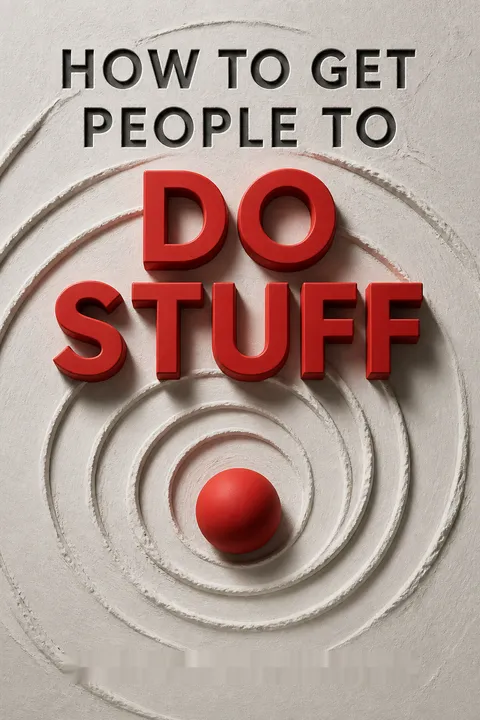
How to Get People to Do Stuff received mixed reviews. Many found it a useful compilation of psychological techniques for influencing behavior, praising its organization and practical examples. Some appreciated its concise overview of various psychological concepts. However, critics felt it oversimplified complex ideas and lacked depth. Some readers expressed ethical concerns about potential manipulation. The book covers seven key motivational drivers, including the need for belonging, habits, storytelling, and mind tricks. Overall, it's seen as a quick reference guide for understanding and applying behavioral psychology principles.
People Also Read









Glossary
Cue → Routine → Reward
Habit formation cycleA model of habitual behavior in which a cue prompts a routine, and a reward reinforces the routine. Repeating the cycle can make the action increasingly automatic. The book uses the model to explain how a new cue and reward can help replace an existing routine, or how a small behavior can be linked to an established habit.
Story editing
Revising a self-narrativeA technique for changing behavior by helping someone revise the story they tell about who they are, why they act as they do, and how they relate to others. The revised narrative can make different choices feel consistent with the person’s identity. The book describes both personal reflection and exposure to other people’s stories as ways to prompt such change.
Story prompting
Offering a new narrativeA method of encouraging someone to form a more useful self-story by exposing them to examples of other people facing a similar situation. Rather than directly instructing the person what to believe, the communicator presents a story that allows the listener to draw parallels. The book describes this approach in an example where students hear how older peers recovered from early academic difficulties.
Variable ratio schedule
Unpredictable action-based rewardsA reinforcement schedule in which a reward follows a changing, unpredictable number of actions. Because the person does not know which action will produce the next reward, the behavior can continue repeatedly and may persist even when rewards stop. The book uses casino slot machines as a familiar example of this schedule.
Shaping
Reinforcing steps toward behaviorA technique for building a behavior that does not yet occur reliably. The communicator reinforces an early action that approximates the goal, then gradually reinforces actions closer to the desired behavior. The book’s example is a manager who first acknowledges a nurse for moving toward a sink, then for touching it, and finally for washing her hands.
System 1 and System 2
Fast and effortful thinkingThe book uses these terms for two broad styles of thought. System 1 is quick, intuitive, and largely automatic; System 2 is slower and requires conscious effort. People often rely on System 1, which is efficient but prone to errors. Surprises or tasks requiring analysis can bring more System 2 attention to a decision.
Goal-gradient effect
Effort rises near goalsThe tendency for people to increase effort as they feel closer to a goal. In the book’s loyalty-card example, customers who received a card with some spaces already filled bought the remaining coffees faster, even though they still had to make the same number of purchases as customers with blank cards.
Flow state
Absorbed, focused engagementA state of deep involvement in an activity, in which attention is concentrated and people may lose track of time. The book describes clear, achievable goals, useful feedback, control over one’s actions, and a suitable level of challenge as conditions that support flow. The right activity and degree of challenge vary by person.
Social validation
Using others as behavioral evidenceThe tendency to look to other people for clues about how to act, especially when a situation is uncertain. Showing that others already perform a desired behavior can encourage participation. The book also warns that highlighting how common an unwanted behavior is may unintentionally normalize it.
FAQ
What's How to Get People to Do Stuff about?
- Focus on Persuasion and Motivation: The book delves into the art and science of influencing others, drawing from psychology and neuroscience.
- Seven Drives of Motivation: It identifies key drivers that influence behavior, such as the need to belong and the power of stories.
- Practical Strategies: Offers actionable strategies for applying these concepts in real-world scenarios.
Why should I read How to Get People to Do Stuff?
- Applicable Across Fields: Insights are useful in business, education, and personal relationships to enhance motivation and persuasion.
- Research-Based Insights: Grounded in empirical research, providing a credible understanding of human behavior.
- Improves Communication Skills: Techniques outlined can enhance communication, making readers more effective leaders or influencers.
What are the key takeaways of How to Get People to Do Stuff?
- Understanding Motivation: Recognizing the seven drives helps tailor approaches to influence others effectively.
- Use of Stories: Emphasizes storytelling as a powerful tool for connecting and driving behavior change.
- Reinforcement Schedules: Discusses various reinforcement schedules to establish and maintain desired behaviors.
What are the best quotes from How to Get People to Do Stuff and what do they mean?
- Intrinsic Motivation: “You can’t actually get people to do stuff unless, on some level, they want to do it.” Aligns requests with intrinsic motivations.
- Group Identity: “When you ask for something, use nouns to invoke group identity rather than verbs.” Enhances compliance by framing requests in terms of identity.
- Social Validation: “To get people to do something, show them that others are already doing it.” Highlights the power of social validation.
What are the seven drives of motivation mentioned in How to Get People to Do Stuff?
- Need to Belong: Emphasizes our innate desire for social connection and acceptance.
- Habits: Understanding habit formation and change is crucial for influencing behavior.
- Power of Stories: Stories shape identities and inspire action and change.
How can I use the need to belong to motivate others according to How to Get People to Do Stuff?
- Create Connections: Foster a sense of community to enhance motivation.
- Use Group Identity: Frame requests in terms of group identity to encourage compliance.
- Leverage Social Proof: Highlight participation and success of others to motivate individuals.
What is the significance of habits in influencing behavior as per How to Get People to Do Stuff?
- Automatic Actions: Habits are powerful tools for influencing actions without constant effort.
- Cue-Routine-Reward Loop: Understanding this loop helps in creating or changing habits effectively.
- Small Changes Matter: Small adjustments to habits can lead to significant behavior changes over time.
How does storytelling impact motivation according to How to Get People to Do Stuff?
- Emotional Connection: Stories engage emotions, making them more memorable and impactful.
- Identity Shaping: Changing narratives can influence behavior and decisions.
- Anecdotes vs. Data: Personal anecdotes resonate more, leading to greater motivation and action.
What role does dopamine play in motivation according to How to Get People to Do Stuff?
- Driver of Desire: Dopamine is not just a pleasure chemical but drives desire and seeking behavior.
- Stimulates Curiosity: Engaging curiosity can effectively engage others.
- Novelty and Attention: Novelty stimulates the dopamine system, grabbing attention.
How can I apply the principles from How to Get People to Do Stuff in my workplace?
- Encourage Mastery: Foster an environment for skill development and achievement.
- Utilize Social Validation: Highlight team successes to create a sense of belonging.
- Implement Feedback Loops: Provide constructive feedback focusing on improvement.
How does How to Get People to Do Stuff suggest using fear to motivate people?
- Fear of Loss: Highlight potential losses to motivate action.
- Scarcity Principle: Create urgency or scarcity to prompt decision-making.
- Balance is Key: Avoid overwhelming individuals, as excessive fear can lead to avoidance.
What are some common pitfalls to avoid when trying to persuade others as outlined in How to Get People to Do Stuff?
- Overcomplicating Messages: Avoid complex language that can confuse and disengage.
- Ignoring Emotional Responses: Address emotional aspects of decision-making for effective persuasion.
- Neglecting Social Dynamics: Consider the influence of social validation and group dynamics.
About the Author
Other books by Susan M. Weinschenk


Download PDF
Download EPUB
.epub digital book format is ideal for reading ebooks on phones, tablets, and e-readers.








