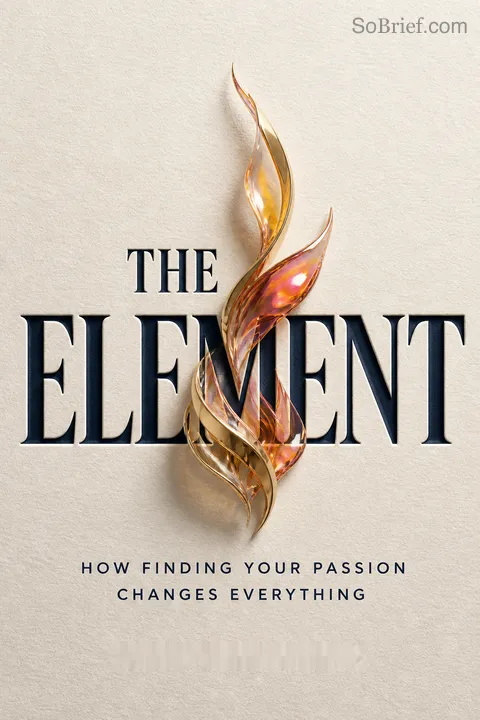


Key Takeaways
Look for the work where ability and appetite meet, then create room for it.
The useful intersection. Robinson calls the Element the meeting point of natural aptitude and personal passion. Being good at something is not enough if the work leaves a person cold, and enthusiasm alone does not guarantee skill. He adds two practical conditions: attitude, meaning the way someone regards their abilities and circumstances, and opportunity, meaning access to places and people where those abilities can develop. Gillian Lynne struggled to sit still in class, but moved naturally to music. A psychologist recognized dance as her strength, and she went on to choreograph major productions.
Look beyond job titles. The Element is not one fixed career or a secret calling everyone must uncover. People may find it in several pursuits, and their interests can change. The idea is a way to notice where skill and genuine engagement reinforce each other, then seek the practice and circumstances that let both grow.
What's useful about this model is that it joins capability with motivation, two forces often treated separately in career advice. A person can be competent but disengaged, or deeply interested but not yet skilled. The intersection gives both a role: aptitude suggests where learning may come readily, while passion helps sustain the effort needed to improve. Opportunity matters because ability is not always visible until it is tried. The model is best used as a compass, not a promise that following interest will automatically produce income, recognition, or an easy life.
Stop letting verbal and math tests stand in for your whole intelligence.
Tests see a slice. Robinson argues that intelligence appears in many forms, not only verbal and mathematical reasoning. Mick Fleetwood struggled with academic work but found exceptional ability as a drummer. Gymnast Bart Conner discovered that his unusual ease moving on his hands could become serious athletic skill once he entered a gymnastics center. Photographer Gordon Parks, who left school early, taught himself across several artistic fields.
Capacity is not a single score. The book describes intelligence as diverse, dynamic, and distinctive: people have different strengths, can develop new connections, and combine abilities in individual ways. IQ and school tests can measure certain skills, but they cannot capture every kind of perception, movement, imagination, or practical judgment. Robinson's point is not that academic skills are useless, but that treating them as the whole of intelligence leaves many talents unseen.
A test is most defensible when it answers a limited question, such as whether a student has mastered a particular skill. Trouble begins when a score becomes a verdict about general worth or future possibility. The stories here make the cost visible: overlooked abilities can look like laziness or low capacity when the assessment measures the wrong thing. A broader view also needs care. Naming different strengths should open routes to learning, not sort people into new rigid categories. The aim is more accurate recognition, not another set of boxes.
Turn imagination into useful work through practice, play, and revision.
Ideas need a medium. Robinson distinguishes imagination, the ability to picture what is not present, from creativity, which puts imagination to work in making something original and valuable. Creativity is not limited to artists, nor reserved for people supposedly born with a special gift. It can appear in science, business, teaching, relationships, or cooking.
Making is a process. Physicist Richard Feynman began wondering about the motion of a spinning plate, then followed the question into mathematical work connected to his research. George Harrison gathered several musician friends to record a song intended as a minor release; their collaboration grew into the Traveling Wilburys. Both examples show how an initial idea can develop through experimentation, skill, and response. The materials matter too: mathematics, music, paint, and movement each make some ideas easier to explore than others.
The distinction between imagining and creating keeps creativity from becoming a flattering label with no practical test. A thought becomes creative work when it is shaped, tried, and improved in a medium. Play can help because it permits exploration before premature judgment closes off options. Yet play does not replace expertise: Feynman's curiosity mattered because he could work mathematically, and the musicians brought years of craft to their collaboration. The strongest reading is that creative freedom and technical discipline are partners, not opposites.
Follow tasks that absorb you, but do not mistake flow for ease.
Absorption is a clue. Robinson uses the term flow, also called being in the zone, for deep involvement in an activity where attention is concentrated, time seems altered, and the work feels rewarding in itself. Pool champion Ewa Laurance described becoming so absorbed that hours at the table seemed to pass in minutes. Writer Aaron Sorkin said that when writing goes well, he can become physically immersed in working through scenes.
Skill meets challenge. The book connects flow with clear goals, useful feedback, and a challenge that calls on skills a person has. It does not mean every moment of a beloved pursuit feels effortless. Practice, frustration, and dull preparation may come with the territory. Nor does flow prove a pursuit is a viable career. It is evidence of a powerful fit between attention and activity, worth investigating alongside the less glamorous demands of doing the work.
Flow is a useful signal because it shifts attention from prestige to lived experience: what holds attention, invites effort, and feels worthwhile while it is happening? The concept also cautions against assuming that fulfillment must feel like constant pleasure. Difficult practice can be part of a deeply absorbing pursuit. Still, intense absorption is not a complete career test. A hobby, a vocation, and a paid profession impose different demands. Flow can identify promising terrain, while practical questions about health, income, and obligations help decide how to travel it.
Find peers who affirm your difference and make your work sharper.
A community can unlock identity. Robinson calls people who share a serious commitment to an activity a tribe. They may collaborate, compete, or simply learn from one another. Sculptor Don Lipski had long made objects without seeing them as art. At graduate school, surrounded by dedicated artists, he began to understand his experiments as genuine artistic work. Bob Dylan's encounter with Woody Guthrie's songs helped him imagine new possibilities for his own music.
Belonging should stretch. A tribe offers validation, inspiration, and exchange. The book contrasts this with fandom, where people may identify with a winning team without participating in the work itself. Creative groups can produce more than isolated individuals: the musicians who recorded Miles Davis's Kind of Blue brought distinct abilities together in spontaneous, coordinated performance. A productive circle makes members feel more themselves while challenging them to do better.
The distinction between a tribe and a crowd is important: shared enthusiasm is not the same as shared practice. A useful peer group offers both recognition and friction, helping someone feel less alone without requiring agreement on every choice. This resembles how expertise grows in communities of practice, where novices observe, contribute, and gradually take on more complex work. The danger is that belonging can harden into conformity. The best group does not merely approve of a person's identity; it gives that person better tools and higher standards.
Treat family, culture, and fear as constraints to navigate, not commands.
Pressure has layers. Robinson groups barriers to finding one's Element into personal, social, and cultural constraints. Fear of failure or disapproval can block experimentation. Family and peers may urge a safer path, while a culture can make certain ambitions difficult to pursue. Artist Chuck Close faced dyslexia, personal hardship, and later paralysis. He adapted his technique and continued making work. Architect Zaha Hadid left Iraq to study in environments more open to her ambitions.
There is no universal escape plan. Paulo Coelho's parents strongly opposed his wish to write, while Arianna Huffington's mother helped her pursue an unlikely place at Cambridge. These contrasting stories show that relationships can either narrow or widen possibility. Sometimes the response is to persist, sometimes to find allies, and sometimes to change environments. The relevant question is not whether obstacles exist, but which ones can be changed, worked around, or accepted as a real cost.
This account avoids reducing every stalled ambition to a lack of courage. Constraints can be internal, relational, or built into institutions, and each calls for a different response. A supportive relative may make risk tolerable; a hostile setting may require distance or a new community. The idea also resists a simplistic celebration of individual grit. Persistence can be admirable, but it cannot erase structural barriers, and not every person can afford to leave a secure job or home. Clear-eyed choice is more helpful than treating sacrifice as proof of seriousness.
Make luck likelier by widening attention and acting on openings.
Chance rewards attention. Psychologist Richard Wiseman studied people who considered themselves lucky and unlucky. Robinson summarizes four tendencies among those who felt lucky: they noticed and acted on opportunities, listened to intuition, expected positive outcomes, and found ways to recover from setbacks. In one café experiment, a participant described as lucky noticed money on the pavement and started a conversation with someone inside. The participant described as unlucky walked past it and left without speaking to anyone.
Reframe without denial. Robinson also describes losing the possibility of a soccer career after polio, then finding work and interests that opened a different life. This does not mean every hardship hides a gift. It means that attention and response influence which possibilities become visible after circumstances change. Luck, in this account, is not simply waiting for fortune; it includes staying open, making attempts, and adapting when a plan fails.
The account usefully separates chance from the ability to notice and use a chance encounter. Attention has limits: what someone is looking for shapes what they see, so deliberately scanning beyond the immediate task can reveal options. Optimism may also encourage action, but it should not be confused with certainty that things will work out. The most robust version of the advice combines openness with feedback. Try, observe what happens, and revise. That approach preserves agency without blaming people for bad outcomes beyond their control.
Ask mentors to notice your strengths, open doors, and raise the bar.
Guidance can reveal talent. A mentor may recognize an ability before the person sees it clearly. Charles Strafford, a school inspector, noticed Ken Robinson's academic potential and pushed his school to offer greater challenge. Dance psychologist support helped Gillian Lynne find a setting where movement was valued rather than treated as misbehavior.
Mentoring has several jobs. Robinson describes four roles:
1. Recognition: noticing a strength or promising interest.
2. Encouragement: helping someone persist through doubt.
3. Facilitation: sharing advice, skills, or access.
4. Stretching: pressing someone beyond their current estimate of what is possible.
A mentor need not be a lifelong authority figure. A teacher, peer, colleague, or experienced practitioner may provide one kind of help at a crucial moment. Mentoring also works in both directions: helping someone else develop can itself become meaningful work.
Mentorship matters partly because talent is hard to assess from the inside. Experienced observers can notice patterns, suggest experiments, and make unfamiliar opportunities reachable. The most valuable help is not simply praise; it combines affirmation with specific feedback and increasing challenge. That combination protects confidence while building competence. There is also a power imbalance to watch. Mentors can mistake resemblance to themselves for potential, or steer a learner toward their own preferred path. Good guidance expands a person's choices rather than claiming ownership of them.
Keep your identity revisable; talent can surface after the expected timetable.
Lives do not follow one track. Robinson challenges the belief that important opportunities expire early. Harriet Doerr published her first novel at seventy-three. Julia Child began professional culinary training in her thirties and published her landmark cookbook close to fifty. Filmmaker Ridley Scott moved through printmaking, television design, and advertising before directing films.
Development continues, unevenly. The book argues that people can keep learning and developing abilities as they age, although physical and cognitive capacities do not all change in the same way. Some skills depend on speed or physical peak; others can benefit from accumulated experience. At Tulsa's Grace Living Center, young children read with older residents, giving both generations a valued role in daily life. The practical lesson is not that every ambition remains possible at every age, but that an earlier choice does not define the whole life.
A nonlinear view of adulthood counters the pressure to choose once and remain consistent forever. It also fits the reality that different skills mature on different schedules: experience can deepen judgment even as particular physical capacities decline. The older beginner is not automatically advantaged, and some paths do have genuine time-sensitive requirements. But treating age as a blanket disqualification confuses a constraint with a verdict. A better question is what version of the underlying interest remains feasible now, and what contribution could still be made.
Give serious time to passions that may never become your profession.
Paid work is not the only home for passion. Gabriel Trop chose German literature as his academic path but remained a dedicated cellist, practicing and performing regularly. Robinson emphasizes that an amateur, in the original sense, pursues something for love rather than income. That does not mean the work is careless or unskilled.
A serious amateur can matter. The book describes Pro-Ams, people who pursue an activity for personal reasons at a high standard. Amateur astronomers, musicians, and programmers can contribute discoveries and creative work. For some, a passion later becomes a profession; for others, keeping it outside paid work protects its place in life. A meaningful pursuit can restore energy and enrich other responsibilities without requiring a dramatic career change or a promise of financial success.
This is a valuable correction to the modern habit of turning every interest into a side hustle. Monetization can bring resources and recognition, but it also adds deadlines, customers, and pressure that may change the activity's appeal. A serious nonprofessional pursuit can still involve discipline, community, and contribution. The key is not to rank paid work below unpaid work, but to stop using salary as the only measure of importance. Time spent well can sustain a person even when it does not appear on a résumé.
Redesign education around individual strengths, not factory-style uniformity.
The system shapes the signal. Robinson argues that mass education inherited features of industrial organization: age-based batches, divided subjects, uniform schedules, and standardized assessment. The resulting hierarchy often gives arts and physical learning less status than language, mathematics, and science. This can hide the abilities schools are meant to develop.
Change the conditions for learning. Robinson favors broad curricula, interdisciplinary teaching, skilled teachers, and assessment that informs rather than dictates instruction. At Grange Primary, pupils learned by running a model town with a council, market, newspaper, and studio. In 2004, the school reported proficiency rates of 91 percent in English, 87 percent in mathematics, and 100 percent in science. Arts-integrated A+ schools also reported strong test results. The examples suggest that creative, contextual learning need not mean abandoning academic standards.
The book's sharpest institutional claim is that a system can misread the people it is supposed to serve. A narrow assessment regime may improve what it counts while pushing other forms of learning aside. Grangeton is compelling because it connects knowledge to meaningful roles, rather than treating application as a reward after instruction. Still, one successful school cannot establish that a particular model works everywhere. Standardized measures can expose inequity when used carefully. The central issue is whether tests guide teaching or replace the professional judgment and responsiveness that good teaching requires.
Analysis
The book's most durable contribution is a shift in the unit of analysis. It asks readers to look beyond an individual's score, job title, or apparent success and examine the relationship between ability, desire, practice, social setting, and opportunity. That relational view explains why the same person can seem incapable in one environment and remarkable in another. Gillian Lynne's movement in a classroom, Don Lipski's work with steel, and Ewa Laurance's geometric reading of a pool table are not interchangeable talents; they illustrate how capability becomes legible through a fitting activity and setting.
The narrative method is persuasive because stories make overlooked potential concrete. It also creates a limitation. The featured people are selected largely because their paths became notable, so their stories cannot show how often passionate pursuit leads to stable work, public recognition, or financial security. The book's own distinction between paid professions and serious amateur pursuits helps address this risk, but readers still need practical planning alongside inspiration. Access to time, training, healthcare, and supportive networks is uneven. Individual attitude can influence action, yet it cannot dissolve unequal conditions.
The argument about education is strongest when it criticizes confusing measurement with learning. A standardized score can provide useful information, but it becomes a poor proxy for a whole person when institutions reward only the measured outcome. The alternative is not abandoning standards. It is combining them with varied ways to learn and demonstrate understanding, strong teachers, and room for student interests to develop. The book's deepest proposal is therefore ecological: individuals flourish through interaction with supportive environments, just as schools and organizations improve when they make room for varied capacities. Its promise is not that everyone will find a perfect occupation, but that a broader view of human ability can produce richer choices, stronger communities, and less wasted potential.
Review Summary
The Element receives mixed reviews, with many praising its inspirational message about finding one's passion and natural talents. Readers appreciate the anecdotes and examples of successful individuals who discovered their "element." However, some criticize the book for being repetitive, lacking concrete advice on how to find one's passion, and relying too heavily on anecdotes rather than research. The book's critique of the education system and emphasis on creativity resonates with many readers, though some find it oversimplified.
People Also Read







Glossary
The Element
aptitude joined with passionThe Element is the point where a person's natural aptitude and genuine passion meet. Robinson also emphasizes that attitude and opportunity affect whether this potential can develop. It is not necessarily one career or a permanent identity. It describes an activity or domain in which a person feels engaged, capable, and more fully themselves.
flow
deep, focused involvementFlow is a state of concentrated involvement in an activity. Attention becomes absorbed, goals and feedback help guide action, and the challenge draws on skills the person has. People may lose awareness of time and find the activity rewarding in itself. Robinson also refers to this experience as being in the zone.
tribe
community of shared practiceA tribe is a group of people connected by commitment to the same activity or domain. Members may collaborate, compete, or learn from one another. Such a community can validate an individual's interests, offer inspiration, and raise standards. Robinson distinguishes this active connection from belonging to a crowd that shares enthusiasm without participating in the work.
circles of constraint
layers of obstaclesCircles of constraint is Robinson's way of grouping barriers that can hinder a person's search for meaningful work. The three layers are personal, social, and cultural. They include fear and self-doubt, pressure from family or peers, and broader expectations about which ambitions or identities are acceptable. Different barriers may require persistence, support, or a change of environment.
Pro-Am
high-standard amateur practiceA Pro-Am is someone who pursues an activity mainly as an amateur, for personal commitment rather than primary income, while bringing professional-level effort and skill to it. Robinson uses the idea to challenge the assumption that amateurs are necessarily less serious or capable. Pro-Am activity can produce worthwhile work and contribution outside a person's paid occupation.
FAQ
What's The Element: How Finding Your Passion Changes Everything about?
- Finding Your Passion: The book explores the intersection of personal passion and natural talent, termed "the Element," which is crucial for fulfillment.
- Personal Stories: It includes stories of individuals who have found their Element, highlighting their journeys and challenges.
- Broader Implications: Robinson argues that discovering one's Element is vital for personal fulfillment and the future of communities and organizations.
Why should I read The Element: How Finding Your Passion Changes Everything?
- Inspiration and Motivation: The book is filled with inspiring stories that encourage readers to pursue their passions and recognize their unique talents.
- Practical Insights: It offers practical advice on identifying and cultivating your Element, providing a framework for growth.
- Cultural Critique: Robinson critiques traditional education systems, advocating for a more personalized approach to learning.
What are the key takeaways of The Element: How Finding Your Passion Changes Everything?
- Importance of Passion: True fulfillment comes from aligning work with passions and natural abilities.
- Diversity of Intelligence: Intelligence is diverse and cannot be measured solely by standardized tests; everyone has unique strengths.
- Finding Your Tribe: Connecting with like-minded individuals who share your passions is crucial for personal growth and success.
What is the definition of "the Element" in The Element: How Finding Your Passion Changes Everything?
- Intersection of Aptitude and Passion: "The Element" is where natural aptitude and personal passion converge, leading to fulfillment and success.
- Personal Experience: Illustrated through stories of individuals who have discovered their Element, transforming their lives.
- Universal Application: Suggests that everyone has the potential to find their Element, regardless of background or circumstances.
What are some personal stories shared in The Element: How Finding Your Passion Changes Everything?
- Gillian Lynne's Journey: A psychologist recognized her talent for dance, leading to a successful career as a choreographer.
- Matt Groening's Path: Despite discouragement, he pursued his passion for drawing, leading to the creation of The Simpsons.
- Paul Samuelson's Discovery: A lecture ignited his passion for economics, demonstrating the importance of finding one's true calling.
What are the barriers to finding your Element discussed in The Element: How Finding Your Passion Changes Everything?
- Personal Constraints: Internal barriers like fear of failure and self-doubt can prevent pursuing passions.
- Social Expectations: Family and societal pressures can hinder personal exploration and conformity to conventional paths.
- Cultural Limitations: Educational systems prioritize standardized testing over creativity, limiting potential.
How does The Element: How Finding Your Passion Changes Everything address education?
- Critique of Traditional Education: Argues that conventional education stifles creativity and fails to recognize diverse intelligences.
- Need for Personalization: Advocates for education that nurtures individual talents and passions, allowing exploration of interests.
- Encouraging Creativity: Emphasizes fostering creativity in schools to help students discover their Element.
What are the best quotes from The Element: How Finding Your Passion Changes Everything and what do they mean?
- “There is nothing either good or bad, but thinking makes it so.”: Highlights the power of perspective in shaping experiences.
- “If you’re not prepared to be wrong, you’ll never produce anything original.”: Emphasizes that fear of failure inhibits creativity.
- “The greatest discovery of my generation is that human beings can alter their lives by altering their attitude of mind.”: Underscores the transformative power of mindset.
What role do mentors play in finding your Element according to The Element: How Finding Your Passion Changes Everything?
- Recognition of Talent: Mentors help individuals recognize their unique talents and passions, often seeing potential overlooked by the mentee.
- Encouragement and Support: Provide encouragement and support, helping overcome self-doubt and societal pressures.
- Guidance and Resources: Offer valuable guidance and resources, sharing experiences and knowledge to navigate challenges.
How can I identify my Element as suggested in The Element: How Finding Your Passion Changes Everything?
- Self-Reflection: Engage in self-reflection to understand passions, interests, and natural talents.
- Experimentation: Try different activities and explore various fields to discover what resonates and where strengths lie.
- Seeking Feedback: Engage with others who share similar interests for valuable insights and encouragement.
How does The Element: How Finding Your Passion Changes Everything critique traditional education systems?
- Stifling Creativity: Argues that traditional education enforces conformity and standardization, stifling creativity.
- Hierarchy of Subjects: Critiques the undervaluing of arts and humanities compared to sciences and mathematics.
- Need for Personalization: Emphasizes personalized education that caters to individual learning styles and interests.
How can I apply the lessons from The Element: How Finding Your Passion Changes Everything in my own life?
- Self-Reflection: Reflect on passions and talents to identify your Element and incorporate them into your life.
- Overcome Barriers: Work on overcoming personal fears and societal pressures using techniques like those from Susan Jeffers’s Feel the Fear and Do It Anyway.
- Seek Mentorship: Look for mentors who can guide and support you, providing insights and encouragement.
About the Author



Download PDF
Download EPUB
.epub digital book format is ideal for reading ebooks on phones, tablets, and e-readers.








