

Key Takeaways
Search beyond the body: traces can reconstruct crimes without a corpse
Look past the obvious. Forensic work is not just the dramatic discovery of a clue at a crime scene. It includes careful collection, laboratory testing, and interpretation in light of the case. Locard’s principle describes how contact can transfer material between people, places, and objects, leaving evidence investigators may later recover. Forensic entomology, the study of insects associated with bodies and their surroundings, can help even when remains are missing. In a thirteenth-century Chinese case, flies settled on the sickle carrying traces of a murdered farmer’s blood, pointing to its owner.
Evidence has a time limit. Insect development can estimate the post-mortem interval, or PMI, meaning the time since death. More precisely, it estimates the time since insects colonised the body, which may be later than death itself. That distinction makes forensic science powerful, but never magical: every trace needs context and careful interpretation.
The memorable shift is from asking whether a body or weapon exists to asking what interactions could have left recoverable material. That is a useful investigative habit well beyond homicide: indirect traces can reveal a process even when its central object is gone. The book also resists the fantasy of instant laboratory certainty. The fly evidence is striking, but its meaning depends on knowing insect behaviour and the scene’s conditions. A clue becomes useful not by being dramatic, but by being connected to a defensible explanation.
Use DNA to ask who, and patterns to reconstruct what happened
Separate two questions. DNA can associate a biological trace with a person, but it cannot by itself explain how the trace arrived. Blood pattern analysis examines the shapes and distribution of stains to infer actions such as contact, dripping, or impact. In one assault case, blood on a defendant’s shoe was consistent with stamping into wet blood, challenging his claim that he had merely pushed the victim away.
A stain has a history. Luminol can reveal traces of blood that are hard to see, but it is a sensitive screening tool, not a complete account of events. In the Massimo Carlotto case, repeated handling had spread dried blood dust across clothing. The resulting glow exaggerated how much blood appeared to be present. Source identification and activity reconstruction are different tasks, and both can be misread without context.
This distinction resembles a broader rule of evidence: identifying the source of a signal is not the same as explaining its cause. A DNA match may be strong evidence that a person contributed material, while leaving open when or why it was deposited. Pattern evidence can help answer that second question, but it carries its own interpretive uncertainty. The strongest account therefore combines different kinds of evidence without pretending that one automatically validates the other.
Build convictions from converging clues, not one dazzling laboratory result
Let evidence cross-check. Chantel Taylor’s body was never found, yet investigators built a case against Stephen Wynne from evidence at his home and among discarded items. Blood on clothing and bedding matched Chantel; blood was found beneath the bedroom carpet; and bone fragments appeared likely to be human. In the loft, investigators found many fly remains and puparia, the casings left by developing flies. Testing detected morphine, while DNA analysis found some components consistent with Chantel’s profile, though it could not establish how many people contributed.
No single clue did everything. The insects supported the possibility that decomposing material had been kept in the loft, while other evidence linked Chantle to the bedroom and the suspect. Together, the findings helped assess Wynne’s account, but did not independently prove every detail of it. He pleaded guilty and was convicted.
The case shows why evidential convergence matters. Different traces can constrain different parts of a story: one may locate a person, another suggest where remains were kept, and another expose a weakness in a suspect’s account. Their value comes from partial independence, not simply from accumulating a long list of clues. The caution is important: evidence that fits a hypothesis is not necessarily evidence unique to it. A reliable case tests plausible alternatives rather than counting every compatible result as separate confirmation.
Treat missing expected traces as evidence against your preferred story
Ask what should be present. Absence can matter when a proposed event would ordinarily leave a particular trace and investigators had a fair chance to detect it. In a case involving a body found in a culvert, the prosecution alleged that the defendant had moved the victim there by car. A visit to the scene revealed a powdery coating from the culvert walls that would have been expected on anything carried through it, yet it was not found on the defendant’s clothing.
Compare explanations. The dead man’s damaged clothes, injuries, high alcohol level, and jacket found upstream supported another account: he had entered the culvert himself and crawled before dying. The court acquitted the defendant. Missing evidence is not automatically proof of innocence, since collection and preservation can fail. Its significance depends on whether the trace was genuinely expected and recoverable.
Negative evidence is powerful only when the expectation behind it is explicit. Otherwise, the absence of a trace can be explained away after the fact, or mistaken for evidence when the proposed event would not reliably produce it. This is a discipline of scientific reasoning: specify what each hypothesis predicts before examining the result. It also protects against one-sided investigation, in which every discovery supports the prosecution while every missing clue is dismissed as bad luck.
A forensic match is only as strong as its method and context
Experts can be wrong. Fingerprint comparisons are structured through ACE-V: analysis, comparison, evaluation, and verification by another examiner. Yet verification does not eliminate human error or confirmation bias, the tendency for expectations to shape what an examiner sees. In the Madrid bombing investigation, FBI examiners wrongly matched a fingerprint to Brandon Mayfield, an American lawyer, before Spanish investigators identified another suspect with a better match. Ear-print evidence also helped convict Mark Dallagher, but DNA later showed that the prints came from someone else.
Numbers need interpretation. A DNA result estimated at one chance in 600,000 may sound unique. Against a population of about 67 million, however, the book notes that roughly 110 people could theoretically share a profile with that frequency. Such figures do not establish who deposited DNA, or how. A statistic is meaningful only when the question it answers is clear.
The deeper lesson is that instruments produce observations, while people build conclusions. Formal procedures can reduce error, but they cannot make judgment infallible, especially when an examiner knows a suspect’s identity or the preferred theory. Statistical evidence has a parallel limitation: a rare profile is not a narrative of guilt. Clear reporting distinguishes the chance of a coincidental match from the probability that a particular person committed the crime, two claims that are often confused.
Preserve old evidence; new methods can reopen decades-old murders
Archives keep options open. In 1981, Angela Gallop took adhesive tapings from the body of Claire Woolterton, whose murder remained unsolved. More than thirty years later, scientists tested material recovered from those tapings using improved DNA methods. The resulting profile matched Colin Campbell, who was convicted of Claire’s murder in 2013. The original samples had survived because they were retained in suitable conditions and could be examined again.
Stored evidence is not static. In the Stephen Lawrence investigation, examiners eventually searched the packaging that had held a suspect’s jacket and found a tiny flake of blood. It contained Stephen’s DNA, along with fibres matching his cardigan. The packaging had preserved evidence that earlier searches of the clothing had not found. Cold-case work is difficult because items may have been handled repeatedly and records may be incomplete, but preservation can make new questions testable.
Preservation is a form of investment in future knowledge. An archive does not merely store yesterday’s conclusions; it retains material that new techniques can interrogate and old assumptions can challenge. That makes documentation and storage part of justice, not clerical overhead. The limits are real: later analysis cannot repair every lost sample or reconstruct every handling event. But without preservation, the possibility of correction disappears before anyone knows it is needed.
Fund the obscure specialties: pollen, fibres, and insects crack cases
Small traces carry geography. Forensic palynology is the study of pollen and spores for investigative purposes. In the murder of Leanne Tiernan, specialist Patricia Wiltshire compared pollen from Leanne’s body and bedding with samples from possible locations. The mixture of plant material, fungal spores, and charred wood pointed to a neglected garden near a bonfire. Investigators recognised the same features in the garden of John Taylor, who was later convicted.
The unfashionable can be decisive. Textile fibres linked offenders to victims in the Sarah Payne and Pembrokeshire Coastal Path cases. Insects have helped investigate deaths without bodies, while digital footage, phone records, and toxicology can answer very different questions. These specialties require distinct expertise and careful interpretation. When budgets favour only familiar tests, investigators may miss the very trace that opens the case.
The book’s range makes a strong argument for epistemic diversity: different specialties notice different properties of the same world. A pollen expert sees location and season; a fibre examiner sees transfers between surfaces; a digital analyst reconstructs movement or communication. Their methods are not interchangeable, and no single technology can replace that accumulated skill. The policy challenge is that painstaking trace work can appear less impressive than a rapid DNA result, even when it is the route that makes the DNA evidence discoverable.
Build contamination checks into every handoff, test, and interpretation
Evidence can acquire false histories. Contamination occurs when material reaches an exhibit from an unrelated source, creating a misleading apparent link. In one laboratory, a rape suspect’s DNA appeared to match a sample from a crime scene. Investigators discovered that a disposable tray had been reused after containing the suspect’s earlier sample. A separate case involving MI6 agent Gareth Williams was complicated when an unknown DNA profile was traced to a laboratory scientist.
Quality is a system. Reliable work depends on controlled handling, clear records, clean equipment, and procedures for checking results against staff profiles and other possible sources. Crime scenes also require access logs and protected routes so legitimate visitors can be distinguished from potential offenders. These safeguards cannot prevent every mistake. They can make errors easier to detect, limit their spread, and help laboratories change procedures when something goes wrong.
Contamination is not merely a technical nuisance. It is a failure of provenance: the evidence may be real, but its apparent connection to the crime is false. That makes chain-of-custody records and laboratory controls part of the scientific argument itself. The strongest systems treat error prevention as an organisational responsibility, not just a test of individual care. Transparency matters too, because concealed mistakes undermine confidence more deeply than documented failures followed by correction.
Keep forensic experts independent, and make uncertainty legible to juries
Science serves truth, not a side. A second opinion can reveal weaknesses in a prosecution case, but it can also confirm evidence that supports it. Gallop’s defence work repeatedly involved checking laboratory methods, reviewing the context, and asking whether findings actually distinguished between competing explanations. In the Jill Dando case, a single firearms-residue particle was initially treated as incriminating. Reassessment found it could have come from an unrelated source, and Barry George’s conviction was quashed.
Explain the limits plainly. The book argues that jurors need understandable accounts of what a test establishes and what it cannot. Case Interpretation and Assessment asks scientists to compare how strongly evidence supports competing propositions, rather than presenting a finding as a verdict. Independent review, careful language, and accessible explanations help courts weigh evidence without mistaking scientific detail for certainty.
Independence is valuable because it introduces a genuine possibility of disagreement before a verdict hardens around one interpretation. The expert’s role is not to be neutral by saying nothing, but to make the reasoning and limits visible enough to scrutinise. Plain language is an ethical tool here: it prevents technical authority from substituting for explanation. Yet accessibility must not flatten complexity. A jury needs clarity about uncertainty, not a false impression that every result has a simple numerical answer.
Analysis
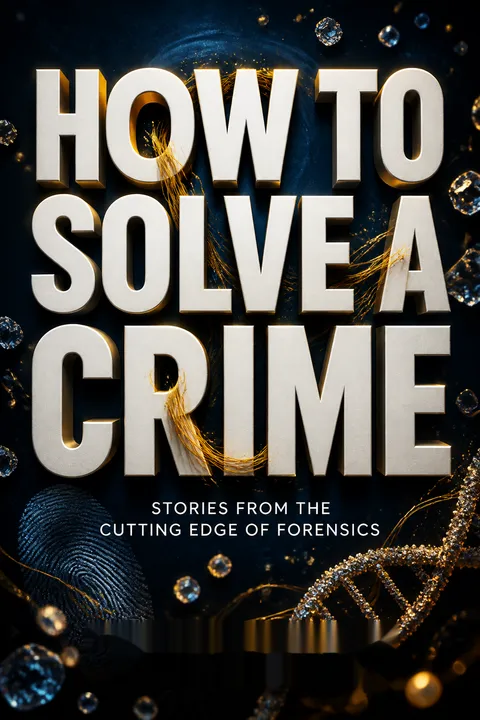
How to Solve a Crime is a case-driven introduction to forensic science, not a procedural manual or a catalogue of laboratory techniques. Its organising argument emerges through stories: traces matter because they can connect people, places, and actions, but their value depends on disciplined collection, specialised interpretation, and scrutiny in court. The narrative moves from insects and blood to DNA, fibres, plants, toxicology, digital evidence, and document examination. That variety is itself part of the case. Forensics is a network of complementary forms of knowledge, not a single machine that prints out guilt.
The book’s most consequential contribution is its insistence that evidence has two histories: what happened at the crime, and what happened to the evidence afterward. A DNA profile or fibre may be analytically genuine yet misleading if contamination, innocent contact, or handling explains its presence. Likewise, an absence matters only when a trace would reasonably be expected and could have been recovered. This is a practical account of scientific reasoning, built around comparison of rival explanations rather than theatrical certainty.
The storytelling also exposes a tension. Gallop argues that many unsolved cases could be resolved with adequate budgets, skilled teams, and access to modern methods. Her examples make that optimism understandable, particularly where old samples yielded new results. Still, the claim should not be read as a guarantee: some evidence is destroyed, never collected, or too ambiguous to distinguish between hypotheses. More technology can expand what can be asked, but it cannot restore every missing observation or remove judgment from interpretation.
The book’s civic argument follows naturally. Forensic capacity needs stable funding, independent review, and durable quality systems because both false conviction and failure to identify a dangerous offender impose real costs. Its most useful takeaway is therefore institutional as much as technical: preserve evidence, maintain diverse expertise, disclose uncertainty, and ensure that no single interpretation becomes immune to challenge.
Review Summary
How to Solve a Crime receives mixed reviews, with an average rating of 3.61/5. Readers praise its informative content on forensic science, real case examples, and clear explanations of various forensic techniques. Some find it fascinating and a must-read for crime enthusiasts. However, others criticize its repetitiveness, lack of depth in case studies, and textbook-like approach. Some readers felt it was too basic or boring, while others appreciated its comprehensive overview of forensic science. The book's structure and writing style are points of contention among reviewers.
People Also Read
Glossary
Locard’s principle
Contact can transfer materialA forensic principle associated with Edmond Locard: when people, objects, or places come into contact, material may transfer between them. Such traces can include blood, fibres, hair, soil, or other particles. The principle guides investigators to search for transferred material, but a trace alone does not establish when, how, or why the contact occurred.
Forensic entomology
Insects as crime evidenceThe study of insects and other invertebrates found on or around decomposing bodies, or in places where bodies have been. Insects can help estimate when a body was colonised, indicate whether it may have been moved, and sometimes suggest where it was previously kept. Their development depends on species and temperature, so interpretation requires contextual information.
Post-mortem interval (PMI)
Estimated time since deathThe period between a person’s death and the discovery or examination of their body. In insect-based estimates, scientists generally determine the time since colonisation rather than the exact time of death. Because insects may arrive after death, this estimate can provide a minimum interval and must be considered alongside other information, such as when the person was last seen alive.
ACE-V
Fingerprint comparison procedureA four-stage process used in fingerprint identification: analysis, comparison, evaluation, and verification. An examiner first assesses the print, compares it with a reference print, evaluates whether the features support an identification, exclusion, or inconclusive result, and has another examiner verify the work. The procedure structures decisions but cannot eliminate human error or bias.
Automated Fingerprint Identification System (AFIS)
Fingerprint database searchA computer system used to search fingerprint databases for prints resembling an unknown print from a crime scene. AFIS can help generate possible candidates when investigators do not yet have a named suspect. A database result is a lead for examination and comparison, not a conclusive identification by itself.
Case Interpretation and Assessment
Compare competing explanationsAn approach to forensic reporting that evaluates how evidence bears on competing propositions, commonly one advanced by the prosecution and another by the defence. Rather than treating a finding as proof of guilt, the scientist explains which proposition the evidence supports more strongly, if either, and how limited that support is in the circumstances.
Surrogate samples
Substitute reference materialItems used to obtain a reference DNA profile when a direct sample from a missing or deceased person is unavailable. Examples include clothing, toothbrushes, or hairbrushes that the person used before death. Their usefulness depends on whether the item can reliably be attributed to that person and whether other contributors or contamination could affect the result.
One-to-one taping
Map traces to exact locationsA trace-recovery method, also called fibre mapping, in which separate pieces of adhesive tape are applied to defined areas of a surface rather than using one strip across the whole area. Recording each tape’s location preserves information about where fibres or other particles were found. This distribution can help assess the nature and extent of contact.
Diatoms
Microscopic aquatic organismsMicroscopic organisms with distinctive silica cell walls that occur in water and waterlogged environments. Their shapes and species distributions vary between locations. In suspected drowning cases, scientists may examine body samples for diatoms that entered the lungs and circulated through the body, and compare them with water samples to assess whether drowning occurred or whether a body was moved.
Electrostatic detection analysis (ESDA)
Reveal indented writingA technique for visualising indentations left on paper when someone writes on a sheet placed above it. An electrostatic charge is applied to the questioned page, and toner gathers in the indented areas, making the marks visible. The recovered impressions may reveal writing from a missing page or help identify alterations in documents and records.
Forensic toxicology
Analyse drugs and poisonsThe analysis of body fluids, tissues, organs, food, or other materials for drugs, medicines, poisons, and their breakdown products. Toxicologists may assess what substance was present, how much was present, and whether it could have contributed to impairment, illness, or death. Results must be interpreted with medical findings and the circumstances of the case.
FAQ
What’s How to Solve a Crime: Stories from the Cutting Edge of Forensics by Angela Gallop about?
- Comprehensive forensic science overview: The book explores the real world of forensic science, using Angela Gallop’s 47-year career and a range of true cases to illustrate how forensic evidence is used to solve crimes.
- Beyond TV portrayals: It aims to dispel myths from popular media, showing the complexity, diversity, and challenges of actual forensic investigations.
- Justice and fairness focus: Gallop emphasizes the role of forensics in both convicting the guilty and exonerating the innocent, highlighting its critical place in the justice system.
Why should I read How to Solve a Crime by Angela Gallop?
- Insight into real forensics: The book offers a rare, behind-the-scenes look at the scientific methods and investigative processes that underpin modern crime solving.
- Engaging true crime cases: Gallop uses compelling real-life cases, such as the Yorkshire Ripper and Alexander Litvinenko, to bring forensic principles to life.
- Understanding forensic challenges: Readers gain awareness of the difficulties forensic scientists face, including contamination, cognitive bias, and the need for rigorous quality control.
What are the key takeaways from How to Solve a Crime by Angela Gallop?
- Forensic science is multifaceted: The book covers a wide range of forensic disciplines, from entomology and toxicology to digital forensics and document analysis.
- Science underpins justice: Forensic evidence is crucial for both convicting the guilty and protecting the innocent, but it must be interpreted with care and context.
- Quality and independence matter: Gallop stresses the importance of independent checks, quality control, and avoiding cognitive bias to prevent miscarriages of justice.
What are the most memorable quotes from How to Solve a Crime by Angela Gallop and what do they mean?
- On perseverance in justice: The Elizabeth Fry quote at the Old Bailey, cited by Gallop, symbolizes hope and resilience in the pursuit of truth in court.
- On toxicology: Paracelsus’ “All substances are poisonous, the only thing that distinguishes them is the dose” highlights the complexity of interpreting poisoning cases.
- On forensic vocation: Gallop’s reflection that “Forensic science turned out to be a true vocation. It was never just a job to provide a living” underscores the passion and dedication required in the field.
- On thoroughness: “Never assume that just because nobody has found any evidence yet, it isn’t there” encourages persistence and open-mindedness in investigations.
What forensic disciplines and methods are explained in How to Solve a Crime by Angela Gallop?
- Wide range of specialisms: The book covers entomology, blood pattern analysis, DNA profiling, trace evidence, digital forensics, handwriting analysis, toxicology, and more.
- Real case applications: Each method is illustrated with real-life cases, showing how different forensic techniques contribute to solving crimes.
- Strengths and limitations: Gallop discusses the reliability, challenges, and potential pitfalls of each forensic discipline.
How does Angela Gallop explain DNA profiling and its impact in How to Solve a Crime?
- Revolutionizing forensic science: DNA profiling provides highly discriminating links between individuals and biological traces, transforming how crimes are solved.
- Cold case breakthroughs: The book details how re-examining stored evidence with DNA techniques has solved decades-old cases, such as the murders of Claire Woolterton and Lynette White.
- Cautions and limitations: Gallop emphasizes careful interpretation of DNA statistics and warns about issues like partial profiles and contamination.
What is the role of trace evidence, fibres, and plant material in forensic investigations according to How to Solve a Crime?
- Microscopic links: Fibres, hairs, soil, pollen, and plant material can connect suspects, victims, and crime scenes, even when other evidence is lacking.
- Analytical techniques: The book explains methods like microscopy, microspectrophotometry, and FTIR spectroscopy for analyzing trace evidence.
- Case studies: Notable cases, such as the Sarah Payne murder, demonstrate how fibre and plant evidence can be pivotal in securing convictions.
How does How to Solve a Crime by Angela Gallop address bloodstain pattern analysis and its forensic value?
- Reconstructing crime scenes: Blood patterns help determine the nature of violence, sequence of events, and distinguish between defensive wounds and assaults.
- Detection techniques: Gallop describes the use of luminol and other reagents to reveal blood traces invisible to the naked eye.
- Case examples: The book includes cases where blood patterns on shoes and clothing confirmed or refuted suspects’ accounts.
What does Angela Gallop say about digital forensics and cybercrime in How to Solve a Crime?
- Growing importance: Digital evidence, such as CCTV, mobile phone data, and computer analysis, is increasingly vital in modern investigations.
- Supporting and reconstructing events: Digital forensics often corroborates other evidence and helps reconstruct timelines and suspect movements.
- Cautions in interpretation: Gallop warns that digital data must be carefully analyzed in context to avoid wrongful accusations.
How does How to Solve a Crime by Angela Gallop explain the investigation of serial offenders and cold cases?
- Pattern recognition: The book discusses the challenges of linking serial crimes due to variations in modus operandi and the importance of forensic pattern recognition.
- Advances in technology: New forensic techniques, especially DNA and fibre analysis, have enabled the resolution of cold cases after many years.
- Persistence pays off: Gallop emphasizes that with adequate resources and expertise, most cases can eventually be solved, providing justice and closure.
What are the challenges of contamination, cognitive bias, and quality control in forensic science according to Angela Gallop?
- Risks of contamination: Trace evidence can be accidentally transferred by crime scene or lab personnel, potentially misleading investigations.
- Quality assurance systems: The book stresses the need for rigorous protocols, protective clothing, and staff DNA databases to minimize contamination.
- Cognitive bias dangers: Gallop warns against bias, especially when forensic work is done by police forces themselves, and advocates for independent, impartial forensic services.
How does How to Solve a Crime by Angela Gallop explain the role of forensic evidence and expert witnesses in court?
- Clear communication: Forensic scientists must present technical findings in understandable language for juries and judges.
- Expert witness pressures: Gallop discusses the challenges of cross-examination and the need for impartiality and thorough preparation.
- Reliability and quality: The credibility of forensic evidence in court depends on robust quality control and assurance systems to prevent errors and maintain trust.
Download PDF
Download EPUB
.epub digital book format is ideal for reading ebooks on phones, tablets, and e-readers.








