

Key Takeaways
Learn computation so design can shape the products people actually use.
Design needs machine fluency. John Maeda began as a designer and engineer who wanted to make complex technology simpler. His argument is not that design has become useless. Rather, digital products are built from code, data, and networked services, so design has more influence when it accounts for how computation works. A polished screen is only the visible surface of an unseen system.
Curiosity beats helplessness. Maeda describes computation as a foreign culture, not merely a language learned in a coding course. Knowing a few technical words is a start, but understanding the system’s possibilities and limits gives people more say in what gets made. The book invites designers, businesspeople, and ordinary users to become curious participants rather than leave the subject to specialists.
This framing makes technical literacy a form of agency, much like civic literacy: participation does not require everyone to become a specialist, but it does require enough understanding to ask better questions. The distinction between interface and underlying system is especially useful because attractive screens can conceal consequential choices about data, defaults, and access. Still, literacy alone cannot equalize power. People may understand a system and still lack the authority to change it, so public accountability and institutional leverage matter alongside individual curiosity.
Turn repeated work into loops instead of multiplying instructions by hand.
Repetition is a machine strength. As a teenager, Maeda wrote a billing program for his family’s tofu shop by typing separate instructions for each day of the year. After a teacher introduced him to loops, he replaced roughly 14,600 lines with fewer than 50. A loop tells a computer to repeat a task, changing a value each time until a condition is met. The machine does not tire, but people must learn how to describe the task well.
People built the machinery. Before electronic computers, human computers did calculations by hand. Women who programmed the ENIAC were crucial to its operation, yet were long left out of the story. Maeda also explains recursion, a way to define a process through smaller versions of itself, like branches made of branches. Both ideas show how computation compresses repeated work, while its history reminds readers not to erase the humans behind it.
The tofu program is more than a coding anecdote: it shows how abstraction can turn labor into leverage. A loop captures a pattern once, then applies it consistently, which is why the same logic matters in software, manufacturing, and routine administration. But automation does not eliminate judgment. Someone decides which task is repeated, which exceptions count, and whose labor is made invisible. The overlooked ENIAC programmers sharpen that point: efficiency can coexist with unfair credit unless recognition is designed into the system.
Expect exponential systems to outrun intuition, then question their human costs.
Doubling hides the finish line. In the book’s lily-pad puzzle, a pond is covered on day 30 by 536,870,912 pads. It is half covered on day 29, not halfway through the month. On day 15 there are only 16,384. Human intuition tends to picture steady additions, while computation often works through multiplication, repeated loops, and rapidly expanding networks.
Nested loops multiply scope. A computer can repeat a task across years, months, days, users, and machines. This makes enormous systems feasible, but can also make their scale hard to perceive. Maeda uses the Eames film Powers of Ten and the endlessly detailed Koch snowflake to convey how computation can zoom outward and inward. Moore’s law, the observed growth in computing power, intensifies the effect. Scale is capability, not proof of wisdom.
The lily-pad puzzle is a compact lesson in nonlinear change: the largest gains arrive when people are least prepared for them. That mental model helps explain why digital systems can seem harmless at first and consequential soon afterward. Yet exponential language can also exaggerate inevitability. Computing still depends on electricity, hardware, institutions, and human decisions, all of which impose constraints. The useful response is neither awe nor panic, but to identify what is compounding, who benefits, and whether the surrounding safeguards are growing at a comparable pace.
Judge AI by its learned patterns, not by how human it sounds.
Lifelike is not alive. Maeda recalls Valentino Braitenberg’s simple robots, whose sensors and motors could produce behavior that looked animal-like. A small device that avoids bright light might seem like a cockroach, though it follows only a simple rule. Joseph Weizenbaum’s ELIZA program likewise seemed attentive by reflecting a user’s words and asking formulaic questions. A machine’s quick response can make it feel intelligent without giving it feelings or understanding.
Learning comes from examples. Neural networks learn patterns from large quantities of data rather than following only explicit IF-THEN instructions. Powerful graphics processors helped make this approach practical. The book reports that image-recognition error rates fell from about 28 percent to 7 percent, while speech-recognition errors fell from about 26 percent to 4 percent. Better imitation can be useful, but it does not establish awareness, judgment, or moral responsibility.
The distinction between fluent performance and understanding remains essential in human-computer interaction. People readily attribute intention to responsive systems, especially when a voice sounds warm or remembers personal details. That response can make tools easier to use, but it can also encourage misplaced trust. Maeda’s account is strongest when it treats apparent intelligence as a product of mechanisms and data. One caution: calling systems lifelike can itself deepen anthropomorphism, so explanations should describe capabilities precisely rather than rely only on the metaphor of a machine acting like a person.
Ship a small, useful beginning, then keep improving it with customers.
Digital products can change after launch. Unlike a car, software can be updated remotely, so makers need not wait for a supposedly perfect final version. A minimum viable product, or MVP, is an early, limited version used to learn whether an idea meets a real need. Maeda argues that it should also be lovable, not merely functional, and calls that goal an MVLP. His example is Google’s emphasis on loading speed, an experience users could feel even if it was not decorative.
Iteration compounds. If a product improves by 1 percent each day for a year, the book calculates that it becomes about 37.8 times better. The exact result depends on what counts as improvement, but the lesson is to keep refining after launch. A neglected product can accumulate technical debt, the costs of quick decisions that make future changes harder. Launching is a beginning, not a handoff.
Iteration gives makers a way to learn from actual use rather than treating an early forecast as fact. It also lowers the cost of changing direction when a product misses the mark. The 1 percent calculation is memorable, though it assumes that gains are measurable, repeatable, and independent. Real products face diminishing returns, trade-offs, and maintenance burdens. The deeper principle is not that small changes always multiply into spectacular success, but that shipping creates a feedback opportunity, and someone must be responsible for acting on what that feedback reveals.
Treat every convenience bought with data as a privacy decision.
Networked products observe use. Telemetry is the collection and transmission of information from a device to its maker. It can help diagnose a crash or show where users struggle, but it can also reveal what people click, search, or hesitate over. Maeda connects this capability to omotenashi, a Japanese idea of hospitality that anticipates a guest’s needs. In a story about serving tea, a host adjusts each cup to the visitor’s thirst and attention.
Personalization has a price. A service that remembers a traveler’s seat preference can be helpful; an unrelated site that knows a visitor’s name can feel intrusive. Cookies can preserve useful settings, while third-party cookies can enable tracking across sites. The book’s practical point is to understand what information is collected, who receives it, and what the user gets in return. Convenience does not make every data use acceptable.
Personalization works because memory reduces friction, but the same mechanism can turn helpful familiarity into surveillance. The hospitality analogy clarifies that good service depends not only on knowing a person, but on respecting the relationship in which that knowledge is used. Consent is weak when it is buried in dense terms that users cannot realistically evaluate. A stronger standard asks whether collection is necessary, whether the benefit is clear, and whether a person can refuse without losing access to basic functions.
Pair large-scale metrics with close listening before changing a product.
Numbers show patterns, not motives. Big data can reveal what millions of users do, while thick data comes from close observation of people in their real circumstances. Maeda describes a WordPress team that saw users repeatedly checking blog statistics and assumed the page needed improvement. Conversations revealed a different problem: new bloggers saw zero views and lost motivation to write. The numbers described behavior; a person’s story explained it.
Test ideas responsibly. Online experiments can compare product variations quickly. In the 2008 Obama campaign, testing 24 combinations of buttons and media reportedly found one that performed 40.6 percent better and raised an additional $60 million. But Facebook’s experiment exposing 689,003 users to differently weighted emotional posts showed that tests can affect people, not just measure them. Experiments need a meaningful question, ethical limits, and attention to the people being tested.
The contrast between big data and thick data is a useful corrective to treating measurement as neutral. Metrics are excellent at detecting regularities, but often poor at explaining what a behavior means in a person’s life. Firsthand accounts can reveal a mistaken premise before a team optimizes the wrong feature. At the same time, a vivid story from one user cannot stand in for an entire population. Strong product judgment triangulates: use aggregate evidence to locate patterns, individual experience to interpret them, and experiments to test a carefully stated hypothesis.
Build diverse teams before their assumptions become automated at scale.
Systems inherit their makers’ blind spots. Maeda describes a technology workforce shaped by unequal participation and cites a 2014 estimate that women held about 21 percent of tech jobs. A hiring tool built from past decisions at Amazon learned to penalize references to women’s colleges and women’s organizations. The apparent software error reflected a deeper problem: historical hiring patterns had been treated as a fair standard.
Inclusion improves the product. Homogeneous teams can move quickly because members share assumptions, but speed can also make exclusion invisible. Maeda favors culture add over culture fit: welcoming people whose experiences broaden the team’s thinking. Kat Holmes’s approach to inclusive design asks teams to notice exclusion, learn from human diversity, and solve for one person in ways that can help many. The aim is both fairer products and fewer avoidable failures.
Diversity is not a decorative feature of a team. It changes which problems get noticed, which evidence seems credible, and which users are imagined as the default. The hiring-tool example makes a crucial systems point: a model can reproduce discrimination without containing an explicit rule to discriminate. Still, representation by itself is not enough. People need authority to challenge assumptions, and organizations need processes that reward listening rather than merely counting demographic categories. Inclusion is most consequential when it changes decisions, not just the roster.
Make systems inspectable, but don't confuse openness with universal safety.
Open source invites participation. Open-source software makes its source code available for others to examine, adapt, and share. Linux, Firefox, and WordPress are examples discussed in the book. Maeda contrasts this with closed systems, where users cannot inspect or modify the code. Open projects can turn software into a community of contributors, spreading practical knowledge beyond the companies that first built the tools.
Transparency has limits. Inspectable code can make hidden behavior easier to question, but openness cannot guarantee that a system is fair, secure, or understandable to every user. Publishing sensitive information can create risks, and machine-learning systems may remain difficult to interpret even when parts of their development are visible. Open source is a way to widen scrutiny and collaboration, not a substitute for sound governance, security, or accountability.
Openness can redistribute expertise by letting more people inspect, repair, and extend the tools they rely on. That matters when software shapes public life but is controlled by a small number of firms. However, transparency is not identical to intelligibility: a large codebase may be technically public yet practically unreadable to most affected people. Nor does access ensure influence. The strongest case for open systems combines accessible documentation, diverse participation, and clear channels for remedy when a system causes harm.
Keep human dignity in the loop when computation changes human lives.
Machines learn from human history. Neural networks absorb patterns in their training data, so they can reproduce unfairness already present in records of hiring, policing, or media. The machine is not an independent moral actor; people choose its data, purpose, and safeguards. Maeda argues that inclusive teams and firsthand knowledge can help expose patterns that aggregate statistics conceal.
Connection is part of the work. Maeda once preferred making things alone, until a mentor urged him to build relationships as seriously as software. His later injury made him notice the many people, from medical staff to service workers, who helped him recover. The book’s closing instruction is to mind the humans: computation can expand what people do, but it cannot replace human care, responsibility, or collaboration.
The book’s most important ethical move is to shift attention from supposedly autonomous machines to the human decisions surrounding them. That makes responsibility harder to evade: designers, managers, data collectors, and institutions all shape what a system learns and whom it serves. Human judgment is not automatically benevolent, however. It can preserve prejudice as readily as it can correct it. The practical challenge is to make care operational through inclusive processes, contestable decisions, and accountability for outcomes, rather than relying on good intentions alone.
Analysis
Maeda’s central achievement is to make computation imaginable without reducing it to a coding manual. Personal stories do the explanatory work: a childhood loop reveals automation, the forgotten women programmers expose historical erasure, and the author’s injury turns an abstract argument about human dependence into a bodily fact. The six-part structure moves from computational mechanics to social consequences, giving the reader a usable mental map: repetition, scale, lifelike behavior, iterative products, instrumentation, and automated imbalance.
The argument is most persuasive when it treats technology as a human-made system whose invisible operations deserve public understanding. Its recurring tension is equally valuable: computation can make products more responsive and useful, while the same speed and scale can amplify surveillance, exclusion, and manipulation. Maeda refuses both simple celebration and machine apocalypse. His preferred response is informed participation, supported by design, technical literacy, and human relationships.
Some claims need careful reading. Exponential growth is a powerful model, but not every technical or social trend compounds smoothly, and a memorable percentage calculation cannot guarantee product success. Likewise, open source improves opportunities for inspection but does not automatically make complex systems legible or equitable. The book’s optimism about wider participation is strongest when paired with institutional power: literacy helps people ask questions, but governance determines whether those questions change outcomes.
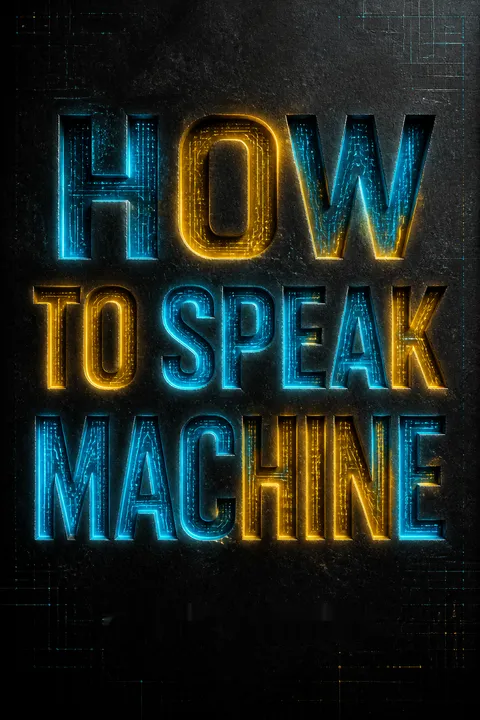
The lasting contribution is its insistence that computation is not separate from culture. A loop is a technical structure; what it repeats is a social choice. A model’s output reflects its data and its makers’ priorities. Design, therefore, is not merely the screen or object presented to a user. It includes the rules, feedback channels, defaults, and working conditions that shape the experience. Learning to speak machine matters because it helps people deliberate about those choices, while remembering that the people affected by them remain the point of the exercise.
Review Summary
Readers found How to Speak Machine to be an accessible introduction to computational thinking for non-technical audiences. Many appreciated Maeda's unique perspective combining art and technology, as well as his clear explanations of complex concepts. Some technical readers felt the content was too basic, while others found value in Maeda's insights on AI, diversity in tech, and the future of human-computer interaction. The book's structure and pacing received mixed reviews, but overall it was praised for its thought-provoking ideas and approachable style.
People Also Read






Glossary
recursion
Self-referential repetitionA computational method in which a process is defined by applying the same process to a smaller or simpler version of the problem. A recursive program needs a stopping condition, called a base case, or it can continue indefinitely. Maeda uses branching trees, nested dolls, and the GNU name to make this self-reference easier to picture.
Moore's law
Rapid computing growthA prediction associated with engineer Gordon Moore that computing capability would increase exponentially over time. Maeda uses it as a shorthand for the accelerating growth in processing power and memory that helps make large-scale computation, machine learning, and frequent software updates practical. It is a technological trend, not a literal law guaranteeing the same pace forever.
minimum viable product (MVP)
Small testable productAn early, limited version of a product that provides enough functionality to be released and evaluated by users. Its purpose is to test an idea and gather evidence before investing in a more complete version. Maeda warns that viability is often interpreted too narrowly as technical reliability, with insufficient attention to whether the experience is appealing.
minimum viable lovable product (MVLP)
Useful product with emotional appealMaeda's extension of the minimum viable product idea. The product must work at a basic level, but it should also offer enough comfort, delight, or fit with people’s lives to encourage them to use it. The added standard matters because digital products now compete for broad audiences, not only technically minded users who may tolerate rough experiences.
omotenashi
Anticipatory hospitalityA Japanese concept of hospitality that includes greeting and serving people attentively, anticipating needs, and making the experience feel thoughtful. Maeda connects it to digital personalization: a service can use information about a user to tailor what it offers. The concept also raises an ethical question about whether that knowledge is used respectfully and with appropriate permission.
thick data
Context-rich human observationQualitative information gathered through close attention to people’s experiences and circumstances. Unlike large-scale behavioral metrics, thick data can help explain why a pattern occurs and what it means to the people involved. Maeda uses it to argue that product teams should combine numerical evidence with interviews and observation rather than mistake measurable behavior for a full explanation.
data humanism
Human context for dataMaeda’s term for interpreting quantitative evidence through attention to people’s lived experience. Data science can identify patterns across many observations, while data humanism asks why those patterns matter and what circumstances produced them. It encourages teams to balance statistical analysis with listening, especially when decisions based on data could affect people’s opportunities or well-being.
Centaur era
Human and AI partnershipA stage in software development where human teams work with relatively lightweight artificial intelligence to improve cloud-based products. The name evokes a human joined with a horse: people contribute judgment and direction, while computational systems offer speed and scale. Maeda presents this as a hybrid stage in which people still actively shape software improvements.
Conway's Game of Life
Local rules, collective patternsA mathematical cellular automaton played on a grid, where simple rules determine whether each cell lives, dies, or becomes populated based on nearby cells. No rule instructs cells to form groups, yet patterns can move, persist, or interact. Maeda uses the game to illustrate how local relationships can produce unexpected collective behavior.
FAQ
What is "How to Speak Machine" by John Maeda about?
- Bridging Design and Computation: The book explores how computation is fundamentally changing the way we design, build, and interact with products and services, emphasizing the need for non-technical people to understand the "language" of machines.
- Six Laws of Machine Design: Maeda introduces six core laws that govern computational design: Machines Run Loops, Machines Get Large, Machines Are Living, Machines Are Incomplete, Machines Can Be Instrumented, and Machines Automate Imbalance.
- Human and Machine Synergy: The narrative weaves Maeda’s personal journey between the worlds of design and technology, advocating for a balance between human values and computational power.
- Accessible for Non-Techies: The book is written to demystify complex computational concepts for designers, business leaders, and anyone interested in the digital world, without requiring a background in computer science.
Why should I read "How to Speak Machine" by John Maeda?
- Understand the Digital World: The book provides essential insights into how computation shapes modern life, making it valuable for anyone working with or impacted by technology.
- Empowerment Through Knowledge: Maeda argues that understanding computation is a form of power, enabling readers to participate in shaping the future rather than being passive consumers.
- Bridges Design and Technology: It’s especially useful for designers, business leaders, and creatives who want to collaborate more effectively with technologists.
- Ethical and Humanistic Perspective: The book addresses the ethical implications of technology, emphasizing the importance of inclusion, diversity, and human values in computational design.
What are the key takeaways from "How to Speak Machine" by John Maeda?
- Computation is a New Raw Material: Understanding how machines "think" is as important as understanding traditional materials in design.
- Loops and Scale Matter: Machines excel at repetition and can operate at scales (both large and small) that are unnatural for humans.
- Incompleteness is a Feature: Digital products are never finished; they are always evolving, and iteration is more valuable than perfection.
- Data and Instrumentation: Modern products are instrumented to collect data, enabling rapid feedback and improvement, but also raising privacy and ethical concerns.
- Automation Can Amplify Imbalance: Without conscious intervention, computational systems can perpetuate and even automate social biases and inequalities.
How does John Maeda define "speaking machine" in "How to Speak Machine"?
- Understanding Computational Logic: "Speaking machine" means grasping the logic, culture, and language of computation, not just learning to code.
- Cultural Fluency: It’s about understanding the mindset and problem-solving approaches of technologists, which differ from traditional design or business thinking.
- Beyond Syntax: Knowing how machines process information, repeat tasks, and scale operations is more important than memorizing programming syntax.
- Empathy for Machines and Humans: It involves appreciating both the power and limitations of machines, and how they interact with human needs and values.
What are the "Six Laws of Design for a Computational Age" in "How to Speak Machine"?
- Machines Run Loops: Computers excel at repetition and can perform tasks endlessly without fatigue.
- Machines Get Large: Computational systems can scale exponentially, both in size and detail, far beyond human capacity.
- Machines Are Living: Modern machines exhibit lifelike behaviors, responding to stimuli and learning from data, blurring the line between living and non-living.
- Machines Are Incomplete: Digital products are always evolving; they are never truly finished and thrive on constant iteration.
- Machines Can Be Instrumented: Software can be monitored and measured in real time, enabling rapid feedback and improvement.
- Machines Automate Imbalance: Without careful design, machines can perpetuate and even amplify social biases and inequalities.
How does "How to Speak Machine" by John Maeda explain the concept of loops and recursion in computation?
- Loops as Repetition Engines: Machines are uniquely suited to perform repetitive tasks (loops) without tiring, unlike humans or animals.
- Recursion as Elegant Repetition: Recursion is a special form of repetition where a process refers to itself, enabling compact and powerful solutions to complex problems.
- Real-World Examples: Maeda uses personal anecdotes, such as his early programming projects, to illustrate how loops and recursion simplify and empower computational tasks.
- Artistic and Mathematical Parallels: The book draws connections between recursion in computation and patterns in nature, art, and mathematics (e.g., fractals, Möbius strips).
What does John Maeda mean by "Machines Get Large" and how does exponential thinking differ from linear thinking?
- Exponential vs. Linear Growth: Maeda explains that machines can scale exponentially, meaning their capabilities double repeatedly, leading to explosive growth that’s hard for humans to intuit.
- Nested Loops and Dimensions: By nesting loops within loops, machines can operate in multiple dimensions, creating vast computational spaces and possibilities.
- Powers of Ten: The book references the "Powers of Ten" concept to illustrate how computation allows us to zoom in and out across scales, from the microscopic to the cosmic.
- Losing Human Scale: Maeda warns that operating at such scales can disconnect technologists from human realities, potentially leading to toxic or exclusionary behaviors.
How does "How to Speak Machine" by John Maeda address the idea that "Machines Are Living"?
- Lifelike Behaviors: Modern machines can sense, respond, and adapt to stimuli, mimicking characteristics of living organisms.
- Artificial Intelligence and Machine Learning: The book discusses how advances in AI and neural networks have enabled machines to learn from data and exhibit behaviors that seem intelligent or even empathetic.
- Human Perception of Aliveness: Maeda explores how speed, responsiveness, and persistence in machines can make them appear "alive" to humans, sometimes blurring the distinction.
- Zombies and Automation: He uses the metaphor of "zombies" to describe tireless, automated systems that can outpace humans and potentially create new challenges.
What is the significance of "incompleteness" in computational products according to "How to Speak Machine"?
- Iterative Development: In the digital world, products are never truly finished; they are released early and improved continuously based on user feedback and data.
- Agile and Lean Methodologies: Maeda explains how modern software development favors shipping incomplete products and iterating rapidly, rather than waiting for perfection.
- Timeliness Over Timelessness: The value of a product lies in its ability to evolve and stay relevant, rather than being a static, "timeless" masterpiece.
- Embracing Imperfection: The book encourages readers to value learning and adaptation over initial completeness, making room for innovation and user-driven improvement.
How does "How to Speak Machine" by John Maeda discuss data, instrumentation, and the ethical implications of telemetry?
- Telemetry as Telepathy: Instrumented software can collect detailed data on user behavior, giving companies near-telepathic insight into customer needs and actions.
- Convenience vs. Privacy: Maeda highlights the trade-off between the convenience of personalized services and the risks to privacy and autonomy.
- Data Science and Humanism: The book advocates for combining quantitative (big data) and qualitative (thick data) approaches to truly understand and serve users.
- Ethical Responsibility: With great power comes great responsibility; designers and technologists must be mindful of how data is collected, used, and protected.
What does John Maeda mean by "Machines Automate Imbalance" and how can designers and technologists address this?
- Bias Amplification: Computational systems can perpetuate and even amplify existing social biases if not consciously designed to be inclusive.
- Diversity and Inclusion: Maeda stresses the importance of diverse teams and inclusive design practices to counteract systemic imbalances in technology.
- Open Source as Equity: The book highlights open source software as a means to democratize access and foster collaboration, reducing exclusion.
- Human-Centered Accountability: Ultimately, humans are responsible for the outcomes of automated systems, and must actively work to ensure fairness and equity.
What are the best quotes from "How to Speak Machine" by John Maeda and what do they mean?
- "Computation is an invisible, alien universe that is infinitely large and infinitesimally detailed." — Emphasizes the vast, often incomprehensible nature of the digital world and the need to understand it.
- "Being curious is better than being afraid—for when we are curious we get inventive, whereas when we are afraid we get destructive." — Encourages a mindset of exploration and learning in the face of technological change.
- "Machines are incomplete and imperfect, like us." — Reminds us that technology is a human creation, subject to flaws and continuous improvement.
- "With just the substitution of two letters for one, 'can' turns to 'care' and technology becomes humanized." — Highlights the importance of empathy and human values in technological progress.
- "Mind the humans." — A succinct call to prioritize human needs, ethics, and well-being in the design and deployment of computational systems.

Download PDF
Download EPUB
.epub digital book format is ideal for reading ebooks on phones, tablets, and e-readers.








