

Key Takeaways
Stop treating the blank page as the beginning of writing
Writing starts much earlier. A paper is not built from nothing in one heroic sitting. Its arguments grow through reading, questions, comparisons, and small acts of written thinking. Ahrens’s central claim is that writing is not a final stage after learning. It is the medium through which learning and research happen. Notes made along the way become material for future work, so the eventual manuscript is assembled from ideas already examined on paper, not summoned from memory at a deadline.
Externalize thought early. Writing forces an idea to become specific enough to inspect. A vague impression may feel complete in the mind, but putting it into sentences exposes missing steps and unclear terms. The goal is not to write more pages each day. It is to make ordinary intellectual work produce usable written material.
The book’s strongest reframing is practical as well as philosophical: writing becomes a method of inquiry, not merely a way to report its results. This aligns with research on distributed cognition, the idea that thinking can be shared between a person and external representations such as diagrams, notes, or drafts. A written claim can be revisited and challenged in a way an unrecorded impression cannot. Still, writing is not the only medium of thought. Conversation, observation, and hands-on experimentation can generate insights that prose alone misses. The useful principle is to externalize ideas early enough that they can be tested, whatever form the first record takes.
Build a thinking partner, not a warehouse, for your notes
Luhmann changed the job. Niklas Luhmann, a German sociologist who began as a public servant, first kept notes in conventional ways and found that they did not lead to much. He developed a Zettelkasten, German for a slip-box: a collection of concise notes connected so that ideas can be revisited in different contexts. The system was not simply an archive of what he had read. Its links and sequences helped him test, extend, and combine ideas.
Output followed interaction. Luhmann produced 58 books and hundreds of articles, and his box held roughly 90,000 notes. The book presents the system as a major part of that productivity, not proof that an app or filing method alone makes someone prolific. The box mattered because it was embedded in daily reading, thinking, and writing.
The image of a note system as a partner is useful because it shifts attention from storage capacity to interaction. In knowledge-management terms, an archive answers a query, while a working system also changes the questions a person can ask. Luhmann’s example makes the possibility vivid, but a famous individual case cannot isolate the effect of his method from his expertise, interests, or working circumstances. That does not diminish the practical lesson. It does caution against treating his publication record as a guaranteed return on a certain number of cards. The more transferable claim is that organized, revisitable ideas can support sustained intellectual work.
Give every note one job, then move it to the right home
Use three distinct destinations. Fleeting notes are quick reminders captured before an idea vanishes; they should be processed soon, then discarded. Literature notes record a source’s relevant ideas briefly, in the reader’s own words, alongside its bibliographic details. Permanent notes state one self-contained idea clearly enough to make sense without the original reading context, and are kept in the slip-box. Project notes belong to a particular manuscript, such as its outline or draft, and can be archived or discarded when that project ends.
The distinction prevents clutter. An underlined sentence is not yet a durable idea, and a chronological journal is not automatically a useful knowledge base. Ahrens recommends processing fleeting notes regularly, ideally within a day or so, while the thought is still clear.
This separation resembles the distinction in information systems between capture, reference, and active work. Each layer answers a different question: What did the person notice? What did the source say? What idea is worth developing? Mixing them makes retrieval harder and can disguise unprocessed material as knowledge. The short delay before processing also matters because a reminder loses meaning when its author forgets the context. The limitation is that classification can become its own hobby. A category scheme is helpful only if it reduces friction; the decisive work remains turning raw capture into clear, reusable thought.
Write one durable idea per note and link it across contexts
Build connections, not folders. A permanent note should express one idea in complete sentences, with its source made clear. Give it a stable place or identifier, then connect it to notes that support, complicate, contradict, or extend it. The aim is not to predict every future topic and file the note under the perfect heading. It is to make the note findable through the lines of thought where it may prove useful.
Let order emerge. Luhmann used numbered cards and branches to extend existing discussions, while digital systems can link one note to several others. An index or a small set of entry notes helps locate a topic, but the important structure lies in the relationships among the notes. One claim about scarcity, for instance, could connect to notes on inequality, decision-making, and personal responsibility.
This is a form of associative indexing: ideas are retrieved through relationships, not only through labels assigned in advance. It resembles network models of memory, where a cue can activate connected concepts and make unexpected material available. The method also makes categorization provisional. A note can acquire new meanings as a thinker’s questions change, instead of being trapped in one folder chosen at the moment of capture. But links are not evidence of a meaningful relationship. A dense graph can become decorative clutter if each connection is not explained or tested. A brief note about why two ideas belong together keeps linking intellectual rather than merely technical.
Rewrite what you read to test understanding, not just familiarity
Paraphrase to find the gaps. Ahrens advises reading with a pen and recording what matters in the reader’s own words. Copying a striking sentence can preserve its wording while leaving its argument misunderstood. Restating the idea requires identifying its point, assumptions, and limits. The reader can then decide whether it connects to existing questions or deserves a permanent note.
Practice beats rereading alone. The book describes a study in which students who took lecture notes by hand showed better understanding than students who typed, a result attributed to handwriting’s slower pace and its pressure to summarize rather than transcribe. Ahrens does not require handwriting at every stage. The central practice is active explanation, which can reveal misunderstanding and make learning more durable than underlining passages for later review.
The crucial distinction here is between recognition and recall. Familiarity from rereading can feel like mastery, whereas explaining an idea without copying its language is a more demanding test. This is closely related to retrieval practice and elaboration, both of which support learning by requiring information to be reconstructed and connected. The handwriting finding is suggestive, not a universal command to abandon keyboards: the value depends on whether the tool encourages thought or verbatim capture. Digital writing can support excellent synthesis too. The standard should be cognitive engagement, not nostalgia for a particular medium.
Let accumulated notes reveal your topic instead of guessing upfront
Research is a loop. Ahrens argues that choosing a topic before reading and thinking often forces writers to defend an early guess. Instead, notes accumulate around questions that repeatedly attract attention. As connections and clusters form, a promising subject becomes visible along with some of the evidence and arguments needed to develop it. The topic is discovered through work, not selected from a blank mind.
Interest can change. A note from one book may unexpectedly connect to another area, prompting a better question than the one that began the search. This bottom-up process also offers a defense against confirmation bias, the tendency to notice information that supports an existing belief. Writers can welcome contradiction because it develops the inquiry rather than threatening a fixed outline. For assigned work, the prompt still sets boundaries, but the argument can evolve within them.
The approach treats research as exploration under uncertainty, closer to iterative scientific inquiry than to executing a fixed project plan. It also creates a useful buffer between encountering evidence and committing to a thesis, which can reduce motivated reasoning. Yet open-ended exploration has costs: some projects have hard deadlines, defined deliverables, or limited scope. Without a constraint, a note network can expand indefinitely. A practical balance is to let evidence shape the question while using external requirements to define the project’s boundaries. Flexibility is productive when it changes direction in response to insight, not when it postpones a decision forever.
Separate writing tasks so attention can change without derailing progress
Different work needs different focus. Research, outlining, drafting, and proofreading are often bundled together as writing, even though each requires a different stance. Drafting needs room to develop an idea; proofreading needs distance from the sentences; outlining requires attention to the whole argument. Switching among these demands while trying to do them simultaneously makes each harder.
Make progress easy to resume. Break the vague project of writing a paper into tasks that can be completed in a work session. Record unfinished questions and the next useful point of inquiry, so the brain does not have to keep the whole project active. The book also recommends keeping several lines of work available, so a block in one task does not end the day. It rejects rigid plans in favor of a dependable structure that leaves room to respond to new findings.
This advice anticipates current concerns about task switching: changing attention carries a cost, and people may mistake the activity of switching for productivity. Distinct work modes also explain why premature editing can stall a draft. External notes and visible outlines reduce the need to reconstruct context after a break. The book’s discussion of willpower is more debatable, since the limited-resource account of ego depletion remains contested. Its practical case does not depend on that theory, however. Clear tasks, fewer organizational choices, and reliable stopping points can make work easier to resume regardless of how motivation is modeled.
Use meaningful connections to make old knowledge retrievable and new ideas possible
Connections give ideas more cues. The slip-box is useful not just because it stores information, but because a new note can lead to older material the writer did not set out to find. Repeatedly comparing notes can expose a contradiction, clarify a distinction, or reveal a pattern across different subjects. That work also supports learning: an idea connected to several meaningful contexts is easier to understand and retrieve than an isolated fact.
Surprise needs structure. Ahrens presents the box as a place where ideas can combine in ways that were not planned. Its value comes from standard notes that can be compared and recombined, not from a magical property of software. The links should be meaningful, and notes should remain clear enough to be checked against their sources. The system can suggest a possibility; the writer still has to judge whether the argument holds.
This account joins two processes often treated separately: memory and creativity. Retrieval cues help knowledge become accessible, while comparison can support analogical reasoning, the transfer of a pattern from one setting to another. In this sense, an interconnected collection is not merely a larger store; it changes what combinations are available for thought. The same openness carries a risk. Human beings readily see patterns, including spurious ones, so a surprising connection should prompt investigation rather than confidence. Links are most valuable when they lead to a testable question, a useful contrast, or a better explanation.
Make small note-making sessions the engine of long-term output
Choose a repeatable unit. Ahrens argues that manuscript pages are a poor daily measure because one page may require weeks of reading and thought. A permanent note is a more bounded task: it can be written, checked, and connected in one sitting. The book suggests that three notes a day can build a substantial body of material over time; Luhmann averaged about six across the years he used his system.
Finish by assembling, not inventing. When a cluster of notes supports a question, gather the relevant material, arrange it into an outline, identify gaps, and draft a connected argument. The first draft is meant to be revised. Ahrens’s workflow turns writing into a sequence of manageable acts, while the shared note base can also supply material for more than one project.
Small units create frequent feedback. A writer can see whether a note is understandable, whether a connection is useful, and whether the system is actually producing material. That is more actionable than a distant goal such as finishing a book. The comparison between three daily notes and Luhmann’s output should not become a quota race: counting notes can reward shallow fragments unless quality and links matter too. The durable habit is a regular cycle of capture, clarification, connection, and use. Productivity emerges not from the count alone, but from notes that remain usable when a real argument needs them.
Analysis
How to Take Smart Notes is best understood as a practical theory of intellectual work. Its central intervention is not a clever filing method but a different location for the hard part of writing. Instead of treating reading and research as preparation for a manuscript, Ahrens makes them stages of writing itself. The writer records and revises ideas while they are still being formed, then draws on that accumulated work to produce a linear text. This changes the blank page from a starting point into an assembly problem.
The system’s design is deliberately spare: short, self-contained notes; stable references; and explicit links. That simplicity matters because its purpose is not merely to retrieve known information. It is to create conditions for comparison, contradiction, and unplanned discovery. A note connected to multiple lines of thought can acquire new uses without being rewritten to fit a new folder. In this respect, the slip-box resembles an external model of memory and a small research environment at once.
The book’s account of learning is especially persuasive when it connects note-making to paraphrase, elaboration, and active recall. Those practices require more than recognition and can reveal what a reader has not understood. Its workflow also offers a convincing remedy for the practical costs of attention switching: distinct tasks, written stopping points, and an easy way to resume.
Some claims deserve narrower interpretation. Luhmann’s remarkable output illustrates the method but does not establish its causal effect, and the book’s expansive claims about productivity cannot be guaranteed by copying his system. Nor should bottom-up exploration displace legitimate deadlines, explicit research questions, or editorial judgment. The method can also become a new form of procrastination if note design and linking replace the creation of finished work.
Its best use is therefore as an intellectual infrastructure, not a productivity oracle. A note earns its place when it sharpens understanding, strengthens a connection, or helps an argument move forward. The test is not whether the box is impressive, but whether it makes the next piece of thinking easier to do and easier to inspect.
Review Summary
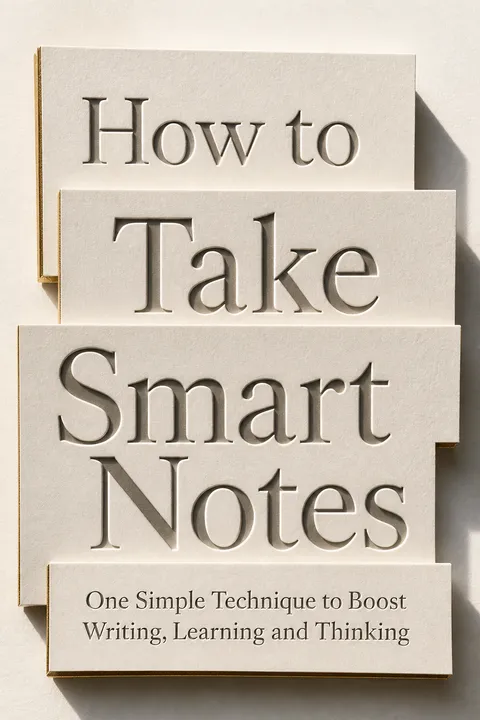
How to Take Smart Notes presents a note-taking method based on Niklas Luhmann's Zettelkasten system. Many readers found it transformative for their learning and writing processes, praising its potential to improve productivity and knowledge retention. The book emphasizes writing as thinking and advocates for a linked, non-hierarchical system of notes. While some critics felt it was repetitive or lacked practical examples, most readers appreciated its insights into effective reading, note-taking, and knowledge management. The book's impact extends beyond academia, appealing to lifelong learners and writers across various fields.
People Also Read







Glossary
Zettelkasten
Linked idea-note systemA Zettelkasten, or slip-box, is a collection of concise, durable notes connected by explicit references. Each note records an idea in a form that can be understood outside its original reading context. Links let notes participate in several lines of thought, so the system can support retrieval, comparison, and the development of new arguments.
Fleeting notes
Temporary thought remindersFleeting notes are quick captures of thoughts, observations, or reminders made while reading or doing something else. They need not be polished or fully explained because their immediate purpose is to preserve a cue for later processing. They should be reviewed soon, clarified or discarded, rather than allowed to accumulate as an unsearchable archive.
Literature notes
Brief notes on sourcesLiterature notes record relevant points from a source, alongside its bibliographic details. They should be selective and written in the reader’s own words, not treated as a transcript or a collection of copied quotations. Their job is to support understanding and provide a reliable bridge from a text to self-contained ideas in the slip-box.
Permanent notes
Self-contained reusable ideasPermanent notes express one idea clearly enough to remain understandable after the writer has forgotten the reading or conversation that prompted it. They use complete sentences, identify relevant sources, and connect to related notes. Unlike temporary reminders or project-specific drafts, they are kept as part of a growing network for future thinking and writing.
Project notes
Materials for one projectProject notes serve a particular manuscript or other defined piece of work. They may include outlines, draft passages, task lists, comments, and collections of project-specific sources. Because their function depends on that project, they are kept apart from reusable permanent notes and can be archived or discarded when the project is complete.
Note sequences
Developing chains of notesNote sequences are connected runs of notes that extend a discussion or line of reasoning. Each note remains individually understandable, while its links show how it responds to or develops other ideas. Sequences provide more structure than a collection of isolated notes without imposing a complete topic hierarchy in advance.
FAQ
What's "How to Take Smart Notes" about?
- Focus on Note-Taking: "How to Take Smart Notes" by Sönke Ahrens is centered around a note-taking technique inspired by Niklas Luhmann's Zettelkasten method, which emphasizes creating a network of interconnected notes to enhance writing, learning, and thinking.
- Boosting Productivity: The book outlines how this method can significantly boost productivity by transforming the way we approach writing and research, making it more efficient and enjoyable.
- Tool-Agnostic Approach: Ahrens keeps the book tool-agnostic, focusing on the principles of the Zettelkasten method rather than specific software, making it adaptable to both digital and analog systems.
Why should I read "How to Take Smart Notes"?
- Enhance Writing Skills: The book provides a systematic approach to improve writing skills by integrating note-taking into the writing process, making it easier to develop and articulate ideas.
- Improve Learning and Thinking: It offers strategies to enhance learning and critical thinking by encouraging the reader to engage deeply with the material and make meaningful connections.
- Practical and Timeless: Ahrens presents a practical method that is not dependent on the latest technology, focusing instead on timeless principles that can be applied across various disciplines and professions.
What are the key takeaways of "How to Take Smart Notes"?
- Writing as Thinking: Writing is not just a way to present ideas but a tool for thinking and developing them. The process of writing helps clarify thoughts and generate new insights.
- Interconnected Notes: The Zettelkasten method emphasizes creating a network of notes that are interconnected, allowing for the emergence of new ideas and insights through the relationships between notes.
- Simplicity and Structure: The method advocates for simplicity in note-taking and a structured approach to organizing notes, which helps in managing complex information and ideas effectively.
How does the Zettelkasten method work according to Sönke Ahrens?
- Two Types of Notes: The method involves creating two types of notes: literature notes, which summarize and reflect on the content of what you read, and permanent notes, which are written in your own words and connected to other notes.
- Linking Notes: Each note is linked to others, creating a web of ideas that can be explored and expanded upon, facilitating the development of complex arguments and insights.
- Indexing System: An index is used to keep track of notes and their connections, allowing for easy retrieval and exploration of ideas.
What are the benefits of using the Zettelkasten method?
- Enhanced Creativity: By connecting notes, the method encourages the discovery of new ideas and perspectives, fostering creativity and innovation.
- Efficient Writing Process: The method streamlines the writing process by providing a rich pool of interconnected ideas to draw from, reducing the time and effort needed to develop a coherent argument.
- Long-Term Learning: It supports long-term learning by encouraging the continuous development and refinement of ideas, making it easier to retain and apply knowledge.
How can "How to Take Smart Notes" improve my academic writing?
- Structured Workflow: The book provides a structured workflow that integrates reading, note-taking, and writing, making the process more efficient and less overwhelming.
- Focus on Understanding: It emphasizes the importance of understanding and engaging with the material, which leads to more insightful and well-supported arguments in academic writing.
- Avoiding Writer's Block: By continuously developing ideas through notes, the method helps prevent writer's block, as you always have a starting point for your writing.
What are the best quotes from "How to Take Smart Notes" and what do they mean?
- "One cannot think without writing." This quote highlights the central theme of the book: writing is an essential tool for thinking and developing ideas.
- "Writing is not what follows research, learning or studying, it is the medium of all this work." This emphasizes the idea that writing should be integrated into the entire process of learning and research, not just the final step.
- "The quality of a paper and the ease with which it is written depends more than anything on what you have done in writing before you even made a decision on the topic." This underscores the importance of preparation and the role of note-taking in producing high-quality writing.
How does Sönke Ahrens suggest overcoming common writing challenges?
- Breaking Down Tasks: Ahrens suggests breaking down the writing process into smaller, manageable tasks, which helps maintain focus and reduce overwhelm.
- Regular Note-Taking: By taking regular notes and connecting them, you build a reservoir of ideas that can be drawn upon when writing, reducing the pressure of starting from scratch.
- Embracing Flexibility: The method encourages flexibility in the writing process, allowing you to adapt and refine your ideas as you go, rather than sticking rigidly to a preconceived plan.
What role does simplicity play in the Zettelkasten method?
- Focus on Essentials: The method emphasizes focusing on the essentials and avoiding unnecessary complexity, which helps maintain clarity and efficiency in the note-taking process.
- Standardized Format: By using a standardized format for notes, the method reduces the cognitive load associated with organizing and retrieving information.
- Facilitating Connections: Simplicity in note-taking facilitates the creation of connections between ideas, which is crucial for generating new insights and understanding complex topics.
How does "How to Take Smart Notes" address the issue of information overload?
- Selective Note-Taking: The method encourages selective note-taking, focusing on the most relevant and insightful information, which helps manage the volume of information.
- Interconnected System: By creating an interconnected system of notes, the method allows for efficient retrieval and exploration of ideas, reducing the feeling of being overwhelmed by information.
- Continuous Refinement: The process of continuously refining and connecting notes helps distill information into its most useful and meaningful form, making it easier to manage and apply.
How can the Zettelkasten method be applied to digital tools?
- Tool-Agnostic Approach: Ahrens emphasizes that the principles of the Zettelkasten method can be applied to both analog and digital tools, allowing for flexibility in implementation.
- Digital Note-Taking Apps: Many digital note-taking apps, such as Obsidian or Roam Research, support the creation of interconnected notes, making them suitable for implementing the Zettelkasten method.
- Focus on Principles: Regardless of the tool used, the focus should remain on the principles of creating, connecting, and indexing notes to build a network of ideas.
What is the significance of the quote "Writing itself makes you realise where there are holes in things"?
- Revealing Gaps: Writing helps reveal gaps in understanding and arguments, prompting further exploration and refinement of ideas.
- Clarifying Thoughts: The process of writing forces you to clarify your thoughts and articulate them clearly, which can lead to new insights and a deeper understanding of the topic.
- Iterative Process: Writing is an iterative process that involves revising and refining ideas, and this quote highlights the importance of embracing this process to improve the quality of your work.
Download PDF
Download EPUB
.epub digital book format is ideal for reading ebooks on phones, tablets, and e-readers.








