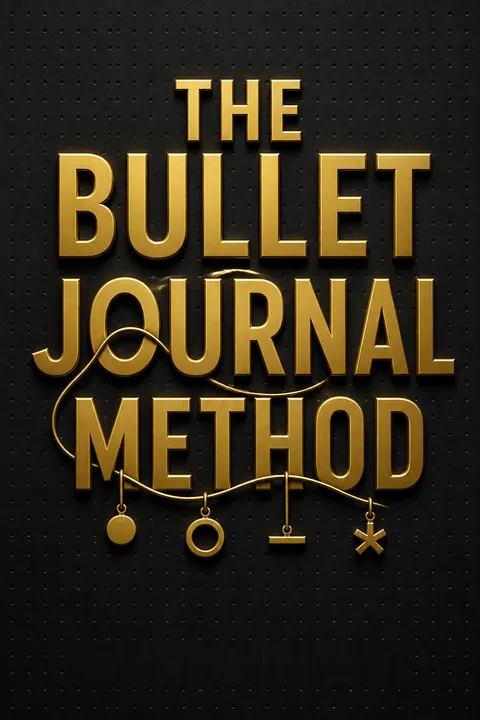


Key Takeaways
Turn a paper record of daily life into choices aligned with what matters.
A system born from friction. Ryder Carroll developed the Bullet Journal after conventional planners failed to fit the way his attention-deficit disorder worked. His notebook combined planning, notes, task lists, and sketches, then grew into a method for recording experience and deciding what deserves attention. Its purpose is not simply to make a longer to-do list, but to connect daily actions with personal priorities.
Two parts, one practice. The system organizes information; the practice uses that record to reflect, clarify values, and choose what to do. Sandy, an overwhelmed parent, used her journal to track family schedules, bills, and small creative goals. The habit helped her regain order, but also gave her a regular moment to focus and notice progress. The journal is useful when it supports that kind of agency, not because paper is magical.
The method treats organization as a means of self-direction, not as an end in itself. That distinction matters in a culture where planning can become an elegant way to postpone action. A written record also acts as cognitive offloading: information no longer has to be held in working memory, leaving more attention for decisions. The paper format may help by creating a quiet ritual, though it is not inherently superior to digital tools. The meaningful test is whether the chosen medium reduces friction and helps a person make better decisions.
Empty your mental closet before deciding what deserves your attention.
List before judging. The Mental Inventory is a first-pass exercise for getting commitments out of your head. Divide a page into three columns: what you are working on, what you think you should work on, and what you want to work on. Keep entries short, and let associated tasks surface. The result is a view of where attention is going and where it might go instead.
Make each item justify itself. Ask whether it matters to you or someone you love, and whether it is vital to daily life. If neither applies, consider what would happen if it never got done. Carroll recounts the advice given to Warren Buffett’s pilot: choose five major goals and treat the rest as distractions until those five are achieved. The point is not to imitate the goals, but to stop treating every possible task as a current obligation.
This exercise turns vague overload into a choice architecture. Separating what is expected from what is desired can expose a common source of stress: confusing social pressure with personal commitment. Its strength is subtraction, not clever prioritization. The test also needs humane interpretation. Caregiving, maintenance, and recovery may matter even when they do not feel inspiring, and some obligations cannot simply be discarded. The exercise works best as a prompt to renegotiate commitments where possible, rather than as a demand to optimize every hour.
Capture tasks, events, and notes in one searchable stream.
Write in a compact code. Rapid Logging is the Bullet Journal’s short-form method for recording information as it happens. Each entry is a task requiring action, an event that happened or is scheduled, or a note worth remembering. Brief entries save time, while a clear topic and page number make a page easier to understand and find. Tasks can be marked complete, moved to another list, scheduled for a later month, or dropped.
Let the notebook stay flexible. The Daily Log catches the day’s changing mix of information. The Monthly Log offers a calendar and a task overview; the Future Log holds dated items beyond the current month; and the Index points to important pages and projects. These modular Collections can be rearranged as needs change. One parent in the book kept a child’s medical details and seizure record in a journal, information that helped emergency responders act quickly.
The system combines capture with retrieval, two problems that productivity tools often solve separately. A single record can reveal links between work, health, relationships, and habits that scattered apps conceal. Its simple categories also lower the burden of deciding where every thought belongs. The tradeoff is that a notebook must be carried, maintained, and protected, especially when it contains sensitive information. A hybrid approach can preserve the journal’s reflective role while using digital tools for search, reminders, sharing, or secure backup.
Make unfinished tasks earn their place at every monthly review.
Rewrite to reconsider. Migration is the regular transfer of unfinished items to a new page, Collection, or future month. At the end of a month, review open tasks one by one. If an item no longer matters, cross it out. If it still matters, rewrite it where it belongs and mark the old entry as moved. A dated task outside the current month goes into the Future Log.
Use friction as a filter. Rewriting takes just enough effort to interrupt automatic carryover. The question is not merely why a task remains incomplete, but whether it still deserves time. At the end of a year or notebook, review the Index and decide which projects and practices are worth keeping. Migration turns an accumulating list into a recurring audit of commitments, helping prevent forgotten tasks from multiplying into a permanent sense of obligation.
Migration makes review part of the workflow rather than an optional ceremony. In behavioral design, a small pause can interrupt automatic habits and create an opening for deliberate choice. Here, the effort of rewriting serves as a checkpoint: repeated carryover becomes visible evidence that a task may be poorly defined, badly timed, or unnecessary. Still, effort is not a reliable measure of importance by itself. A meaningful task may be difficult to rewrite, while a trivial one may be easy. The pause matters; the judgment must remain personal.
Review your record to replace distorted memory with usable perspective.
Close the loop each day. Daily Reflection means checking the journal in the morning and evening. The morning review surfaces open tasks and helps set priorities. The evening review updates the record, marks finished work, removes irrelevant items, and asks why the remaining tasks matter. The book suggests keeping the practice brief and consistent rather than waiting for the perfect reflective mood.
Use evidence, not just recollection. Carroll tells of Michael, who reviewed his entries after a breakup and realized that the relationship had been less caring than his memory suggested. The record gave him perspective. A journal can also counter the tendency to overlook ordinary good moments: writing down a satisfying meal, a completed task, or time with a friend makes progress and gratitude easier to see. Reflection is a way to learn from experience, not a trial in which the past self is sentenced.
A contemporaneous record can correct the mind’s tendency to reconstruct experience around present feelings. It also creates a feedback loop: intention, action, review, and adjustment. That makes reflection useful for both practical planning and emotional perspective. The same practice can become rumination if every entry is repeatedly analyzed for hidden meaning. A helpful review stays curious and specific: what happened, what mattered, and what might be changed? Recording positive moments is not forced optimism; it broadens the evidence considered when judging a difficult week.
Choose goals for their meaning, not for the happiness they promise.
Success can miss its target. Carroll describes spending nights and weekends building Paintapic, a successful custom paint-by-number business. When the product launched, he ordered a kit, carried it home, and lost interest before opening it. The achievement had answered the entrepreneurial challenge he enjoyed, but not a deeper desire to use the product. The story asks a practical question: what is the effort meant to give you?
Follow what draws attention. The book argues that happiness is temporary and people often misjudge how long success will satisfy them. Meaning is more durable when goals connect to felt interests, relationships, or contribution. Its Two Lives exercise asks readers to imagine the consequences of a familiar, comfortable path and a riskier path, then write an obituary for each. The contrast can reveal aspirations worth testing, rather than goals borrowed from status, advertising, or other people.
The distinction between pleasure and meaning helps explain why external milestones can disappoint even when they are objectively impressive. It resembles a central idea in motivation research: sustained effort is more likely when a goal feels personally endorsed rather than imposed. Yet curiosity is a signal, not an infallible compass. It can point toward novelty, avoidance, or a passing fascination as readily as enduring purpose. The book’s strongest safeguard is experimentation: treat a sense of meaning as a hypothesis to examine through action, not a revelation that must be obeyed.
Test a dream in short sprints before betting years on it.
Make ambition testable. A Sprint is a short, self-contained project that tests part of a larger goal. It should have a clear outcome, actionable tasks, few barriers to starting, and a limited time frame, ideally a week or two and less than a month. Carroll’s childhood dream of stop-motion animation changed after he made a small film and discovered that the work did not suit him as a career. The experiment gave him useful information without requiring a life-sized commitment.
Improve through repeated trials. Break a goal into smaller questions and actions, then review what worked. The book connects this approach to kaizen, continual improvement through manageable changes, and the Plan, Do, Check, Act cycle. A completed Sprint provides evidence, motivation, and an opportunity to revise the larger goal. A failed attempt can still be a successful test if it clarifies what to try next or what to stop pursuing.
Small experiments bring the logic of prototyping into personal decisions. Instead of debating an imagined future, a person gathers evidence from a limited trial. This reduces the cost of changing direction and makes progress more visible. The method is especially useful when identity and career decisions are uncertain, because it separates liking an idea from liking its daily practice. A caution: not every worthwhile commitment can be tested cheaply, and short trials may underrepresent the patience required for mastery. The point is not to avoid commitment, but to commit with better information.
Time-box difficult work before avoidance turns it into an emergency.
Give a task boundaries. Time boxing assigns an activity a defined block of time. Carroll uses tax preparation as an example: divide the work into short sessions for gathering documents, organizing information, and submitting the return instead of postponing everything until the deadline. A bounded session can make a daunting task feel manageable while adding enough urgency to hold attention.
Protect your best attention. The book recommends scheduling difficult or commonly postponed work early in the day, adjusted for the time when a person is most focused. Constantly switching tasks can leave attention partially attached to unfinished work, making the next task harder. The chapter also invokes memento mori, the reminder that life is finite, and recounts Carroll’s regret at delaying a call to his grandfather. A schedule is not just a container for obligations; it is a choice about where limited attention goes.
Time boxing translates an abstract intention into a boundary that can be acted on now. It can reduce the intimidation of open-ended work and make procrastination more costly than beginning. The approach also respects a basic constraint of attention: switching tasks is not free. However, a calendar cannot manufacture energy or control interruptions, and putting every difficult task first may be unrealistic for people with caregiving or variable work. The technique is most useful as a flexible experiment: protect one meaningful block, then adjust its timing and size based on actual experience.
Spend effort on your response, not outcomes outside your control.
Separate action from outcome. Drawing on Stoic philosophy, Carroll distinguishes events a person cannot control from the response they can choose. Another person’s approval, a promotion, or a friend’s decision cannot be commanded. Actions such as preparing, listening, or raising a concern are more directly within reach. The journal can help convert an outcome-focused goal into a process task that is actionable.
Pause before reacting. When a colleague’s remark provokes anger, the book recommends writing an unsent letter to clarify what happened, why it hurt, and what response might help. The exercise creates distance from the first impulse and may reveal a misunderstanding or another person’s perspective. The author also stresses that behavior affects others: irritation can spread through a team or household, while patience and support can travel outward too. Responsibility begins with the response, not with pretending that painful events do not matter.
This distinction restores agency without promising control over other people or circumstances. It also protects against a common trap: treating worry as preparation when no available action can change the outcome. Writing before responding can function as emotional regulation, turning an immediate impulse into an account that can be inspected. The nuance is important: focusing on response should not become a reason to tolerate harm or blame oneself for structural constraints. Agency is real, but it operates within limits; wise action includes recognizing when to seek help, set boundaries, or leave.
Keep the journal imperfect, flexible, and useful enough to keep using.
Design for a real purpose. Custom Collections are pages built for specific needs, such as a project plan, a budget, or a habit tracker. A tracker is useful not merely because it records behavior, but because it can reveal patterns that inform action. The book advises keeping layouts legible and sustainable, and favors practical function over decoration. If a page takes so much effort to maintain that it becomes a chore, simplify it or let it go.
Let the tool change with you. Carroll uses wabi-sabi, a Japanese aesthetic that values the character of imperfection and change, to challenge the idea that a notebook must look flawless. A crooked line or messy entry does not erase its usefulness. Collections should be reviewed and revised as needs change. The online Bullet Journal community offers examples, but the standard is personal: does the design help its owner think, act, or learn?
The method’s flexibility is a strength because people’s responsibilities and capacities change. Its emphasis on usefulness also counters the social-media tendency to confuse attractive pages with effective practice. A tracker becomes more informative when paired with context, since a missed workout, for instance, may reflect illness or workload rather than lack of discipline. The design principle therefore extends beyond aesthetics: collect only data that can support interpretation or a decision. Imperfection is not automatically valuable, but accepting it can keep the tool in service of life rather than performance.
Analysis
The Bullet Journal is best understood as a small personal information system joined to a reflective discipline. Its strongest contribution is not any single page layout, but the loop connecting capture, classification, review, and renewed choice. Rapid Logging reduces the cost of recording; the Index and time-based logs make information retrievable; migration creates a deliberate checkpoint; reflection asks whether the resulting activity still deserves attention. In combination, these steps turn a notebook into both an external memory and a record of changing priorities.
The system’s analog friction is purposeful. Handwriting slows capture enough to encourage selection, while rewriting a task interrupts automatic carryover. This is a useful counterweight to digital systems built for speed and limitless storage. But friction is not universally beneficial. For people with motor disabilities, fatigue, limited time, or complex shared workflows, paper may add burden rather than clarity. The book itself allows digital calendars and complementary tools, an important reminder that the method is a set of functions, not a loyalty test for stationery.
The deeper idea is that productivity should be judged by alignment, not volume. The Paintapic story makes that concrete: successful execution can still serve the wrong motive. Regular review can expose that mismatch, but it cannot define meaning on a person’s behalf. Curiosity, memory, and emotional response provide evidence, not certainty. The most reliable use of the journal is therefore experimental: record what is done, observe its effects, and adjust commitments with humility.
A risk follows from the method’s appeal. Planning, trackers, and decorative customization can become substitute accomplishments, creating a polished archive of intentions without corresponding action. The book’s recurring tests, whether a Collection adds value and whether a task remains meaningful, guard against that drift. The journal succeeds when it makes life more legible and action more deliberate, then gets out of the way.
Review Summary
The Bullet Journal Method receives mixed reviews. Many praise its organizational system and mindfulness approach, finding it helpful for productivity and self-reflection. Critics argue the book is overly long and repetitive, with some viewing it as a cash grab. Readers appreciate the flexibility and customization of the method but are divided on the book's philosophical content. Some find the author's writing style engaging, while others find it pretentious. Overall, the book is seen as a useful guide for those interested in bullet journaling, though some suggest online resources suffice.
People Also Read




Glossary
Bullet Journal
Flexible paper planning systemA notebook-based system for capturing tasks, events, notes, and projects, then reviewing them to guide future choices. Its modular pages can serve as a planner, journal, project tool, or record of experience. The method combines this organizational system with a reflective practice intended to align activity with personal priorities.
Rapid Logging
Compact thought captureThe Bullet Journal’s short-form method for recording information as it occurs. Entries are categorized as tasks, events, or notes and written briefly enough to be quick while retaining enough context to remain understandable. Topics and page numbers help identify and retrieve the material.
Collections
Pages grouped by purposeCollections are sets of notebook pages devoted to related information, such as a monthly plan, a reading list, or a project. The core Collections are the Daily Log, Monthly Log, Future Log, and Index. Users can create and adapt others as their needs change.
Migration
Review and move entriesThe process of reviewing open tasks and transferring only those that remain relevant to a new monthly page, a project Collection, or the Future Log. Items that no longer matter are removed. Rewriting creates a pause for reconsideration and helps prevent lists from growing without review.
Mental Inventory
Three-column commitment auditAn exercise for externalizing commitments by listing what a person is working on, believes they should work on, and wants to work on. Each item is then examined for personal importance and practical necessity. The exercise helps reveal distractions and clarify where time and attention might be directed.
Reflection
Regular review of experienceA recurring practice of revisiting notebook entries to examine priorities, actions, and experience. Daily Reflection includes a forward-looking review to prepare for the day and a review of the day’s record. Monthly and yearly reviews use Migration to reconsider commitments and patterns.
Sprints
Short, self-contained trialsLimited projects that break a larger goal into manageable experiments. A Sprint has a clear outcome, actionable tasks, few barriers to starting, and a relatively short time frame. Reviewing a Sprint’s results can build momentum, teach the user about the goal, or show that the larger ambition should change.
time boxing
Bounded work sessionAssigning a task a defined period of time, with a clear start and finish. The limit can make an intimidating or dull activity easier to begin by adding structure and urgency. A complex task can be divided across multiple sessions rather than left until it becomes an emergency.
Deming Cycle
Plan, test, review, adjustA four-stage process for continual improvement: Plan a change, Do or test it, Check the result, and Act on what was learned. In the book, it provides a practical pattern for using small experiments to improve a routine or project instead of relying on a single perfect plan.
Five Whys
Trace a problem’s causesA questioning technique that examines a problem by repeatedly asking why, often for five rounds. Each answer becomes the focus of the next question. The method can uncover underlying conditions and values that a surface-level description hides, helping turn a large concern into smaller possible actions.
Signifiers
Symbols that highlight entriesSmall symbols placed beside notebook entries to make particular information easier to spot or interpret. The book’s examples include marking a task as a priority or identifying an important idea. Signifiers should remain limited so they improve scanning without making the notation cumbersome.
threading
Link related notebook pagesA technique for connecting separate instances of the same Collection by writing one page number beside another. It lets a reader move between related pages without searching through the whole notebook. The method can also link content across different notebooks by including a volume number.
wabi-sabi
Beauty in imperfectionA Japanese aesthetic idea that values impermanence, individuality, and the imperfect character of things. In the book, it offers a way to treat mistakes and irregular pages as compatible with usefulness and growth. The concept shifts attention from flawless presentation toward continued practice and improvement.
FAQ
What's "The Bullet Journal Method" by Ryder Carroll about?
- Overview: "The Bullet Journal Method" is a guide to a productivity system that combines organization, mindfulness, and intentionality. It helps users track their past, order their present, and plan their future.
- Purpose: The book aims to help readers become more organized and mindful by using a simple notebook to capture thoughts, tasks, and events.
- System and Practice: It introduces a system of rapid logging and collections, and a practice of reflection and goal setting to enhance productivity and personal growth.
- Community and Flexibility: The method is adaptable to individual needs and has a supportive community that shares various ways to customize the system.
Why should I read "The Bullet Journal Method"?
- Improve Organization: The book offers a structured yet flexible approach to organizing tasks and thoughts, which can help reduce overwhelm and increase productivity.
- Mindfulness and Intentionality: It encourages readers to be more mindful and intentional with their time and energy, leading to a more meaningful life.
- Personal Growth: By reflecting on past actions and setting clear goals, readers can foster personal growth and self-awareness.
- Community Support: The Bullet Journal community provides inspiration and support, making it easier to adopt and adapt the method to personal needs.
What are the key takeaways of "The Bullet Journal Method"?
- Rapid Logging: A quick and efficient way to capture tasks, events, and notes using symbols and short sentences.
- Collections: Modular building blocks that organize related information, such as daily logs, monthly logs, and custom collections.
- Reflection and Migration: Regularly reviewing and migrating tasks to focus on what truly matters and discard distractions.
- Intentional Living: Encourages living with purpose by aligning actions with personal values and goals.
How does the Bullet Journal system work?
- Rapid Logging: Uses symbols to categorize entries into tasks, events, and notes, making it easy to capture and prioritize information.
- Collections: Core collections like the daily log, monthly log, and future log help organize tasks and events over different time frames.
- Indexing: An index at the beginning of the journal helps locate content quickly, making it easy to reference past entries.
- Customization: Users can create custom collections to suit their specific needs, allowing the system to evolve with them.
What is Rapid Logging in the Bullet Journal Method?
- Core Technique: Rapid Logging is the language of the Bullet Journal, using symbols to quickly capture and categorize thoughts.
- Symbols: Tasks are marked with a dot, events with a circle, and notes with a dash, providing context and priority at a glance.
- Efficiency: This method saves time and helps users stay organized by distilling information into concise entries.
- Flexibility: Users can customize symbols and signifiers to suit their personal needs and preferences.
How do Collections work in the Bullet Journal Method?
- Modular Structure: Collections are templates that organize related information, such as tasks, events, and notes, into coherent groups.
- Core Collections: Include the daily log, monthly log, future log, and index, which form the foundation of the Bullet Journal.
- Custom Collections: Users can create their own collections for specific projects or goals, allowing for personalization and adaptability.
- Dynamic Use: Collections can be added, modified, or removed as needed, making the system flexible and responsive to changing needs.
What is the purpose of the Index in the Bullet Journal?
- Content Locator: The Index helps users quickly find specific content within their Bullet Journal by listing topics and page numbers.
- Dynamic Organization: It allows for non-linear organization, enabling users to add new entries and collections without disrupting the flow.
- Subcollections: Users can create subcollections for complex projects, which are also indexed for easy reference.
- Threading: A technique to link related content across different pages or notebooks, enhancing the journal's navigability.
How does the Bullet Journal Method encourage intentional living?
- Reflection: Regular reflection helps users evaluate their tasks and goals, ensuring they align with personal values and priorities.
- Goal Setting: The method emphasizes setting meaningful goals based on curiosity and personal experience, rather than external expectations.
- Mindful Action: By focusing on what truly matters, users can reduce distractions and make more deliberate choices.
- Personal Growth: The practice of intentional living fosters self-awareness and personal development, leading to a more fulfilling life.
What are some best practices for setting up a Bullet Journal?
- Start Simple: Begin with the core collections—daily log, monthly log, future log, and index—to get familiar with the system.
- Customize Gradually: As you become comfortable, introduce custom collections and symbols to tailor the journal to your needs.
- Consistent Reflection: Regularly review and migrate tasks to maintain focus on priorities and discard irrelevant items.
- Community Engagement: Explore the Bullet Journal community for inspiration, support, and new ideas to enhance your practice.
How can the Bullet Journal Method help with personal growth?
- Self-Reflection: Encourages regular reflection on actions and goals, fostering self-awareness and understanding.
- Goal Achievement: Breaks down goals into manageable tasks and sprints, making it easier to track progress and stay motivated.
- Learning from Experience: By documenting successes and failures, users can learn from their experiences and apply insights to future endeavors.
- Empowerment: The method empowers users to take control of their lives by aligning actions with personal values and aspirations.
What are some common challenges when starting a Bullet Journal, and how can they be overcome?
- Overwhelm: Start with the basics and gradually introduce new elements to avoid feeling overwhelmed by the system's flexibility.
- Consistency: Set aside regular times for reflection and journaling to build a consistent habit and maintain momentum.
- Perfectionism: Embrace imperfection and focus on functionality over aesthetics to prevent getting bogged down by appearance.
- Adaptability: Be open to adjusting the system to better suit your needs, and seek inspiration from the community for new ideas.
What are some of the best quotes from "The Bullet Journal Method" and what do they mean?
- "Productivity is about getting more done by working on fewer things." This emphasizes the importance of focusing on meaningful tasks rather than being busy with many.
- "Happiness cannot be pursued, it can only ensue." Suggests that happiness is a by-product of living a meaningful life, not a direct goal.
- "Intentional living is the art of making our own choices before others’ choices make us." Highlights the importance of being proactive in decision-making to align with personal values.
- "The long way is the short way." Encourages taking the time to reflect and plan, as it leads to more effective and efficient outcomes in the long run.
Download PDF
Download EPUB
.epub digital book format is ideal for reading ebooks on phones, tablets, and e-readers.








