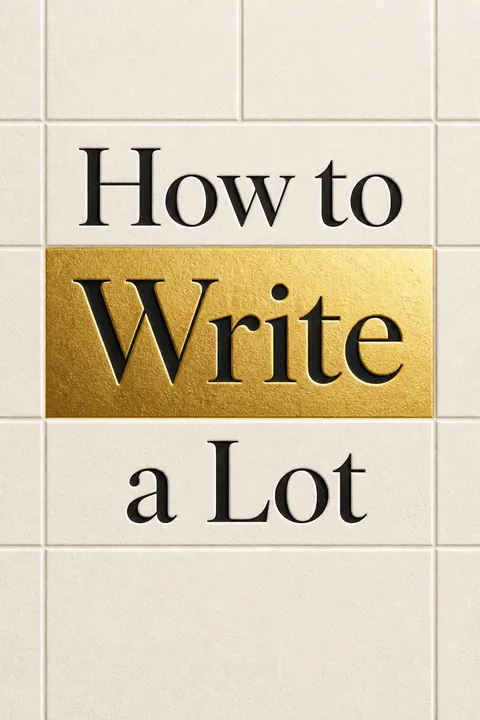


Key Takeaways
Put writing on the calendar, not on the someday list
Treat writing like a class. Silvia’s central claim is practical: productive academic writing depends less on a special identity or sudden inspiration than on regularly doing the work. Schedule writing as you would teaching, during ordinary workdays rather than waiting for a clear week or summer break. Four hours a week is his suggested starting point, not a universal quota. The habit matters more than the exact number of sessions or their length.
Make room for a life. A regular appointment turns writing from a constant source of guilt into a bounded part of the week. Silvia describes changing his own schedule as family life changed, while continuing to write on weekdays. The point is not to publish as much as possible. It is to complete meaningful work without handing evenings, weekends, and vacations over to an endless backlog.
What's compelling is the shift from asking what kind of writer someone is to asking what their week makes possible. This resembles an implementation intention: a specific time and setting make an intended action easier to initiate than a vague goal. The approach also treats leisure as something to protect, not a reward earned after work is finished. A fixed appointment can still fail when teaching loads, caregiving, or health needs change, so a useful schedule should be dependable without becoming a test of personal virtue.
Stop treating inspiration, equipment, and free weeks as prerequisites
Expose the waiting game. Silvia calls common excuses specious barriers: reasons that sound legitimate but keep writing perpetually in the future. The list includes waiting for more reading or analysis, a better desk or computer, inspiration, or a week when other duties are cleared away. Those duties rarely disappear. Treat reading, analysis, outlining, and other work that advances a manuscript as part of writing time, rather than as a gate that must be passed before writing can begin.
Routine beats rare intensity. In a small experiment reported by Robert Boice, struggling professors assigned to write at scheduled sessions produced 3.5 times as many pages as those who wrote only when inspired, and 16 times as many as those told to abstain. The scheduled group also generated creative ideas more frequently. The result makes a strong case for showing up, though it is not a guarantee that every writer or task responds the same way.
The argument is persuasive because it identifies how preparation can imitate progress. A new tool or another article may be useful, but its value depends on whether it moves the actual project forward. The Boice finding gives the advice a behavioral anchor, while the small sample counsels against treating its ratios as universal predictions. The broader lesson is about reducing the cost of starting: regular contact with a difficult task can produce momentum and ideas that waiting for the right mood cannot reliably supply.
Make each session defensible, concrete, and easy to resume
Design for follow-through. Choose times that are both realistic for your energy and hard for meetings to displace. Silvia suggests rejecting a slot unless it can be protected most weeks. A recurring place helps too: repeated cues can make it easier to settle into work, whether the location is a library, office, or quiet corner at home. The ideal setting is the one where writing actually happens, not merely the one that looks appealing.
Give the session an endpoint. Replace vague intentions such as “work on the article” with a task that can be judged: draft a section, revise a paragraph, outline a chapter, or reconcile references. Track whether you showed up, time spent, or words produced. Even a simple yes-or-no log can reveal whether a planned routine is becoming real. Writing time can include any necessary task that advances the project, not just typing prose.
This is an understated form of environment design. When time, place, and a visible next task are stable, less attention is spent deciding what to do and more remains for the work itself. Tracking also corrects memory's tendency to replace a week of intentions with a story of steady effort. The measurements should serve diagnosis, not self-punishment: word counts can be misleading when someone is analyzing data, reading sources, or revising a complex argument. A flexible measure of progress is often more useful than a single productivity score.
Choose a priority rule before your projects start competing
Make the tradeoff visible. Academics often juggle projects with different levels of importance, urgency, age, and appeal. Silvia describes the resulting aimless switching as behavioral chatter: moving among goals without giving any one enough attention to advance. Start by listing current and potential writing projects, then decide what principle will guide the next choice.
Every rule has a cost. Prioritizing the most important project protects ambitious work, but can leave smaller commitments unfinished. Completing the nearest-to-publication task reduces the backlog, but may defer a book or major article. Working oldest-first, easiest-first, or on whatever feels exciting each has similar drawbacks. There is no perfect ordering. The useful discipline is to know why a project has won this week and whether that reason reflects its value, not just its convenience.
This framing usefully turns a familiar feeling of overload into a resource-allocation problem. A portfolio of projects cannot all be first, and switching has costs that a long to-do list conceals. The absence of a single best rule is a strength: departments, deadlines, and intellectual aims differ. It also means a priority system should be revisited rather than followed mechanically. A time-sensitive fellowship or a nearly finished revision may rationally interrupt a book, while repeated interruptions can quietly make the book impossible.
Use peers for accountability, not compulsory critique
Keep the group voluntary. A writing group can reinforce a schedule, make solitary work feel less isolating, and provide a nudge to keep commitments. Silvia’s long-running group meets briefly each week: members review the goals they set, report whether they met them, and name a concrete goal for the next week. Recording goals prevents convenient revisions to memory. Missing a goal is a reason to set a more realistic next one, not to stage a trial.
Pick the right format. A write-together group offers quiet company; an accountability group offers check-ins. Feedback groups can be valuable when participants trust one another and share relevant expertise, but they often falter when members spend more time reviewing than writing. Voluntary membership and low hierarchy matter. A group imposed by a supervisor can feel less like support and more like another obligation.
The social element works best when it creates dependable expectations without turning productivity into public surveillance. In organizational settings, peer norms can make a behavior feel ordinary, while a specific commitment gives vague intentions a deadline. Silvia’s preference for voluntary groups recognizes that support is not one-size-fits-all: some writers benefit from company, others concentrate better alone. Accountability also has limits. If missed goals are met with shame, participants may conceal difficulty instead of adjusting the plan, undermining the very information the group needs.
Draft for meaning first, then revise for sound
Separate making from judging. Trying to produce polished sentences while generating ideas can turn every line into a small referendum on the writer’s competence. Silvia recommends writing a rough draft first and editing in a separate pass. The initial version may be awkward; its job is to give revision something to improve.
Make the reader's path clear. Favor familiar words, define necessary technical terms, and use those terms consistently. Strong verbs and parallel sentence structures can make comparisons easier to follow. Remove filler and inflated phrases when they add no meaning, while recognizing that passive voice can be appropriate when the actor is unknown or unimportant. Clear prose is not a display of simplicity for its own sake. It helps specialists, students, and readers using English as an additional language follow the argument.
Separating drafting from editing resembles the distinction between divergent and convergent thinking: generating possibilities and evaluating them draw on different modes of attention. It can reduce the friction of beginning without lowering standards, because revision remains essential. The advice about accessible language is also an argument about inclusion: unnecessary jargon imposes extra work on readers without necessarily adding precision. Still, clarity is not always achieved by shorter sentences or active voice. Technical complexity sometimes belongs to the idea, so editing should remove needless difficulty rather than flatten meaningful distinctions.
Build the article around its journal's readers, not your entire dataset
Choose the audience early. The same study can speak to different fields, but each field expects different emphases, references, and levels of detail. Silvia advises selecting a target journal before drafting and using its recent articles as models. For empirical papers in many social and health sciences, the familiar structure is IMRAD: Introduction, Method, Results, and Discussion. A focused outline helps keep the manuscript within the journal's typical length.
Guide readers through evidence. The Introduction should frame the problem, develop the relevant ideas, and explain how the study addresses the question. The Method should make procedures and measures understandable. In Results, put central findings first and move dense detail into tables or figures where appropriate. The Discussion should connect the findings to the larger question without turning every possible implication into another section. A paper is stronger when it makes a few important points clearly.
Audience selection is a practical form of rhetorical design. A manuscript does not merely report findings; it tells a community why those findings belong in its conversation. The book's books-and-bookends formula offers one way to shape an Introduction, with a short opening and closing around the main conceptual sections. Journal conventions can help readers navigate, but copying them blindly can preserve habits that no longer serve the argument. Models are most useful as evidence about audience expectations, not as templates that replace judgment.
Treat revision as a map of action points, not a verdict
Expect an imperfect process. Rejection is common in peer review. If a journal rejects 80 percent of submissions, the base acceptance rate is 20 percent, though that figure alone says nothing about the quality of a particular paper. An invitation to revise is an opportunity: extract each actionable request from the editor's letter and reviews, then decide how to respond.
Answer without drama. For each comment, make the change, explain why a suggested change is unsuitable, or ask the editor to decide an uncertain point. Organize the response by editor and reviewer, identify what changed, and point to where it changed. Silvia argues that a thorough, composed response makes the editor's task easier. While waiting for a decision, start or continue another project instead of letting one submission occupy the whole writing life.
A review letter is easier to use when treated as information rather than as a judgment of the author's worth. This is compatible with a broader principle of error correction: a system improves when criticism is translated into specific changes and reasons. Peer review can sharpen methods and arguments, but it is neither perfectly consistent nor free of disciplinary bias. A calm response does not require agreement with every reviewer. It requires distinguishing substantive concerns from preferences, then making the reasoning legible to the editor.
Finish one book chapter at a time, even without a sabbatical
Plan before committing. A scholarly book needs a defined audience, a thesis, and a structure that can support its argument across chapters. Topic alone is not enough: the thesis is the claim readers should understand or reconsider. A detailed table of contents turns a vast project into a sequence of manageable parts.
Keep the project moving. A book does not require a sabbatical if it receives regular time during the work week. The chapter is a useful unit of progress; polishing scattered pages across several chapters can create bulk without completing the argument. Silvia advises saving the opening chapter and preface until the rest of the manuscript clarifies what the book has become. Authors should also protect book time from marginal projects and deliver a manuscript close to the length and scope promised to the publisher.
The book chapter is a natural unit because it combines a meaningful intellectual task with a finish line. That structure can make a project spanning years less psychologically remote. The advice to define audience and thesis before drafting also mirrors project design in engineering: requirements set early constraints that prevent costly rework. Yet plans need room to change as research develops. The aim is not to force new evidence into an old outline, but to preserve enough structure that discovery does not become endless expansion.
Submit grants where your expertise already gives you home-field advantage
Build a repeatable practice. Grant proposals are easier after the first attempt, so Silvia recommends thinking in terms of submitting grants over time rather than making one all-or-nothing bid. Read agency instructions closely, contact the institution's grants office early, study successful and unsuccessful examples, and get feedback on a draft. Start well before the deadline so institutional review does not become a last-minute crisis.
Compete where you belong. Some researchers focus on a few sponsors and build detailed knowledge of their expectations; others submit more widely, accepting that many proposals will fail. Either way, proposals are judged against a field of competitors. Applying to a fashionable topic only loosely connected to one's expertise puts a writer against established specialists. Grant work also consumes time that could produce articles or books, so funding goals should be weighed against the rest of a scholar's work.
Grant strategy is a problem of fit as much as proposal quality. Repeated contact with a small set of funders can build institutional knowledge, while broader submission may suit researchers whose roles depend on grant income. The home-field principle guards against chasing every attractive call, a version of strategic focus found in many competitive domains. But funding priorities are shaped by politics, wealth, and public attention as well as scholarly merit. A strong fit improves the odds; it cannot make the funding landscape fair.
Use the schedule to reclaim weekends, not maximize publication counts
Choose what productivity serves. Silvia is not arguing that every academic should publish more, or that publication totals measure intellectual worth. A schedule can help someone complete a book or clear a backlog, but it can also reduce guilt for a scholar who wants to write selectively. The aim is to make writing a bounded part of ordinary work rather than a permanent claim on personal time.
Reject the next false promise. Many academics expect life to open up after graduate school, a new job, tenure, or retirement. The next demand often arrives first. Protecting writing time during the week and protecting free time outside it both require deliberate choices. More output is useful only when it represents work worth doing. A paper produced merely to add another line to a publication list is not a victory the book asks readers to pursue.
The book's most humane implication is that routine can create freedom, not just output. Bounded work periods can reduce the mental spillover that makes leisure feel contaminated by unfinished tasks. This also resists a familiar institutional distortion: treating measurable publications as a complete account of scholarship. The argument does not erase real constraints, especially precarious employment and heavy teaching or service loads. It does, however, offer a standard for evaluating productivity: whether the work advances ideas the scholar values while leaving room for a life beyond the CV.
Analysis
Silvia's central contribution is to make academic writing behavioral and ordinary. The familiar story says that scholars need more time, stronger motivation, a sabbatical, or a more confident identity. His alternative is narrower and more actionable: reserve recurring time, show up, define the next task, and keep a record. The strategy is powerful partly because it reduces the number of decisions that must be made while facing an unpleasant or ambiguous task. It also exposes how apparently productive preparation, perfectionism, and tool-shopping can postpone the moment of contact with the work.
The book's practical range matters. Scheduling is the core, but the advice follows the writing process from weekly habits to group accountability, sentence-level revision, article structure, peer review, books, and grants. This prevents productivity from being reduced to word counts. Reading, analysis, reference work, and revision count when they advance a project, while an elegant routine is not useful if it serves work the writer does not value. The closing insistence that publication is not a race gives the method an ethical boundary.
The approach is strongest for writers who control at least some of their calendars and whose projects can be broken into recurring tasks. That premise is less available to scholars facing unstable employment, excessive workloads, caregiving demands, or a funding system that dictates their priorities. Scheduling cannot manufacture institutional time or remove inequity. Nor does regularity guarantee originality or quality. It creates repeated opportunities to think, draft, and revise, which is a more credible promise than waiting for ideal conditions. The book's lasting lesson is not that discipline solves every problem, but that predictable work habits can prevent avoidable obstacles from masquerading as permanent barriers.
Review Summary
How to Write a Lot is praised for its practical, no-nonsense approach to academic writing. Readers appreciate Silvia's humor and straightforward advice, which centers on creating and sticking to a writing schedule. Many find the book motivating and helpful for improving productivity. Some criticize it for being overly simplistic or reinforcing a potentially harmful work culture. Overall, most reviewers found value in the book's core message and writing strategies, particularly for academic writers and graduate students.
People Also Read


Glossary
Specious barriers
Plausible excuses for delayReasons for not writing that initially sound legitimate but, on inspection, often protect procrastination. Examples include waiting for a large free block, more preparation, better equipment, inspiration, or a cleared workload. Silvia's response is to schedule writing and include necessary preparatory tasks within that time.
Binge writing
Infrequent, deadline-driven writingA pattern in which writers spend long periods intending and worrying about a project, then attempt to produce a large amount during a concentrated burst. The burst may yield pages, but the cycle of delay, anxiety, and exhausting effort tends to repeat. Silvia contrasts it with regular scheduled sessions.
Windfall writing
Extra writing beyond scheduleWriting done during time that unexpectedly becomes available or after a scheduled session has ended. Silvia welcomes these extra opportunities but cautions against relying on them instead of keeping the regular schedule. Occasional extra time cannot be banked as a substitute for consistent work.
Behavioral chatter
Switching among competing goalsA pattern of moving from one active goal to another without making substantial progress on any of them. Silvia applies the term to scholars who juggle many writing projects without a priority rule. Choosing a consistent basis for deciding what to work on can reduce aimless switching.
IMRAD
Empirical article structureA common organization for empirical papers in social and health sciences: Introduction, Method, Results, and Discussion. The Introduction frames the question, the Method describes how the research was conducted, the Results present findings, and the Discussion interprets them in context.
Books-and-bookends formula
Structured article introductionA way to organize an article's Introduction. A brief opening frames the problem, a central section develops the relevant theories and evidence in a few chunks, and a closing section explains the present research and how it addresses the question. The structure helps writers stay focused and gives readers a clear path.
Boice (1990) study
Scheduled writing experimentAn experiment with a small sample of college professors who struggled with writing. Participants were assigned to abstain from writing, write only when inspired during scheduled sessions, or write during every scheduled session. The scheduled-writing group produced more pages and generated creative ideas more frequently, supporting routine over inspiration alone.
FAQ
What's "How to Write a Lot" about?
- Practical Guide: "How to Write a Lot" by Paul J. Silvia is a practical guide aimed at helping academics become more productive writers.
- Behavioral Approach: The book emphasizes a behavioral approach to writing, focusing on specific actions rather than changing one's identity or values.
- Routine and Efficiency: It advocates for making writing a routine part of the workweek, reducing stress and guilt associated with writing.
- Applicable to All Academics: While it includes examples from psychology, the strategies are applicable to a broad scholarly audience.
Why should I read "How to Write a Lot"?
- Overcome Writing Barriers: The book helps readers identify and overcome common barriers to writing, such as lack of time and procrastination.
- Develop Writing Habits: It provides strategies for developing consistent writing habits, which can lead to increased productivity.
- Balance Work and Life: Silvia offers advice on balancing writing with other professional and personal responsibilities.
- Improve Writing Quality: The book includes tips on improving writing style and clarity, making your work more engaging and effective.
What are the key takeaways of "How to Write a Lot"?
- Schedule Writing Time: Allocate specific times for writing during the workweek, treating it like a class you teach.
- Set Concrete Goals: Break down writing projects into manageable tasks with clear, achievable goals.
- Track Progress: Monitor your writing output to stay motivated and identify areas for improvement.
- Join a Writing Group: Consider joining or forming a writing group for accountability and support.
How does Paul J. Silvia suggest overcoming writing barriers?
- Identify Specious Barriers: Recognize common excuses for not writing, such as waiting for inspiration or needing more time.
- Create a Writing Schedule: Allot regular, defensible time slots for writing, much like scheduling a class.
- Focus on Behavior: Change writing habits by focusing on actions you can take immediately, rather than waiting for the perfect conditions.
- Use Peer Accountability: Leverage writing groups to maintain motivation and accountability.
What is the "writing schedule" method in "How to Write a Lot"?
- Regular Time Slots: Schedule specific times each week dedicated solely to writing, treating it as a non-negotiable appointment.
- Defensible Times: Choose times that are less likely to be interrupted by meetings or other obligations.
- Consistency Over Quantity: The key is regularity, not the number of hours; even a few hours a week can lead to significant progress.
- Flexibility for Windfall Writing: While sticking to the schedule is crucial, additional writing outside these times is a bonus.
How does "How to Write a Lot" address writer's block?
- Writer's Block as a Myth: Silvia argues that writer's block is not a real affliction but a label for not writing.
- Focus on Routine: By following a writing schedule, you can write regularly regardless of feeling inspired.
- Separate Writing Tasks: Distinguish between generating text and revising it to avoid perfectionism during initial drafts.
- Embrace Imperfection: Accept that not every writing session will be productive, but consistency will yield results over time.
What are the benefits of joining a writing group according to Paul J. Silvia?
- Accountability and Goals: Writing groups provide peer pressure to meet writing goals and maintain a schedule.
- Variety of Formats: Groups can focus on setting goals, writing together, or providing feedback, depending on members' needs.
- Voluntary Participation: Successful groups are formed by members who choose to be there, fostering a supportive environment.
- Avoid Hierarchies: Separate groups for faculty and students can prevent power dynamics from hindering open discussion.
How does "How to Write a Lot" suggest improving writing style?
- Choose Good Words: Use clear, concise language and avoid jargon or trendy phrases that obscure meaning.
- Write Strong Sentences: Employ varied sentence structures and use punctuation like semicolons and dashes effectively.
- Avoid Passive Voice: Write in the active voice to make your writing more direct and engaging.
- Revise Separately: Focus on generating text first, then revise for style and clarity in separate sessions.
What advice does Paul J. Silvia give for writing journal articles?
- Pick Your Audience First: Tailor your article to the specific journal and audience you are targeting.
- Follow the IMRAD Structure: Use the Introduction, Method, Results, and Discussion format common in many fields.
- Submit Great First Drafts: Aim for a polished first submission to increase the chances of acceptance.
- Handle Revisions Wisely: Address reviewers' comments thoroughly and resubmit promptly to improve acceptance odds.
What are the reasons for writing a book according to "How to Write a Lot"?
- Make a Difference: Books can reach practitioners and the public more effectively than journal articles.
- Explore Big Ideas: Some concepts require the depth and scope that only a book can provide.
- Learn and Grow: Writing a book can be a way to learn a new field or synthesize existing knowledge.
- Establish Expertise: A book can establish you as an authority in your field and attract opportunities for public engagement.
How does "How to Write a Lot" approach grant writing?
- Write Multiple Grants: Treat grant writing as an ongoing process rather than a one-time effort.
- Compete on Home Field: Focus on proposals that align with your core expertise to increase success rates.
- Be Strategic: Choose whether to be an "elephant" (few, well-crafted proposals) or a "seahorse" (many, less detailed proposals).
- Balance with Publications: Ensure that grant writing does not overshadow the need to publish articles and books.
What are the best quotes from "How to Write a Lot" and what do they mean?
- "Writing is a skill, not a gift." This emphasizes that productive writing comes from learned behaviors and habits, not innate talent.
- "Decide what you want to do, then decide to do it. Then do it." A call to action, encouraging readers to take control of their writing habits.
- "Writing isn’t a race." Reminds readers that the goal is not to publish the most but to write meaningfully and sustainably.
- "Want less and do more." Encourages focusing on actionable steps rather than waiting for ideal conditions or inspiration.
Download PDF
Download EPUB
.epub digital book format is ideal for reading ebooks on phones, tablets, and e-readers.








