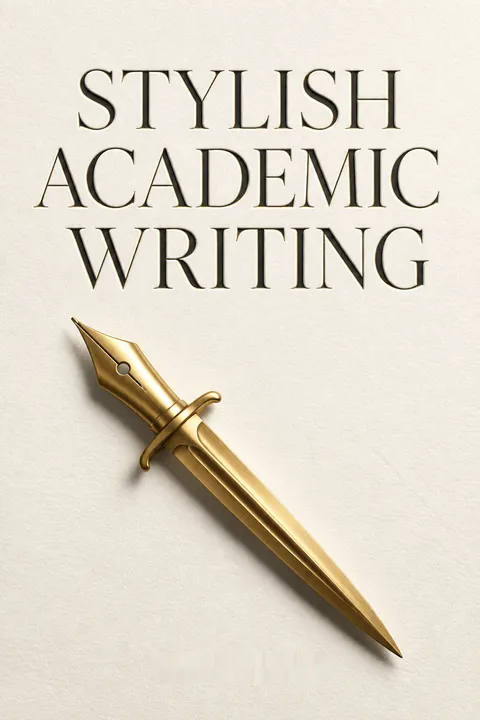


Key Takeaways
Make academic prose engaging without trading away complexity or rigor
Style serves the argument. Helen Sword challenges the belief that lively writing makes scholarship less serious. The aim is not to decorate research with clever phrasing, but to help readers understand complex ideas and care about them. Clear sentences, vivid examples, and a recognizable human voice can carry rigorous thinking rather than dilute it.
Choice beats conformity. Sword draws on interviews with more than seventy academics, analysis of hundreds of scholarly articles, and a survey of writing guides. Across these sources, admired writers share a concern for communication, careful craft, and creative freedom. Their styles differ, but they make deliberate choices instead of treating disciplinary habits as unquestionable rules.
The distinction between style and substance is often false: the way an argument is presented affects what readers can notice, remember, and evaluate. In that sense, clarity is not merely hospitality; it is part of scholarly accountability. Readers cannot test a claim they cannot follow. Still, elegance is not a substitute for evidence, and a compelling narrative can make weak reasoning feel stronger than it is. The useful standard is not whether prose entertains, but whether its choices make the reasoning more visible without disguising its limits.
Treat disciplinary conventions as pressure, not laws
Variation already exists. Sword analyzed 500 peer-reviewed articles across ten disciplines. Medicine showed the strongest uniformity, with every sampled article following the standard research structure or a close variant. Elsewhere, exceptions were common. First-person pronouns appeared in all sampled evolutionary biology articles, but in only 40 percent of the history articles and 54 percent of higher education articles. A convention, the evidence suggests, is not always a command.
Borrow across borders. A children’s hospital invited Formula One pit-stop mechanics to observe surgery. Their suggestions improved coordination and patient transfers. Sword uses the collaboration to argue that specialized work can benefit from outside perspectives. Academic writers, too, can learn techniques from other fields, while adapting them to the demands of their own audience and evidence.
This is a useful corrective to professional folklore: people often enforce rules that no editor or style manual actually requires. The pit-stop example also illustrates how expertise can travel when observers focus on shared problems, such as coordination and clarity, rather than assuming methods transfer unchanged. The survey offers a snapshot, not a permanent map of academic practice: it covers selected journals and articles from a particular period. Its strongest lesson is therefore permission to investigate local norms, not a license to ignore them.
Put researchers and readers back into the sentence
Agency clarifies claims. Impersonal sentences often make actions seem to happen by themselves: a study “demonstrates,” a result “is shown,” or a decision “was made.” Naming the researcher and using an active verb can reveal who did what and make responsibility easier to assess. This does not require every author to write in a confessional voice. It means choosing deliberately between first person, third person, and a more distant style.
Objectivity is not pronoun-free. In Sword’s sample, first-person pronouns appeared in 100 percent of evolutionary biology articles, compared with 40 percent of history articles. Historians who avoided “I” still used forceful descriptions and judgments. Removing personal pronouns, then, does not remove perspective; it can simply make that perspective less visible.
Making the agent visible can improve both readability and the auditability of knowledge. In research, readers need to distinguish observed results from the choices that produced them, including decisions about sampling, interpretation, and emphasis. First person can help mark that distinction, but it is not automatically more honest: an author can use “we” while obscuring a team’s disagreements or institutional power. The deeper principle is accountable attribution. A sentence should make the source of an action or judgment clear, whether that source is an author, a research team, or an institution.
Give abstract arguments concrete nouns and verbs to move
Let sentences act. A sentence becomes difficult when abstractions crowd out people, objects, and actions. Sword recommends naming a concrete subject, choosing a lively verb, and keeping the subject close to its action. Instead of saying that “the objective of the project was the control of pollution,” a writer could state that the team designed the project to reduce pollution. The idea remains complex, but the reader can see who did what.
Watch nominalizations. A nominalization turns an action or quality into an abstract noun, as when “decide” becomes “decision.” Such nouns are sometimes useful, but too many can bury the action beneath layers of abstraction. In 78 percent of the sampled higher education articles, at least seven words in every hundred belonged to common nominalizing forms. Examples and concrete details help restore balance.
The advice aligns with a basic feature of working memory: readers must hold relationships among ideas in mind while processing a sentence. When the actors and actions are easy to identify, less effort goes into decoding grammar and more can go into evaluating the claim. Yet abstract nouns are not inherently bad. Scientific fields often need them to name stable concepts, and repeated references to people can make prose cumbersome. The practical test is local: when an abstract noun hides an action that matters to the argument, put the action back into a verb.
Make titles and openings promise a worthwhile reading experience
The first impression matters. A title signals whether a piece is technical, inviting, playful, or austere. Sword’s survey of 1,000 articles found that 48 percent used a colon, but only 22 percent had titles she judged both engaging and informative. A subtitle can supply necessary detail, but pairing two abstract, technical phrases rarely makes an article more inviting.
Give readers a reason to continue. About 25 percent of the articles began with an engaging opening, such as a question, scene, anecdote, or quotation. The rest often began by summarizing the topic or claiming its importance. A direct opening can still be rigorous: a review of road injuries, for instance, gained force by beginning with concrete figures about deaths, injuries, and costs before introducing its research purpose.
Titles and openings function as small contracts with readers: they set expectations about relevance, tone, and difficulty. A vivid lead can also provide an immediate mental model that makes later abstractions easier to absorb. But attention is not the same as trust. A provocative title that overstates the evidence creates a debt the article may not repay, while a clever hook can distract from a weak argument. The strongest opening is not the most theatrical one; it is the one whose promise accurately previews the work’s intellectual contribution.
Give research a narrative, then anchor it in examples
Research has a story. Sword’s “story net” is a way to find and sustain the human or intellectual narrative within a scholarly project. A paper might follow the researcher’s question, the history of a debate, the experiences of participants, or the development of an idea. A story reports what happened; a plot also helps readers understand why events connect. For example, a study of police legitimacy can trace how people’s judgments of police procedures shape their satisfaction with police services.
Show the idea at work. Examples, anecdotes, case studies, and scenarios give abstract claims something readers can picture. A psychologist explaining how perception combines incomplete visual information might describe a person seen in fragments through railings. The example prepares readers to understand the theory. Narrative should illuminate the evidence, not replace it.
Narrative is a powerful tool for organizing information because it gives readers a sequence of questions, obstacles, and consequences to follow. Concrete cases can make a theory memorable and reveal where it applies. The ethical challenge is that stories simplify: a neat plot may imply a single cause where the evidence supports several, or turn research participants into props for an argument. Strong scholarly storytelling keeps the evidence in view, distinguishes illustration from proof, and makes room for competing perspectives rather than forcing every finding into a tidy ending.
Use jargon only when precision beats plain language
Technical terms can earn their place. Specialized vocabulary helps experts communicate efficiently when a term names a precise concept. The problem begins when jargon mainly signals group membership, obscures a simple point, or appears without explanation. Sword’s survey of 100 writing guides found that 21 advised avoiding disciplinary jargon, while 46 urged writers to use it cautiously and accurately. None endorsed an unrestricted use of technical language.
Give readers a handhold. When a term is necessary, define it or provide enough context for readers to follow the argument. Sword examines scholarly uses of “Foucauldian,” an adjective referring to ideas associated with Michel Foucault. In several articles, the label appeared without substantial engagement with Foucault’s own work. The word then signaled affiliation more clearly than it explained the analysis.
Jargon works like compression: it can pack a complicated shared meaning into a short expression, but only for readers who know how to decompress it. That makes specialist vocabulary valuable within a research community and risky at its boundaries. Plain language is not always more precise, and translating every technical term can blur meaningful distinctions. A useful question is whether the term helps readers think more accurately or merely helps the writer sound authoritative. Defining essential terminology gives newcomers access without asking specialists to abandon precision.
Choose structures that guide readers, not merely satisfy templates
Structure shapes attention. The IMRAD format organizes research under Introduction, Method, Results, and Discussion. It helps readers locate information and can prompt authors to report essential steps. Yet generic headings reveal little about a paper’s particular argument, and writing only to a template can encourage template-shaped thinking. Sword found that every medical article in her sample followed IMRAD or a close variant, while other disciplines allowed more structural variety.
Experiment with signposts. A hybrid structure can preserve familiar sections while adding specific headings that preview an argument. More unusual designs can also work, but readers need a clear route through them. Sword describes an article that announced four main findings and then organized its sections inconsistently, leaving readers unsure how the parts fitted together. Structural freedom is most useful when the organization itself helps explain the research.
Structure is a form of cognitive guidance. Familiar headings reduce search costs, while distinctive headings can make an argument easier to remember and distinguish from neighboring work. The trade-off resembles interface design: standardized controls help users navigate, but a rigid template may conceal what makes a particular task different. Novel organization is not automatically more thoughtful, just as conventional organization is not automatically dull. The deciding question is whether readers can reconstruct the logic of the work from its sequence and signposts.
Let citations acknowledge colleagues without swallowing the prose
Citation is part of the argument. Citation styles shape which voices appear prominently and how evidence enters a sentence. Some systems foreground authors; others foreground information. Each can support scholarly accountability, but long parenthetical lists and wandering footnotes can interrupt the reader’s progress. Sword argues that writers retain meaningful choices even when a journal dictates the format: citations can be concise, specific, and placed where they support the claim.
Credit with precision. A citation should help readers identify the source behind an idea, not simply display the author’s reading list. Sword notes that citation habits vary greatly across fields: anthropologists in her sample cited an average of 75 sources per article, while computer scientists cited 27. Neither number alone measures quality. The relevant questions are whether the source is appropriate, the attribution is accurate, and the reference helps readers verify or extend the discussion.
References are both an intellectual record and a social map. They show whose work a field treats as foundational, and they can make readers’ routes into a debate easier or harder. That social function deserves scrutiny: citation patterns may reproduce exclusions even when each individual reference is accurate. At the same time, citation volume is a poor proxy for rigor. A short, well-targeted reference trail can be more useful than an exhaustive catalogue, especially when citations interrupt the claim they are meant to support.
Read beyond your field, then make deliberate stylistic risks
Creativity is part of scholarship. Sword finds that engaging academic writers draw on qualities often treated as extras: curiosity, humor, pleasure in language, and imagination. Their creativity does not mean abandoning evidence. It means finding forms that suit the subject, whether that involves a personal voice, a vivid comparison, a surprising opening, or an unconventional structure. Reading across disciplines gives writers more models than imitation of the nearest journal can provide.
Experiment with judgment. A writer can test a new opening, revise a dull sentence, or ask a colleague outside the field to read an abstract. Sword emphasizes that choices should fit the audience and purpose: a specialist article and a public lecture may need different levels of explanation. Even a small change can make a difficult idea easier to follow, while feedback helps distinguish effective risk from mere novelty.
The invitation to experiment is strongest when paired with reflective practice: try a technique, observe how readers respond, and revise rather than treating originality as a personality trait. This resembles design research, where prototypes are tested against actual use instead of judged by intention alone. The risks are not evenly distributed, however. Early-career researchers may face stronger pressure to conform than established scholars. That makes modest, evidence-led experiments especially valuable: writers can expand their choices while remaining attentive to the institutional conditions in which those choices will be judged.
Analysis
Sword’s central argument is not that academic prose should imitate journalism or fiction. It is that scholarly writers possess more stylistic agency than disciplinary folklore suggests, and that using this agency can improve the communication of complex work. The book makes that case through a deliberate progression: first it exposes the mismatch between standard advice and published prose, then it surveys disciplinary habits, and finally it offers practical choices involving voice, sentences, titles, narrative, jargon, structure, citations, and creative expression. Its examples matter because the argument is demonstrated rather than merely asserted. Readers see researchers in many fields use engaging techniques without surrendering intellectual seriousness.
The book’s strongest contribution is its reframing of style as a matter of craft and audience responsibility, not ornament. Its insistence on concrete language, visible agency, and clear organization gives writers specific ways to make scholarship more legible. It also avoids a single ideal voice: a technical article, a public lecture, and a reflective humanities essay need not sound alike. That flexibility helps prevent accessibility from becoming another rigid formula.
The evidence should nevertheless be read with care. The article sample covers selected journals and a specific period, and several measures, such as whether a title is engaging, depend on editorial judgment. The survey can reveal variation and challenge received wisdom, but it cannot establish that one stylistic choice improves every reader’s comprehension or every paper’s reception. Nor does readability alone settle questions of truth, methodological soundness, or fairness. A gripping story can distort, and a technical term can be more exact than its plain-language substitute.
The most durable lesson is therefore not to make every academic text lively. It is to notice when convention is serving the work and when it has become inertia. Writers can match style to purpose, test alternatives, and retain the techniques that make their reasoning clearer. The result is not a universal style, but a more conscious and responsible practice of writing.
People Also Read




Glossary
Creating a Research Space (CARS)
A four-move introductionA model for structuring research article introductions. Writers establish that a topic matters, review relevant prior work, identify what remains unresolved, and present the current study as a response to that opening. Sword notes that the sequence can help authors build an argument, but formulaic use may produce predictable openings.
IMRAD
A standard research structureAn article structure organized around Introduction, Method, Results, and Discussion. It helps readers find the purpose, procedures, findings, and interpretation of a study. Sword describes it as highly standardized in medicine and common elsewhere, while noting that hybrid or alternative structures can also serve readers when clearly organized.
Paratext
Material framing a textThe material and contextual elements that surround a work and shape how readers approach it. Examples include titles, subtitles, abstracts, book covers, publisher descriptions, and conference programs. These elements can provide information that allows a title or opening to be more playful or concise without leaving readers entirely uninformed.
Subtext
An implied authorial messageA message readers infer from a stylistic choice rather than from its explicit wording. A title may imply that a piece will be playful, technical, accessible, or challenging. Because readers can draw different inferences from the same choice, writers should consider whether the impression their style creates matches the work itself.
Nominalization
An action turned into a nounA noun formed from a verb or adjective, often using endings such as -ion, -ment, or -ity. Nominalizations can name important concepts, but dense clusters may obscure who acts and what happens. Replacing some with concrete subjects and active verbs can make a sentence easier to follow.
The Story Net
A narrative map for researchSword’s metaphor for finding and sustaining the narratives inside academic work. A project may contain the researcher’s journey, the history of the question, the experiences of participants, or the development of an idea. Writers can select and arrange these stories to help readers follow why the research matters and how its claims arise.
Jargonitis
Excessive technical languageSword’s playful label for the overuse of specialized or inflated language. Jargon can provide precise shorthand among experts, but it becomes a problem when it obscures meaning, signals belonging without adding insight, or substitutes for engagement with a concept. Writers can retain necessary terms while defining or contextualizing them.
Download PDF
Download EPUB
.epub digital book format is ideal for reading ebooks on phones, tablets, and e-readers.








