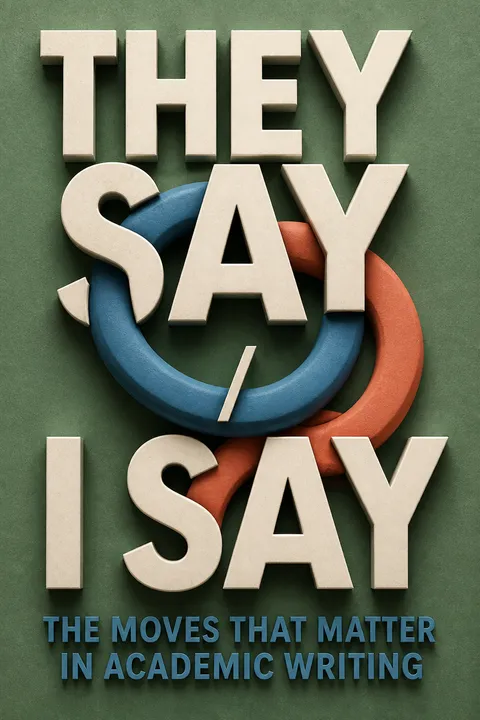


Key Takeaways
Make every argument answer a question someone else might actually ask
A thesis needs a trigger. The book’s central claim is that persuasive writing joins an existing conversation. A conference speaker once spent a talk praising a sociologist’s work but never mentioned that other scholars had attacked it. The audience could follow his praise, yet had no reason to understand why it mattered. Once he named the criticism, his purpose became clear: he was answering it.
Show the conversation early. Introduce the view that prompts your argument, then state your response before readers lose the thread. The opposing view need not come from a famous scholar. It could be a common assumption, a classmate’s claim, or something the writer once believed. It can even be implied rather than stated, but readers still need enough context to understand what the argument is doing.
This approach treats argument as a social act, not a performance delivered into a vacuum. It resembles good conversation: a response makes sense because someone can identify what prompted it. That framing also helps readers test a claim against alternatives instead of judging it as a free-floating opinion. The risk is inventing an opponent merely to create drama. A useful test is whether the people represented would recognize their view, and whether answering it genuinely clarifies the issue.
Summarize opponents so fairly they recognize themselves before you disagree
Listen before you answer. A strong summary temporarily sets aside the writer’s own beliefs to represent another position on its own terms. Peter Elbow calls this practice the believing game: trying to understand a view from the inside, even when one rejects it. Without that effort, a writer may turn an argument into a familiar cliché. The book calls this the closest cliché syndrome, mistaking a source’s more specific claim for a common idea the writer already knows.
Choose details with purpose. A summary should be accurate, but it should also prepare the reader for the writer’s argument. In discussing David Zinczenko’s critique of fast food, for instance, a writer arguing for parental responsibility would emphasize his discussion of parents and food choices, rather than list every point he makes. Fairness and focus belong together.
Fair summary is a form of intellectual discipline: it forces a writer to distinguish evidence from prior belief. It also makes disagreement more useful, because the debate concerns the actual claim rather than a convenient caricature. The method has a limit: a summary can be accurate yet selective, and selection itself shapes readers’ impressions. Naming the purpose of the summary, and including the source’s strongest relevant reasons, helps make that framing visible rather than covert.
Treat quotations as evidence that needs your interpretation attached
A quotation is not self-explanatory. Exact wording can establish that a source made a claim and help preserve its emphasis. But readers may not know who is speaking, what the passage means, or why it belongs in the argument. The book calls the solution a quotation sandwich: introduce the source and set up the passage, present the quotation, then explain its meaning and relevance in the writer’s own words.
Make every passage earn its place. In its example about philosopher Susan Bordo, the writers show how a statistic about dieting among girls in Fiji can support a broader claim about the spread of media influence. Without that framing, the number sits on the page without a clear job. The best quotation is not simply memorable or impressive. It is connected to a specific step in the writer’s reasoning.
Framing a quotation makes interpretation accountable. Rather than letting a source appear to speak for itself, the writer explains how its words support a claim, giving readers a chance to assess that use. This is especially important when a passage is ambiguous or contested. The practice also guards against citation-as-decoration, where references signal research without advancing an argument. Still, explanation should not smother the quoted material: the frame should clarify the passage, not replace careful reading with the writer’s preferred gloss.
Choose a clear stance, then make room for qualified agreement
Readers need a map. The book groups responses into agreement, disagreement, and a combination of both. Clear positioning helps readers understand how a claim relates to the view it answers, even when the argument itself is subtle. Disagreement must offer reasons, such as missing evidence or an assumption that does not hold. Agreement should add something: new evidence, an implication, or an explanation that makes the original idea more accessible.
Mixed positions can be precise. Katha Pollitt describes a disagreement with her daughter about displaying the American flag. One sees it as a symbol of warlike nationalism; the other sees solidarity and remembrance. Pollitt recognizes part of each interpretation. That is not indecision if the writer specifies what is accepted and what remains disputed. The same pattern works in literary interpretation, where a writer can explain how one reading is persuasive yet incomplete.
This simple map is valuable because readers often need orientation before they can appreciate complexity. In negotiation and deliberative settings, acknowledging a shared premise can lower defensiveness while keeping disagreement substantive. But the categories are starting points, not a complete theory of argument. Some writers are exploring a question without a settled position, and some disputes turn on evidence or definitions rather than allegiance to a side. The important thing is not forced certainty, but clarity about the kind of response being made.
Give objections their strongest voice before explaining where they fail
Criticism can improve a draft. Writer Jane Tompkins describes waking in alarm after realizing readers might have a serious objection to her work. Instead of abandoning the project, she used the objection as a reason to reshape it. The book calls the move of bringing a likely critic into the argument a naysayer. Giving that voice space can expose weak assumptions, make the writer’s reasoning more credible, and show respect for readers who may disagree.
Answer with more than dismissal. Kim Chernin imagines a skeptic arguing that losing weight can make a person feel better. She grants that short-term benefit, then questions whether it lasts. This kind of concession can refine a claim without surrendering it. If an objection proves stronger than the response, the writer may need to narrow or revise the original position rather than pretend the difficulty is gone.
A serious objection functions like a stress test: it reveals whether an argument survives contact with a reasonable alternative. This resembles adversarial review in research, where criticism can improve a claim before it reaches a wider audience. The technique works only when the objection is represented fairly and answered with evidence or reasoning. A token objection, quickly dismissed, can make a text feel more manipulative than rigorous. Some objections also remain unresolved, and acknowledging that uncertainty can be more persuasive than manufacturing a victory.
Tell readers who cares, and what changes if your claim is true
Relevance is part of the argument. The book separates two questions. Who cares asks which people or groups have a stake in the claim. So what asks what difference the claim makes beyond that interested group. A writer may explain both by connecting a specific debate to a broader concern readers already recognize.
Make the stakes concrete. Science writer Denise Grady describes research that recast fat cells as active contributors to bodily processes, rather than inert storage. The shift matters to researchers studying obesity and health, and it matters more broadly because obesity affects public health. The larger point is not to inflate every claim into a crisis. It is to explain why the issue deserves attention, what assumptions or decisions might change, and whose understanding or actions could be affected.
Stating the stakes helps readers see the bridge between specialized knowledge and public life. It is also a check on the writer: if no consequence or interested audience can be named, the claim may need a sharper purpose. Yet significance should be proportionate. A narrow result does not automatically transform policy, and an audience should not be pressured into caring through exaggerated urgency. Strong writing shows the chain from evidence to implication, while marking what remains uncertain.
Build each sentence from the one before it, not beside it
Readers should not do all the connecting. One student’s sentences repeatedly jumped from an idea to an unrelated fact, like saying a dog was good and then noting it had fleas. The facts might both be true, but the relationship was left unstated. The book recommends making that relationship explicit with transitions, clear references to earlier ideas, and repeated key terms.
Repeat with a purpose. Repetition can keep an argument focused when a writer restates a central idea in fresh language or adds a new angle. Transitions signal whether the next point adds, contrasts, explains, or draws a consequence. Pointing words such as this or those can help, but only when readers can tell exactly what they refer to. During revision, check not just whether each sentence makes sense alone, but whether it visibly follows from the preceding one.
Coherence is a form of reader care: it reduces the effort needed to reconstruct the logic between claims. Cognitive research broadly supports the importance of connected information for comprehension, though clarity is not achieved by adding a transition to every sentence. A connector can falsely imply a logical relation that the evidence does not support. The useful question is therefore twofold: what is the actual relationship between these ideas, and have the words on the page made that relationship clear?
Explain how readers should interpret your claims, not just what they are
Guide the reading. The book calls this metacommentary: commentary about a writer’s own claims that clarifies their meaning, limits, importance, or relation to other points. It can prevent a claim from being confused with a nearby but different argument, explain why an example matters, or tell readers how the discussion is organized. Neil Postman, for example, previews his argument about changes in public discourse and distinguishes it from a simpler complaint about television being lowbrow.
Use it to revise, not pad. Metacommentary can reveal implications the writer had not fully articulated. It also helps during revision: ask whether the main position is clear, whether a quotation is interpreted, whether likely objections are answered, and whether readers know why the argument matters. A title can perform this guiding function too, giving readers an early clue to the claim rather than merely naming a broad subject.
Metacommentary makes the writer’s interpretive choices visible, much like signposting in a lecture or labels in a data visualization. It can prevent predictable misunderstandings without demanding that readers guess the intended route. Its danger is overmanagement: repeated explanations of what a text means can become tedious or sound defensive. The strongest guidance appears where a genuine ambiguity, shift, or implication needs attention, and then trusts readers to follow the argument.
Use templates as scaffolding for thought, not scripts for imitation
Forms can generate ideas. The book’s sentence patterns model recurring rhetorical moves, such as introducing a debate, qualifying a claim, or answering an objection. They are meant to help writers begin moves they may not yet know how to make. The authors argue that templates do not dictate the content of an argument, and that established forms can support originality, much as a familiar structure can give an artist room to improvise.
Learn the move, then adapt it. The authors point to established researchers and scientific journals that use prescribed forms to state how findings relate to prior knowledge. They also distinguish reusable conventional phrasing from borrowed ideas: the latter still require attribution. A template should prompt questions about evidence, opposing views, and purpose. If it only produces smooth sentences without real reasoning, the form has become a mask rather than a tool.
Scaffolding is useful because expertise often hides its own routines. Making those routines explicit gives beginners a way to practice them and eventually recognize them in their reading. This is consistent with apprenticeship models of learning, where novices first use structured supports before acting more independently. The counterpoint is that a polished template can create the appearance of argument without intellectual substance. Teaching should therefore assess the quality of the thinking inside the structure, not merely whether the expected rhetorical slots are filled.
Keep your own voice; rigor does not require verbal disguise
Academic language has room to breathe. The authors challenge the idea that serious writing must sound stiff or abandon everyday speech. Writers can combine disciplinary language with familiar expressions when the audience and purpose permit it. Robert Connors and Andrea Lunsford, for example, mix scholarly discussion of error in student writing with vivid, informal descriptions of strict grading practices.
Style still has consequences. The book does not recommend using slang everywhere. A job application or grant proposal may call for conventional formal language, while an essay, discussion, or other context may benefit from a more personal register. It also discusses code-meshing, the blending of language varieties within one piece of writing. Such choices can challenge assumptions about which varieties count as legitimate, but writers still need to consider how their intended readers will interpret them.
The argument connects style to access and identity: a single prestige register can make academic participation feel like a demand to erase one’s linguistic history. Blending registers can broaden what counts as intellectual expression, while precise audience awareness helps writers make that choice strategically. There is no universally neutral style, and institutional settings do reward some forms more than others. Recognizing that tension lets writers make deliberate choices without confusing conformity with rigor or informality with authenticity.
Read across disciplines by reconstructing the debate beneath the text
Reading means locating the disagreement. Instead of asking only for a text’s main point, readers can ask what view motivated it and how the writer responds. This helps decode difficult arguments, including Judith Butler’s opening discussion of uncertainty about gender and feminism. When the opposing view is unstated, readers must infer it from context without forcing the text into a familiar cliché.
The same habit travels. In literature, look for conflicts among characters, interpretations, or ideas, then test a reading against details in the work. In science, examine how methods and data support an interpretation. In social science, identify prior explanations and gaps in what has been studied. In class or online discussion, connect a contribution to a specific earlier point. Across settings, the aim is to respond to what was actually said, not merely use it as an excuse to repeat a settled opinion.
This method makes reading active: it asks readers to reconstruct the intellectual situation around a text, rather than treating the page as a sealed container. That skill supports scientific skepticism, literary interpretation, and civic discussion, though each field has different standards for evidence and inference. The authors’ claim that academic disciplines share rhetorical moves is persuasive as a starting point, not a claim that every discipline argues identically. Genre conventions shape what counts as a sound response, so transferable habits must still be adapted.
Analysis
The book’s lasting contribution is not a collection of sentence starters. It is a model of writing as situated reasoning. A claim becomes intelligible when readers can see what it answers, what evidence supports it, and what alternatives remain. This model also reframes reading: comprehension requires tracking the movement among voices, including assumptions that are never explicitly named. Writing and reading become reciprocal practices of interpretation rather than separate school tasks.
Templates make tacit academic conventions visible. That is a democratic intervention: students who have not absorbed those conventions through family, schooling, or extensive reading receive a practical route into them. The book also insists that form can generate thought. A prompt to imagine a critic may expose a qualification the writer had not noticed; a request to explain a quotation can reveal that its relevance was never clear. Structure, in this account, is not the enemy of originality but one of its conditions.
Still, rhetorical fluency is not the same as truth. A writer can summarize fairly, cite carefully, and anticipate objections while relying on weak evidence. Templates can also make disagreement look more balanced than it is, or imply that every debate has two comparable sides. In high-stakes disputes, power affects whose claims are published, heard, and treated as credible. The book’s conversational ideal is strongest when paired with attention to those asymmetries and with domain-specific standards for evidence.
The practical lesson is to treat its moves as questions, not mandatory formulas: What prompted this claim? What would a thoughtful critic say? What does the evidence establish, and what remains uncertain? Why should anyone beyond the writer care? Used this way, the framework offers more than a recipe for academic prose. It trains readers to notice how arguments are built, where they can be challenged, and how to join them without pretending to have the final word.
Review Summary
"They Say / I Say" receives mixed reviews, with ratings ranging from 1 to 5 stars. Many readers find it helpful for academic writing, praising its templates and strategies for engaging in scholarly conversations. Critics argue the templates are too formulaic and may limit creativity. Some view it as essential for students learning academic writing, while others feel it oversimplifies the process. The book's approach to summarizing and responding to others' ideas is generally well-received, though some readers find the content repetitive or basic.
People Also Read




Glossary
They Say / I Say
argument as responseThe book’s central model of persuasive writing. A writer identifies what other people, a group, or a common assumption says, then presents a claim in relation to it. The response may agree, disagree, qualify, or combine these positions. The model explains why an argument needs a context and a reason for being heard.
believing game
inhabiting another viewA reading and writing practice associated in the book with Peter Elbow. The writer temporarily sets aside personal agreement or disagreement and tries to understand another position from its own perspective. This helps produce a fair summary and makes later criticism more credible because the opposing view has not been reduced to a caricature.
closest cliché syndrome
mistaking claim for clichéThe error of summarizing a source as if it expressed a familiar, simplified belief, rather than the more specific argument it actually makes. It can happen when writers rely on memory or prior assumptions instead of returning to the source. The result is a response to an imagined position, not the source’s real one.
quotation sandwich
frame a quotationA method for integrating a quotation into an argument. The writer introduces the speaker and prepares readers for the passage, presents the exact words, then explains what the passage means and how it supports the writer’s point. The method prevents quotations from appearing without context or an explanation of their relevance.
naysayer
an argument’s criticA likely objection or opposing perspective represented within a writer’s own text. The writer states the objection, treats it fairly, and responds with reasons, evidence, or a qualification to the original claim. Including a naysayer can reveal weaknesses and show that the argument has considered alternatives, though it does not guarantee that the reply succeeds.
metacommentary
commentary on claimsText that explains how readers should understand the writer’s main claims. It can clarify a meaning, distinguish a point from a nearby argument, explain why an example matters, describe the structure of a discussion, or identify an implication. It works alongside the main argument to guide interpretation and reduce misunderstanding.
code-meshing
blending language varietiesA term discussed in the book for combining different language varieties within a piece of writing. This can include disciplinary language alongside everyday expressions or culturally specific forms of English. The practice can challenge assumptions about which varieties are appropriate for academic work, while still requiring attention to audience, purpose, and context.
FAQ
What's They Say / I Say about?
- Focus on Academic Writing: They Say / I Say by Gerald Graff and Cathy Birkenstein emphasizes engaging with others' ideas in academic writing. It teaches students to enter conversations by summarizing others' arguments and responding with their own.
- Templates for Clarity: The book provides templates to help students structure their writing, making it easier to incorporate others' voices and their own. This approach demystifies the writing process.
- Rhetorical Moves: It identifies key rhetorical moves essential for persuasive writing, such as summarizing, quoting, and responding to counterarguments.
Why should I read They Say / I Say?
- Improves Writing Skills: The book is a valuable resource for enhancing academic writing skills, offering practical strategies applicable across various disciplines.
- Engagement with Ideas: It encourages readers to engage with others' ideas, fostering critical thinking and a deeper understanding of subjects, crucial for effective academic communication.
- Widely Used Resource: Adopted in over 1,500 colleges and universities, its effectiveness and relevance in teaching composition and rhetoric are well-recognized.
What are the key takeaways of They Say / I Say?
- "They Say / I Say" Framework: The central concept emphasizes responding to others' arguments, helping writers articulate their positions in relation to existing discourse.
- Templates for Writing: Numerous templates guide students in summarizing, quoting, and responding to arguments, serving as practical tools for organizing thoughts and enhancing clarity.
- Importance of Metacommentary: The book stresses metacommentary's value in clarifying and elaborating on arguments, guiding readers through reasoning and anticipating objections.
What are the best quotes from They Say / I Say and what do they mean?
- "Writing well means entering a conversation": This quote encapsulates the book's core message that effective writing is part of a dialogue with others, highlighting academic discourse's collaborative nature.
- "Templates have a generative quality": It emphasizes that templates not only organize writing but also stimulate new ideas, encouraging critical thinking about arguments and presentation.
- "The ability to engage with the thoughts of others is one of the most important skills taught in any college-level writing course": This underscores the significance of understanding and responding to different perspectives in academic writing.
How does They Say / I Say help with summarizing others' arguments?
- Clear Guidelines for Summarizing: The book provides specific templates for summarizing others' arguments effectively, helping students capture the essence without misrepresentation.
- Encourages Fair Representation: By emphasizing accurate representation, it fosters a respectful and thoughtful approach to academic discourse, crucial for building credibility.
- Balance Between Own Voice and Others: The authors stress balancing summarizing others' views with one's perspective, ensuring the writer's voice remains present.
What techniques does They Say / I Say suggest for responding to arguments?
- Agreeing, Disagreeing, and Both: The book outlines three primary response ways: agreeing, disagreeing, or a combination, helping writers articulate positions clearly.
- Use of Templates: Templates for each response type make it easier for students to structure arguments, with phrases like "I agree that..." or "I disagree because..."
- Anticipating Counterarguments: Writers are encouraged to anticipate objections and address them, strengthening arguments and demonstrating respect for differing viewpoints.
How can I use metacommentary effectively in my writing according to They Say / I Say?
- Clarifying Your Points: Metacommentary helps clarify and elaborate on arguments, guiding readers through reasoning with phrases like "In other words..."
- Anticipating Misunderstandings: It allows addressing potential misunderstandings proactively, strengthening credibility and maintaining reader engagement.
- Adding Depth to Arguments: Metacommentary explores claim implications, drawing out nuances, making writing more compelling and insightful.
What are some common mistakes to avoid when quoting in They Say / I Say?
- Failing to Frame Quotations: The book emphasizes framing quotations within text to avoid "dangling" or "hit-and-run" quotes lacking clarity and connection.
- Overquoting or Underquoting: Writers should balance quoting to support claims while ensuring their voice remains prominent.
- Assuming Quotations Speak for Themselves: Writers must explain each quotation's significance and relation to their argument.
How does They Say / I Say address the importance of transitions in writing?
- Connecting Ideas Smoothly: Transitions create a cohesive flow between sentences and paragraphs, guiding readers through arguments and clarifying idea relationships.
- Types of Transitions: The book provides a list of transitions categorized by functions like addition, contrast, and conclusion, allowing appropriate choices for contexts.
- Avoiding Choppy Writing: Using transitions prevents writing from becoming disjointed, enhancing readability and maintaining reader engagement.
How can I ensure my writing reflects my own voice while adhering to academic standards according to They Say / I Say?
- Mixing Styles: The book encourages blending academic language with colloquial expressions for an engaging style, maintaining a unique voice while meeting academic expectations.
- Using Personal Experience: Incorporating personal anecdotes adds authenticity, connecting with readers personally while addressing academic topics.
- Avoiding Overly Complex Language: The authors caution against unnecessarily complex language, advocating a balance between sophistication and accessibility.
How does They Say / I Say define academic writing?
- Engagement with Others: Academic writing is defined as a conversation where writers engage with others' ideas, acknowledging and responding to different viewpoints.
- Argumentative Structure: It emphasizes presenting a clear claim supported by evidence, clarifying the writer's position within broader discourse.
- Use of Templates: Templates help students structure arguments effectively, guiding responses and framing ideas within existing discussions.
What challenges does They Say / I Say address in academic writing?
- Misunderstanding of Argumentation: It addresses the misconception that academic writing is solely about presenting one's ideas, emphasizing engaging with others' arguments.
- Difficulty in Structuring Arguments: Many students struggle with structuring arguments; templates offer clear frameworks to alleviate this challenge.
- Fear of Engaging with Opposing Views: Students often fear addressing opposing viewpoints, which can weaken arguments; the book encourages embracing these challenges for growth.
Download PDF
Download EPUB
.epub digital book format is ideal for reading ebooks on phones, tablets, and e-readers.








