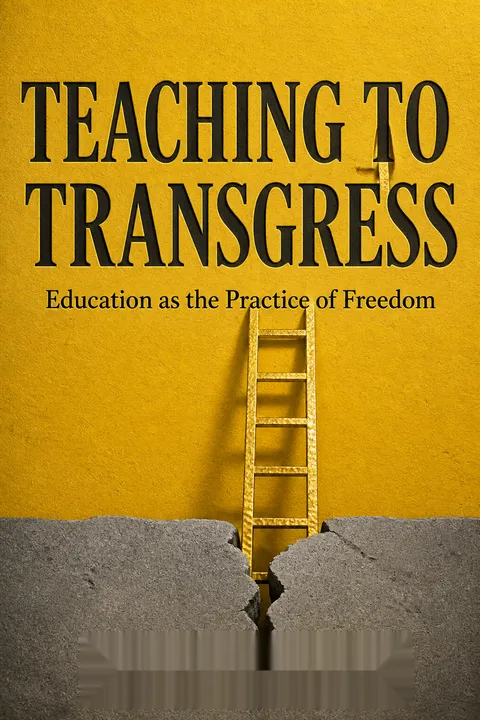


Key Takeaways
Make education a practice of freedom, not a pipeline for obedience.
Learning can liberate. hooks traces this conviction to her childhood in segregated Black schools, where Black women teachers knew students’ families and treated intellectual growth as part of resisting racism. Learning there was joyful and politically meaningful. After desegregation, she encountered schools where Black students were expected to comply, and knowledge was detached from their lives. The contrast taught her that education is never merely the transfer of information: it can either strengthen people’s ability to think and act, or train them to accept existing authority.
The classroom is political. At predominantly white universities, hooks found that questioning conventional teaching could be treated as disobedience. She draws on Paulo Freire’s critical pedagogy to argue that students must participate in making knowledge, rather than simply receive and repeat it. Teaching to transgress means moving beyond inherited boundaries in what gets taught, who is heard, and how learning happens.
What's striking is that the book locates educational freedom in ordinary classroom choices, not only in policy or curriculum. A teacher's response to a question, the books assigned, and whose knowledge counts all shape students' sense of agency. This makes pedagogy consequential even when no one names it political. The argument also resists a comforting assumption: good intentions do not make teaching neutral. Yet teachers cannot individually undo institutional inequality. Their practice matters, but its reach depends on whether institutions protect the time, resources, and dissent that meaningful learning requires.
Make every student audible, then build learning through shared responsibility.
Presence must be practiced. hooks argues that a classroom community forms when students recognize one another as contributors, rather than orienting every exchange toward the professor. In her classes, students sometimes wrote brief reflections and read them aloud, ensuring each person entered the shared space. Her courses could include thirty to sixty students, and at times more than one hundred, so the exercise did not depend on an intimate seminar. It made listening part of the lesson and reduced the chance that a student would remain invisible.
Participation is not just speaking. A student may be hesitant, unfamiliar with the subject, or wary of being judged. The teacher remains more accountable because institutional authority rests with them, but the class's energy cannot be produced by the professor alone. hooks also warns against treating personal disclosure as a requirement for belonging: student voice should be welcomed, not extracted.
The key distinction is between inviting participation and demanding performance. A student can be present without being ready to narrate private experience, and a quiet student is not necessarily disengaged. The book's emphasis on listening usefully broadens participation beyond speaking first or most often. It also complicates the popular idea that a good discussion is automatically democratic. Without deliberate facilitation, familiar hierarchies can determine who talks and whose contributions receive attention. Shared responsibility therefore requires structure, not just an open invitation.
Teach whole people, beginning with the teacher's own unfinished growth.
Knowledge touches a life. hooks calls her approach engaged pedagogy, a form of teaching that joins intellectual learning with attention to students' and teachers' well-being. Influenced by Freire and Buddhist teacher Thich Nhat Hanh, she rejects the idea that a classroom should contain only abstract minds. Students bring histories, bodies, and practical questions about how to live; acknowledging that does not make a class therapy. It connects academic ideas to the world students must navigate.
Teachers must also change. Engaged pedagogy asks instructors to work toward their own self-actualization, rather than demanding openness from students while remaining unreachable themselves. hooks describes a student whose account of joining a fraternity challenged her judgment. She shared her concerns but recognized that the student's choices belonged to him. His reflection on the experience became part of their mutual learning.
The argument treats a teacher's self-awareness as part of professional competence, not a private hobby. That matters because students quickly notice a gap between liberatory ideas and a professor's conduct. At the same time, well-being should not become a new credential imposed on educators, many of whom work under exhausting conditions. The practical standard is less perfection than reflective accountability: recognizing how personal habits affect a classroom, and staying open to correction without surrendering responsibility for teaching.
Treat multicultural teaching as a redesign, not a diverse reading list.
Representation alone falls short. At Oberlin, hooks and colleague Chandra Mohanty organized faculty seminars on teaching in a multicultural classroom. The discussions revealed that professors needed room to voice anxieties and learn practical approaches, not merely instructions to change. A syllabus can include a Black writer and still preserve old assumptions. hooks describes a class in which a student praised a professor for teaching Toni Morrison without discussing race, as if avoiding the subject proved the work's universal value. For hooks, that evades the very histories that shape how literature is made and read.
Difference brings friction. Students may fear speaking, while teachers may mistake silence for comfort or disagreement for disorder. An inclusive classroom must address who speaks, who listens, and who is treated as an authority. The goal is not a frictionless celebration of diversity, but shared learning that can withstand conflict.
This section distinguishes inclusion from assimilation: adding unfamiliar authors while keeping established interpretive habits intact leaves the center of authority unchanged. The same principle applies beyond literature. A changed roster or reading list matters less if classroom routines still reward only one style of speech and argument. Yet conflict is not proof of progress by itself. Disagreement can expose suppressed assumptions, but it can also reproduce harm. Teachers need to make the purpose of difficult exchanges clear and ensure that the burden of educating others does not fall on marginalized students.
Make theory answer lived pain and lead back into action.
Thinking can help heal. In her childhood, hooks used reflection to make sense of family authority and the pain of being punished for questioning it. She came to theory not as distant abstraction, but as a way to understand what was happening and imagine other possibilities. She argues that theory becomes liberatory when people direct it toward understanding and changing lived conditions. Clear, accessible ideas matter because work that cannot be shared beyond academic specialists may fail to support collective change.
Reflection needs practice. hooks draws on Freire's term praxis, the ongoing joining of action and reflection to transform the world. Political beliefs alone do not alter daily life. A person who calls themself a feminist, for example, must examine how that commitment appears in relationships and habits. Theory helps name patterns and devise action; experience then tests whether the ideas are useful.
The powerful move here is to treat theory as a tool people make together, rather than a product reserved for credentialed experts. That challenges both inaccessible academic writing and the opposite temptation to dismiss analysis as empty talk. Reflection can reveal patterns that isolated action misses, while practice exposes ideas that sound persuasive but do not help. Accessibility, however, is not the same as simplification. A theory must remain rigorous enough to explain power, while communicating in forms people can question, adapt, and use.
Honor experience without making identity an unquestionable credential.
Experience carries knowledge. hooks calls attention to the authority of experience, the insight people gain from living through conditions that others may study only from a distance. In classrooms where marginalized students' realities are ignored, speaking from experience can be a way to claim presence. hooks describes asking students to share early memories of race while studying Toni Morrison. The exercise made personal histories part of collective learning, rather than treating them as irrelevant to academic analysis.
No one experience explains everyone. Personal testimony can deepen a discussion, but it can also be used to silence others or imply that a group has one shared viewpoint. hooks challenges critiques that blame marginalized students for asserting identity while overlooking how dominant groups already enjoy unspoken authority. Her answer is to bring experiential and analytical knowledge together, while asking who speaks, who is generalized, and who is excluded.
The distinction is not between objective facts and subjective stories, but between different kinds of evidence and the claims made from them. Firsthand experience may reveal features that detached observation misses, yet it cannot stand in for every person who shares an identity. The classroom must also account for unequal credibility: some speakers are presumed authoritative before they open their mouths, while others must prove their right to contribute. Treating testimony seriously therefore means listening carefully, and still examining its scope and context.
Build feminist solidarity through accountability, reciprocity, and honest historical memory.
Good intentions do not erase history. hooks examines the unequal relationship between Black women and white women, including the domestic arrangement in which Black women served white households. Affection could exist in those homes, but it did not remove differences in power or status. That history shaped Black women's suspicion of calls for feminist sisterhood that did not acknowledge racism or white women's participation in it. A warm invitation, by itself, could sound like a demand that Black women set aside their experience to make others comfortable.
Solidarity takes work. hooks describes more promising relationships as involving honest confrontation about race and reciprocal exchange, rather than relying on Black women to teach white women about racism. She also rejects withdrawal as a solution: without participation, excluded voices lose further influence. Building trust requires acknowledging harm, changing behavior, and making room for disagreement without assuming that every difficult encounter is beyond repair.
The analysis is strongest where it separates closeness from equality. Care does not automatically cancel hierarchy, a lesson relevant to workplaces, families, and political alliances as much as feminist organizing. Reciprocity also means that marginalized people should not be assigned permanent teaching duties in the name of solidarity. Still, historical understanding cannot dictate how any individual relationship will unfold. It offers a more honest starting point, not a guarantee of trust. People must judge solidarity by changed conduct as well as declared commitments.
Make daily habits match your stated politics of freedom.
Values are tested in ordinary life. hooks recalls an interracial friendship from her high school years in the segregated South. She and her white friend faced hostility for crossing racial and gender boundaries, and his parents made a point of welcoming Black people into their home. The friendship showed her that commitment to equality was not just a political idea: it shaped whom people welcomed, defended, and treated as worthy of intimacy.
Change requires more than slogans. Drawing on Martin Luther King Jr.'s call for a revolution in values, hooks argues that societies cannot overcome racism, sexism, and class exploitation while continuing to prize property and power above people. She criticizes public appeals to traditional morality when the daily habits and institutions of those making them preserve domination. Freedom becomes credible when private conduct and public principles begin to agree.
The high school story gives political commitment a scale people can recognize: a relationship, a household, and the choices made when others disapprove. It helps explain why institutional reform depends on personal habits without reducing systemic injustice to individual prejudice. One friendship cannot undo segregation, and private virtue cannot substitute for policy. But laws and declarations are vulnerable when daily behavior quietly contradicts them. The useful question is not whether someone endorses equality, but what their routine choices protect, challenge, or leave untouched.
Turn the dominant language into a tool for resistance and belonging.
Speech carries power. hooks reflects on English as a language shaped by conquest, but also one that enslaved Africans needed in order to communicate across imposed separations. Black speakers transformed English into distinctive vernacular forms that could carry shared meaning and resistance beyond the rules of standard usage. Language was not merely a container for ideas: who was permitted to speak, and in which form, affected whose knowledge could be recognized.
Difference deserves a hearing. hooks argues that black vernacular should not be treated as ignorance or reduced to entertainment. She recalls students realizing that they had assumed standard English was the only language appropriate in class, even when it was not their first language. A classroom can invite students to use other languages and translate when useful, rather than requiring them to abandon familiar speech to appear intelligent.
Language is both a means of access and a gatekeeping device. Standard forms can help people communicate across settings, but treating one form as the measure of intelligence confuses convention with capacity. The chapter also makes listening an ethical practice: not understanding immediately can prompt attention rather than ridicule. Still, translation and code-switching can place extra labor on speakers of marginalized languages. Respecting linguistic difference means changing listeners' expectations, not simply asking speakers to make themselves more convenient.
Expose class rules hiding inside classroom manners and academic authority.
Order is not neutral. hooks entered Stanford from a working-class background and soon learned that class shaped more than access to money. Classroom norms rewarded silence, restrained emotion, and comfort with authority, traits associated with middle-class behavior. Students who spoke forcefully or challenged a professor could be dismissed as disruptive. Such rules can make a classroom appear fair while quietly favoring students already familiar with its codes.
Use power deliberately. hooks does not ask teachers to pretend that students and professors have equal institutional authority. Instead, she urges teachers to examine how that authority works and to use it to make learning more democratic. Students from working-class backgrounds should not have to discard their histories to succeed. Teachers can make class assumptions discussable, create room for different forms of participation, and challenge the idea that decorum matters more than substantive exchange.
This account makes etiquette visible as a form of institutional selection: whose tone reads as thoughtful, and whose reads as a threat? Naming that process can help instructors distinguish genuine disruption from discomfort with unfamiliar styles. Yet no single classroom rule will be fair in every context. A lively exchange can energize some students and intimidate others. Democratic teaching therefore requires attention to effects, not just a teacher's intention to be permissive, and it needs ways for students to participate without adopting one approved personality.
Let intellectual rigor include bodies, feeling, pleasure, and limits.
Learning is embodied. hooks argues that classrooms often pretend only the mind is present, as if emotion and physical life interfere with serious thought. She uses eros in a broad sense: a life-animating energy that can intensify curiosity and engagement, not simply sexual desire. In a course on Black women writers, one student described changing how she wore her hair after reconsidering internalized racism. Another student connected classroom learning to the freedom he felt in dancing. Their accounts showed ideas altering habits of being.
Pleasure and difficulty coexist. A lively class is not automatically rigorous, and a painful discussion is not automatically harmful. Teachers must make room for feeling without turning class into therapy or ignoring boundaries. hooks also emphasizes that engaged teaching takes real labor and can be undermined by oversized classes and institutional demands. Passion matters, but it does not remove the need for rest, care, and judgment.
The chapter's challenge is not to make every class emotionally intense. It is to stop treating emotional neutrality as the natural condition of learning, especially when some students already feel exposed or unwelcome. Embodied teaching can make abstract ideas matter, while boundaries protect students from being pressured into disclosure or intimacy. The institutional point is equally important: passion cannot compensate indefinitely for excessive workloads and crowded rooms. A sustainable pedagogy needs both human connection and material conditions that allow attention to last.
Analysis
Teaching to Transgress is not a step-by-step teaching manual. It is an essay collection that moves between memoir, political argument, dialogue, and classroom scenes. That form enacts its central claim: knowledge is made through exchange among lived experience, analysis, and action. hooks begins with the contrast between affirming Black schools and alienating desegregated settings, then expands the classroom into a site where race, gender, class, language, authority, and embodiment meet. The result is a theory of teaching grounded in relationships rather than a universal technique.
The book's most durable contribution is its insistence that pedagogy is substantive politics. A professor can adopt progressive texts yet preserve old hierarchies through grading, speech, classroom arrangement, or whose contributions count. Conversely, changing who participates and how listening works can alter what knowledge becomes possible. This account makes teaching visible as labor and ethical responsibility, while refusing the fantasy that a teacher can manufacture community alone. Students bring agency, resistance, and difference that no scripted method can fully manage.
That emphasis also creates tensions worth keeping in view. Calls for voice and personal experience can become coercive if students are expected to disclose private histories, or if one person is made spokesperson for a group. hooks recognizes these dangers and answers through reciprocal vulnerability, critical examination, and shared responsibility. Her approach is therefore not a license for unstructured conversation. It requires judgment: to hear experience without treating it as infallible, to challenge without humiliation, and to permit conflict without confusing it with failure.
Institutional conditions limit the reach of these practices. Hooks describes oversized classes, academic incentives that undervalue teaching, and professional habits that protect authority. Her vision asks individual teachers to act differently, but also shows why goodwill alone is insufficient. The book ultimately makes freedom a classroom practice and a collective project. Its standard is not whether a class feels pleasant at every moment, but whether people can think more critically, recognize one another more fully, and connect what they learn to how they live.
Review Summary
Teaching to Transgress is widely praised as a transformative work on pedagogy. Readers appreciate hooks' intelligent and passionate writing on elevating teaching through personal engagement and self-awareness. Many found the book's focus on intersectionality, critical thinking, and student empowerment inspiring. Some critics felt certain chapters were too theoretical or jargony. Overall, reviewers commend hooks for challenging traditional educational paradigms and offering a vision of education as a liberating, transformative practice. The book is seen as particularly relevant for educators seeking to create more inclusive and engaging learning environments.
People Also Read






Glossary
Engaged pedagogy
Whole-person, participatory teachingA teaching approach that treats learning as a shared process involving students' and teachers' intellectual, emotional, and embodied lives. It asks instructors to pursue their own growth, welcome student participation, and connect knowledge to lived experience. Unlike a model based only on delivering information, it aims to support students' capacity to think critically and live with greater agency.
Banking system of education
Students as passive receiversAn educational model in which teachers deposit information into students, who are expected to memorize, store, and repeat it. The model treats students as passive consumers rather than participants in producing knowledge. hooks uses the term to criticize instruction that prioritizes compliance and recall over dialogue, critical thought, and the connection between learning and social life.
Conscientization
Developing critical awarenessA process of becoming critically aware of how social and political conditions shape one's life and identity. In hooks's discussion of Freire, this awareness is an important beginning, not a complete transformation by itself. It becomes meaningful when joined to action and reflection that engage the conditions people seek to change.
Praxis
Reflection joined with actionThe ongoing relationship between reflecting on the world and acting to change it. hooks draws on Freire's use of the term to argue that political awareness cannot remain an abstract belief. Action without reflection can be directionless, while reflection without action leaves unjust conditions untouched. Praxis connects what people understand with how they live and intervene.
Authority of experience
Knowledge grounded in lived experienceThe insight people can gain from living through a social condition, especially one they are often asked to explain or defend. hooks values experience as a meaningful source of knowledge, particularly when institutions have ignored marginalized voices. She also warns that experience can be used to silence others or treated as proof that one person speaks for an entire group.
Eros
Energy that animates learningA life-animating force that can move people from potential toward fuller engagement. In hooks's discussion of teaching, eros is broader than sexual desire: it can describe the passion, curiosity, and vitality that bring energy to intellectual work. Recognizing it challenges the assumption that serious learning requires teachers and students to suppress their bodies and feelings.
FAQ
What's Teaching to Transgress about?
- Education as Freedom: Teaching to Transgress by bell hooks emphasizes education as a practice of freedom, advocating for a transformative approach that empowers both students and teachers.
- Critical Pedagogy: The book draws on critical pedagogy, particularly Paulo Freire's work, to argue that education should encourage critical thinking and social change.
- Intersectionality: hooks explores how race, gender, and class intersect, influencing educational experiences and highlighting the need for inclusive teaching practices.
Why should I read Teaching to Transgress?
- Empowerment through Education: The book offers insights into how education can be a tool for liberation, essential for educators, students, and social justice advocates.
- Personal Reflection: hooks shares personal experiences within the educational system, encouraging readers to reflect on their own educational journeys.
- Practical Strategies: It includes strategies for creating inclusive and engaging classroom environments, valuable for educators seeking change.
What are the key takeaways of Teaching to Transgress?
- Engaged Pedagogy: hooks advocates for pedagogy that respects and cares for students' emotional and spiritual growth.
- Multicultural Education: The book stresses the need for education that values diverse experiences, moving beyond a one-size-fits-all approach.
- Critical Thinking: Fostering critical thinking skills is central, encouraging students to question societal norms and engage in transformative practices.
What are the best quotes from Teaching to Transgress and what do they mean?
- “Education as the practice of freedom”: This encapsulates the book's thesis that education should empower individuals to think critically and act against oppression.
- “To begin always anew”: Reflects the idea that learning is a continuous process of growth and transformation.
- “The classroom remains the most radical space of possibility in the academy”: Highlights the classroom's potential as a site of social change and liberation.
What is engaged pedagogy according to bell hooks?
- Holistic Approach: Engaged pedagogy addresses students' emotional and spiritual needs, not just intellectual development.
- Mutual Growth: Teaching should be reciprocal, where both students and teachers learn from each other, fostering community.
- Critical Consciousness: The goal is to cultivate critical consciousness, enabling students to challenge oppressive societal structures.
How does bell hooks define critical pedagogy?
- Liberatory Education: Critical pedagogy seeks to liberate individuals from oppressive systems through reflection and action.
- Empowerment through Knowledge: Education should empower individuals to question and transform their realities.
- Collective Responsibility: It involves educators and students engaging in dialogue and action promoting social justice.
How does bell hooks address race and gender in Teaching to Transgress?
- Intersectionality: hooks discusses how race and gender intersect in education, often overlooked in traditional feminist discourse.
- Racism in Feminism: She critiques white feminism for not addressing race complexities, urging genuine solidarity with women of color.
- Empathy and Understanding: Calls for confronting racism and privilege to foster honest dialogue and solidarity.
What role does personal narrative play in Teaching to Transgress?
- Authenticity in Teaching: Personal narratives make hooks' arguments relatable and authentic, enhancing the learning experience.
- Connection to Theory: Intertwining stories with theory shows how lived experiences inform educational practices.
- Encouraging Vulnerability: Encourages educators to share stories, fostering a classroom environment of openness and connection.
How does Teaching to Transgress redefine the role of the teacher?
- Teacher as Facilitator: Redefines the teacher's role from authoritative to a facilitator of learning, emphasizing collaboration.
- Emotional Investment: Teachers should be emotionally invested in students' learning, creating spaces where obedience isn't the goal.
- Challenging Norms: Encourages challenging conventional norms, advocating for a more inclusive and dynamic educational approach.
What challenges does bell hooks identify in the educational system?
- Silencing of Voices: Many students, especially marginalized ones, feel silenced, stifling critical engagement.
- Bourgeois Values: Critiques the dominance of bourgeois values, creating barriers to open dialogue and authentic learning.
- Resistance to Change: Highlights resistance within institutions to embrace progressive pedagogical practices.
How can educators implement the ideas from Teaching to Transgress in their classrooms?
- Create Inclusive Spaces: Strive for environments where all students feel valued and empowered to share perspectives.
- Encourage Critical Dialogue: Promote open dialogue and critical thinking for deeper engagement with material and peers.
- Reflect on Personal Biases: Teachers should reflect on biases and privileges, working towards equitable teaching practices.
How does bell hooks view the relationship between theory and practice in education?
- Theory as a Tool for Liberation: Theory should inform practice, providing a framework for addressing social injustices.
- Integration of Experience: Emphasizes integrating personal experiences into theoretical discussions for relevance.
- Continuous Reflection: Advocates for ongoing reflection on theory and practice, assessing methods and impacts on students.
About the Author
Other books by bell hooks








Download PDF
Download EPUB
.epub digital book format is ideal for reading ebooks on phones, tablets, and e-readers.








