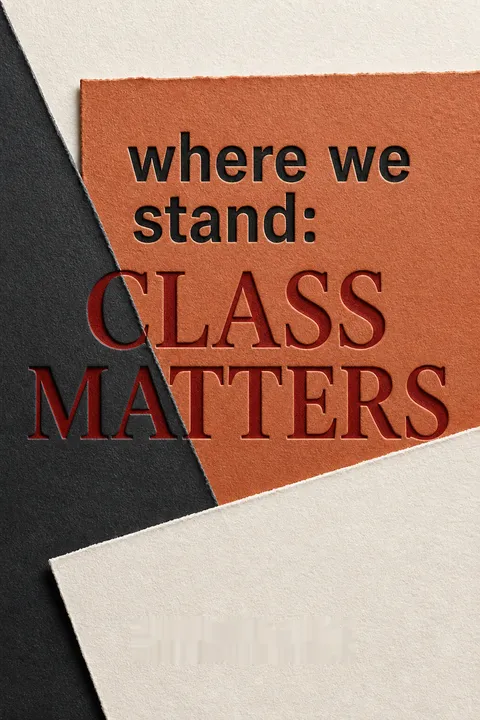


Key Takeaways
Treat class as a force shaping race, gender, and everyday belonging
Class is more than income. hooks argues that class shapes who has security, influence, and the benefit of the doubt, yet public discussion often treats it as impolite or reduces it to money. Race and gender matter in their own right, but they can also distract from who controls resources and whose labor sustains comfort. In her Greenwich Village neighborhood, a Black woman could be mistaken for a shop assistant despite dressing like the customers. Affluence did not erase racial assumptions about who belonged.
Notice who benefits. The same society may celebrate diversity while defending unequal wealth and housing. Class analysis asks not only who faces discrimination, but how money and status change the consequences of that discrimination. hooks’s point is not that class replaces race or gender. It is that justice requires examining how the systems work together.
The useful shift is from treating identity categories as competing explanations to asking how they alter one another. A wealthy Black resident may face racism and still have protections unavailable to a poor Black neighbor; both facts matter. This resembles intersectional analysis, which studies how social positions combine rather than ranking one form of disadvantage above another. Class, however, is not a master key: income and occupation alone cannot explain every instance of exclusion. The method works best when paired with attention to local history, institutions, and the specific people who hold decision-making power.
Trace your class story through family, work, and the doors education opens
Class consciousness starts close to home. Class consciousness means recognizing one’s place in an economic hierarchy and understanding how institutions help produce that position. hooks grew up in a working-class Black family where money was tight, but class itself was rarely named. Her family explained limited opportunity mainly through race, while her mother’s longing for store-bought goods and a more conventional home reflected a desire to move beyond her origins.
Mobility has a cost. At college, hooks encountered classmates who assumed everyone could afford travel, clothes, and time away from campus. Her journey to Stanford brought intellectual opportunity, but also isolation and the pressure to fit an elite institution’s expectations. She kept her allegiance to working people while gaining credentials that opened a path to privilege. Education changed her options, not the contradictions she had to navigate.
A personal history makes structural forces legible without reducing a life to a case study. The concrete details of housing, school expenses, and family expectations show how class is learned through ordinary decisions, not only through political theory. This also complicates the familiar story of upward mobility as an uncomplicated escape. Institutions can expand a student’s choices while signaling that acceptance requires distance from home. That tension deserves attention in discussions of access: admission is not the same as belonging, and individual success does not show that the institution is fair.
Consumer culture sells the rich person's values to people who lack wealth
Shopping can conceal class. hooks describes advertising and television as powerful teachers: they suggest that anyone can share the good life by buying the right objects. This makes consumption look democratic while leaving unequal wages, housing, and security largely out of view. The desire to own what the wealthy own can weaken solidarity among people whose economic interests are similar.
The numbers reveal the divide. Citing Zillah Eisenstein, hooks reports that the wealthiest 20 percent of U.S. citizens received 99 percent of the increase in marketable wealth between 1983 and 1989. She also cites more than 38 million people living in poverty at the time. These figures belong to the book’s period, but they sharpen its argument: images of universal prosperity can flourish alongside concentrated wealth and widespread need.
Consumer identity can make inequality feel like a personal failure: the shortfall appears to be an inability to buy, rather than a distribution of income and security. This is especially persuasive when advertising presents products as entry tickets to belonging. The idea connects to status competition, in which the social meaning of a possession depends partly on who else can obtain it. Still, consumer desire is not simply deception. People may reasonably want comfort, beauty, and choice. The critique is strongest when it distinguishes those human wants from a system that makes purchasing power the main proof of worth.
Practice simplicity as solidarity, not as a substitute for meeting need
Sharing challenges hierarchy. In hooks’s childhood church community, people were taught to care for the poor and share resources discreetly, so giving would not humiliate the recipient. She later distinguishes solidarity from pity: solidarity means recognizing shared dependence and acting against conditions that keep people in need. It also challenges the assumption that those with more deserve to rule or that those with less are to blame.
Simplicity is not deprivation. The book presents living simply as resisting excess so that resources can be shared, not romanticizing poverty. A person without food, shelter, or health care needs those necessities; spiritual comfort cannot replace them. hooks draws on religious teachings and progressive theology to argue for both immediate care and changes to policies that distribute necessities according to wealth.
This distinction guards against two opposite errors: reducing justice to charity, and treating material aid as politically shallow. Immediate support matters because people cannot wait for structural reform to meet basic needs. Yet aid can preserve the giver’s authority if recipients have no say in its terms. Solidarity points toward shared decision-making and durable public provision, not just benevolent acts. The book’s spiritual language adds a moral challenge to economic reasoning: a society can afford to treat care as a common obligation, even when doing so does not maximize private profit.
Treat affluence as a test of generosity, not proof of virtue
Ownership changes relationships. hooks describes buying an expensive used car and becoming more protective of it than she had been of her previous car. A repair after lending it to a friend made sharing feel riskier. The episode shows how possessions can create emotional attachments that narrow generosity, even in someone committed to sharing.
Watch for false scarcity. hooks also describes learning to budget, reduce debt, and understand financial tools that had been unfamiliar in her working-class upbringing. She observes that people with substantial resources may still feel poor when they compare themselves with those who have more. Greed can appear as conspicuous spending or quiet hoarding. Her response is ongoing self-scrutiny, paired with practical knowledge that can support financial agency rather than shame.
The car story is powerful because it turns a moral accusation into a recognizable psychological mechanism: protecting an object can begin to feel like protecting the self. Behavioral economics calls attention to how people often value what they own more highly than an equivalent thing they do not own. That tendency does not make generosity impossible, but it suggests that good intentions need habits and institutions behind them. The same caution applies to budgeting advice: it can increase control over limited resources, but it cannot make inadequate wages or unaffordable services adequate.
Build racial solidarity that can name class conflict inside communities
Shared race does not erase class. hooks describes how Black communities have included sharply different economic positions, even when segregation created common exposure to racism. She recalls that privileged Black residents could distance themselves from poorer neighbors while benefiting from the respectability and influence of a small elite. After civil rights gains opened access to mainstream institutions, some upwardly mobile Black people moved away from the communities that had sustained them.
Leadership needs accountability. W.E.B. Du Bois’s idea of a “talented tenth” imagined educated Black leaders uplifting the wider community. Du Bois later worried that an elite might instead pursue its own comfort. hooks uses this change in perspective to argue that racial justice requires both opposition to racism and scrutiny of class power among Black people. Criticizing exploitation is not a rejection of racial solidarity; it can be part of making that solidarity real.
This argument resists a common political bargain: suppress internal disagreement in the name of unity. A coalition can be necessary against a shared injustice while still containing unequal access to money, platforms, and protection. Naming those differences can make collective action more credible, provided critique does not become a way to dismiss racism or isolate individuals. The Du Bois example also raises a durable question about representation: does leadership create channels for the community to shape decisions, or does it mainly secure entry for a few into existing institutions?
A feminism that advances careers on women's cheap labor is incomplete
Equality can stop at the office door. hooks contrasts reformist feminism, which seeks greater access for women within existing institutions, with revolutionary feminism, which aims to change the structures producing domination. Early mainstream attention often centered on educated, privileged white women dissatisfied with domestic confinement. Many working-class women already worked outside the home, often for low wages, while also doing unpaid household labor.
Ask who does the work. When privileged women gained careers without a corresponding shift in men’s share of care and housework, other women were hired to clean homes and care for children, often for poor wages. hooks argues that class and race cannot be added as afterthoughts: they shape whose freedom is made possible and whose labor remains undervalued. A feminism concerned with justice must include the material conditions of poor and working-class women.
The key contribution is to treat care work as part of the economy rather than as private background. A career can expand one person’s autonomy while leaving the underlying division of labor intact, especially when another worker absorbs the domestic tasks. This connects feminist analysis to social reproduction, the often-invisible work that maintains households and prepares people to participate in paid labor. The distinction between reform and transformation is useful, though the two need not be enemies: policy gains can matter greatly while still falling short of changing the structures that distribute care, time, and economic security.
Make white poverty visible without pretending race stops mattering
Poverty is not only Black. hooks argues that U.S. media often presents poverty with a Black face, obscuring the fact that most poor people in the country are white, even as Black people are disproportionately poor. In her childhood, poor white neighbors had racial privilege they could use against Black families, while also being demeaned by wealthier whites as socially inferior. Class and race shaped both their vulnerability and their power.
Solidarity requires precision. The book recalls a poor white classmate taunted by Black students on a bus. The cruelty did not erase the racial order that gave her advantages elsewhere, but it showed that class contempt can travel across racial lines. hooks argues that poor and working-class people can recognize common economic pressures without pretending their histories or risks are identical.
Making white poverty visible can correct a distorted public picture and help build broader economic coalitions. The necessary qualification is that shared hardship does not produce equal treatment: racial privilege can change access to safety, credibility, and opportunity even among people with little money. That is not a reason to abandon cross-racial solidarity; it is the condition for making it honest. Coalitions are more durable when they can name both the common interests that unite people and the unequal power relations that divide them.
Treat housing as political power, not merely a private investment
Property can enforce exclusion. When hooks searched for housing in New York, agents often framed predominantly white neighborhoods as a matter of class rather than race. She describes properties disappearing after agents met her, and residents worrying about Black visitors even when they accepted her as a buyer. The language of property values could disguise racial discrimination as neutral financial caution.
Displacement can happen quietly. The book also describes rising rents and property costs pushing poor and working-class residents out of neighborhoods as wealthier newcomers arrive. This process can alter a community without explicit racial hostility: people are priced out, services shift, and ownership becomes harder to retain. hooks argues that safe, affordable housing is a shared social need, not merely an investment vehicle for those able to profit from scarcity.
Housing is where abstract class relations become physical: it determines proximity to work, services, schools, and social networks. The account also shows why discrimination is difficult to identify when each decision can be explained as a market judgment. A careful analysis must distinguish deliberate exclusion from price-driven displacement, while recognizing that both can reproduce segregated outcomes. Treating housing as infrastructure for human life makes policy questions unavoidable: who can remain, who has a voice in development, and whether property gains should outweigh a community’s continuity.
Cross class boundaries through accountable sharing, not rescue or retreat
Connection takes practice. hooks describes tensions with family and friends after her income rose. Offering money could help, but it could also create shame, dependence, or a new hierarchy. She argues that sharing works best when it respects people’s agency and is joined to honest conversation, rather than assuming that the giver knows best. Practical knowledge matters too: when a sister receiving assistance thought budgeting was pointless, hooks encouraged her to track every expense, however small, as a way to see and direct her own choices.
Make solidarity structural. The book’s closing argument reaches beyond personal generosity to redistribution, decent work, and affordable housing. hooks identifies her class allegiance with working people, even after gaining economic privilege. The goal is not to erase every difference in income, but to reduce the power of class hierarchy and ensure that everyone can meet basic needs and live with dignity.
This ending avoids the fantasy that good intentions dissolve unequal power. Sharing can be exploited, misread, or emotionally difficult, so neither withdrawal nor open-ended rescue is a sufficient strategy. Transparent agreements, financial skills, and recipient control can make support more respectful, while public policies reduce the burden placed on individual relationships. The deeper standard is whether help increases another person’s capacity to act, rather than making the giver indispensable. That test applies to family aid, philanthropy, and social programs alike.
Analysis
Where We Stand is both social criticism and a memoir of class mobility. Its structure matters: hooks moves from childhood homes and family money to elite education, affluent neighborhoods, feminist politics, and proposals for solidarity. The personal narrative is not decoration around an argument. It shows how class becomes legible through bedrooms, school costs, clothes, domestic labor, and the awkwardness of accepting or offering help. These details make a usually abstract system feel intimate without reducing it to individual choices.
The book’s central intervention is to insist that class cannot be treated as a synonym for income. Class includes access to institutional influence, the ability to protect one’s comfort, and the cultural assumptions that define who belongs. Race and gender shape those processes, while class can change the effects of racial and gendered disadvantage. This is a strong intersectional method because it avoids the false choice between economic analysis and identity-based analysis. Its most persuasive examples show how purportedly neutral categories, such as respectability, property value, or professional success, can conceal unequal power.
The argument is also deliberately ethical. Hooks asks readers with greater resources to examine not only what they own, but how consumption, fear, and comparison reshape their relationships. Simplicity and sharing become practices of resistance, while the insistence on policy change prevents personal virtue from standing in for justice. At points, the book’s language of predation and class warfare risks making opponents appear more unified or strategically coordinated than the evidence in an individual example can establish. That intensity is part of its polemical force, but readers should distinguish documented mechanisms from broad interpretation.
The enduring value of the book is its refusal to separate material arrangements from emotional life. Shame, envy, loyalty, aspiration, and generosity are not side effects of class; they are among the ways class hierarchy reproduces itself. hooks offers no frictionless solution. She instead gives readers a demanding test: examine where resources and authority flow, and whether personal and political choices strengthen dependence or expand shared capacity.
Review Summary
Where We Stand: Class Matters receives mostly positive reviews for its insightful exploration of class in America. Readers appreciate hooks' personal narratives and accessible writing style. Many find her analysis of class intersections with race and gender compelling. Some criticize the lack of data and repetitive nature of certain arguments. The book is praised for its frank discussion of poverty, consumerism, and economic inequality. While some disagree with hooks' religious perspective or proposed solutions, most view it as a thought-provoking examination of class issues in the United States.
People Also Read


Glossary
Class consciousness
Recognizing class positionAn understanding of one’s place in an economic hierarchy and of the social structures that shape that position. In hooks’s account, class consciousness requires more than knowing who has money. It also means recognizing how class affects work, opportunity, belonging, and power, and how it interacts with race and gender.
Hedonistic consumerism
Consumption as fulfillmentA culture that treats acquiring and enjoying material goods as a central route to happiness, status, and personal worth. hooks argues that advertising encourages this outlook across classes, making people identify with wealth even when they lack it. The resulting desire can obscure economic inequality and weaken commitments to shared resources.
Living simply
Resisting excess to shareA deliberate way of living that limits unnecessary consumption and treats resources as available for community as well as personal use. hooks distinguishes simplicity from poverty: simplicity is a chosen practice, while poverty is material deprivation. The practice is meaningful when paired with attention to people’s actual needs and with resistance to economic injustice.
Solidarity with the poor
Shared commitment against deprivationMore than feeling sympathy, solidarity recognizes the interdependence of people across class and involves actions that support the dignity and agency of those facing poverty. In hooks’s account, it includes sharing resources, resisting exploitation, and challenging policies that distribute basic necessities according to private wealth.
Talented tenth
Educated Black leadershipA concept associated with W.E.B. Du Bois that called for educated and accomplished Black people to help advance the broader Black community. hooks discusses Du Bois’s later concern that an elite might instead protect its own interests. The concept raises questions about whether leaders remain accountable to the people they claim to represent.
Reformist feminism
Equality within existing structuresA feminist approach focused on gaining women equal access and rights within existing institutions. hooks argues that this approach can improve individual opportunities while leaving deeper systems of class and gender hierarchy intact. Its gains may especially benefit privileged women if the labor of poorer women continues to support their careers and domestic lives.
Revolutionary feminism
Transforming systems of dominationA feminist politics that seeks not only equal access within existing institutions, but fundamental change to the structures that produce sexism, classism, and racism. In hooks’s account, it begins with critical understanding and includes practical efforts to change work, care, education, and economic arrangements for women across class positions.
White supremacist capitalist patriarchy
Interlocking systems of dominationhooks’s term for the combined operation of white supremacy, capitalism, and patriarchy. It emphasizes that racial hierarchy, economic exploitation, and male domination do not function as isolated forces. The term directs attention to how institutions and everyday practices can reproduce all three at once, often benefiting some groups through the labor and exclusion of others.
Real estate racism
Racial exclusion through housingThe use of real estate practices, housing decisions, and claims about property value to maintain racial separation or disadvantage people of color. hooks describes discrimination by agents and residents, as well as displacement through rising costs. The term highlights how exclusion can persist even when it is presented as a neutral matter of class or investment.
FAQ
What's "Where We Stand: Class Matters" about?
- Exploration of Class: The book delves into the often-ignored subject of class in America, examining how it intersects with race and gender.
- Personal and Political Journey: bell hooks shares her personal journey from a working-class background to class consciousness, highlighting the political implications of class in her life.
- Critique of Capitalism: It critiques the capitalist system that perpetuates class divisions and the widening gap between the rich and the poor.
- Call for Dialogue: The book urges a national dialogue on class to address the systemic issues and promote justice and equality.
Why should I read "Where We Stand: Class Matters"?
- Insightful Analysis: The book provides a deep analysis of class dynamics in America, offering perspectives that are often overlooked in mainstream discussions.
- Personal Narratives: bell hooks uses personal stories to illustrate the impact of class on individual lives, making the subject relatable and engaging.
- Intersectional Approach: It examines the intersections of class with race and gender, providing a comprehensive understanding of social hierarchies.
- Call to Action: The book encourages readers to engage in conversations about class and work towards a more equitable society.
What are the key takeaways of "Where We Stand: Class Matters"?
- Class is Central: Class is a central, yet often ignored, aspect of social identity that significantly impacts people's lives.
- Intersectionality: Class cannot be understood in isolation; it intersects with race and gender, affecting individuals differently.
- Need for Solidarity: Solidarity with the poor and working class is essential for creating a just society.
- Challenge Capitalism: The book calls for challenging the capitalist system that perpetuates inequality and exploitation.
How does bell hooks define class in "Where We Stand: Class Matters"?
- Beyond Economics: Class is more than just economic status; it involves behavior, assumptions, and expectations.
- Cultural and Social Dimensions: It includes cultural and social dimensions, such as how individuals are taught to behave and what they expect from life.
- Intersection with Race and Gender: Class is deeply intertwined with race and gender, influencing how individuals experience the world.
- Impact on Identity: Class shapes one's identity and future, affecting how problems are understood and solved.
What personal experiences does bell hooks share in "Where We Stand: Class Matters"?
- Working-Class Background: hooks shares her upbringing in a working-class family and the economic struggles they faced.
- Educational Journey: She discusses her experiences attending elite educational institutions and the class dynamics she encountered.
- Class Mobility: hooks reflects on her journey from working-class roots to achieving economic success and the challenges it posed.
- Family Dynamics: The book includes stories about her family's attitudes towards money and class, highlighting the complexities of class identity.
How does "Where We Stand: Class Matters" address the intersection of class and race?
- Historical Context: The book provides historical context on how class and race have been intertwined in America, particularly for black communities.
- Racial Solidarity: hooks discusses the importance of racial solidarity in overcoming class divisions within black communities.
- Class Privilege: She examines how class privilege can mediate the impact of racism, offering some protection to economically privileged black individuals.
- Critique of Black Elite: The book critiques the black elite for often abandoning the poor and working-class black communities in pursuit of personal gain.
What solutions does bell hooks propose for addressing class issues in "Where We Stand: Class Matters"?
- Dialogue and Awareness: hooks advocates for open dialogue about class to raise awareness and challenge existing hierarchies.
- Solidarity and Sharing: She emphasizes the importance of solidarity with the poor and sharing resources to create a more equitable society.
- Living Simply: The book suggests living simply and resisting consumerism as a way to counteract the culture of greed.
- Systemic Change: hooks calls for systemic change to address the root causes of class inequality, including challenging capitalism.
What role does consumerism play in "Where We Stand: Class Matters"?
- Culture of Greed: Consumerism is depicted as a driving force behind the culture of greed that exacerbates class divisions.
- False Classlessness: Advertising promotes the myth of a classless society by suggesting that anyone can achieve wealth through consumption.
- Impact on the Poor: The book highlights how consumerism pressures the poor to engage in conspicuous consumption, often leading to financial instability.
- Resistance to Consumerism: hooks advocates for resisting consumerism and embracing simplicity to foster solidarity and community.
How does "Where We Stand: Class Matters" critique the politics of greed?
- Greed as a Norm: The book critiques how greed has become normalized in American culture, overshadowing values of community and sharing.
- Impact on Society: Greed is shown to contribute to the widening gap between the rich and the poor, leading to social and economic instability.
- Moral and Ethical Concerns: hooks raises moral and ethical concerns about the pursuit of wealth at the expense of others' well-being.
- Call for Change: The book calls for a shift away from greed towards a more equitable distribution of resources and opportunities.
What are the best quotes from "Where We Stand: Class Matters" and what do they mean?
- "Class is much more than money." This quote emphasizes that class encompasses cultural, social, and behavioral aspects, not just economic status.
- "Solidarity with the poor is the only path that can lead our nation back to a vision of community." It highlights the importance of standing with the poor to create a just and equitable society.
- "The poor may be with us always. Yet this does not mean that the poor cannot live well." This quote challenges the notion that poverty equates to a lack of quality of life, advocating for dignity and fulfillment despite economic hardship.
- "Wealth can be redistributed in ways that challenge and change class exploitation and oppression." It calls for systemic changes to address class inequality and promote social justice.
How does bell hooks address feminism and class power in "Where We Stand: Class Matters"?
- Intersection of Feminism and Class: hooks explores how class power influences feminist movements and the struggle for gender equality.
- Critique of Reformist Feminism: The book critiques reformist feminism for often ignoring class issues and focusing on the concerns of privileged women.
- Solidarity Across Classes: hooks advocates for solidarity across class lines within feminist movements to address the needs of all women.
- Visionary Feminism: She calls for a visionary feminist movement that challenges classism and promotes social justice for all women.
What is the significance of the title "Where We Stand: Class Matters"?
- Class as Central Theme: The title underscores the centrality of class in shaping individual and collective experiences in America.
- Call to Awareness: It serves as a call to awareness, urging readers to consider their own class positions and the impact of class on society.
- Invitation to Dialogue: The title invites dialogue about class, encouraging readers to engage in conversations that challenge existing hierarchies.
- Emphasis on Action: "Where We Stand" suggests a need for action, prompting readers to take a stand against class inequality and work towards change.
About the Author
Other books by bell hooks





Download PDF
Download EPUB
.epub digital book format is ideal for reading ebooks on phones, tablets, and e-readers.








