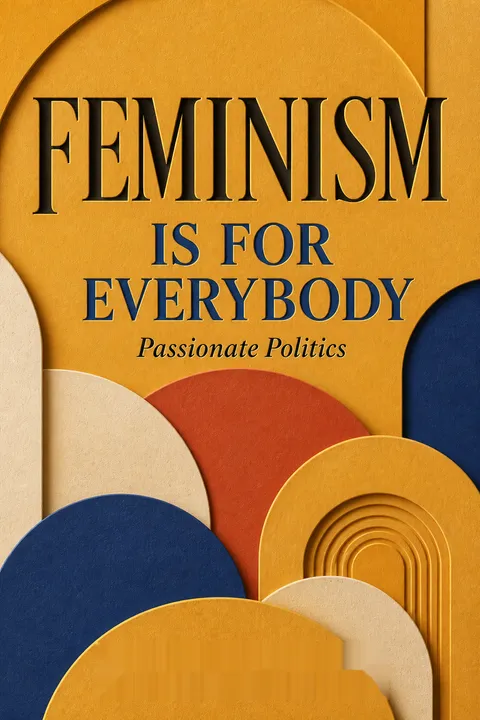


Key Takeaways
Define feminism by the system it opposes, not the people it supposedly hates.
Name the actual target. hooks defines feminism as a movement to end sexism, exploitation, and oppression. That definition challenges the familiar caricature that feminists simply oppose men. Sexism is a system of beliefs and institutions that privileges male authority, and people of every gender can learn and reproduce it. Men as a group benefit most from patriarchy, but hooks argues that its demands for dominance also restrict men and damage their relationships. Changing the system therefore requires allies of all genders, not a contest between men and women.
A personal need becomes political. As a teenager, hooks resisted male authority in her household while feeling depressed and uncertain about her future. Feminist ideas gave her a language for understanding that experience as part of a larger pattern. The book grows from that promise: political clarity can help people make sense of private life and imagine different ways to live.
What's striking is how much work the definition does by naming a pattern rather than assigning blame to an entire sex. That distinction resembles structural approaches in sociology, which ask how rules and incentives reproduce inequality even when individuals mean well. It also makes the political invitation wider: anyone can examine their own participation and choose a different practice. The distinction should not blur unequal power, however. Saying that everyone can reproduce sexism does not mean everyone benefits equally from it. A useful application keeps both facts in view: responsibility is broadly shared, while power and harm are unevenly distributed.
Treat feminist commitment as a practice of self-change, not a label.
Learn to see the pattern. hooks uses the term consciousness-raising for group discussion that helps people recognize how sexism shapes everyday experience, understand it as systemic, and consider ways to change it. Women shared personal stories, listened to one another, and disagreed about what those stories meant. The point was not only emotional release. Naming a private hurt as a recurring social pattern could make resistance possible, while examining one's own beliefs exposed internalized sexism.
Build knowledge together. These groups often met in homes and welcomed people beyond the university. Women's studies courses later gave feminist thought legitimacy and reach, but hooks argues that classrooms could not fully replace community groups. Academic work sometimes became difficult for the public to access, and feminism risked becoming a credential or career language rather than a political commitment. Learning feminism means more than adopting its name: it means putting its analysis to work in how people treat one another.
The method links personal narrative to collective analysis, a combination also central to participatory education: learners bring experience, test interpretations together, and revise their understanding. That process can reveal patterns that isolated individuals might mistake for personal failure. It also guards against treating political identity as proof of virtue. The limitation is that a group can reinforce its own assumptions unless members can question its norms and hear people with different experiences. hooks's emphasis on dialogue and disagreement matters for precisely that reason. Solidarity needs trust, but it also needs room for correction.
Solidarity becomes real when women confront power between women.
Shared struggle takes work. Feminist sisterhood, in hooks's account, is not automatic affection among women or a claim that all women experience oppression in the same way. It is political solidarity built by challenging sexism and the ways women can dominate or exploit one another through race and class power. Without that work, a movement may speak in the name of all women while centering the interests of the already privileged.
A classroom exposed the stakes. At Stanford, hooks recalls seeing women speak less confidently than men and hearing their intellectual abilities questioned. Feminist organizing challenged those assumptions and created greater space for women's work. Yet she argues that gains for some women did not guarantee justice for all. A privileged woman gaining workplace freedom while relying on poorly paid women for domestic labor can reproduce the very hierarchy feminism opposes. Solidarity requires attention to who receives the benefit and who carries the cost.
This account makes coalition a material practice, not just a shared identity. The question is not only who is included in a movement's language, but whose labor sustains its members and whose priorities shape its agenda. That insight connects feminist politics to labor analysis and to intersectional approaches that examine how power operates through several social positions at once. There is a practical challenge here: naming unequal advantage can provoke defensiveness, especially when people experience themselves as disadvantaged in other ways. The answer is not to abandon common cause, but to make its terms negotiable and accountable.
Join global struggles without appointing Western women as their rescuers.
Refuse the savior role. hooks criticizes forms of Western feminism that assume women in the United States are already liberated and therefore qualified to set agendas for women elsewhere. That posture can repeat colonial power: it treats women outside the West as passive recipients of help instead of political actors with their own knowledge and movements. Global feminist solidarity, in her account, means joining struggles against sexism without claiming ownership of them.
Compare without flattening. hooks asks readers to connect practices such as female circumcision with Western pressures that can also endanger women's bodies, including starvation in pursuit of thinness and harmful cosmetic procedures. The comparison redirects attention to shared roots in control over women's bodies. It does not mean every practice is identical or causes the same harm. A serious global analysis must recognize both connections and differences, and avoid using criticism of another culture to excuse sexism at home.
The argument anticipates a central problem in international advocacy: concern can become paternalism when the people most affected are treated as objects of intervention rather than authors of change. Comparing bodily practices across contexts can unsettle Western self-congratulation and invite reciprocal scrutiny. Such comparisons need care. Similar underlying pressures do not make distinct histories, risks, or forms of coercion interchangeable. The strongest version of hooks's approach holds those truths together: solidarity learns from local leadership, while comparison helps reveal how power travels through different cultural forms.
Measure work by whether it creates freedom, not merely a paycheck.
A job is not liberation. hooks challenges the idea that entering paid work automatically frees women. For many working-class women, employment meant low wages alongside continuing responsibility for housework and children. Better-paid careers gave some privileged women greater independence, but those gains did not change the economic conditions of most women. In the book's account, women earned roughly 73 cents for each dollar earned by men, a figure presented in its period rather than as a current statistic.
Ask who does the work. Economic self-sufficiency can make it easier for a woman to leave a dominating relationship, but paid employment alone cannot guarantee autonomy or a decent life. hooks calls for attention to wages, working conditions, poverty, and caregiving, and proposes approaches such as job sharing and greater support for people raising children. She also warns that the freedom of affluent women can rest on the poorly paid labor of other women. A feminist view of work must examine both income and the distribution of time, care, and power.
This distinction between employment and economic agency is useful well beyond feminism. Labor can supply income and social connection while still leaving workers with little control over their time or conditions. The focus on caregiving also corrects a narrow economic measure that counts paid production while treating household labor as if it appeared by magic. hooks's proposals point toward institutional change, though the book does not specify how to fund or implement every one. The durable question remains concrete: does an arrangement give people real choices, or does it merely shift exhausting work from one group to another?
Protect bodily autonomy beyond abortion, from healthcare to beauty standards.
See the whole body. hooks argues that reproductive freedom includes more than abortion access. It also involves sex education, contraception, prenatal and preventive care, and protection from unnecessary medical procedures such as hysterectomies. Access matters: when safe, affordable services disappear, women with money may retain choices that poor and working-class women lose.
Challenge the beauty mandate. Feminist activism also challenged the idea that a woman's value depends on meeting standards set for male approval. hooks recalls women reclaiming comfort in clothing and rejecting restrictive expectations around bras, high heels, and makeup. But rejecting a sexist standard does not require rejecting beauty or adornment. The problem is compulsion: a culture can praise women's freedom while flooding girls and women with images that make thinness seem necessary for worth. Critique needs to be paired with healthier alternatives, or the old ideal simply returns under new packaging.
The unifying concept is agency over the body, whether the pressure comes from medical institutions, law, or commercial images. This broad framing helps connect issues often divided into separate policy debates. It also clarifies why formal choice is insufficient when cost, information, or social pressure makes one option practically unavailable. The beauty discussion adds an important complication: rejecting coercion should not turn into policing women who enjoy fashion or makeup. Autonomy includes the freedom to adorn, as well as the freedom not to treat appearance as a condition of human value.
Challenge domination in homes, including violence adults direct at children.
Look beyond one perpetrator. hooks uses patriarchal violence to describe violence rooted in the belief that powerful people may control others through force. The term includes men's violence against women, abuse between same-sex partners, and violence adults direct at children. She argues that calling abuse a private domestic matter can hide its connection to a wider culture that treats domination as legitimate.
Children reveal the hierarchy. hooks describes a dinner party where a woman praised herself for pinching her young son hard enough to control him. The guests approved, although similar force against an adult woman would likely have been recognized as abuse. The episode shows how authority can make coercion appear acceptable when directed downward. hooks also argues that boys need alternatives to patriarchal masculinity, which ties self-worth to control. Love, emotional development, and nonviolent caregiving offer a different model for children of every gender.
The strength of this frame is its attention to the social permission behind violence, not only the identity of a perpetrator. It makes the parent-child relationship politically visible without excusing the greater patterns of male violence that concern hooks. Research across fields often distinguishes individual acts from norms that legitimize coercion; this distinction helps explain why condemning abuse in principle may not change everyday discipline. A broad framework still needs precise attention to differing forms, frequency, and consequences of violence. Naming a shared logic should open comparison, not erase those distinctions.
Build love and sex around consent, agency, and mutual care.
Freedom requires mutuality. hooks argues that romantic love becomes destructive when possession and control are mistaken for devotion. Feminist politics should challenge that model without treating love itself as the enemy. In a loving partnership, each person's needs and growth matter, and no one should have to accept subordination to keep the relationship.
Pleasure needs agency. Feminist sexual politics challenged the idea that women should be passive, ashamed of desire, or responsible for satisfying men's wishes. hooks stresses that sexual freedom is not simply having more partners. It includes reliable contraception, knowledge of one's body, and the ability to choose whether and when to have sex without punishment. Lesbian activists also showed that women's happiness need not depend on men, though same-sex relationships are not automatically free of domination. Equal partnership requires ongoing work at home as well as in bed, especially around childcare and housework.
The account joins emotional ethics to practical conditions: affection is not mutual when one person cannot safely refuse, leave, or name a need. That makes consent necessary but not sufficient; economic dependence and unequal care work can limit agency even without overt force. hooks's inclusion of lesbian experience also separates sexual identity from political virtue. No relationship type guarantees equality by itself. The useful measure is how power is handled: whether partners can negotiate desire, responsibility, and disagreement without one person's comfort becoming the rule for both.
Let feminist politics welcome spiritual life while challenging religious patriarchy.
Justice can be spiritual. hooks describes feminist spirituality as a search for forms of religious and spiritual life that affirm women's dignity rather than male authority. Women have found refuge in spiritual practice even within traditions shaped by sexism, and feminist thinkers have challenged interpretations that present women's subordination as divinely ordained. Some have also drawn on traditions with feminine images of the sacred.
Change belief and practice. For hooks, cultural transformation cannot ignore religion when religious ideas help shape expectations about gender and control of women's bodies. Feminist Christians and people in other faith traditions can reinterpret their traditions rather than assume that feminism requires abandoning faith. At the same time, spiritual language alone does not make a practice just. The relevant question is whether belief supports liberation from domination or gives that domination sacred cover.
This section avoids a false choice between political analysis and spiritual meaning. Religion can offer community, ethical purpose, and solace, while institutions and doctrines can also authorize hierarchy. That dual role explains why dismissal from outside a faith may fail to persuade people whose spiritual lives are central to them. Reinterpretation can make change intelligible from within a tradition, though it should not substitute for examining who holds authority and whose bodies or voices are constrained. The approach is strongest when spiritual affirmation and institutional accountability proceed together.
Take feminist knowledge out of elite classrooms and into everyday life.
Make the ideas reachable. hooks distinguishes reformist feminism, which seeks greater equality within existing institutions, from the more transformative vision she calls visionary feminism. Reforms such as fairer treatment at work matter, but they do not by themselves end the systems that reproduce sexism, racism, and class hierarchy. A movement needs both immediate gains and a wider account of the society it wants to build.
Teach beyond the university. hooks worries that feminist theory can become academic language for a small audience while mass media spreads caricatures. She calls for accessible books, children's education, community discussion, and communication through formats beyond print. Feminist work belongs in homes, schools, workplaces, and public life, and it must address people of every gender and background. The book itself is part of that strategy: a primer designed to help readers explain feminism to people who have never encountered it directly.
The book's form is part of its argument. It treats accessibility not as a simplification of serious thought, but as a condition for democratic participation. Social movements depend on more than winning policy debates; people need shared language for recognizing a problem and imagining alternatives. Yet popular communication can become slogan without analysis, while academic work can preserve complexity at the cost of reach. hooks's challenge is to build routes between those settings: translate ideas without stripping away conflict, and let public experience reshape theory.
Analysis
Feminism Is for Everybody is both an introduction to feminist politics and an argument about how political knowledge should circulate. Its chapter sequence moves from definition and consciousness-raising through race, class, work, bodies, violence, relationships, and spirituality, then returns to the need for a broad public movement. The structure is cumulative: sexism is not a single unfair attitude but a pattern reproduced across intimate life, institutions, and culture. Each domain tests whether feminist commitments remain consistent when the issue shifts from women's formal rights to labor, children, sexuality, religion, or global power.
The book's most important analytical move is to refuse a simple division between innocent victims and uniform oppressors. Women can reproduce sexism; men can resist it; women's gains can depend on other women's labor. This makes solidarity an ethical and material practice rather than a presumed bond. hooks's attention to race, class, and colonial power gives that claim substance, while her insistence on accessible language makes the analysis usable beyond specialist audiences.
The book also has productive tensions. Its systemic vocabulary can sometimes gather very different institutions and harms under one large account of patriarchy, so readers need to keep asking which mechanism operates in a specific case and who has the power to change it. Its proposals for transformed work, education, and care are more visionary than operational. That is partly the purpose of the primer: to establish the political horizon before supplying a detailed policy program. The result is strongest as a moral and interpretive map. It teaches readers to connect private experience to public structure, and to judge feminist claims by whether they reduce domination across relationships, not merely whether some women gain access to existing power.
Review Summary
Feminism Is for Everybody receives mixed reviews. Many praise its accessible introduction to intersectional feminism and hooks' critiques of white, upper-class feminism. Readers appreciate hooks' emphasis on inclusivity and her broad coverage of feminist issues. However, some criticize the book's academic jargon, lack of citations, and hooks' personal opinions presented as facts. Several reviewers note that the book may not be suitable for complete beginners despite its intended purpose. Overall, readers find the book thought-provoking but divided on its effectiveness as a primer on feminism.
People Also Read
Glossary
consciousness-raising
Collective analysis of sexismA group practice in which people discuss personal experiences, identify how sexist beliefs and institutions shape them, and develop ways to challenge those patterns. In hooks's account, these discussions joined emotional recognition with political learning. They also required participants to examine their own internalized sexism, rather than treating feminist change as something demanded only of other people.
patriarchal violence
Violence used to enforce dominationhooks's term for violence grounded in the belief that a more powerful person may control others through coercive force. It includes men's violence against women, violence in same-sex relationships, and adult violence against children. The term emphasizes that abuse in the home is connected to broader sexist ideas about authority, hierarchy, and the right to dominate.
woman-identified woman
Woman-centered political allegianceA term hooks discusses for a woman whose sense of self and political commitment do not depend on men's approval. It does not require a particular sexual identity or partner. The term distinguishes a political orientation centered on women's autonomy and solidarity from one in which heterosexual relationships or male recognition routinely take priority over feminist commitments.
reformist feminism
Equality within existing systemsA form of feminist politics focused on securing women's rights and opportunities within established institutions, such as gaining access to careers or equal treatment at work. hooks recognizes the value of such reforms but argues that they can leave larger structures of sexism, racism, and class exploitation intact, especially when gains accrue mainly to privileged women.
visionary feminism
Transformative politics against dominationhooks's term for a feminist vision that seeks immediate improvements while also imagining and working toward a society organized around mutuality rather than domination. It addresses sexism alongside racism, class hierarchy, and imperial power, and aims to make freedom and well-being possible for people across genders and social positions.
white supremacist capitalist patriarchy
Interlocking systems of dominationhooks's compact phrase for the mutually reinforcing structures of white supremacy, capitalism, and patriarchy. It names a social order in which racial hierarchy, economic exploitation, and male dominance interact rather than operate as separate problems. The phrase directs attention to how power and material benefit can be distributed differently among women as well as between women and men.
FAQ
What's "Feminism Is for Everybody: Passionate Politics" about?
- Overview of feminism: The book is a primer on feminism, exploring its nature and promise to eliminate sexism, sexist exploitation, and oppression.
- Author's perspective: Written by bell hooks, a cultural critic and feminist writer, it aims to make feminism accessible to everyone.
- Feminism's impact: It discusses how feminism can change lives and encourages readers to see feminism as a movement for all people, not just women.
Why should I read "Feminism Is for Everybody"?
- Understanding feminism: The book provides a clear and concise explanation of feminist theory and practice.
- Broad audience: It is written in an accessible style, making it suitable for readers new to feminist ideas.
- Empowerment: It offers insights into how feminism can positively impact both personal and societal levels.
What are the key takeaways of "Feminism Is for Everybody"?
- Feminism's definition: Feminism is a movement to end sexism, sexist exploitation, and oppression.
- Inclusivity: The book emphasizes that feminism is for everyone, regardless of gender or background.
- Social change: It highlights the importance of building a mass feminist movement to achieve social justice.
How does bell hooks define feminism in "Feminism Is for Everybody"?
- Clear definition: Feminism is defined as a movement to end sexism, sexist exploitation, and oppression.
- Not anti-male: The definition clarifies that feminism is not about being anti-male but about addressing sexism.
- Inclusive approach: It acknowledges that both men and women can perpetuate sexist thinking and actions.
What is the significance of consciousness-raising in "Feminism Is for Everybody"?
- Awareness building: Consciousness-raising is crucial for understanding and challenging patriarchy and sexism.
- Group discussions: It involves group settings where individuals can share experiences and develop feminist consciousness.
- Conversion to feminism: The process is seen as a way to convert individuals to feminist thinking and action.
How does "Feminism Is for Everybody" address the issue of race and gender?
- Intersectionality: The book discusses the importance of acknowledging race and racism within feminist movements.
- Challenges to white feminists: It highlights how black women and women of color have challenged racism in feminism.
- Inclusive feminism: Emphasizes the need for a feminist movement that addresses the realities of all women.
What role does class play in "Feminism Is for Everybody"?
- Class differences: The book explores how class divides women and affects feminist movements.
- Reformist vs. revolutionary: It contrasts reformist feminism, which seeks equality within the existing system, with revolutionary feminism, which seeks systemic change.
- Economic self-sufficiency: Discusses the importance of economic independence for women's liberation.
How does "Feminism Is for Everybody" approach the topic of reproductive rights?
- Broad perspective: The book emphasizes reproductive rights beyond just abortion, including access to contraception and healthcare.
- Class bias: It highlights how class privilege affects access to reproductive rights.
- Ongoing struggle: Reproductive rights remain a central feminist issue, with a focus on maintaining safe and legal access for all women.
What does "Feminism Is for Everybody" say about feminist masculinity?
- Alternative masculinity: The book calls for a vision of masculinity that is not rooted in domination.
- Self-esteem and identity: It suggests that feminist masculinity should be based on self-love and mutual respect.
- Role of men: Encourages men to embrace feminist politics and challenge patriarchal norms.
How does "Feminism Is for Everybody" address violence?
- Patriarchal violence: The book links domestic violence to patriarchal thinking and male domination.
- Comprehensive approach: It calls for ending all forms of violence, not just male violence against women.
- Cultural change: Emphasizes the need for a cultural shift to challenge and change violent behaviors.
What insights does "Feminism Is for Everybody" offer on feminist spirituality?
- Critique of patriarchal religion: The book critiques traditional religious beliefs that support sexism and male domination.
- Spiritual awakening: It discusses the role of feminist spirituality in transforming religious practices.
- Liberation theology: Connects spiritual liberation with feminist struggles for justice and equality.
What are the best quotes from "Feminism Is for Everybody" and what do they mean?
- "Feminism is for everybody": This quote encapsulates the book's central message that feminism is inclusive and relevant to all.
- "Love can never take root in a relationship based on domination and coercion": Highlights the importance of mutual respect and equality in relationships.
- "Visionary feminism is a wise and loving politic": Emphasizes that feminism is grounded in love and justice, aiming to end domination and oppression.
About the Author
Other books by bell hooks





Download PDF
Download EPUB
.epub digital book format is ideal for reading ebooks on phones, tablets, and e-readers.








