

Key Takeaways
Build feminism around the 99 percent, not elite access to power.
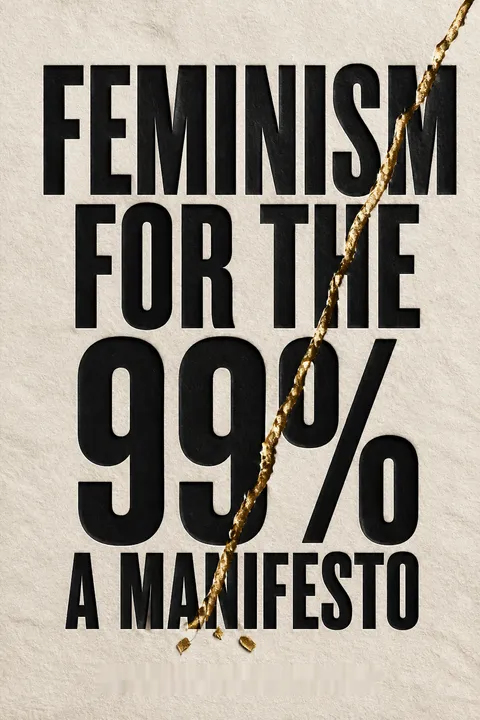
Two competing feminisms. The authors open with a contrast: corporate feminism seeks more women in executive offices, while militant feminist organizers challenge the system that makes those offices powerful. In 2018, a Spanish feminist strike drew more than five million participants and called for a society free from sexist oppression and exploitation. The book takes its side: feminism should serve poor and working-class women, migrants, racialized people, queer and trans people, and others who experience exploitation and domination. Its name, feminism for the 99 percent, signals a movement aimed at the majority, not simply equal access for a few.
The authors argue that legal rights matter, but cannot deliver freedom when people lack healthcare, safe housing, decent work, or the means to leave violence.
What's striking is the change in the test for feminist progress. Representation is not dismissed, but it is judged by whether it changes material conditions beyond the boardroom. That is a useful corrective to treating visibility as evidence of redistribution. The phrase 99 percent works as a coalition-building signal, not a precise economic category. Its strength depends on whether a movement makes real differences in race, class, disability, and sexuality visible, rather than assuming that a shared label automatically produces shared interests.
Use strikes to make invisible labor politically impossible to ignore.
A wider kind of strike. The feminist strike movement spread from Poland, where women protested a proposed abortion ban, to Argentina and many other countries. Organizers expanded the strike beyond leaving paid jobs. They called attention to care, housework, and other unpaid activities, and connected these to workplace harassment, reproductive rights, and public services. In Spain, the 2018 action combined work stoppages with marches, boycotts, and closures.
This expanded practice makes the strike a way to show how much society depends on work that conventional labor politics often overlooks. The authors connect it to teachers’ strikes and campaigns against cuts to healthcare, education, housing, and water services. These actions broaden both who counts as a worker and where class conflict takes place.
The strike functions here as a political demonstration of dependence: when work stops, the normally hidden supports of everyday life become visible. That insight connects labor organizing to the study of infrastructure, where a system is often easiest to understand when it fails. The approach also raises a practical question. People with precarious jobs, caregiving duties, or no paid leave may be least able to stop working. A powerful strike therefore needs ways to share risk and support participation, not only a compelling account of what society depends on.
Count care as infrastructure, because wage labor cannot sustain itself.
The work behind work. Social reproduction is the work that creates and sustains people, families, and communities, including the care and support that keep people able to work. The authors use a case from Taiwan: a mother who had raised two sons and paid for their dental education sued one son for failing to support her in old age. The court ordered him to pay nearly one million dollars toward the cost of his upbringing. The case makes visible what ordinary economic accounts tend to hide: people require years of resources and labor before they can enter paid work.
Capitalism depends on this people-making work while often treating it as private duty rather than socially necessary labor. Much of it falls to women, and class and race shape who performs it, for whom, and under what conditions.
Calling care infrastructure clarifies that its value is not sentimental or secondary: transport, schools, clinics, and caregiving all help make social and economic life possible. The book’s framework also explains why cuts to public services can shift costs rather than eliminate them, moving labor into households and onto women. A useful nuance is that care is not automatically equitable simply because it happens outside markets. Families and communities can reproduce unequal power too. The key question is who has time, resources, and authority to provide care, and who gets to benefit from it.
A woman at the top is not equality if others bear the cost.
The glass ceiling is not enough. The authors criticize liberal feminism for measuring progress by whether a small number of women can rise through corporate, political, or military hierarchies. That approach can leave the hierarchy intact while changing who manages it. It also overlooks the women whose low-paid work makes elite careers possible. A professional woman may gain time for her job by hiring a migrant woman to clean her home or care for her children, while that worker struggles to meet responsibilities in her own family.
The authors argue that this version of feminism favors meritocracy over equality. It condemns discrimination but does not challenge the economic arrangements that restrict most people’s choices. Their alternative is not simply more women at the top, but a transformation of the conditions that keep many women at the bottom.
The argument distinguishes descriptive representation, who occupies a position, from substantive change, what that position does to people’s lives. That distinction is valuable well beyond feminism: institutions can diversify their leadership without changing the distribution of risk, labor, or wealth. The critique is strongest when it asks who absorbs the costs of one person’s advancement. It should not imply that representation has no value, however. Access to decision-making can matter, especially when exclusion has been systematic. The sharper standard is whether representation comes with changes to the rules and resources that structure everyone else’s options.
Read economic, care, ecological, and political breakdowns as connected crises.
More than a market crash. The book treats the 2007-2008 financial crisis as one part of a wider social crisis. Capitalism, the authors argue, relies on conditions it does not fully pay to maintain: human care, public institutions, and nature. The pursuit of profit can therefore weaken the very foundations on which economic activity depends. Neoliberal policies intensify these pressures through lower wages, weaker labor protections, reduced public services, and environmental damage.
This account connects financial instability to exhausted families, political systems constrained by investors and debt, and ecological decline. The authors describe crisis not only as a period of suffering but also as a political opening: when established institutions lose credibility, people may seek new organizations and alliances. The decisive question is whether that opening benefits concentrated wealth or broad social needs.
The book’s systems view is useful because it resists treating care, climate, and democracy as separate policy compartments. It asks what shared arrangements generate several kinds of damage at once. This resembles ecological systems thinking, where pressure on one part of a system can undermine the others. Still, naming capitalism as the common cause can risk making distinct mechanisms look interchangeable. Financial rules, public budgets, gender norms, and ecological choices operate differently and may require different remedies. A strong structural diagnosis should therefore connect these mechanisms without erasing their specific histories or the possibility of meaningful reforms.
Give survivors real exit options, not punishment alone or debt.
Violence has many routes. The authors cite estimates that more than one in three women worldwide experience some form of gender violence during their lives, and that intimate partners are responsible for 38 percent of women’s murders. They connect private abuse to public power: employers, teachers, police, and other authorities can exploit people whose jobs, housing, immigration status, or professional futures depend on them.
The book criticizes two inadequate responses. A reliance on criminal punishment can disproportionately harm poor and racialized communities without changing the conditions that enable abuse. Market-based microloans, meanwhile, can deepen a woman’s dependence on creditors rather than provide safety. The authors emphasize practical supports, including housing and public services, so survivors can leave dangerous relationships and workplaces. They argue that gender violence cannot be separated from economic, state, and racial violence.
The focus on exit options links intimate safety to material security. A person cannot freely refuse an abusive partner or employer if doing so means losing housing, income, or legal security. This is an important contribution to debates that treat violence mainly as a question of individual behavior or legal remedy. The critique of punishment also highlights the unequal reach of criminal systems. Yet rejecting punishment as a sufficient answer does not settle what protection should look like in immediate danger. Prevention, survivor-led services, accountability, and emergency safety measures need to be considered together, with attention to who controls each response.
Defend sexual freedom without letting markets define its acceptable forms.
Rights need material support. The authors reject a simple choice between sexual conservatism and liberal acceptance. Conservative movements seek to restrict sexuality in the name of family or tradition; liberal institutions may recognize LGBTQ+ people while rewarding forms of life that fit consumer culture, state rules, and respectable family norms. Corporate acceptance, for example, can coexist with discrimination against poor queer people and people of color.
Legal victories matter, but the authors argue they do not guarantee the means to exercise freedom. They point to states that recognize trans people while failing to cover the costs of transition. They also criticize the use of LGBTQ+ acceptance to present states as enlightened while depicting other populations as backward. Their alternative ties sexual freedom to material support and a broader challenge to class, racial, and gender hierarchy.
This analysis separates recognition from the conditions that make recognition usable. A right that exists on paper but is unaffordable or unsafe can have sharply limited reach. The critique of market-friendly inclusion also explains how corporations may celebrate difference while leaving workplace power untouched. At the same time, formal legal protections can prevent real harm, so suspicion of state recognition should not become indifference to its practical benefits. The productive question is how to protect rights now while widening access and resisting the idea that acceptance must be earned through respectability or purchasing power.
Build solidarity through unequal realities, not a fantasy of identical oppression.
Difference belongs in the coalition. The authors describe capitalism as historically intertwined with slavery, colonialism, and the dispossession of Indigenous peoples. They argue that racialized workers have often been forced into especially precarious labor, while racialized women have performed low-paid or unpaid care for more privileged households. In the present, migrant domestic workers may care for other people’s children while separated from their own families.
This history complicates any appeal to universal sisterhood. Women do not experience oppression in identical ways, and some have benefited from arrangements that burden others. The authors therefore call for solidarity built through political work: identifying how different forms of oppression connect, acknowledging unequal positions, and organizing across them. They reject both the erasure of difference and the idea that differences make collective struggle impossible.
The distinction between solidarity and sameness is crucial. Solidarity is not a claim that everyone suffers equally; it is a practice of recognizing how unequal positions are connected and negotiating shared action without requiring uniform experience. This approach helps avoid two common errors: treating one group’s experience as universal, or treating every group as politically sealed off from the others. Its difficulty is organizational. Recognition alone does not redistribute authority. A coalition must make room for those most burdened by its policies to shape priorities, or its language of inclusion can repeat the hierarchy it means to oppose.
Join ecological defense to care and community, not carbon markets alone.
Climate is a social issue. The authors argue that profit-driven extraction treats nature as a cheap source of materials and a place to deposit waste. The effects are unequal: they cite women as 80 percent of climate refugees and describe poor women of color as especially exposed to environmental hazards. Women also lead struggles over water, land, mining, pipelines, and biodiversity.
These movements connect environmental protection with the conditions communities need to live. The authors contrast that approach with green financial schemes that allow pollution-related activity to become a source of profit without resolving the underlying damage. Their eco-socialist position treats human well-being and ecological sustainability as linked: protecting nature cannot mean sacrificing communities, and supporting communities cannot mean ignoring the ecological basis of life.
The connection between environmental conditions and care work reveals why climate impacts are not distributed evenly. When water, food, or housing becomes less secure, the labor of managing that loss often falls to people already responsible for household survival. This lens strengthens environmental politics by asking who bears the costs, not merely whether a project is labeled green. The caution is that the book’s opposition to market-based remedies does not, by itself, specify how a transition should be financed or governed. A credible alternative needs both ecological limits and accountable decision-making by affected communities.
Turn separate campaigns into a durable anti-capitalist coalition.
Struggle can change alliances. The authors call for feminists to join labor, anti-racist, environmental, migrant-rights, anti-imperialist, and LGBTQ+ movements. They reject both reactionary populism and progressive neoliberalism, which they describe as different ways of managing a system that continues to benefit the powerful. Their strategy is to win working-class people away from both camps and build a broader force for social change.
The book presents struggle as a school: collective action can help participants understand the sources of their problems, reassess who shares their interests, and imagine different arrangements. But unity is not automatic. A coalition must take differences seriously while identifying how institutions connect them. The goal is not simply to add feminist demands to existing politics, but to change the priorities governing work, care, public resources, and the economy.
The coalition strategy recognizes that no single movement can address the full range of harms described in the book. It also treats organizing as a process that can reshape political identities, rather than assuming people arrive with fixed interests. The challenge is translating a shared diagnosis into decisions about priorities, trade-offs, and accountability. A coalition can oppose the status quo yet still reproduce exclusions internally. Its durability depends on concrete practices: whose demands lead, how disagreements are handled, and whether common programs improve material conditions for those with the least power.
Analysis
The manifesto’s central move is to redefine what counts as economic life. Wage production is not a self-contained engine: it depends on care, public institutions, social bonds, and natural systems that markets often treat as free inputs. This wider frame explains why the authors place reproductive rights, domestic labor, housing, climate, sexual violence, and democracy within one political argument. It also changes the image of the working class. Workers include not only people in formal employment, but also those doing unpaid care, precarious service work, and community labor that makes paid work possible.
The book’s sharpest political distinction is between representation and transformation. A woman’s access to corporate or state power can be a real gain without changing who bears the costs of that power. The critique is persuasive when it shows how elite advancement can rely on poorly paid migrant care labor, or how legal protections remain thin when people cannot afford healthcare or safe housing. Its account of feminist strikes is equally important: withdrawing unpaid labor makes visible a dependency that conventional workplace politics can overlook.
The argument is also deliberately totalizing. It presents capitalism as the shared structure linking gender oppression, racism, ecological destruction, and democratic failure. That gives the movement a coherent explanation and a basis for alliances, but it creates a strategic burden. If every problem is connected, organizers still need to specify which institutions can be changed first, which reforms reduce immediate harm, and how competing needs will be negotiated. The label 99 percent is best understood as an invitation to build a majority coalition, not a claim that the majority already has identical interests.
The manifesto’s lasting value is therefore less a finished blueprint than a political method: start from the work and lives that official accounts discount, trace who benefits from that discounting, and organize across differences without pretending they disappear. Its ambition is broad, but its most practical test is concrete: whether collective action makes care more secure, work less coercive, and public decisions more answerable to those who sustain society.
Review Summary
Feminism for the 99%: A Manifesto receives mixed reviews. Many praise its concise critique of capitalism and call for intersectional, anti-racist, and eco-socialist feminism. Readers appreciate its bold vision and accessibility. However, some criticize its academic language, lack of concrete solutions, and overly broad anti-capitalist stance. Several reviewers note it may not be truly accessible to the "99%" it aims to reach. Overall, it's seen as a thought-provoking manifesto that challenges liberal feminism and advocates for a more inclusive, radical approach.
People Also Read






Glossary
feminism for the 99 percent
majority-centered anticapitalist feminismA feminist political project aimed at the majority rather than the advancement of a privileged few. It links gender justice to struggles against class exploitation, racism, imperialism, ecological destruction, and the deprivation of public services. The term describes both a political orientation and a coalition-building goal.
feminist strike
withholding paid and unpaid laborA strike that broadens labor action beyond paid jobs. It can include withdrawing housework and care, as well as workplace stoppages, marches, boycotts, and other public actions. By making unpaid labor visible, feminist strikes connect personal and household life with workplace demands, reproductive rights, and public services.
social reproduction
work that sustains peopleThe activities and relationships that create and sustain people as social beings, including care, child-rearing, household labor, and maintaining families and communities. In capitalist societies, this work also replenishes the people able to work for wages, although much of it is unpaid or undervalued and disproportionately assigned to women.
progressive neoliberalism
elite-friendly progressive politicsA political alignment that pairs the language of social progress, diversity, or equality with economic arrangements that continue to favor capital and concentrated wealth. In the book, it includes corporate-friendly forms of feminism and other justice movements that seek inclusion within existing hierarchies rather than transforming the conditions that produce inequality.
carceral feminism
reliance on criminal punishmentAn approach to gender violence that treats criminal laws, policing, and imprisonment as primary tools of protection. The authors argue that this response can strengthen institutions that disproportionately punish poor and racialized people while leaving underlying power relations and survivors’ lack of safe housing or economic independence unresolved.
global care chains
cross-border transfers of care workLinked arrangements in which more privileged households hire poorer, often migrant or racialized women to provide care and domestic labor. Those workers may then transfer their own family responsibilities to other women, frequently across borders or class lines. The chain moves care burdens without eliminating them.
expropriation
taking without adequate compensationThe seizure or appropriation of labor, resources, or capacities without paying the costs required to sustain or replace them. The book uses the term for processes such as colonial dispossession, racialized labor extraction, and the appropriation of social-reproductive work. It distinguishes this from wage exploitation while showing how the two can operate together.
FAQ
What's "Feminism for the 99%: A Manifesto" about?
- Core Argument: The book argues for a feminism that serves the vast majority of women, not just the privileged few. It critiques liberal feminism for aligning with capitalist interests.
- Anticapitalist Stance: It promotes an anticapitalist feminism that seeks to dismantle the structures of capitalism that perpetuate gender inequality.
- Global Movement: The manifesto is inspired by global feminist strikes and movements that challenge both patriarchy and capitalism.
- Intersectional Approach: It emphasizes the interconnectedness of gender, race, class, and environmental issues in the fight for equality.
Why should I read "Feminism for the 99%"?
- Critical Perspective: It offers a critical perspective on mainstream feminism, highlighting its limitations and proposing a more inclusive approach.
- Global Relevance: The book addresses global issues, making it relevant for understanding feminism in a worldwide context.
- Activist Inspiration: It serves as a call to action for those interested in feminist activism and social justice.
- Theoretical Insight: Provides a theoretical framework for understanding the relationship between capitalism and gender oppression.
What are the key takeaways of "Feminism for the 99%"?
- Reject Liberal Feminism: The book argues that liberal feminism is insufficient and often complicit with capitalist structures.
- Embrace Anticapitalist Feminism: It advocates for a feminism that challenges capitalism and seeks systemic change.
- Intersectionality is Crucial: Emphasizes the importance of addressing race, class, and environmental issues alongside gender.
- Global Solidarity: Calls for international solidarity among feminists and other social justice movements.
How do the authors define "Feminism for the 99%"?
- Inclusive Feminism: It is a feminism that serves the needs of the vast majority, not just the elite.
- Anticapitalist Approach: It seeks to dismantle capitalist structures that perpetuate inequality.
- Intersectional Focus: Addresses the interconnectedness of various forms of oppression, including race, class, and gender.
- Global Movement: Inspired by international feminist strikes and movements challenging both patriarchy and capitalism.
What criticisms do the authors have of liberal feminism?
- Complicity with Capitalism: Liberal feminism is criticized for aligning with capitalist interests and focusing on individual advancement.
- Meritocracy Over Equality: It is seen as promoting meritocracy rather than true equality, benefiting only a privileged few.
- Neglect of Socioeconomic Issues: The authors argue that liberal feminism ignores the socioeconomic constraints that affect the majority of women.
- Outsourcing Oppression: It allows privileged women to "lean in" by leaning on the labor of less privileged women.
What is the significance of the feminist strikes mentioned in the book?
- Repoliticizing Women's Day: The strikes have revived the historical roots of International Women’s Day in working-class and socialist feminism.
- Global Movement: They have become a transnational movement, uniting women across different countries and cultures.
- New Forms of Strikes: The strikes have expanded the concept of labor to include unpaid work, such as housework and caregiving.
- Solidarity and Power: Demonstrate the political potential of women’s power and the importance of solidarity in feminist activism.
How do the authors connect capitalism to gender oppression?
- Subordination of Reproduction: Capitalism subordinates social reproduction to production for profit, reinforcing gender oppression.
- Exploitation and Expropriation: Women’s labor, both paid and unpaid, is exploited and undervalued in capitalist societies.
- Crisis of Care: Neoliberal capitalism exacerbates crises in social reproduction, stretching women’s capacities to the breaking point.
- Intersectional Oppression: Capitalism intertwines gender oppression with race, class, and other forms of domination.
What role does social reproduction play in the authors' argument?
- Essential Work: Social reproduction is vital for sustaining human life and labor power, yet it is undervalued in capitalist societies.
- Gendered Labor: This work is largely performed by women and is often unpaid or underpaid.
- Crisis Point: Neoliberal policies have intensified the crisis of social reproduction, leading to a depletion of social capacities.
- Site of Struggle: Social reproduction is a key site of struggle for feminist movements seeking systemic change.
What solutions do the authors propose for achieving gender justice?
- Anticapitalist Feminism: They advocate for a feminism that challenges and seeks to dismantle capitalist structures.
- Global Solidarity: Emphasize the importance of building alliances with other social justice movements, including anti-racist and environmental groups.
- Redefining Work: Call for a redefinition of what counts as work, including unpaid and reproductive labor.
- Systemic Change: Propose a massive reorganization of society to prioritize people-making over profit-making.
How do the authors address the issue of gender violence?
- Systemic Condition: Gender violence is seen as a systemic condition rooted in capitalist social relations.
- Beyond Carceral Solutions: They reject carceral feminism and market-based solutions, advocating for systemic change instead.
- Intersectional Approach: Emphasize the interconnectedness of gender violence with other forms of capitalist violence, such as economic and state violence.
- Comprehensive Fight: Call for a comprehensive fight against all forms of violence in capitalist society.
What is the authors' stance on sexual liberation?
- Critique of Sexual Liberalism: They critique sexual liberalism for being tied to capitalist norms and failing to achieve true liberation.
- Beyond Binary Choices: Reject both sexual reaction and sexual liberalism, advocating for a more radical liberation.
- Material Bases: Argue that true sexual liberation requires a noncapitalist society that supports diverse family and personal associations.
- Reviving Radical Spirit: Seek to revive the radical spirit of past liberation movements, such as the Stonewall uprising.
What is the relationship between capitalism and ecological crisis according to the authors?
- Capitalism's Exploitation of Nature: Capitalism treats natural resources as infinite and free, leading to ecological destabilization.
- Women on the Front Lines: Women are disproportionately affected by ecological crises and are often at the forefront of environmental struggles.
- Integrated Struggles: Advocate for integrated struggles that connect ecological issues with social justice and anti-capitalist movements.
- Eco-Socialist Vision: Propose an eco-socialist vision that links the liberation of women with the preservation of the planet.
Download PDF
Download EPUB
.epub digital book format is ideal for reading ebooks on phones, tablets, and e-readers.








