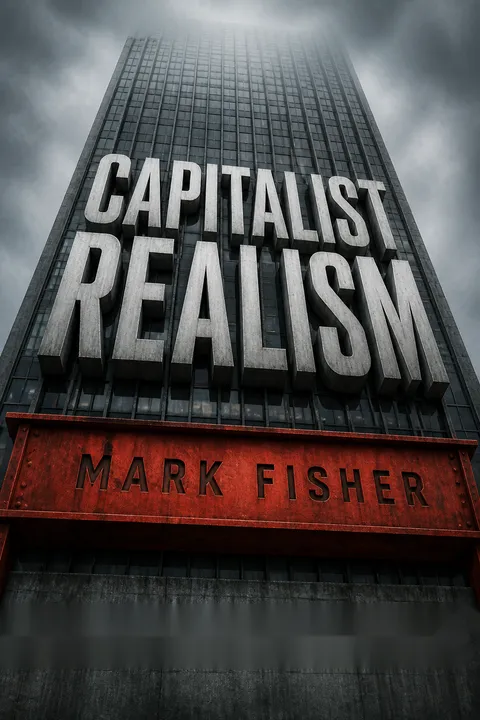


Key Takeaways
Treat capitalism's inevitability as an ideology, not a fact of nature.
A system mistaken for reality. Mark Fisher calls the prevailing sense that capitalism is the only workable social order “capitalist realism.” It reaches beyond support for markets: it limits what people can imagine as politically possible. In the film Children of Men, a collapsing society still preserves elite art collections, consumer comforts, and market life. The catastrophe feels less like a break from the present than its continuation under harsher conditions.
Culture needs a future. The film's infertile world also suggests a culture unable to produce genuinely new ideas. Picasso's Guernica, once a protest against violence, hangs as a prestigious object stripped of its original force. When the new cannot challenge the inherited, even the past becomes decoration. Fisher's central provocation is that people can picture global disaster more readily than a world beyond capitalism.
What's striking is how the film makes political possibility a cultural question. A society can preserve its museums and still lose the living practices that once made art matter. This connects to the idea of path dependence: institutions and habits built over time can make alternatives seem impractical, even when they are not impossible. The argument is powerful as a diagnosis of narrowed horizons, though it risks making cultural stagnation sound total. Local experiments, public institutions, and social movements can still create alternatives in miniature, even when they do not yet add up to a rival system.
Ask whether rebellion has been packaged before it even begins.
Rebellion as a market style. Fisher uses “precorporation” for the way capitalist culture anticipates and shapes desires before they become independent challenges. The familiar cycle of rebellion followed by commercial absorption is not the whole story: dissent can be formatted in advance as a sellable identity. “Alternative” and “independent” styles can circulate as mainstream options, complete with recognizable gestures of defiance.
The dead end of cool. Fisher reads Nirvana's Kurt Cobain as acutely aware that protest itself could become spectacle. Once the system can sell the pose of resistance, refusing the system may feel scripted too. The result is not simply cynical music or fashion. It is a sense that every new move has already been seen, named, and priced, while older cultural forms return as imitation rather than renewal.
This account helps explain why a culture saturated with novelty can feel strangely repetitive. Branding often sells not just products but ready-made identities, including the identity of the outsider. Yet incorporation is not always complete: audiences can use commercial forms in unexpected ways, and a message may travel farther after entering popular culture. The useful question is therefore not whether a cultural work is pure or compromised, but whether it changes what people can notice, say, or organize together. Fisher's example makes the trap visible without requiring the claim that escape is impossible.
Do not confuse recognizing a problem with changing its machinery.
Critique can become entertainment. “Interpassivity” describes a situation in which a cultural object performs an emotion or action on behalf of its audience, letting people feel involved without changing their behavior. Fisher points to Wall-E, whose satire blames corporate consumerism for a ruined Earth, while the film itself remains a commercial product for consumers. Its criticism may be sincere, but watching the critique can also provide a satisfying substitute for acting on it.
Good intentions, familiar channels. Live 8 and Bono's Product Red campaign offer a related example. They drew attention to poverty and directed some consumer spending toward charitable ends, but left the market system itself largely unquestioned. Fisher's concern is not that charity or awareness is worthless. It is that ethical consumption can make systemic problems look solvable through individual purchases, while political organization and structural change recede from view.
The distinction between awareness and agency is useful well beyond media. Behavioral research often finds that intentions and actions diverge, especially when the easier action offers an immediate feeling of completion. A film or campaign can make a distant crisis emotionally legible, which is a genuine achievement; it can also leave viewers with a premature sense of having done their part. A practical test is to ask what the response changes: a private feeling, a transaction, or the rules and institutions producing the harm. Those effects can coexist, but they should not be mistaken for one another.
Expose what counts as realistic by tracing who benefits.
Necessity has a history. Fisher argues that what society calls realistic is politically made, then presented as common sense. Privatization and the weakening of unions, for instance, were once difficult to imagine in Britain but later became ordinary policy. The concept of “business ontology” names the assumption that society's institutions, including education and health care, should operate as businesses.
Look for the suppressed fracture. Fisher draws on psychoanalytic theory to distinguish apparent “reality” from the “Real,” the conflict or limit that a social order cannot comfortably represent. Environmental damage is one such fracture: markets may absorb climate concern into advertising, while the growth imperative that drives the economy remains intact. The task is not merely to condemn suffering as unfair, since that can be dismissed as wishful thinking. It is to show how supposedly practical arrangements generate problems they cannot resolve.
This is a strong method for political analysis: treat “there is no alternative” as a claim that needs evidence, not as the end of discussion. It also resembles historical institutionalism, which studies how choices become locked into systems and then mistaken for natural constraints. The psychoanalytic language adds a way to notice what official narratives leave out, although it can be difficult to test or define precisely. Grounding the argument in specific policy choices helps. A convincing alternative must explain not only what is failing, but how different arrangements could work.
Read student disengagement as a social symptom, not a character flaw.
Knowing, yet feeling powerless. Fisher calls “reflexive impotence” the condition of recognizing that things are bad while believing nothing can be done. He saw it among students who appeared disengaged not because they lacked information, but because change already seemed futile. He also describes “depressive hedonia”: a state in which pleasure-seeking continues, yet it becomes difficult to focus on anything beyond immediate gratification.
A classroom caught between systems. In the further-education college where Fisher taught, funding depended on attendance, achievement, and retention. Students could have little incentive to attend or complete work, while the institution could not easily exclude them. Some struggled to read for more than a few sentences and called the activity boring. Fisher connects this to an entertainment environment of fast, continuous stimulation, not simply to individual laziness or a diagnosis.
The shift from moral judgment to social explanation can make educators more curious about the conditions shaping attention. Digital media, unstable prospects, and institutional incentives may all matter, but the book's classroom observations cannot establish that capitalism causes any particular learning difficulty or mental illness. That distinction matters: structural analysis should widen the search for causes, not replace careful clinical or educational assessment. Fisher's sharpest point is about agency. When students expect effort to have little consequence, exhortations to try harder are unlikely to be enough; institutions must make meaningful participation possible.
Flexibility can mean permanent insecurity, not freedom.
Work without a long horizon. Fisher uses “post-Fordism” for the shift from stable, large-scale production and long-term employment toward flexible work, temporary jobs, outsourcing, and constantly changing roles. He marks October 6, 1979, when the U.S. Federal Reserve sharply raised interest rates, as a turning point in this economic reorganization. In Michael Mann's film Heat, he finds a cultural emblem of the new ethos in a criminal crew held together by future profit rather than family loyalties.
Instability follows people home. Workers are expected to retrain, communicate constantly, and adapt to unforeseen demands. Richard Sennett's research, which Fisher draws on, links these conditions to pressure on family life, where trust and commitment require time and continuity. Fisher also cites a British study in which reported psychiatric morbidity rose from 22 percent in 1977 to 31 percent in 1986. He treats this as evidence worth politicizing, not proof that work conditions alone caused the increase.
The connection between job insecurity and personal life is a useful correction to the idea that economic flexibility is a cost-free gain in choice. Unpredictable schedules and short contracts can transfer risk from organizations to workers, including the risk of planning care, education, and housing. At the same time, stable employment is not automatically humane; the old factory system could be coercive and exhausting. The political question is how to secure people's ability to plan without restoring every feature of Fordist work. Fisher's own caution around mental-health statistics is important: correlation can identify a problem, but it does not settle its causes.
When audits become the work, institutions optimize appearances over service.
Measurement breeds its own workload. Fisher calls the combination of market language and expanding administrative targets “market Stalinism.” In education, employees complete forms describing aims, outcomes, student results, and self-assessments, while external inspections and performance measures add further layers. The promise is accountability and efficiency. The danger is that institutions spend increasing effort producing evidence that they are doing the work.
Targets can displace purpose. Fisher describes teachers narrowing lessons toward exam performance and hospitals favoring routine procedures that help meet measured targets. In both cases, a proxy for quality can crowd out harder-to-measure value. Even a supposedly lighter inspection can create constant self-monitoring when staff must prove that their own assessment systems are adequate. The result is a bureaucratic loop: workers document, rate, and report activity for an abstract evaluator, while the underlying service receives less attention.
This resembles Goodhart's law: once a measure becomes a target, people have incentives to improve the measure rather than the underlying outcome. The framework is especially useful where public services involve complex work that cannot be captured by a single score. Auditing is not inherently useless; transparent measures can reveal neglect and unequal treatment. The problem is treating the record as a complete picture of reality. A better system would combine quantitative indicators with professional judgment, local knowledge, and direct accounts from the people using the service.
Demand collective responsibility for systems no individual can control.
A system without a center. Fisher argues that contemporary capitalism can feel both powerful and unaccountable. His example is the call center: a customer repeats the same problem to workers who may lack the information or authority to resolve it. Anger has a target in the person on the line, but the cause lies in an organization whose decisions are scattered across systems and departments.
Ethics can shift blame downward. Recycling campaigns, for example, can make every consumer responsible for environmental damage while the economic structures driving production disappear from view. Fisher does not argue that individual choices are irrelevant. He argues that personal responsibility cannot substitute for collective power over large-scale systems. The challenge is to create institutions and political groups capable of acting where isolated consumers, employees, and even officials have little control.
This is a valuable distinction between personal conduct and effective responsibility. A person may have duties within a system without having the power to redesign it; confusing those facts can produce guilt without leverage. Collective action can pool knowledge and influence, but it also needs mechanisms for accountability, since “the system” can become an excuse for inaction by people with real authority. Fisher's call to construct a collective political subject points toward that difficulty: shared harm does not automatically create shared organization. Institutions have to make coordination durable.
Build alternatives that answer unmet desires, not just denounce capitalism.
Criticism needs a program. Fisher argues that opposition cannot stop at nostalgia for the old workplace or protests that make demands without building political organization. Neoliberalism succeeded partly by taking up desires for freedom from rigid routines, then channeling them into insecure, flexible work. A credible left would need to answer those desires differently, including by restoring worker control and challenging administrative labor that does not improve public services.
Create public life worth choosing. Fisher's “Marxist Supernanny” is a provocation against treating people only as consumers whose existing preferences must be satisfied. Education and public culture can challenge audiences with unfamiliar, demanding work rather than endlessly repeating what already sells. He also argues that distress and environmental limits require collective responses, not just private adjustments. The 2008 bank rescues, in his account, showed that a crisis alone does not produce an alternative: political organization must make one thinkable and practical.
The strongest strategic insight is that opposition must compete in the territory of desire, not merely expose hypocrisy. People need security, autonomy, and cultural discovery; a politics that offers only sacrifice or denunciation leaves those needs to commercial systems. The proposal also raises a real democratic question: who decides which cultural experiences challenge or educate, and how can public institutions avoid paternalism? Fisher's emphasis on experimentation helps. Public provision need not mean one central authority dictating taste; it can mean giving artists, educators, and communities room to take risks beyond immediate market demand.
Analysis
Fisher's book is best read as a diagnosis of political imagination, not as a comprehensive account of capitalism or a finished plan for replacing it. Its central move is to show how an economic order becomes ambient: markets appear inescapable not only because institutions depend on them, but because ordinary culture trains people to treat their assumptions as realism. That argument gains force from the book's changes of scale. A dystopian film, a bored student, a teacher completing audit paperwork, and a customer trapped in a call-center maze become different views of the same problem: social life is organized by structures that seem powerful while responsibility is difficult to locate.
The method is vivid, but it has risks. Fisher's examples are interpretive, and some causal claims, particularly those linking economic organization to mental distress, remain hypotheses rather than demonstrated explanations. The concept of capitalist realism can also become so expansive that it explains every sign of conformity while making contrary evidence hard to recognize. A rigorous use of the idea should ask what would count as an exception, and should distinguish market pressures from other causes such as institutional history, technology, and individual circumstances.
The book's political ambition is stronger than its institutional detail. It insists that criticism must become a rival vision rather than a ritual of disapproval, and it identifies promising fronts: worker autonomy, less pointless administration, public culture, and collective responses to ecological limits. Yet building a political subject capable of coordinating these aims is not automatic. Shared frustration can fragment into private coping or mutually incompatible demands. The argument therefore works as both a warning and a challenge: expose the contingency hidden inside claims of necessity, then develop institutions that make alternatives usable, accountable, and desirable. Its lasting value lies in refusing to confuse the failure of earlier political forms with proof that no new form can be built.
Review Summary
Capitalist Realism receives mixed reviews, with many praising its concise yet thought-provoking analysis of late capitalism's pervasive influence. Readers appreciate Fisher's cultural references and insights on topics like mental health and bureaucracy. Some find the writing dense and jargon-heavy, while others consider it accessible. Critics note the book's dated aspects and lack of concrete solutions. Overall, it's regarded as an important work for understanding contemporary capitalist society, though its pessimistic tone and occasional generalizations are points of contention.
People Also Read







Glossary
Capitalist realism
Capitalism as the only possibilityFisher's term for the widespread assumption that capitalism is the only viable political and economic system, making alternatives difficult even to imagine. It is more than a defense of markets: it shapes culture, work, education, and public policy, so that historically created arrangements appear natural or inevitable.
Precorporation
Desires shaped in advanceThe pre-emptive formatting of desires, hopes, and rebellious gestures by capitalist culture. Rather than waiting for an independent cultural challenge and then absorbing it, the system can anticipate oppositional styles and present them as familiar, marketable choices from the outset.
Interpassivity
An action performed on one's behalfA term Fisher draws from Robert Pfaller for situations in which a cultural object or practice performs an emotion, belief, or action on behalf of its audience. A person can feel that a film or campaign has expressed their criticism, for example, while continuing the behavior being criticized.
Reflexive impotence
Knowing change feels impossibleFisher's description of a condition in which people recognize that social conditions are harmful but feel unable to alter them. The expectation of powerlessness is not merely passive: by discouraging action, it can help reproduce the very situation people regard as unavoidable.
Depressive hedonia
Pleasure without sustained engagementFisher's description of a pattern in which a person is not simply unable to experience pleasure, but becomes absorbed in seeking immediate pleasure while finding it difficult to pursue other activities. He uses the term to interpret some students' reliance on entertainment and their difficulty sustaining attention.
Post-Fordism
Flexible, insecure work organizationA reorganization of production and employment away from stable, large-scale workplaces and long-term job paths toward flexible work, outsourcing, temporary employment, and repeated retraining. Fisher emphasizes that communication and adaptation become part of labor, while work's instability can spill into personal and family life.
Market Stalinism
Targets replacing meaningful workFisher's label for a system that combines market-oriented management with intensive bureaucracy, auditing, and performance targets. Its resemblance to Stalinist administration lies in the priority given to measurable symbols of achievement over substantive results, even though the political and economic systems differ.
Business ontology
Society understood as businessFisher's term for the taken-for-granted assumption that every institution and area of social life should be organized according to business principles. It makes market efficiency seem like a universal measure of value, including in services such as education and health care.
FAQ
What's "Capitalist Realism: Is There No Alternative?" about?
- Exploration of Capitalist Realism: The book examines the pervasive sense that capitalism is the only viable political and economic system, making it difficult to imagine alternatives.
- Cultural and Political Analysis: Mark Fisher critiques how capitalist realism affects culture, politics, and individual psychology, leading to a sense of inevitability and resignation.
- Impact on Society: It discusses how capitalist realism shapes public services, education, and mental health, often leading to bureaucratic inefficiencies and widespread discontent.
- Philosophical Underpinnings: The book draws on thinkers like Fredric Jameson, Slavoj Žižek, and Gilles Deleuze to explore the philosophical dimensions of capitalist realism.
Why should I read "Capitalist Realism: Is There No Alternative?" by Mark Fisher?
- Critical Insight: The book provides a deep critique of contemporary capitalism, offering insights into why it feels so inescapable.
- Cultural Relevance: It connects economic theories with cultural phenomena, making it relevant for understanding today's media and societal trends.
- Philosophical Depth: Fisher's work is grounded in philosophical thought, making it a rich text for those interested in critical theory.
- Practical Implications: The book discusses real-world implications, such as the impact on mental health and education, making it applicable to everyday life.
What are the key takeaways of "Capitalist Realism: Is There No Alternative?"?
- Inescapability of Capitalism: Capitalism is seen as the only viable system, making alternatives hard to imagine.
- Cultural and Psychological Effects: The book explores how capitalist realism affects culture and individual psychology, leading to widespread discontent.
- Critique of Neoliberalism: Fisher critiques neoliberal policies and their impact on public services and individual well-being.
- Call for Alternatives: The book encourages the exploration of new political and economic models to challenge capitalist realism.
How does Mark Fisher define "capitalist realism"?
- Widespread Sense of Inevitability: Capitalist realism is the belief that capitalism is the only viable system, making alternatives seem impossible.
- Cultural and Economic Dominance: It describes how capitalism permeates all aspects of life, from culture to politics and individual psychology.
- Philosophical Underpinnings: Fisher draws on thinkers like Jameson and Žižek to explore the philosophical dimensions of capitalist realism.
- Impact on Imagination: The concept suggests that capitalist realism stifles the imagination, making it difficult to envision different ways of living.
What are the best quotes from "Capitalist Realism: Is There No Alternative?" and what do they mean?
- "It’s easier to imagine the end of the world than the end of capitalism." This quote highlights the pervasive sense of inevitability surrounding capitalism.
- "Capitalism seamlessly occupies the horizons of the thinkable." It suggests that capitalism limits our ability to imagine alternatives.
- "The long, dark night of the end of history has to be grasped as an enormous opportunity." Fisher encourages readers to see the current state as a chance to explore new possibilities.
- "The tiniest event can tear a hole in the grey curtain of reaction." This quote emphasizes the potential for small actions to challenge the status quo.
How does "Capitalist Realism" relate to mental health?
- Link to Depression: Fisher argues that capitalist realism contributes to rising rates of depression and mental distress.
- Privatization of Stress: The book discusses how stress is treated as an individual problem rather than a systemic issue.
- Critique of Neoliberal Policies: Fisher critiques neoliberal policies for exacerbating mental health issues by promoting individualism and competition.
- Call for Politicization: The book suggests that mental health issues should be politicized to challenge capitalist realism.
What role does bureaucracy play in "Capitalist Realism"?
- Market Stalinism: Fisher describes the proliferation of bureaucracy under neoliberalism as "market Stalinism," where symbols of achievement are valued over actual achievement.
- Impact on Public Services: Bureaucracy in education and healthcare is critiqued for prioritizing targets and audits over genuine improvement.
- Surveillance and Control: The book discusses how bureaucracy serves as a tool for surveillance and control in capitalist societies.
- Resistance to Marketization: Fisher argues that certain processes resist marketization, leading to increased bureaucracy.
How does Mark Fisher critique neoliberalism in "Capitalist Realism"?
- Discrediting Neoliberalism: Fisher argues that neoliberalism has been discredited but continues to dominate political economy as an inertial default.
- Impact on Public Services: Neoliberal policies are critiqued for their negative impact on education, healthcare, and mental health.
- Cultural and Economic Effects: The book explores how neoliberalism shapes culture and individual psychology, leading to widespread discontent.
- Call for Alternatives: Fisher encourages the exploration of new political and economic models to challenge neoliberalism.
What is the significance of the "big Other" in "Capitalist Realism"?
- Symbolic Structure: The "big Other" is a symbolic structure presupposed by any social field, representing collective fictions.
- Role in Capitalism: Fisher uses the concept to explain how capitalist realism functions, with PR and propaganda maintaining the illusion of coherence.
- Crisis of Symbolic Efficiency: The decline in belief in the "big Other" is linked to the crisis of symbolic efficiency in postmodernism.
- Public Relations and Perception: The "big Other" is the consumer of PR, allowing capitalism to function despite widespread awareness of its shortcomings.
How does "Capitalist Realism" address the concept of the "Nanny State"?
- Critique of Anti-Statism: Fisher critiques the neoliberal and neoconservative hostility towards the "Nanny State" while highlighting the contradictions in their reliance on state functions.
- Blame and Responsibility: The book discusses how the state is often blamed for failures that are systemic, deflecting attention from corporate irresponsibility.
- Centerlessness of Capitalism: Fisher argues that the centerlessness of global capitalism is unthinkable, leading to scapegoating of the state.
- Call for Collective Management: The book suggests that collective management is necessary to address systemic issues like environmental catastrophe.
What does Mark Fisher propose as alternatives to capitalist realism?
- New Political Subject: Fisher calls for the emergence of a new political subject capable of challenging capitalist realism.
- Worker Autonomy: The book advocates for worker autonomy and a rejection of excessive auditing and managerialism.
- Collective Management: Fisher suggests that collective management is necessary to address systemic issues like environmental catastrophe.
- Revitalized Left: The book encourages a revitalized left to confidently occupy new political terrain and explore alternatives to capitalism.
How does "Capitalist Realism" relate to cultural production and media?
- Impact on Culture: Fisher argues that capitalist realism stifles cultural innovation, leading to a culture of conformity and repetition.
- Role of Media: The book critiques media for failing to challenge audiences and for promoting a culture of solipsism and interpassivity.
- Public Service Broadcasting: Fisher highlights the importance of public service broadcasting in providing complex and intellectually demanding content.
- Call for Cultural Risk: The book encourages media professionals to take risks and offer audiences something different from what already satisfies them.
About the Author
Other books by Mark Fisher

Download PDF
Download EPUB
.epub digital book format is ideal for reading ebooks on phones, tablets, and e-readers.








