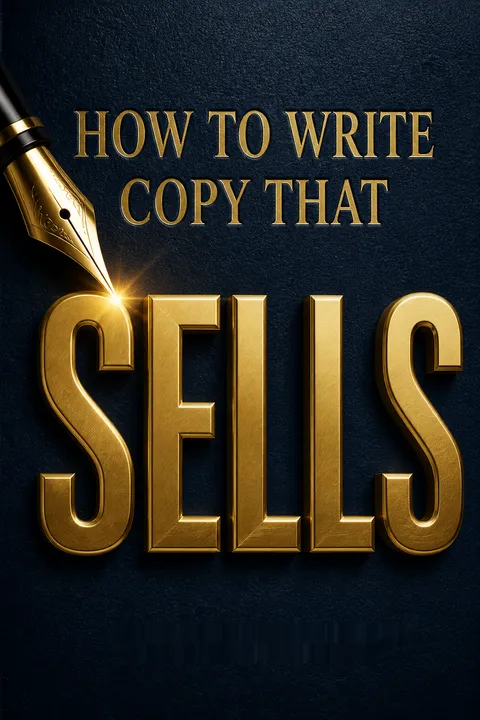


Key Takeaways
Treat copy as a sales conversation, not decoration or coercion
Words do the selling. Copywriting is persuasive writing across sales pages, email, video, and other media. A story in the book traces the idea to a 1904 meeting: copywriter John E. Kennedy persuaded advertising executive Albert Lasker that advertising could be understood as selling through written words. The practical lesson is that attractive design cannot rescue a message that fails to explain why a buyer should care.
Persuade in the buyer’s interest. Effective copy identifies a real problem, presents a credible solution, and asks for a decision. Edwards warns that the same psychological tools can manipulate people into choices that harm them. The writer’s obligation is therefore not just to make a sale, but to sell something that genuinely helps the customer.
The sales conversation analogy is useful because it makes copy accountable to a real exchange: one party has a need, the other offers a solution, and trust shapes the decision. Digital copy, however, cannot respond to a reader’s questions in real time. That makes clear terms, accessible evidence, and honest limits especially important. Persuasion is not ethically neutral simply because a buyer can click away. The standard should be whether the message supports an informed choice, not merely whether it increases conversion.
Guide readers from their pain to a clear, evidence-backed next step
Start with the reader. The book’s P.A.S.T.O.R. framework organizes a sales message as a sequence of care: identify the person and problem, make the consequences of inaction concrete, tell a true story about a solution, show the transformation through proof, explain the offer, and request a response. Its shepherding metaphor means serving and protecting the audience, not treating customers as a crowd to exploit.
Make the problem recognizable. A fitness message, for example, might acknowledge repeated attempts to lose weight and the discouragement that follows, without shaming the reader. Then it can show what the problem costs, explain how the solution works, and use genuine customer testimony. The sequence ends with specific instructions, such as where to click and what happens next.
This sequence resembles good clinical communication: understand the person’s experience before recommending an intervention, explain the likely consequences, then make the next step understandable. That order can help readers feel seen rather than targeted. The risk is that describing pain and the cost of delay can become pressure, especially when a seller exaggerates consequences. The framework is strongest when the problem is accurately represented, the evidence matches the claim, and the customer can decline without being cast as irrational.
Build sales pages for skimmers before asking anyone to read closely
Design for scanning. A sales page is a path through information, not merely a long block of persuasive prose. Edwards groups its components around attention, explanation, trust, proof, value, risk reduction, and the purchase request. A pre-headline and headline draw in the intended reader; a short supporting section expands the promise; subheads and bullets let someone scanning the page understand its argument; testimonials and credibility answer doubts; the offer, guarantee, call to action, and closing note help complete the decision.
Research before drafting. The book recommends searching for the language customers use in forums, product discussions, webinars, and live events. An entrepreneur named Armand Morin reportedly listened to audience questions at seminars because those questions revealed what potential customers wanted solved. Research supplies the words and concerns that make a page relevant.
The scan-first design reflects a basic fact of interface use: people often seek landmarks before committing attention to detail. Clear headings and a visible offer reduce the effort required to understand a page. This is also a usability principle, not only a sales tactic. A page that is easy to skim should make limitations and total cost easy to find, too. Otherwise, the same visual hierarchy that helps a good decision can hide important information and produce misplaced confidence.
Make headlines earn attention, then use bullets to deepen curiosity
Sell the next sentence. A headline should interrupt a reader’s scan, signal who the message is for, communicate its central benefit, and give a reason to continue. The book offers five useful patterns: a how-to promise, a clear exchange, a reason why, a probing question, or an if-then statement. Morgan, an executive consultant, renamed a dry article about organizational change with a more vivid pop-culture reference, and the post began attracting comments.
Draft more than you need. Bullets make benefits easy to scan and can either state a benefit plainly or hint at an intriguing detail. Edwards recommends writing five bullets in each of 21 formats, producing 105 candidates, then keeping roughly the strongest third. The formats range from direct benefits and numbered tips to questions and surprising contrasts. A swipe file can inspire structure, but copying another writer’s words is not the point.
The distinction between earning attention and delivering the entire argument is valuable: a headline is an invitation, not a substitute for substance. Generating many options also separates ideation from selection, a technique used in creative work to reduce premature self-editing. Curiosity can attract readers, but it can also become clickbait when the promised answer is trivial or withheld artificially. A useful test is whether the body fulfills the headline’s specific promise without requiring the reader to buy merely to learn what the headline implied.
Run email as a permission-based relationship with one action per message
Use sequences deliberately. The book distinguishes live campaigns, automated sequences, and one-off broadcasts. Live messages can respond to current events and audience questions; automated messages can welcome subscribers, prepare them for an event, follow up afterward, or help customers use what they bought. A separate goodwill email can offer useful material without asking for a purchase. The point is to treat email as continuing communication, not a string of disconnected promotions.
Make each message easy to act on. Get permission, explain what subscribers will receive, mail consistently, and honor unsubscribe requests. Decide the Most Wanted Response, or MWR, before writing: the single action the email should prompt. A message might ask for a click, a reply, or a purchase, but several competing requests can leave readers unsure what matters. Subject lines should feel relevant and invite attention without disguising the message.
The one-action rule is a practical response to cognitive load: several competing choices can make a simple email feel like a menu with no recommendation. Consistent, permission-based contact also gives readers a chance to form accurate expectations about the sender. Yet frequency is not automatically a virtue. The right cadence depends on whether each message earns attention with useful content and whether subscribers can easily change their preferences. Engagement should be measured alongside unsubscribes, complaints, and customer outcomes.
Sell the transformation, then choose an offer that fits buyer awareness
Lead with the result. Buyers generally want the change a product enables, not the delivery mechanism. Someone buying exercise videos wants fitness results, not a stack of discs. Explain the transformation first, then show how the product delivers it. Bonuses should be relevant and useful, not a pile of unrelated extras. The book also urges sellers to make price, terms, and what the customer receives unmistakably clear.
Match the offer to awareness. Edwards’s O.P.E.N. Scale describes people as oblivious to a problem, pondering a possible solution, engaged in actively seeking one, or in urgent need. An easy-to-try offer may help reach an unaware audience; a direct purchase request may suit someone already looking for a solution. Other structures include trials, limited-time access, applications, installments, and recurring subscriptions. Any deadline or limit must be real, and recurring charges must be plainly disclosed.
Matching an offer to awareness is a useful reminder that the same message does not fit every stage of decision-making. Someone who has not recognized a problem may need education, while someone actively comparing solutions may value specifics and a straightforward purchase path. The framework is a seller’s map, not a license to push an unready buyer toward urgency. In particular, trials and recurring billing can exploit inattention. Clear disclosures and easy cancellation are part of a good offer, not administrative details.
Put the purchase risk on yourself and make checkout unmistakable
Address fear beyond price. A guarantee can reduce concern that the product will disappoint, but buyers may also fear hassle, stress, or feeling foolish. Edwards’s ten-part approach recommends stating the refund promise plainly, restating the benefits, making the promise personal, explaining how to request a refund, and emphasizing that the process is prompt and uncomplicated. He illustrates the approach with a fictional dentist whose guarantee reinforces the promised smile and the practice’s distinctive gentle care.
Finish the decision. A close should recap the main benefit and guarantee, then directly ask for the order. Checkout should explain what happens after submission, look consistent with the sales page, and be tested for errors. The book also recommends specific instructions and honest urgency. A guarantee cannot make an unsupported claim true, and extravagant promises should never outrun what the seller can deliver.
A guarantee is a form of procedural trust: it tells buyers not only what remedy exists, but whether using it will be fair and manageable. That insight connects marketing to service design, where a clear, low-friction recovery process can preserve relationships after a failure. The author’s claim that longer guarantees can reduce refunds is plausible, but the effect depends on product type, customer behavior, and fulfillment costs. Ethical risk reversal requires both a usable refund process and a product that merits the confidence being advertised.
Turn a launch into a true story with a memorable central idea
Think beyond launch day. A product launch is a sequence of messages across email, posts, reports, partner promotions, a sales page, and follow-up. The book says the sales page may account for only 10-20 percent of the launch copy, and that as much as 30 percent of sales may arrive in the week after launch day. Its proposed story arc creates anticipation, shares the problem and solution, and ends with a clear offer. Every story should be true, including unexpected developments.
Give the story a center. The Dominant Story Idea, or DSI, is the core premise that makes the product’s story easy to grasp. Edwards compares a sales page to a movie trailer: present the central idea, let readers imagine the desired experience, and offer proof that the product works. A dog-training offer, for instance, might trace the problem, the search for a solution, and the evidence behind the method.
Story gives scattered communications continuity, while a central premise helps an audience understand why the pieces belong together. This is useful for launches, where repetition across formats can otherwise feel like repeated advertising. The movie-trailer analogy also highlights a crucial constraint: the preview must represent the actual experience. Narrative can make evidence memorable, but emotional coherence is not evidence by itself. Testimonials, results, and scarcity claims still need independent support, and a story should not manufacture a crisis to keep attention.
Publish a tested draft within 30 days instead of polishing forever
Learn from response. The book treats copywriting as a skill developed by writing, publishing, and observing what readers do. Its closing challenge is deliberately small at first: begin implementing one idea within two minutes, perhaps by drafting subject lines or outlining a sequence. Then choose an offer, schedule the sales message, and set a publication date no more than 30 days away.
Let results teach. A campaign’s response can reveal whether the promise was clear, whether the audience recognized the problem, or whether the offer created unnecessary friction. The goal is not to treat every purchase as proof that every claim was sound. Rather, use buyer behavior and customer feedback to revise the message and the product. Copy should be improved through evidence, not protected as a piece of art that cannot be questioned.
A deadline converts abstract learning into an experiment, which is often the only way to discover how a real audience interprets a message. The emphasis on action is especially apt in copywriting, where private confidence cannot substitute for reader response. Still, conversion alone is an incomplete measure. A persuasive campaign can increase purchases while also increasing refunds, complaints, or disappointed customers. Better evaluation connects the initial response to whether buyers understood the offer and received the promised value.
Analysis
The book’s central contribution is a practical bridge between audience understanding and concrete writing decisions. It argues that copy is not decoration added after a product is built. It is the means by which a business explains a problem, makes a case for its solution, and helps someone decide. Its strongest organizing idea is the P.A.S.T.O.R. sequence, which treats persuasion as a progression from recognizing a person’s problem to asking for a response. The book then breaks that work into usable craft: headlines, bullets, email sequences, offers, guarantees, closes, and launches.
Its most important ethical claim is also its most productive constraint. Persuasion is legitimate when the product serves the buyer and the claims are true. That principle gives the reader a way to distinguish useful urgency from manufactured scarcity, and reassurance from an empty guarantee. The book is right to stress that fear is not just fear of losing money. Confusing terms, difficult refunds, and the possibility of feeling foolish can all obstruct a decision.
The methods are strongest when treated as hypotheses rather than universal laws. The book often presents tactics as reliable conversion boosters, yet their effect depends on audience, product, channel, and trust. A long guarantee may reassure one buyer and create delivery risk for a seller; a curiosity-driven bullet may attract attention or damage credibility if it withholds too much. The appropriate test is not merely whether a page sells, but whether buyers understand what they are buying and are satisfied afterward.
That perspective makes the book more than a collection of templates. It is a system for turning customer research into a message, then using response to improve both the message and the offer. Its most durable lesson is that effective copywriting combines empathy, structure, proof, and a clear request, while accepting accountability for the customer’s experience after the click.
Review Summary
How to Write Copy That Sells receives mostly positive reviews for its practical copywriting advice and frameworks like PASTOR. Readers appreciate the clear explanations, examples, and templates provided. Some find it particularly useful for writing sales pages and launching products. Critics note that parts feel dated or repetitive, and the style may be too "clickbait-y" for some. Overall, many reviewers consider it a valuable resource for entrepreneurs and marketers looking to improve their copywriting skills, though opinions vary on its depth and applicability across different contexts.
People Also Read






Glossary
Copy Thesis™
one-sentence sales propositionA concise statement of the audience, the problem the offer addresses, the product or service, and the reason it can help. It serves as the central claim that the rest of the sales message develops and supports. Edwards recommends clarifying this proposition before writing the surrounding copy.
P.A.S.T.O.R. Copywriting Framework™
reader-centered sales sequenceA six-part structure for persuasive copy. It moves from identifying the person, problem, and pain, through the consequences of inaction, a story and solution, evidence of transformation, a clear offer, and a direct request for action. The framework is tied to a shepherding metaphor of guiding and caring for customers.
Most Wanted Response
one desired reader actionThe single action a reader should take after encountering a particular email or message. It may be clicking a link, replying, completing a survey, or buying. Defining this action before drafting helps keep the message focused and prevents several competing calls to action from confusing the reader.
P.A.C. formula
subject-line attention guideA method for shaping email subject lines around Personal relevance, Anticipation, and Curiosity. The subject should connect to the reader’s interests, benefit from expectations created by earlier useful messages, and invite the reader to learn more. It is a writing guide, not a guarantee that a subject line will be opened.
O.P.E.N. Scale
buyer-awareness stagesA model dividing potential buyers into four levels of awareness: Oblivious to a problem, Pondering a possible solution, Engaged in actively seeking one, and in Need of help. Edwards uses the stages to suggest that an offer should suit how aware and ready the buyer is, rather than applying one sales approach to everyone.
Dominant Story Idea
central premise of a campaignThe core story or premise that makes a product’s sales message distinctive and easy to understand. Edwards compares it to the central idea of a movie trailer, supported by a sample of the desired experience and evidence that the product works. It should organize the message without replacing proof.
Ray’s Way
ten-part guarantee methodEdwards’s approach to making a guarantee more persuasive than a bare refund statement. It combines clear refund language with benefits, a unique selling point, a personal promise, simple return instructions, speed, and a distinctive name. The method is meant to move perceived risk from the buyer to the seller.
Zeigarnik effect
memory for unfinished tasksThe book uses this term for the tendency to remember unfinished or unresolved matters more readily than completed ones. In email, Edwards suggests using an unfinished story or question to encourage readers to continue in a later message or follow a link. The device should lead to a meaningful answer, not a deliberately misleading tease.
FAQ
What's "How to Write Copy That Sells" about?
- Comprehensive Guide: "How to Write Copy That Sells" by Ray Edwards is a detailed guide on crafting persuasive sales copy that effectively converts readers into buyers.
- Step-by-Step System: The book provides a step-by-step system for writing copy that increases sales, attracts more customers, and encourages repeat business.
- Focus on Copywriting: It emphasizes the importance of copywriting as a pivotal business skill that can transform ideas into income and passion into profits.
Why should I read "How to Write Copy That Sells"?
- Proven Techniques: The book offers proven techniques and strategies used by successful copywriters to generate millions in sales.
- Practical Advice: It provides practical advice and templates that can be immediately applied to improve your marketing efforts.
- Ethical Selling: Ray Edwards emphasizes ethical selling, ensuring that your copy not only sells but also builds trust and credibility with your audience.
What are the key takeaways of "How to Write Copy That Sells"?
- P.A.S.T.O.R. Framework: A unique framework for writing copy that focuses on understanding the person, amplifying the problem, telling a story, offering a solution, and requesting a response.
- Irresistible Offers: The importance of crafting offers that are so appealing they sell themselves, using techniques like risk reversal and powerful closes.
- Copywriting as Salesmanship: Copywriting is described as "salesmanship in print," highlighting its role as a critical component of successful marketing.
What is the P.A.S.T.O.R. Framework in "How to Write Copy That Sells"?
- Person, Problem, Pain: Identify the person you are writing to, the problem your product solves, and the pain the problem causes.
- Amplify and Aspirations: Amplify the consequences of not solving the problem and highlight the aspirations of the reader.
- Story and Solution: Tell a compelling story that leads to the solution your product offers, transforming the reader's situation.
How does Ray Edwards suggest creating irresistible offers?
- Stand-Alone Offers: Ensure your offer can stand alone, providing all the information needed for a buying decision.
- Risk Reversal: Use guarantees to remove the buyer's risk, making it easier for them to say yes.
- Aspirational Language: Use language that invokes the reader's desires and aspirations, making the offer more compelling.
What are some of the best quotes from "How to Write Copy That Sells" and what do they mean?
- "Salesmanship in print": This quote encapsulates the essence of copywriting as a form of selling through written words.
- "An irresistible offer is one that’s so appealing, it sells itself": Highlights the importance of crafting offers that are so attractive that they naturally lead to sales.
- "Timid salesmen have skinny kids": A reminder of the importance of being bold and confident in your sales approach.
What is the significance of the "Dominant Story Idea" (DSI) in copywriting?
- Core Message: The DSI is the core message or theme that drives your sales copy, similar to a movie's storyline.
- Emotional Connection: It helps create an emotional connection with the reader, making the copy more engaging and persuasive.
- Guides the Copy: The DSI guides the structure and content of your copy, ensuring consistency and focus.
How does Ray Edwards recommend using bullet points in sales copy?
- Attention-Grabbing: Bullet points make your copy easier to read and highlight key benefits, capturing the reader's attention.
- Variety and Interest: Use different types of bullet points to maintain interest and avoid monotony.
- Curiosity and Engagement: Craft bullet points that pique curiosity and encourage the reader to continue engaging with the copy.
What are the different types of offers discussed in "How to Write Copy That Sells"?
- Hard and Soft Offers: Hard offers are straightforward, while soft offers allow for a trial period before payment.
- Limited Supply and Time Offers: Create urgency by limiting the availability of the product or the time the offer is valid.
- Application and Payment Plan Offers: Use application processes for exclusivity and payment plans to make high-ticket items more accessible.
How does "How to Write Copy That Sells" address the use of email marketing?
- Email Sequences: The book discusses the importance of using campaign sequences, both live and automated, to nurture leads and drive sales.
- Persuasive Emails: It provides tips for crafting emails that are personal, engaging, and effective in prompting action.
- Building Relationships: Emphasizes the role of email in building relationships and maintaining communication with prospects and customers.
What role do guarantees play in "How to Write Copy That Sells"?
- Risk Reversal: Guarantees are used to reverse the risk for the buyer, making it easier for them to commit to a purchase.
- Building Trust: A strong guarantee builds trust and confidence in the product and the seller.
- Creative Guarantees: The book encourages using creative and personalized guarantees to stand out and reassure customers.
How can "How to Write Copy That Sells" help improve my business?
- Increased Sales: By applying the techniques in the book, you can write copy that effectively converts readers into buyers, increasing sales.
- Customer Engagement: The strategies help create more engaging and persuasive marketing materials, leading to better customer relationships.
- Business Growth: With improved copywriting skills, you can enhance your marketing efforts, leading to business growth and success.
Download PDF
Download EPUB
.epub digital book format is ideal for reading ebooks on phones, tablets, and e-readers.








