

Key Takeaways
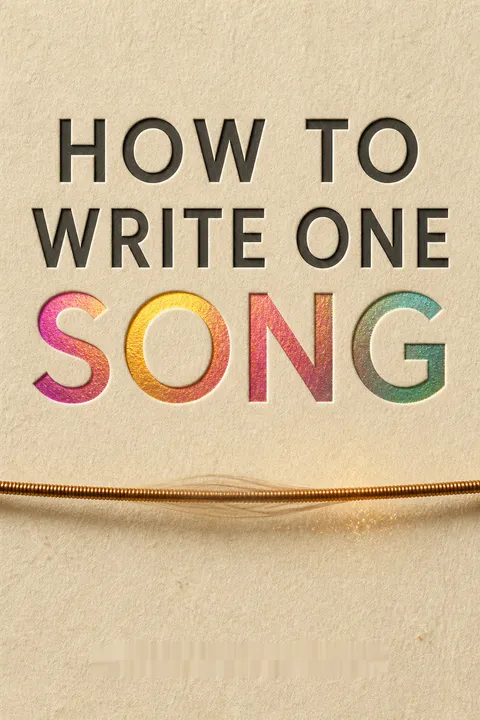
Write one song before demanding that you become a songwriter.
Start with the doing. Tweedy argues that claiming an artistic identity can feel intimidating because everyone carries a different picture of what a songwriter should be. Making one song is smaller and more real than trying to become an impressive kind of person. The focus is the act itself, not an imagined career, audience, or persona. In that act, he hopes, self-consciousness can recede and attention can settle on the work.
His father, a railroad worker with little formal schooling, sometimes wrote poems after work about what was troubling him. Tweedy sees the important step not as technical mastery, but as his father giving himself permission to put private thoughts into art. A song can matter even if it never leaves the room.
The distinction between identity and action resembles a useful idea in behavioral psychology: repeated behavior can build a sense of capability more reliably than declaring a new identity. It also lowers the stakes. A person need not settle the grand question of whether they are a real artist before making something. Still, identity can be a source of belonging and persistence, not only pressure. The practical point is not to reject labels, but to keep them from becoming a test that must be passed before work can begin.
Begin before inspiration arrives; the work can summon it.
Action can come first. After Wilco finished the album Summerteeth, the record label asked for a single. Tweedy told the executives he already had the right song, though he did not. He wrote most of Can’t Stand It while flying to Los Angeles. The demand created a starting condition, and the act of writing brought energy and ideas that had not been waiting fully formed.
This is not a claim that every deadline produces a good song, or that inspiration is irrelevant. It is a rejection of the idea that inspiration must arrive before work can start. Tweedy recommends putting the tools within reach, then making something small: play, write, hum, or record. Creative attention is easier to invite when there is already something to respond to.
This account fits the logic of behavioral activation: beginning a valued activity can change motivation, rather than motivation always preceding action. It also explains why a constraint can help. A limited window narrows the options and weakens the fantasy that work must happen under perfect conditions. Yet deadlines can also produce stress, especially when control is low. The useful principle is voluntary structure, not pressure for its own sake. A short, repeatable appointment with the work can provide the nudge without turning art into another emergency.
Build a small daily practice that stores words, sounds, and sparks.
Keep material in motion. Tweedy’s routine has three parts: gathering language, collecting bits of music, and trying combinations of the two. A line, melody, chord pattern, or striking sound need not become a song immediately. Recording a passing idea on a phone or writing it in a notebook keeps it available when a later melody or lyric needs it.
He describes recording guitar fragments alongside unusual birdsong, then rediscovering those recordings much later. The point is not to imitate his full-time studio schedule. He explicitly allows that five or ten minutes can be enough to build a store of raw material. His creative process is a repeatable set of actions and mental habits, not a mysterious burst that must be awaited.
A notebook or voice memo acts as external memory. It frees attention from the job of preserving every idea and makes creative work less dependent on having a perfect thought at the perfect time. This is a small example of distributed cognition, in which thinking is supported by tools and surroundings, not only by the mind. The method also changes what counts as material: a sound noticed and saved becomes part of a creative practice. A daily routine should remain adaptable, however, or it can become a standard that punishes people with limited time or unstable schedules.
Let yourself make bad songs; judgment belongs after discovery.
Separate making from rating. Tweedy says beginners often fear that a weak song will expose them as frauds. He sees the fear itself as a barrier: people who refuse to sound bad never get the practice that can make them better. During the making of Yankee Hotel Foxtrot, Warner Bros. executives repeatedly rejected the band’s mixes. Tweedy later listened to the version he valued and found that the criticism had not erased his connection to the record.
He distinguishes hard work from the mythology that art requires torment. Creating can be demanding without being miserable. A useful goal during a first pass is to stay curious and make material; later, a more discerning mind can choose, revise, or discard. Failure becomes useful when it teaches something, but it does not need to be romanticized.
The separation of exploration from evaluation has a close cousin in design practice: generate possibilities first, then apply constraints. Constant appraisal during early work can narrow attention to safe, familiar choices. The album story also makes a valuable point about criticism: a judgment from a gatekeeper is information, not a final verdict on either the work or its maker. At the same time, rejection can carry real professional and financial consequences. Treating it as survivable is empowering, but does not make its costs imaginary.
Treat ordinary words as sound before forcing them to mean something.
Loosen familiar language. Tweedy believes words carry rhythm and musical qualities before they are arranged into a clear message. His word ladder exercise begins with verbs from one setting and nouns in the room, then pairs them in unexpected ways. A separate exercise has the writer scan a book while humming, collecting words that fit a melody without worrying about the source text’s meaning.
Other methods include cutting written lines apart and rearranging them, collecting rhymes without building a whole poem, and recording a conversation to look for phrases that might sing. These exercises are not meant to produce finished lyrics on command. They interrupt habitual phrasing, offer surprising ingredients, and give the writer something concrete to shape. Simple, precise language can carry more force than decoration piled on a vague idea.
These exercises practice defamiliarization: familiar language is made strange enough to be noticed again. They also use associative thinking, allowing the mind to connect words before a conscious plan filters them. That can produce memorable images, but surprise alone is not a guarantee of meaning. A lyric still has to earn its listener’s attention through sound, emotional force, or a compelling pattern. The method is strongest as a way to generate options, not as a rule that every unusual pairing deserves to survive revision.
Borrow another point of view to reach truths your own voice hides.
Use distance to get closer. Tweedy often imagined another singer while writing, rather than asking whether a lyric sounded like himself. While working on A Ghost Is Born, he was in a painful period and struggled to write as Jeff Tweedy. He began imagining songs addressed to his young children from the perspectives of animals and other nonhuman narrators. One song grew from the viewpoint of an insect at a picnic, an unwelcome visitor in a world much larger than itself.
The fictional distance did not make the song emotionally empty. It gave him a safer way to approach feelings that were difficult to state directly. A narrator can be a person, an animal, or an object in the room. The perspective is invented, but the observations and emotional choices still come from the writer.
This resembles psychological distancing, a strategy in which people approach difficult experience through a third-person frame, metaphor, or imagined character. Distance can reduce the threat of direct confession while preserving emotional detail. Fiction is not necessarily an escape from truth; it can be a route into it. There is a limit, though: a persona can also become a hiding place if it substitutes for examining the feeling underneath. The most productive question is what the chosen voice makes possible that the habitual narrator could not say.
Study songs closely, then transform borrowed ingredients and credit what remains.
Listen like an apprentice. Tweedy considers deep listening part of musicianship. Learning a favorite song well enough to sing or play it reveals how its sections, timing, and melodic choices fit together. A song that sounds effortless often contains a carefully built internal logic that casual listening can miss.
He also urges writers not to fear influence. A chord progression that catches the ear can be a starting point for a different melody and a new song. But taking an entire song and presenting it unchanged as one’s own is not the same thing as learning from it. If recognizable material remains, it should be credited, and inspirations should be acknowledged when appropriate. The aim is to enter a shared musical conversation, not to conceal where an idea came from.
Art develops through apprenticeship and exchange, even when the finished work feels individual. Learning a song is a form of close reading: it reveals choices that can then be adapted rather than merely admired. The ethical distinction matters because influence exists on a continuum, while audiences and rights holders may experience copying very concretely. Credit cannot resolve every question about appropriation or ownership, especially where unequal power shapes whose work gets borrowed and rewarded. It does, however, make influence more honest and encourages attention to the source.
Record rough melodies and let nonsense lead toward singable words.
Let sound guide the lyric. When a melody arrives before its words, Tweedy records a mumble track: a rough vocal made from syllables or sounds that fit the tune. Listening back, he writes down the words or phrases he seems to hear, then revises them into lyrics that carry meaning and remain comfortable to sing.
This process keeps the melody active while the language catches up. It also reveals that the best lyric is not always the most elegant phrase on the page. Words have to fit the tune’s rhythm, vowels, and breath. Tweedy records fragments on a phone so ideas can be revisited, and he treats recording as a working tool rather than a demand for polished production. The words and music can find each other in either order.
A recording makes fleeting sound durable enough to inspect, which changes the task from inventing everything at once to noticing and revising. The method also gives melody a role in language selection: a vowel or rhythmic shape can suggest words that silent drafting would not produce. This is a form of embodied composition, where voice and breath help determine what works. Nonsense can generate useful material, but the final edit still needs to distinguish a compelling phrase from an accidental resemblance that merely sounds like language.
When stuck, change the entry point, rest, or keep working.
A single route is not required. Tweedy doubts that creative blockage means the ability to make anything has disappeared. Often, the writer dislikes what is emerging or feels trapped by an expectation about how the song should proceed. He suggests starting with the strongest line, turning a suspected weak chorus into the opening, reversing a chord sequence, or changing instruments and arrangements.
Stepping away can help too. Tweedy sometimes leaves a difficult song alone and returns after working on something else or sleeping. Time can reveal that the song is closer to finished than it seemed, or that it needs to become something different. But rest is not a universal answer. If avoidance is the real problem, continuing through discomfort may teach more than another delay. The task is to test a different move, not worship the feeling of being stuck.
The advice holds two strategies in productive tension: incubation and persistence. Incubation gives a problem time outside active attention, while continued effort can uncover a solution that passive waiting would not. Which helps depends on the source of the impasse. Fatigue and fixation often call for distance; fear of an imperfect result may call for staying with the task. Tweedy’s practical experiments make the distinction testable. Rather than asking whether inspiration has vanished, the writer can ask what specific constraint or expectation is narrowing the available choices.
Let one listener turn private making into an act of connection.
Share the song simply. Tweedy’s final suggestion is modest: perform the song at least once for someone outside the maker’s own mind. It could be a loved one or a person at an open mic. He does not require a polished recording, a label, or a public audience. Singing aloud for another person introduces vulnerability, and the listener’s presence can reveal whether the words and melody communicate as intended.
For Tweedy, songs reach toward connection: with other people, with oneself, or with something larger. He does not claim that a listener makes a song real; the act of making already matters. Sharing gives the song another life in someone else’s attention. It can also change the performance, as a singer adjusts when another person is listening. The accomplishment is not fame. It is having made and offered something that did not exist before.
Sharing turns solitary creation into a small social event. Research across communication and interpersonal psychology often treats expression as relational: meaning is shaped not only by what a person intends, but by how another person receives it. A first listener can make the work feel less abstract and more human. Yet public sharing is not a universal requirement for artistic value. The book’s suggestion works best as an invitation to connection, not another performance standard. A private song can still be worthwhile, especially when exposure would make the act feel unsafe.
Analysis
How to Write One Song is a practical guide wrapped around a defense of amateur and professional creativity alike. Its central move is to replace the daunting project of becoming a songwriter with the manageable act of making one song. That narrowing is more than motivational packaging: it changes the unit of attention from reputation to experience, and from imagined talent to observable practice. The narrative supports the argument with working examples, including a song written under label pressure, rejected album mixes, and lyrics approached through invented voices.
The book’s most useful model is iterative rather than formulaic. Writers collect words and musical fragments, put them together, record what happens, and revise by listening. Exercises are designed to disrupt habitual judgment, not to guarantee a finished product. This is why the advice can accommodate both structured routine and improvisation. A timer, a notebook, a changed instrument, or a night’s sleep can each alter what the writer notices.
The strongest psychological insight is that evaluation has a time and place. A writer who judges every phrase while generating it may choose only what already feels safe. Separating invention from selection permits surprise, while revision preserves standards. Tweedy’s account also makes an important distinction between demanding work and the romantic myth that suffering is a prerequisite for art. Creative labor can be serious without being self-destructive.
Some claims need careful application. The argument that people can find time if they truly want to create can motivate, but it risks treating constrained schedules as evidence of weak desire. Caregiving, disability, money, and exhaustion shape access to creative time. Likewise, one listener can deepen connection, but exposure is not necessary for a song to count. The book is most persuasive when its advice is understood as permission and possibility, not a test of commitment. Its lasting invitation is to make something small enough to begin, then stay curious long enough to hear what it becomes.
Review Summary
How to Write One Song receives mostly positive reviews, with readers praising Tweedy's encouraging tone and practical advice for aspiring songwriters. Many appreciate the book's focus on creativity and overcoming self-doubt. Some find it inspiring beyond songwriting, applicable to various artistic pursuits. Critics note that the content may be basic for experienced songwriters. Fans of Wilco and Tweedy particularly enjoy the insights into his creative process. Overall, reviewers find the book accessible, heartfelt, and motivating for creative expression.
People Also Read

Glossary
disappearing
Absorbed creative attentionTweedy’s term for becoming deeply absorbed in making a song, with less attention devoted to self-conscious monitoring and judgment. It is not literal disappearance. The maker’s sense of time and self may recede as attention settles on the creative process, making it easier to discover ideas that deliberate planning might exclude.
Process
Repeatable creative approachTweedy uses process to mean the actions, tools, routines, and mental habits that help someone make art reliably. It includes practical steps such as writing, recording, and revising, as well as methods for quieting self-judgment and entering a more receptive creative state. The process is personal rather than a fixed recipe.
Word Ladder
Unexpected word pairingsA language exercise in which a writer lists words, often verbs associated with one subject and nouns found nearby, then combines them in unfamiliar ways. The unusual pairings interrupt familiar phrases and can generate images or lyric fragments. The purpose is not to produce a finished song immediately, but to loosen habitual language and create material to revise.
Cut-up technique
Rearranged written fragmentsA writing method in which existing text is divided into lines, phrases, or individual words and then rearranged, sometimes randomly. Tweedy uses it to find unexpected relationships or to change the emphasis and sequence of a lyric. The altered arrangement can reveal a more vivid version of the material without requiring the writer to invent every phrase anew.
mumble tracks
Nonsense sung over melodiesRough recordings of a melody sung with improvised syllables or sounds before final lyrics exist. By listening back and writing down the words or phrases suggested by the sounds, a songwriter can develop lyrics that fit the tune’s rhythm and phrasing. The technique keeps musical momentum alive while language is still taking shape.
FAQ
What's "How to Write One Song" by Jeff Tweedy about?
- Focus on one song: The book emphasizes the importance of focusing on writing just one song at a time, rather than being overwhelmed by the idea of writing many.
- Songwriting as a process: Tweedy explores songwriting as a process of self-discovery and creativity, rather than a mystical or purely inspirational act.
- Practical exercises: It provides practical exercises and techniques to help readers develop their songwriting skills and overcome creative blocks.
- Personal insights: The book includes personal anecdotes and insights from Tweedy's own experiences as a songwriter and musician.
Why should I read "How to Write One Song" by Jeff Tweedy?
- Develop songwriting skills: The book offers valuable insights and exercises to help both beginners and experienced songwriters improve their craft.
- Creative encouragement: Tweedy encourages readers to embrace creativity and overcome self-doubt, making it a motivational read for anyone interested in artistic pursuits.
- Unique perspective: As a successful musician, Tweedy provides a unique perspective on the songwriting process, blending practical advice with personal stories.
- Accessible writing style: The book is written in an engaging and accessible style, making it easy to follow and apply the concepts discussed.
What are the key takeaways of "How to Write One Song" by Jeff Tweedy?
- Focus on process: Emphasize the importance of the creative process over the end product, encouraging readers to enjoy the act of songwriting itself.
- Daily practice: Establish a routine and make songwriting a regular habit to improve skills and invite inspiration.
- Overcome obstacles: Learn to identify and overcome common obstacles such as self-doubt, lack of time, and fear of failure.
- Embrace imperfection: Accept that not every song will be perfect, and that failure is a natural part of the creative journey.
What are the best quotes from "How to Write One Song" by Jeff Tweedy and what do they mean?
- "Songs are mysterious." This quote highlights the enigmatic nature of songwriting and the idea that songs often emerge from a blend of conscious and subconscious thought.
- "Inspiration is overrated." Tweedy emphasizes that waiting for inspiration is less effective than actively engaging in the creative process through regular practice.
- "A song will always love you back." This suggests that the act of creating a song is inherently rewarding and fulfilling, regardless of its reception by others.
- "You have to sound bad to sound good." This encourages readers to embrace imperfection and understand that growth comes from making mistakes and learning from them.
How does Jeff Tweedy suggest overcoming creative blocks in "How to Write One Song"?
- Reframe the block: Tweedy suggests viewing creative blocks as hurdles or challenges rather than insurmountable obstacles.
- Start in the wrong place: Experiment with starting a song from an unconventional point, such as the chorus or a different instrument.
- Put it away: Sometimes stepping away from a project can provide clarity and allow ideas to develop subconsciously.
- Keep working: Persist through discomfort and frustration, as overcoming these challenges can lead to valuable insights and growth.
What exercises does Jeff Tweedy recommend in "How to Write One Song"?
- Word ladder: Create unexpected word pairings to break free from habitual language patterns and generate new lyrical ideas.
- Stealing words from a book: Use random words from a book to inspire lyrics, focusing on melody rather than meaning.
- Cut-up techniques: Rearrange prewritten text to discover new phrases and ideas, encouraging a fresh perspective on language.
- Have a conversation: Record a conversation and use snippets of dialogue as a basis for song lyrics, highlighting the natural music of everyday speech.
How does Jeff Tweedy view the relationship between inspiration and craft in "How to Write One Song"?
- Inspiration is invited: Tweedy believes that inspiration is not a prerequisite for creativity but can be invited through regular practice and engagement with the craft.
- Craft is essential: Developing songwriting skills and understanding musical structures are crucial components of the creative process.
- Balance of both: While inspiration can lead to unexpected breakthroughs, a strong foundation in craft allows for more consistent and reliable songwriting.
- Process over product: Emphasizing the process of creation rather than waiting for inspiration ensures a more fulfilling and productive artistic journey.
What role does routine play in songwriting according to "How to Write One Song" by Jeff Tweedy?
- Establish a routine: Tweedy advocates for making songwriting a regular part of daily life to improve skills and invite inspiration.
- Consistency is key: Regular practice helps build confidence and familiarity with the creative process, making it easier to overcome obstacles.
- Routine as a tool: A structured approach to songwriting can help manage time effectively and create a conducive environment for creativity.
- Flexibility within routine: While routine is important, Tweedy also encourages flexibility and adaptability to keep the creative process fresh and engaging.
How does Jeff Tweedy address self-doubt in "How to Write One Song"?
- Acknowledge self-doubt: Recognize that self-doubt is a common experience for all creatives and not a reflection of one's abilities.
- Permission to create: Give yourself permission to write without judgment, focusing on the joy of creation rather than the quality of the outcome.
- Embrace imperfection: Understand that not every song will be perfect and that failure is a natural part of the creative journey.
- Focus on process: Shift attention from the end product to the process of songwriting, allowing for a more fulfilling and less pressured experience.
What is Jeff Tweedy's approach to lyrics in "How to Write One Song"?
- Words as music: Tweedy views words as inherently musical and encourages exploring their sounds and rhythms in songwriting.
- Unlock hidden meanings: Use exercises to uncover the worlds and meanings hidden within words, allowing for more expressive and evocative lyrics.
- Simple language: Favor simple, precise language over complex vocabulary to maintain the emotional impact of a song.
- Experimentation: Encourage experimentation with language to discover new ways of expressing ideas and emotions in song.
How does Jeff Tweedy suggest using other people's music in "How to Write One Song"?
- Learn from others: Study and learn other people's songs to understand their structure, melody, and lyrical techniques.
- Inspiration, not imitation: Use elements from other songs as inspiration while ensuring that your work remains original and personal.
- Steal with integrity: Borrow ideas or techniques with respect and acknowledgment, transforming them into something uniquely your own.
- Continuous learning: Keep exploring and learning from a wide range of music to expand your creative horizons and develop your own style.
What is the significance of "one song" in "How to Write One Song" by Jeff Tweedy?
- Focus on one song: The concept of "one song" emphasizes the importance of focusing on a single creative project at a time, reducing overwhelm and fostering deeper engagement.
- Building blocks: Writing one song at a time allows for the development of skills and confidence, serving as building blocks for future creative endeavors.
- Mindful creation: Concentrating on one song encourages mindfulness and presence in the creative process, leading to more authentic and meaningful work.
- Achievable goals: Setting the goal of writing one song makes the creative process more approachable and less daunting, encouraging consistent practice and growth.
Download PDF
Download EPUB
.epub digital book format is ideal for reading ebooks on phones, tablets, and e-readers.








