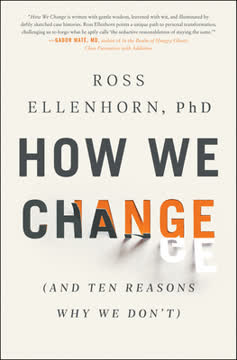
Key Takeaways
1. Change is Hard Because Sameness is a Powerful, Protective Choice.
That force within us that’s happy to maintain the status quo usually wins the battle more often than does change.
The illusion of ease. Many self-help programs suggest change is simple, requiring only knowledge or skill. However, this overlooks powerful, often subconscious, forces that actively keep us from changing, despite our desires for a better life. Statistics reveal this struggle:
- Addiction treatment: Only a third succeed.
- Exercise goals: 73% fail.
- Diets: 69% quit, 80% regain weight.
- New Year's resolutions: 93% are broken.
Sameness has its logic. We often view change as the only reasonable path, dismissing sameness as unreasonable. Yet, there are attractive and sensible reasons to stay the same, such as wanting security, avoiding perceived failure, or sidestepping the pain of disappointing others. These deeper reasons often lie below conscious awareness.
Contemplation is key. Lasting change isn't about following prescribed tactics but about courageous self-leadership. Research shows deep change results from contemplation – dispassionately weighing the pros and cons of both changing and staying the same. Until we understand why sameness wins, advice alone is ineffective.
2. The Tension Between "Where You Are" and "Where You Want to Be" Drives All Change.
The tension caused by this particular discrepancy, and your drive to rid yourself of this tension, often leads to a good thing: the motivation to reach the goal.
Discrepancy fuels motivation. Our minds are wired to seek completeness, forming "gestalts" or whole perceptions. When we set a goal, we create a discrepancy between our current state ("where you are") and our desired state ("where you want to be"). This tension, like a stretched rubber band, generates motivation to resolve the discrepancy.
Lewin's force field. Psychologist Kurt Lewin's "force field analysis" illustrates this dynamic. Behavior is a function of driving forces (pushing towards the goal) and restraining forces (holding back). Motivation arises from the interplay of these forces. For example:
- Driving forces: Desire for employment, pride in skill, desire for a tip.
- Restraining forces: Bad news from home, poor memory, alarming political developments.
Goals are personal. How-to advice often fails because it ignores the unique meaning a goal holds for each person. The strength of motivation depends on the meaning of the goal, not just its surface appearance. Underlying, personal goals, often hidden, are the strongest enablers or restrainers.
3. Anxiety, Hope, and Faith: The Three Core Laws Governing Personal Change.
When you head toward personal change, you are following the call to take hold of your existence and make it better.
Law One: The "Dizziness of Freedom." Personal change confronts us with our existential aloneness and accountability. This awareness, termed the "dizziness of freedom" by Kierkegaard, generates anxiety. This anxiety acts as a powerful restraining force, making us seek comfort in bad faith – pretending we have no choice.
- Example: The author's procrastination in writing, avoiding the blank page's reflection of sole accountability.
- Example: Jim's crippling anxiety after an accident, leading him to seek interactions that made him feel passive rather than accountable.
Law Two: The Driving Force of Hope. Hope is the counterforce to existential anxiety, propelling us forward despite our aloneness. It involves identifying an important goal, acknowledging its absence, and finding pathways to achieve it. Hope is crucial for adapting, exploring, and innovating in an uncertain world.
- Churchill's "We shall fight" speech exemplifies hope as persistent action despite odds.
- Snyder's theory: Hope includes "agency thinking" – confidence in one's ability to use pathways.
Law Three: The Driving Force of Faith. Faith is the unprovable confidence in oneself, others, and the world, essential for acting on hope. It's the "I can do this" belief that allows us to take risks. When faith is injured by disappointment, hope's power collapses, leading to helplessness.
- Example: Bridget's parents' unwavering faith in her, despite bipolar disorder, fueled her hope and recovery.
- Emotions as information: Faith in ourselves allows us to trust our "gut feelings" for decision-making.
4. Fear of Hope: Why We Actively Avoid Our Own Aspirations.
When you lack faith in your own agency due to disappointments in your life, your accountability and aloneness—those things we all try to keep out of our awareness, but that personal change inevitably bring into awareness—now feel scarier than scary.
Hope's dangerous allure. Hope, by designating something as important and highlighting its absence, makes us vulnerable to disappointment. If past disappointments have eroded our faith in our ability to cope with failure, hope itself becomes a threat. This "fear of hope" (FOH) causes us to avoid aspirations.
The "don't-get-your-hopes-up wall." Mary, a client with a history of trauma and setbacks, described her resistance to change as hitting a "don't-get-your-hopes-up wall." This metaphor perfectly illustrates FOH: a defensive posture to protect oneself from the devastating feeling of helplessness that follows crushed hopes.
- FOH research shows:
- High FOH correlates with more "counterfactual thinking" ("if only" thoughts).
- High FOH and high hope leads to fewer envisioned positive future events.
- High FOH narrows one's "time perspective" to the immediate past and future.
Injured faith. FOH is not a lack of hope, but a fear of its consequences. It stems from injured faith—a distrust in one's emotions and self-efficacy due to repeated disappointments. This leads to a "petrified state," where one avoids action to prevent further blows to self-worth.
5. Sameness is an Ingenious Act of Self-Preservation, Not Just Passive Resistance.
Staying the same, in other words, isn’t just the negative result of your existential anxiety. It’s also an act of preserving hope.
The possum's pose. When we choose sameness, we are not merely passive; we are actively sheltering our hope from potential disappointment. This "possum's pose" is a strategic retreat, a form of self-care designed to protect our capacity to author our lives. It's a way to restore resources needed for future challenges.
Hope in hiding. Even in apparent stagnation, hope often persists, pushing upward. Anxiety, for instance, is not a sign of hopelessness but a product of hope pushing against the awareness of accountability. Helplessness, too, indicates a continued aspiration, but with injured faith.
- Counterfactuals ("what-ifs") can be a contained form of hope, exploring alternative pathways without risking real-world failure.
- Blaming external factors preserves hope in one's own agency, while self-blame can be a way to avoid the intolerable thought of a chaotic, unjust world.
Honoring sameness. Viewing sameness as a choice, rooted in self-protective reasons, can paradoxically diminish its power to keep us stuck. It allows us to acknowledge the "Vishnu" (god of preservation) within us, recognizing that this protective impulse, though sometimes bumbling, comes from self-love.
- Example: Eating cake while dieting might be a subconscious act to "put a lid on hope," avoiding the anxiety of further progress.
- Accepting sameness as a choice puts us back in charge, fostering self-compassion and strengthening our driving forces.
6. True Change Demands Humbly Facing Your Current, Imperfect Reality.
Not everything that is faced can be changed, but nothing can be changed until it is faced.
The mirror of incompleteness. Personal change requires a candid assessment of our current state, which often means confronting aspects of ourselves we find dissatisfying or incomplete. This "fathoming" of our problems can be painful, as it highlights the gap between who we are and who we aspire to be.
- Example: Starting a diet makes one more aware of being overweight than before.
- Example: Peter, the "Boy Genius," avoided college applications because they forced him to confront his current status as an "Older Freshman," far from his imagined identity as a marine biologist.
The curious paradox of self-acceptance. As Carl Rogers noted, "when I accept myself just as I am, I can change." This dialectic requires a nonjudgmental approach to our current self, allowing us to acknowledge imperfections without succumbing to shame or grandiosity.
- Example: Eric, a chain-smoker, created "idiot cards" with an unflattering photo of himself smoking. This playful, self-deprecating act allowed him to face his habit without shame, increasing his self-efficacy and leading to successful cessation.
Humility as ballast. Humility (from "humilitas," meaning "from the ground") is the antidote to hubris and shame. It allows us to acknowledge our limits while remaining ambitious. The "humility zone" is the space where we can operate, accepting our incompleteness without resorting to narcissistic defenses or premature self-completion.
- Example: Peter's "narcissistic defense" involved vacillating between hubris (imagining himself a marine biologist) and shame (feeling like a slacker), preventing him from taking real steps.
7. Small Steps Are Often Insulting, Yet They Are the Only Path to Big Change.
The heights charm us, but the steps do not; with the mountain in our view we love to walk the plains.
The "insult" of incrementalism. While we may have grand visions, change is achieved through "baby steps." These small, incremental actions can feel insulting, constantly reminding us of the vast distance to our goal and our current inadequacy. This "put-down" quality can be highly demotivating.
- Example: Ann, learning Spanish, felt "stupid" and wanted to quit because her initial efforts highlighted how far she was from fluency.
- Example: The author's messy office, where each cleaning effort reveals past neglect, making the task feel like a "series of insults."
Minding the gap. Sustaining motivation requires "minding the gap" between where you are and where you want to be, accepting the repeated reminders of what you lack. This is a continuous test of humility and patience, especially when returning to a previously failed goal.
- Lewin's theory: Achieving small goals incrementally builds motivation for larger ones. Each small success recharges hope and self-efficacy.
The craft of change. Like a jazz musician "woodshedding" (practicing alone), successful change requires consistent, often mundane, effort. This "craft" of personal change demands humility, focusing on the intrinsic satisfaction of practice rather than immediate external rewards.
- Alcoholics Anonymous's "one day at a time" philosophy and "sobriety chips" are designed to celebrate small, incremental successes within a framework of humility, preventing hubris and shame.
8. We Often Protect Our Pain by Memorializing Past Hurts Through Sameness.
Staying the same is often the only means of protecting an enduring memory of past events that were painful or traumatic.
Memorials to suffering. Just as societies erect monuments to collective suffering, individuals can unconsciously "memorialize" personal pain or trauma by adopting a fixed posture toward life. Changing, in this context, can feel like "destroying the negatives"—erasing the evidence or significance of past hurts.
- Example: Alison, a trauma survivor, felt that recovery meant "destroying the negatives" of her past abuse, making it harder for others to acknowledge her suffering.
- This posture is a form of "re-membering," bringing the past into the present through one's unchanging stance.
Resentment as a memorial. Resentment, the repeated feeling of anger over past wrongs, can also anchor us to sameness. It's a self-defeating way to seek justice, keeping us bound to those who caused the pain.
- Example: Dave, unjustly fired, resisted a new, better job offer because accepting it felt like his former employer was "getting away with murder." His unemployment, in a perverse way, served as a "Look what you did!" memorial.
Fear of hope and injustice. When we experience injustice, especially if we believe the world should be just, we may fear hope. Moving forward with hope can feel like moving on without justice, threatening the memorial we've built to our pain. This belief can lead to a sense that the world is controllable but malevolent.
9. Personal Change Inevitably Reshapes Our Relationships with Others.
Positive personal change inevitably creates the real chance of uncertainty, and even conflict, in your relationships.
The cost of growth. Changing ourselves can alter the dynamics of our most important relationships, sometimes in uncomfortable ways. This can range from making others feel unneeded, sparking envy, or disrupting familiar patterns of intimacy.
- Example: The author's wife cherishes his foibles; becoming "perfect" might diminish a cherished aspect of their connection.
- Example: Emily, addicted to online gaming, found deep social connection in virtual worlds. Her recovery required finding new "real-world" connections (LARP, a job) to replace the social function of gaming, as traditional treatment would have isolated her.
"Alone in the presence of others." Our ability to be autonomous and explore depends on feeling "held" in the consciousness of others. When we change, especially by becoming more self-sufficient, we risk losing the attention and care that often comes from being perceived as "needy" or "problematic."
- Children often rely on "bad" behaviors (crashes, cries) to secure parental attention, as these elicit stronger, more enduring responses than successes.
- "Failure to launch" or "enabling" labels often misinterpret a fear of losing connection as a pathology, rather than a troubled form of love.
The paradox of mature love. While "immature love" says "I love you because I need you," "mature love" says "I need you because I love you." Moving towards mature love, where connection is autonomously produced, requires accepting the potential for greater aloneness, which can be a powerful deterrent to change.
10. Our Deepest Self-Perceptions Resist Change, Even Positive Ones.
Changing yourself means changing how you relate to you.
The need for self-consistency. We have a powerful need for "self-verification"—to feel a clear consistency between how we view ourselves and how others view us. This need is so strong that we may even cling to negative self-perceptions if they are familiar, resisting positive changes that disrupt our internal "gestalt" of self.
- Example: The author, despite having an organized office, still perceives himself as "a mess" due to years of internalized stigma from being labeled "learning disabled." He even perpetuated the "messy office" lie in the book to maintain this self-image.
Grief for the old self. Positive change can evoke a sense of grief or disorientation for the "old self" and the relationships built around it.
- Example: The author's pride in his son Max's newfound independence during his semester abroad was mixed with grief for their old, need-based connection, leaving the author feeling "roleless" and awkward.
The "Student of the Year" dilemma. Even significant external validation can feel "weird" or inauthentic if it doesn't align with our ingrained self-perception.
- Example: James, a humble med student, struggled to integrate his "Student of the Year" award because it didn't fit his self-image as someone who worked hard but wasn't naturally brilliant or attention-seeking.
The internal conversation. Change is a contemplative conversation between "you and you, about you." It requires confronting the discomfort of a new self-relationship, where old patterns of self-perception and interaction no longer apply. This internal resistance is often the final, most subtle barrier to lasting transformation.
11. You Are Both Alone and Profoundly Interconnected in Your Journey of Change.
We are both alone and completely interconnected.
The "Big Both-And." The idea that we are solely responsible for our change is a profound truth, but it's only half the story. We are also profoundly interconnected, and our ability to change depends heavily on our social environment and external circumstances. To ignore this is to embrace a "radical individualism" that is both extreme and profoundly wrong.
Social resources are crucial. Our capacity to face aloneness and accountability is fortified by social connections. Social-psychological research shows that:
- Our sense of purpose, social support, and self-worth affect how we perceive challenges (e.g., a hill's steepness).
- Feeling valued and connected makes us more willing to risk facing our ultimate aloneness.
- Example: Harber's tarantula study showed that recalling social support (or lack thereof) influenced the perceived proximity of a threat.
The "Harold's Moon" effect. Even Harold, the symbol of self-authorship, needed the "moon" (representing parents or connection) to light his path. This constant, protective presence allows us to be "alone in the presence of others," fostering the security needed to explore and grow.
- Example: The author's elevator ride, where a brief, positive social interaction with strangers, unexpectedly boosted his faith and courage to give difficult feedback.
Beyond individual grit: The role of power and oppression. Sometimes, change is impossible not due to personal failing, but due to external political and economic forces. Blaming individuals for their lack of change in oppressive circumstances is "blaming the victim" and dangerously disempowering.
- Example: The CEO's easy path to a degree versus an immigrant cook's K2-like struggle, highlighting material and structural inequalities.
- Indignation and fury are necessary emotions when growth is restrained by inequality and prejudice, preventing the "twisting of public issues into personal troubles."
Last updated:
Similar Books