

Key Takeaways
Consider human origins as a descent from consciousness, not matter alone
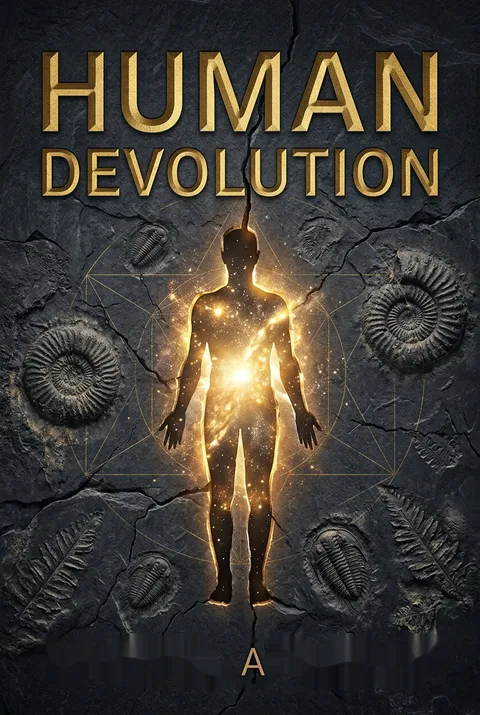
The central reversal. Michael Cremo argues that humans did not evolve upward from simpler organisms. In his Vedic account, each person is an enduring unit of consciousness that originally exists in relationship with God. When consciousness turns toward independent enjoyment, it becomes embodied in subtle mind and then gross matter. Human bodies and other forms are produced through reproduction, but the process is guided by higher intelligences rather than unguided natural selection alone.
A layered origin story. Cremo’s account combines creation, reproduction with modification, and extraterrestrial or extradimensional agency. It also places human history within vast cycles of manifestation and destruction, rather than a single recent evolutionary timeline. This is the book’s proposed alternative, not a conclusion established by mainstream biology.
What's striking is how the book changes the starting question. Instead of asking only how bodies acquired their present structures, it asks what kind of being experiences life through a body. That move connects evolutionary biology to philosophy of mind and religious anthropology. Its strength is conceptual breadth; its cost is a heavier burden of proof. A spiritual origin account must explain not just consciousness, but also the detailed, testable patterns of inheritance and anatomical change that evolutionary biology investigates.
Audit the fossils that vanish when they challenge a familiar human timeline
The disputed record. Cremo and Richard Thompson’s earlier book, Forbidden Archeology, gathers reports of human bones and artifacts said to come from unexpectedly ancient geological layers. Cremo highlights nineteenth-century discoveries in California gold mines, where human bones and stone tools were reportedly found beneath lava and in deposits dated from millions to tens of millions of years old. He also describes the Hueyatlaco site in Mexico, where geologists reported dates near 250,000 years for advanced stone tools.
The proposed pattern. Cremo calls the exclusion of such evidence knowledge filtration: the selective rejection or neglect of findings that conflict with accepted theory. He interprets these cases as evidence that modern humans coexisted with other hominids far earlier than standard timelines allow. The dating, provenance, and interpretation of many cited finds remain disputed.
The book is right that the history of science includes discarded evidence, and that professional consensus deserves historical scrutiny rather than automatic deference. But a rejected anomaly is not, by rejection alone, validated evidence. Archaeological claims depend on secure excavation records, uncontaminated context, reliable dating, and independent replication. These standards can be applied unevenly, yet they are also essential safeguards against intrusion, misidentification, and fraud. The strongest approach is case-by-case auditing, not treating disagreement with a paradigm as proof of suppression.
Treat genetic clocks as estimates, not transcripts of human origins
Models have assumptions. Cremo challenges genetic arguments for a recent African origin of modern humans, especially studies using mitochondrial DNA. Such studies infer ancestry and timing from patterns of genetic variation, then convert mutation rates into dates. Their results depend on assumptions about mutation rates, natural selection, population size, and how populations moved and mixed.
The book’s objection. Cremo cites researchers who found that different methods and assumptions produced very different dates for the common ancestor of present-day mitochondrial DNA. He also notes that evidence from other parts of the genome can yield different estimates. He uses this uncertainty to argue that genetic evidence cannot simply overrule fossils or establish a single, certain account of human origins. The book does not demonstrate that genetic evidence supports its proposed extreme antiquity.
The distinction between data and model is valuable across genetics, climate science, and cosmology: measurements do not interpret themselves. Yet uncertainty in a molecular clock does not make every competing timeline equally plausible. Since this book appeared, genome comparisons, ancient DNA, and fossil research have supplied powerful, mutually reinforcing evidence for recent African origins and common ancestry. Those findings remain open to refinement, but they are not nullified by showing that one clock depends on assumptions. Model criticism should improve inference, not erase the weight of convergent evidence.
Separate body, subtle mind, and conscious self before explaining experience
Three distinct elements. Cremo proposes that a living being consists of ordinary matter, a subtle material mind, and consciousness, or spirit. In his terminology, mind can carry sensory impressions and influence matter, but is not itself conscious. The conscious self is the experiencing subject and can, he argues, exist apart from both mind and body.
The evidence he assembles. The book reviews out-of-body experiences, reports of accurate perceptions during medical crises, past-life memories investigated by Ian Stevenson, and experiments involving telepathy or mental influence on random devices. Cremo treats these reports as reasons to investigate a nonmaterial self. They do not, on their own, prove that consciousness leaves the brain or survives death.
This distinction usefully separates subjective experience from the machinery that supports perception and action. Neuroscience can correlate brain activity with conscious states without settling every philosophical question about why experience exists. Still, evidence for an unexplained perception is not automatically evidence for a separable soul. Memory errors, sensory cues, and retrospective reconstruction must be tested alongside extraordinary interpretations. The framework is most productive when it generates precise experiments that could distinguish an independent conscious self from brain-based explanations.
Keep anomalous reports open to inquiry, while demanding stronger tests
Wallace’s challenge. Alfred Russel Wallace, co-discoverer with Darwin of natural selection, also investigated mesmerism and spiritualism. He reported levitating objects, apparitions, and messages from the dead, and argued that scientific assumptions should not decide in advance which observations are impossible. Cremo also recounts the involvement of prominent researchers, including William Crookes, Pierre Curie, and members of the Society for Psychical Research.
A contested record. These investigators sometimes described careful controls, but many of the reported phenomena were difficult to reproduce and took place in settings vulnerable to deception or sensory leakage. Cremo presents the history as an overlooked part of science, and as evidence that materialist assumptions can shape what researchers accept. The reports remain controversial, rather than settled scientific findings.
The historical lesson is not that famous scientists were always right, but that reputation should not substitute for examining methods. Psychical research also shows why experimental safeguards matter: observers can be sincere and still be mistaken, while mediums can cheat under some conditions and produce genuine-seeming effects. Replication, blinding, and independent analysis help separate these possibilities. A research culture can be skeptical without being contemptuous, and open-minded without treating testimony as equivalent to controlled evidence.
Compare spirit cosmologies without mistaking cultural recurrence for proof
A recurring map. Cremo compares Vedic cosmology with accounts from Greek, Chinese, Ainu, Tlingit, Ojibwa, African, and other traditions. He finds recurring features: a highest divine source, creator or guardian beings, earthly life, and realms inhabited by ancestors, spirits, or demons. He interprets this pattern as evidence for a real cosmic hierarchy rather than a collection of unrelated myths.
A body as a city. The book uses the Vedic allegory called the City of Nine Gates to explain embodiment. Its nine gates represent the body’s openings; a king represents the conscious self, while a queen and attendants represent intelligence and sensory functions. The story presents the body as a vehicle through which consciousness engages material experience.
Cross-cultural comparison can reveal shared human questions about death, agency, and the unseen, and it can prevent scholars from dismissing unfamiliar traditions as mere superstition. But similarity has several possible causes: cultural exchange, common cognitive tendencies, or shared observations. The resemblance does not decide among them. The City of Nine Gates is especially useful as a model of layered experience, but its explanatory value should be judged by whether it clarifies phenomena and makes testable distinctions, not simply by its symbolic richness.
Ask what organizes biological form beyond the DNA sequence
A development problem. Cremo argues that genes do not, by themselves, explain how a fertilized egg develops into a coordinated organism. He discusses the complexity of vision, blood clotting, cellular transport, and DNA replication, and contends that Darwinian accounts have not specified every intermediate step by which such systems arose.
The proposed addition. In the Vedic model, a bija, or subtle seed, contains essential elements of a body’s developmental plan. DNA supplies molecular instructions, while the bija is proposed to help explain how those materials are organized into a living form. Cremo also points to disputed plant and insect fossils from Pakistan’s Salt Range as evidence that complex life may have appeared far earlier than standard evolutionary timelines allow.
The question of how genes coordinate development is scientifically important, and contemporary developmental biology studies gene regulation, cell signaling, and interactions among tissues. But an incomplete account of a mechanism is not evidence that a nonmaterial plan supplies the missing steps. Evolutionary explanations can be tested against comparative anatomy, genetics, and observed developmental processes. The Salt Range claims also require careful geological verification. A useful alternative must explain more than complexity in general: it must generate predictions that outperform existing biological models.
Let cosmic fine-tuning sharpen the design question, not settle it
Sensitive settings. Cremo reviews the apparent fine-tuning of physical constants and force ratios. He highlights the ratio between electromagnetism and gravity, described in the book as roughly one part in 10^36, and the nuclear binding value of about 0.007. Small changes, he argues, could prevent stable stars, heavy elements, or life as we know it from forming.
Three explanations. The book considers chance, a vast collection of universes with differing settings, and intelligent design. It also draws on astronomer Martin Rees’s discussion of six numbers that shape the universe. Cremo favors design, and connects the question to the Vedic idea that the universe is arranged for life. The fine-tuning argument concerns the conditions for life, not direct evidence of how humans originated.
Fine-tuning is a serious problem in cosmology because it links abstract constants to the existence of stars, chemistry, and observers. The anthropic principle adds a selection effect: observers can only find themselves in conditions compatible with observation. That does not explain why the constants have their values, but it complicates simple probability claims. Multiverse proposals and design arguments both reach beyond directly observed evidence. The most careful conclusion is that fine-tuning sharpens the question of cosmic origins while leaving the answer contested.
Test claims of paranormal influence on bodies and physical objects
Reported effects. Cremo surveys experiments in which people allegedly influenced bacterial growth, studies of distant healing, accounts of miraculous tissue repair, and reports of birthmarks matching wounds from a supposed previous life. One example involves healer Olga Worrall: in experiments reported by Beverly Rubik, bacterial cultures she attempted to influence grew more than control cultures, including cultures exposed to antibiotics.
A broad inference. Cremo interprets these cases as evidence that mind or consciousness can alter matter, and that stronger intelligences might shape biological forms. He also discusses the Lourdes medical records, while acknowledging that cures are rare and cannot be predicted. The book’s argument relies on reports and experiments it considers credible, but many claims require more independent replication and tighter controls.
The book’s broad collection of cases is valuable as a map of claims that deserve differentiated assessment. A laboratory effect on bacteria, a clinical recovery, and a remembered past life are not the same kind of evidence and should not be pooled into one conclusion. Small effects can be especially vulnerable to publication bias and subtle methodological flaws. At the same time, rigor does not require dismissing unusual outcomes in advance. Replication by teams with competing expectations is the key test.
Read UFO encounters as evidence to investigate, not conclusions to adopt
More than lights. Cremo reviews military and civilian reports of unidentified flying objects, including radar observations, unusual flight behavior, alleged landings, and encounters with humanoid occupants. He notes that governments in several countries investigated the phenomenon, while some officials and scientists considered extraterrestrial explanations plausible. The book also describes abduction reports involving missing time, medical procedures, and telepathic communication.
The hierarchy connection. Cremo interprets UFO occupants alongside angels, spirits, and beings in traditional cosmologies. In his account, some may be extradimensional rather than simply visitors from another planet. The reports, if accurate, could challenge a purely material picture of human origins. But an unexplained observation does not by itself identify its cause, and evidence for a craft is distinct from evidence for its occupants or intentions.
The UFO chapter is strongest when it distinguishes the observation from its interpretation. Radar returns, multiple witnesses, and physical traces can establish that an event deserves investigation; they do not automatically establish extraterrestrial origin. Abduction narratives raise additional questions about memory, trauma, and how experiences are reconstructed under hypnosis. The book’s willingness to include official and military reports broadens the archive, but the decisive work remains independent verification and transparent access to underlying records.
Treat spiritual practice as the proposed route back from material identification
The return journey. In Cremo’s Vedic account, consciousness becomes covered by mind and matter when it turns away from its original relationship with God. Repeated embodiment follows the desires carried by the subtle body. Re-evolution means recovering spiritual awareness and returning to the realm of pure consciousness, rather than improving the material body indefinitely.
A practical path. Cremo presents mantra meditation, especially chanting names of God, as the recommended practice for the current age. This places the book’s archaeological and scientific arguments within a devotional purpose: human life is meant to transform consciousness, not merely explain biological ancestry. The proposal is rooted in the author’s Gaudiya Vaishnava tradition and should be understood as a religious path, not as a conclusion established by the book’s scientific evidence.
The final turn gives the argument an existential purpose: origins matter because they shape what a person thinks life is for. Contemplative traditions commonly treat attention and desire as trainable, and mantra practice offers a concrete discipline within this tradition. Its spiritual claims are assessed through practice, community, and theology, not by the same methods used to date fossils. Keeping those standards distinct lets readers take the proposal seriously without confusing devotional conviction with empirical confirmation.
Analysis
Human Devolution is not a neutral survey of human origins. It is a staged argument for replacing materialist assumptions with a Gaudiya Vaishnava account of consciousness, embodiment, and cosmic order. The book first presents anomalous archaeological reports, then questions genetic and developmental explanations, introduces psychical research, and finally builds a Vedic alternative. Its narrative engine is cumulative: each disputed fossil, séance, healing, or UFO report is treated as one more reason to widen the explanatory frame.
The strongest intellectual move is its insistence that a scientific worldview has assumptions, and that anomalies should not be dismissed solely because they are inconvenient. The book also usefully separates questions often collapsed together: how life begins, how bodies develop, what consciousness is, and whether mind can act on matter. Its weakest move is the shift from uncertainty in prevailing explanations to confidence in a specific alternative. A disputed artifact, an unusual experience, or a gap in developmental knowledge does not independently establish human antiquity of billions of years, survival after death, or divine design. Those propositions require distinct evidence.
The method is especially vulnerable to asymmetry. Anomalous findings that support the thesis are often treated as credible, while mainstream interpretations are described as products of bias. Yet contamination, mistaken dating, memory effects, fraud, and ordinary developmental mechanisms must be tested for each case, not invoked selectively. Conversely, consensus is not infallible, and the history of science confirms that some valuable ideas begin at its margins.
The book is best read as a provocative research program and a religiously grounded metaphysics, not as a replacement scientific synthesis. Its questions about consciousness, selection effects, and the sociology of evidence remain useful even where its conclusions exceed what its evidence can secure. The central challenge it leaves readers is methodological: how can inquiry stay open to unfamiliar realities without allowing openness to become a shortcut from anomaly to belief?
Review Summary
Human Devolution receives mixed reviews, with an overall positive rating. Many readers praise its thorough research, challenging of orthodox views, and thought-provoking content on human origins and spirituality. They appreciate the author's logical approach and extensive evidence presented. Critics argue it undermines evolution theory and relies on questionable sources. Some find it difficult to read due to dense information, while others consider it a masterpiece. The book's exploration of Vedic cosmology and alternative theories of human existence resonates with many readers seeking a different perspective on human origins.
People Also Read
Glossary
Human devolution
Consciousness entering material embodimentCremo’s alternative to human evolution from simpler organisms. It holds that conscious selves originally exist in a spiritual realm and become embodied in subtle mind and gross matter when they turn from their relationship with God. The production of bodies involves reproduction with modification, but is guided by higher intelligences.
knowledge filtration
Selective exclusion of anomalous evidenceCremo’s term for the alleged process by which evidence that conflicts with a dominant scientific theory is ignored, rejected, or kept outside mainstream discussion. He applies it especially to reports of ancient human fossils and artifacts. The term describes his interpretation of scientific history, not a neutral label accepted by all researchers.
atma
Individual conscious selfIn the Vedic framework used by Cremo, the atma is the enduring unit of consciousness associated with a living being. It is distinct from both the gross physical body and the subtle material mind. The atma is described as originating in relationship with the supreme conscious being and as capable of existing beyond a particular body.
Supersoul
God accompanying each living beingCremo’s English rendering of Paramatma, a personal manifestation of God said to accompany each conscious self within the material world. The Supersoul observes and permits the self’s actions and provides a link between consciousness and matter. In the book’s model, this presence helps explain how intention and physical processes can interact.
bija
Subtle seed of bodily formA Sanskrit term meaning seed, used by Cremo for a subtle developmental plan associated with a type of body. He proposes that DNA supplies molecular instructions, while the bija contains essential organizing information for the form that develops. This is part of his Vedic model, not an established biological mechanism.
City of Nine Gates
Allegory of embodied consciousnessAn allegory in the Shrimad Bhagavatam, interpreted by Cremo as a model of the human body and mind. Its nine gates represent the body’s openings; a king represents the conscious self, while a queen and her attendants represent intelligence and sensory functions. The story depicts consciousness interacting with material experience through layered bodily systems.
Gaudiya Vaishnava Vedanta (GVV) ontology
Vedic model of self and matterThe philosophical account Cremo associates with the Gaudiya Vaishnava tradition. It distinguishes the conscious self, a subtle material realm of mind and intelligence, and gross physical matter, while treating each as related to God. Cremo argues that this ontology can organize evidence about brain activity, consciousness, paranormal experience, and spiritual cosmology.
cosmic hierarchy
Ordered levels of conscious beingsCremo’s term for a multilevel cosmos populated by beings with different forms and powers. At its highest level is a supreme conscious being; below are creator gods, demigods, humans, animals, ghosts, and other entities. The levels correspond broadly to regions where spirit, subtle mind, or gross matter predominates.
About the Author
Other books by Michael A. Cremo
Download PDF
Download EPUB
.epub digital book format is ideal for reading ebooks on phones, tablets, and e-readers.








