

Key Takeaways
You can refuse the career script without refusing responsibility
A different kind of adulthood. Stillman’s resistance to career planning begins in high school, where a guidance counselor translated his interest in skateboarding, girls, and travel into a recommendation to drive a bus. The problem was not that bus driving was beneath him. It was that adults expected a teenager to choose one occupation before he knew what kind of life he wanted. He argues that rejecting a conventional career does not mean withdrawing from the world or living aimlessly. It means taking responsibility for a life built around curiosity, freedom, and meaningful experience.
His own path is the proof of concept: he tried business and sales, worked in a bike shop, drove for Uber, and wrote books. The through-line was not a job title. It was time outdoors.
What's useful here is the distinction between rejecting a prescribed career and rejecting responsibility. Modern work often treats occupational identity as a proxy for maturity, even though a title says little about whether someone is useful, dependable, or fulfilled. Stillman’s examples suggest that adulthood can mean designing a sustainable life rather than selecting one permanent role. The caution is that career flexibility is easier for people with health, mobility, savings, or supportive relationships. The argument is strongest as permission to question the default, not as a claim that stable careers are inherently misguided.
Design the life you want before choosing the work that funds it
Start with an ordinary day. Stillman says people often plan backward: they choose a degree, job, or income target, then hope it will produce happiness. He recommends first describing a satisfying day in detail. Where would you wake up? What would you spend your time doing? What might an ordinary week look like? Then choose work and practical steps that support that picture.
For Stillman and his wife Valerie, the goal was not simply to earn well. They wanted time for backpacking, skiing, mountain biking, and kayaking in the American West. That clarity helped them decide what work to accept, what expenses to avoid, and eventually where to move. A high income can be useful, but only when it serves a life the earner actually wants.
This reverses the familiar means-and-ends error: people optimize for salary or status without checking whether those resources buy the experiences they value. Values-based planning offers a practical way to test a choice: does this job support the desired day, or merely sound impressive? The exercise also makes tradeoffs visible before they become expensive. Stillman’s approach assumes that people can identify preferences by imagining them. For some, preferences emerge through trial, caregiving, or changing circumstances. A draft of an ideal day should guide experiments, not become another rigid standard.
Lower your costs so a smaller paycheck can buy back time
Income is only half the equation. After several years in sales and insurance, Stillman left a six-figure income for a bicycle-shop job paying $15 an hour. He says the drop barely registered because he and Valerie had little debt, modest expenses, and no need to keep buying more expensive things. The bike shop gave him something his previous jobs did not: daily contact with a hobby he loved and time to ride with coworkers.
The couple’s later decision to sell their house and travel in a truck camper extended the same logic. Fewer possessions and lower costs reduced the amount of work required to support their chosen life. Their point is not that everyone should earn less. It is that a large paycheck can be less valuable than a lower-cost life with time left to enjoy it.
The underlying insight is economic, not merely inspirational: freedom depends on both income and the fixed costs that income must cover. Lowering recurring expenses can make a person less dependent on a particular employer and more able to choose work for fit. This resembles the logic of financial independence, though Stillman emphasizes time and experience over accumulated wealth. The tradeoff deserves attention: minimal expenses should not mean ignoring health costs, emergencies, or future obligations. A modest budget creates options only when it is realistic and includes some resilience.
Build a livelihood from adaptable skills, not one fragile job title
Make work a toolkit. Stillman’s route west was assembled from practical experiments. He learned vending-machine sales from an uncle, built a small vending business, then used that experience to get a car-sales job. He moved into mortgage and insurance sales, and later learned bicycle repair. Each step supplied money, skills, or a clearer sense of what he did not want.
After returning from a year on the road, he and Valerie drove for Uber. They noticed that airport rides were the valuable trips, printed business cards, and arranged rides in advance rather than waiting for fares at random. This let them earn a day’s income in fewer hours. The lesson is to notice what works, adapt the job around the life, and remain willing to change industries when circumstances shift.
This is a persuasive account of transferable skills: listening, sales, customer service, and spotting demand can travel across industries. The airport-driving example is especially concrete because it shows how observation can improve an existing job without a grand reinvention. In uncertain labor markets, a portfolio of practical abilities may offer more resilience than one narrow professional identity. Yet flexibility is not a universal substitute for credentials or bargaining power. The broader principle is to keep learning skills that create choices, while recognizing that some fields require formal training and stable employment.
Make the dream specific enough to schedule, then start before certainty arrives
Give desire a destination. Stillman argues that a vague wish to escape is not a plan. He and Valerie wanted to live near Colorado’s mountains, so they researched towns, moved to Boulder, and eventually traveled for a year in a camper. Their move became possible partly through an unexpected lead: while looking for a realtor, Stillman accidentally called a property-management company. An agent mentioned a couple seeking a home in their neighborhood, and renting their Ohio house helped support the move.
He calls such unexpected openings breadcrumbs, meaning opportunities or coincidences that seem to point toward a stated goal. The practical advice is to make the destination clear, take an initial step, and pay attention to useful openings. Plans can remain flexible; waiting until every uncertainty disappears can become a reason never to begin.
Specific goals make action easier because they turn a broad wish into decisions about place, timing, money, and next steps. A clear aim can also make relevant opportunities more noticeable, as attention tends to privilege information connected to current priorities. That is a grounded reading of Stillman’s breadcrumbs. The stronger metaphysical claim, that the universe deliberately arranges these events, is a matter of belief rather than something established by the anecdotes. Readers can use the practice without adopting that claim: define the aim, act, and evaluate opportunities with ordinary judgment.
Use attention as a steering wheel, not proof the universe obeys
Choose what gets your effort. Stillman uses the term Infinite Intelligence for the organizing force he believes underlies nature, also describing it as God or the universe. In his view, clear intention and attention help people receive guidance from this force. He urges readers to stop feeding every frustration with worry and instead direct energy toward a desired outcome or a concrete response.
A practical example comes when injuries prevent his usual hiking and mountain biking. Rather than treating the season as lost, he switches to kayaking and paddleboarding. The book’s larger claim that the universe supplies what people focus on is more speculative. What the example clearly shows is that attention can help someone notice alternatives and act on them instead of becoming stuck on what is unavailable.
The useful psychological mechanism is selective attention: a person who names a goal is more likely to notice relevant options and persist through obstacles. Reframing an injury around available activities can also protect agency without denying disappointment. That does not mean thought controls external events, or that hardship reflects a person’s focus. Treating every setback as something the mind attracted can unfairly blame people for illness, poverty, or discrimination. The idea works best as a practice of directing effort toward what remains actionable, not as a universal explanation of why events occur.
Stop postponing happiness until promotions, retirement, or perfect circumstances
Trace the goal to its reason. Stillman uses the Five Whys, a technique of repeatedly asking why a person wants something, to uncover the need beneath a stated goal. Someone might want a degree to get a good job, a job to earn money, and money to create a meaningful life. The underlying desire, he argues, is often happiness. So he asks readers to consider what brings satisfaction now, rather than promising themselves they will be happy after the next achievement.
Stillman links this principle to his own choice to trade a higher income for bicycle repair and more time outside. His point is not that planning is pointless. It is that a future reward should not consume the present that it is meant to improve. Ask what a goal is for before investing years in it.
Repeatedly asking why can expose when a measurable target is only an indirect route to a human need, such as belonging, autonomy, or enjoyment. That makes the Five Whys a useful decision aid, though its answers need not end in happiness; they may reveal duty, security, or care for others. Present-focused satisfaction also does not require abandoning long-term plans. The valuable distinction is between building toward a meaningful future and treating current life as disposable until that future arrives.
Make outdoor play and continued learning part of adulthood
Keep the world surprising. As a teenager, Stillman found that skateboarding transformed ordinary suburban surfaces into places for invention and play. The punk and skate communities gave him belonging, creativity, and a way to challenge expectations. Later, mountains, trails, and wilderness supplied new forms of exploration. He argues that adults need more than work and passive entertainment: movement, curiosity, and learning help keep life vivid.
He also worries that children lose opportunities when play is overmanaged or confined indoors. Unstructured time outside, he says, gives children room to invent games, test their abilities, and develop a bond with the natural world. Learning a new skill can similarly reopen possibilities for adults. Nature is not just scenery in this book. It is a setting for attention, challenge, discovery, and care.
The book’s strongest case for outdoor life is experiential: skating, hiking, and exploring give people direct contact with challenge and discovery, rather than consuming someone else’s version of adventure. Environmental psychology also studies how contact with nature relates to attention and wellbeing, although those relationships do not mean outdoor time alone resolves mental-health problems. Stillman’s concern for children gains force when framed as access to varied, self-directed experiences, not as a cure-all. The practical question is how communities can make safe, welcoming outdoor play possible for more families.
Own less so security does not quietly consume the freedom you wanted
Reduce the weight of things. Stillman describes possessions, debt, home maintenance, and recurring bills as forces that can narrow a person’s choices. Before Valerie and he set out on the road, they sold or gave away most of what they owned and moved into a truck camper. They packed only what served a purpose, and he found the reduced load mentally freeing as well as practical.
The book does not require an all-or-nothing escape from society. Stillman acknowledges that a person may want a stable home, a simpler apartment, or a hybrid life with one foot in ordinary work and another in wilderness. The test is whether an expense supports a chosen priority or merely adds obligations. Simplifying is not a virtue by itself; it is a way to make room for what matters.
Decluttering becomes more consequential when viewed as a choice about future obligations. A large home or a costly lifestyle can demand time and income long after the purchase, while fewer fixed expenses may widen a person’s ability to change course. Stillman’s hybrid option prevents the argument from collapsing into a romantic ideal of permanent van life. It also invites a fair question: which forms of security genuinely protect wellbeing, and which are habits of consumption? The answer varies with disability, family needs, climate, and access to affordable housing.
Choose uncertainty you value, and stay flexible about the route
Take risks with your eyes open. Stillman contrasts chosen challenges, such as navigating a desert or getting lost abroad, with unwanted strains like bills and traffic. His father-in-law worked toward retirement for decades, then died less than two months after retiring. The loss makes Stillman question the assumption that meaningful life can safely be deferred until old age. He encourages readers to begin with small adventures and to accept that not every step will go smoothly.
He also distinguishes a clear destination from a rigid itinerary. A goal can be firm while the path changes, much like a river bending around terrain. In relationships, this flexibility includes supporting a partner’s separate interests rather than demanding identical hobbies. Adventure, in this account, is chosen uncertainty in service of a life the person values.
Mortality gives the book’s argument urgency, but the father-in-law’s death is a reminder of uncertainty, not evidence that retirement planning is foolish. Preparation can protect people and dependents; the risk is making future enjoyment the only permitted form of living. The distinction between a stable aim and an adaptable route is broadly useful because plans meet changing bodies, finances, and relationships. Small experiments can test whether an imagined adventure fits reality. Courage here is not recklessness. It is refusing to let fear make every important decision.
Analysis
Stillman’s central argument is less about refusing work than changing the order of decision-making. The conventional sequence starts with education, career, income, and consumption, then promises that a satisfying life will follow. His alternative starts with the desired experience and treats work, money, housing, and skills as adjustable supports. The memoir makes this argument tangible: an Ohio teenager finds belonging through skateboarding, discovers the mountains, experiments with sales, accepts a modest bike-shop wage, and eventually travels in a camper while writing. The story’s continuity is not professional advancement but a sustained preference for outdoor life and independence.
That narrative is the book’s chief strength. It converts an abstract permission to live differently into concrete mechanisms: reduce fixed expenses, learn portable skills, use work creatively, make plans specific, and try small steps before demanding certainty. It also gives nature a role beyond recreation. Wilderness supplies wonder, physical challenge, and a reason to protect land that might otherwise remain an abstraction.
The book is less persuasive when it turns useful psychological practices into cosmic explanations. Focus can direct attention and effort; gratitude can make valued experiences more salient. Neither establishes that the universe arranges events in response to desire. That distinction matters because metaphysical certainty can slide into blaming people for outcomes they cannot control. Similarly, Stillman’s American freedom and low-cost travel options are not equally available to everyone. Health, caregiving, immigration status, income, and housing costs constrain choice.
Those limits need not cancel the book’s insight. Its most durable proposal is not that everyone should quit a career or live in a van. It is to stop assuming that one social template represents adulthood. A reader can retain a stable job, family commitments, and a conventional home while still asking what those arrangements are meant to serve. The book succeeds when it makes that question feel urgent, practical, and personal, while leaving room for different answers.
Review Summary
I Don't Want To Grow Up receives mostly positive reviews for its unconventional perspective on life and emphasis on pursuing happiness and personal dreams. Readers appreciate its inspirational message, encouraging them to break free from societal norms and embrace their inner child. Some find it repetitive or overly simplistic, while others criticize its privileged viewpoint. The book resonates with those seeking alternative lifestyles but may not address practical concerns. Overall, it's praised for its thought-provoking ideas about prioritizing experiences and living authentically.
People Also Read





Glossary
The prescribed life
Conventional life sequenceStillman’s label for the familiar progression from school to a job, a house, family responsibilities, consumer spending, retirement, and death. He uses it to describe a socially expected template, not a mandatory or universally followed sequence. The term represents the life pattern his book asks readers to examine and, when it does not fit, revise.
Infinite Intelligence
Nature’s organizing forceStillman’s name for a power he believes organizes life and the natural world. He also associates it with God or the universe, while leaving room for different beliefs. In his framework, clear intentions, attention, instinct, and gratitude help people align with this force. The concept is spiritual and metaphysical, rather than a scientific explanation.
Breadcrumbs
Promising unexpected openingsStillman’s term for coincidences, encounters, or opportunities that appear to point toward a clearly stated goal. He advises readers to notice and investigate these openings rather than dismiss them automatically. His account interprets them as guidance from Infinite Intelligence, though they can also be understood as relevant opportunities made more noticeable by focused attention.
The Five Whys
Repeated questions uncover purposeA questioning technique Stillman uses to identify the underlying reason for a goal. A person asks why they want something, then asks why again about each answer. For example, wanting a degree may lead to wanting a job, money, and a meaningful life. Stillman suggests that the inquiry often reveals happiness as the deeper aim, though other motives may emerge.
vibration
Emotional energy levelStillman uses vibration to describe a person’s felt state of energy and vitality. He associates passion, gratitude, exercise, and emotional intensity with higher vibration, and sedentary habits or poor health with lower vibration. The word carries a spiritual meaning in the book and should not be confused with a measured physical frequency or established medical diagnosis.
sixth sense
Feeling-based intuitive guidanceStillman’s term for relying on instinct and felt signals rather than analyzing every choice verbally. He believes this intuitive awareness helps people notice useful opportunities and avoid paths that feel wrong. Keeping plans open, especially during travel and exploration, gives this sense room to operate. The term refers to subjective intuition, not a separate biological sense.
FAQ
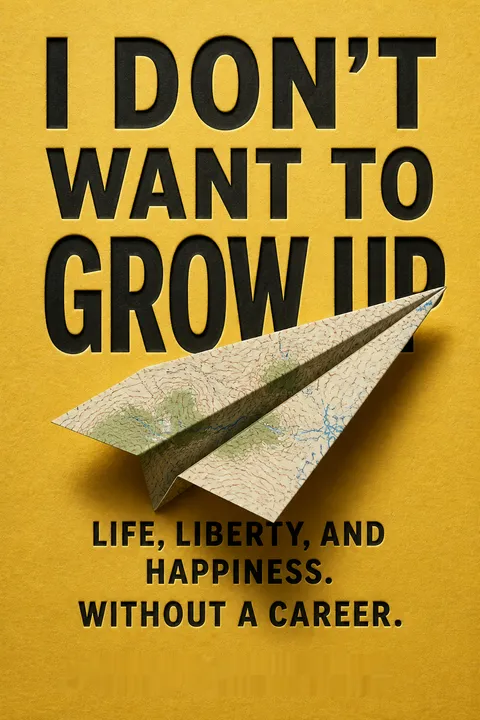
1. What’s "I Don’t Want To Grow Up: Life, Liberty, and Happiness. Without a Career." by Scott Stillman about?
- Nature, Memoir, and Philosophy: The book blends memoir, philosophy, and nature writing to explore how to live a fulfilling life outside traditional career paths.
- Rejecting Conventional Success: Stillman challenges the societal expectation of growing up, getting a career, and following a prescribed life, advocating instead for a life centered on joy, adventure, and connection to nature.
- Living with Intention: The author shares his personal journey of prioritizing experiences, freedom, and happiness over money, status, or possessions.
- Practical Inspiration: Through stories and advice, Stillman encourages readers to question norms, follow their passions, and design a life that feels authentic and meaningful.
2. Why should I read "I Don’t Want To Grow Up" by Scott Stillman?
- Alternative Life Perspective: The book offers a refreshing alternative to the mainstream narrative of career and consumerism, appealing to those feeling out of place in conventional society.
- Actionable Inspiration: Stillman provides practical steps and mindset shifts for readers who want to live more freely, simply, and joyfully.
- Nature as a Guide: Readers interested in deepening their relationship with nature and using it as a source of wisdom will find valuable insights.
- Encouragement for Nonconformists: The book validates and empowers “freaks,” dreamers, and anyone who feels pressured to fit into a mold that doesn’t suit them.
3. What are the key takeaways from "I Don’t Want To Grow Up" by Scott Stillman?
- Happiness Over Career: True happiness comes from living authentically and prioritizing joy, not from following a prescribed career path.
- Simplicity and Freedom: Simplifying life and reducing material possessions can lead to greater freedom and fulfillment.
- Follow Your Instincts: Trusting intuition and being open to life’s breadcrumbs can lead to unexpected opportunities and adventures.
- Nature’s Wisdom: Reconnecting with nature is essential for well-being, creativity, and a sense of belonging.
4. How does Scott Stillman define "not growing up" in "I Don’t Want To Grow Up"?
- Rejecting Societal Prescriptions: Not growing up means refusing to blindly follow society’s rules about success, work, and adulthood.
- Maintaining Childlike Awe: It’s about preserving a sense of wonder, curiosity, and playfulness throughout life.
- Living Authentically: Stillman frames it as living according to your own values and passions, rather than external expectations.
- Continuous Learning and Adventure: The concept includes embracing lifelong learning, adventure, and adaptability instead of settling into routine and stagnation.
5. What is the "prescribed life" that Scott Stillman critiques in "I Don’t Want To Grow Up"?
- Linear Life Path: The prescribed life is the standard sequence of school, job, house, family, consumerism, retirement, and death.
- Conformity and Security: It emphasizes security, predictability, and fitting in over individuality and risk-taking.
- Sacrificing Dreams: Stillman argues that this path often requires sacrificing personal dreams and passions for societal approval.
- Resulting Unhappiness: He links the prescribed life to widespread anxiety, depression, and a sense of disconnection from self and nature.
6. What practical advice does Scott Stillman give for living without a traditional career in "I Don’t Want To Grow Up"?
- Define Your Ideal Life: Start by visualizing what you want your life to look like, focusing on experiences rather than job titles or income.
- Simplify and Minimize: Reduce debt and possessions to lower your cost of living and increase your freedom.
- Be Resourceful and Versatile: Embrace a variety of jobs or income streams that support your lifestyle, rather than tying your identity to a single career.
- Follow Passions and Instincts: Let your interests and gut feelings guide your choices, and be open to changing direction as you grow.
7. How does "I Don’t Want To Grow Up" by Scott Stillman connect happiness to lifestyle choices?
- Present-Moment Happiness: Stillman emphasizes that happiness is found in the present, not in deferred dreams or future achievements.
- Joy as a Compass: He encourages readers to identify what brings them joy and to make those activities central to their lives.
- Avoiding the "I’ll Be Happy When..." Trap: The book warns against postponing happiness for milestones like retirement, financial goals, or relationship status.
- Happiness as a Ripple Effect: By prioritizing personal happiness, individuals are better able to inspire and help others.
8. What role does nature play in "I Don’t Want To Grow Up" by Scott Stillman?
- Nature as Teacher: Nature is presented as a source of wisdom, healing, and inspiration, inseparable from a meaningful life.
- Reconnecting for Well-being: Stillman argues that time in nature restores creativity, health, and a sense of belonging.
- Counteracting Modern Malaise: The book links disconnection from nature to societal problems like depression, anxiety, and loss of purpose.
- Advocacy for Wilderness: Stillman calls for the preservation of wild places, seeing them as essential for both personal and collective well-being.
9. What is the concept of "Infinite Intelligence" in "I Don’t Want To Grow Up" by Scott Stillman?
- Universal Organizing Force: Infinite Intelligence refers to the mysterious force that organizes the universe and is accessible to everyone.
- Tapping Into Guidance: By clarifying desires and following intuition, individuals can align with this intelligence to manifest their dreams.
- Breadcrumbs and Coincidence: The book describes how life offers "breadcrumbs" or signs when you’re on the right path, and following them leads to serendipity.
- Requires Clarity and Action: Infinite Intelligence responds to clear intentions and gratitude, not vague wishes or passive longing.
10. How does Scott Stillman address money and materialism in "I Don’t Want To Grow Up"?
- Money as a Tool, Not a Goal: Stillman argues that money should serve your desired lifestyle, not be the end goal itself.
- Dangers of Consumerism: He critiques the pursuit of possessions and status as distractions from true happiness and freedom.
- Simplicity Over Wealth: The book advocates for simplifying life, reducing expenses, and focusing on experiences rather than accumulating things.
- Emergency Gear Fund: Stillman suggests practical steps like maintaining an emergency gear fund to support an adventurous lifestyle without financial stress.
11. What are the main obstacles to "not growing up" according to Scott Stillman in "I Don’t Want To Grow Up"?
- Social Pressure and Doubt: Family, friends, and society often discourage unconventional choices, labeling them as unrealistic or irresponsible.
- Attachment to Security: The desire for safety, routine, and possessions can make it hard to break free from the prescribed life.
- Fear of Uncertainty: Many people are paralyzed by the unknown, unable to commit to new paths or adventures.
- Lack of Clarity: Not knowing what you truly want can prevent you from taking action or recognizing opportunities.
12. What are the best quotes from "I Don’t Want To Grow Up" by Scott Stillman and what do they mean?
- “When I went to school, they asked me what I wanted to be when I grew up. I wrote down ‘happy.’ They told me I didn’t understand the assignment. I told them they didn’t understand life.”
- This quote encapsulates the book’s core message: happiness is the true goal, not a career or status.
- “Refusing to grow up is choosing to live—and experiencing every day with the playfulness and curiosity of a child.”
- Stillman urges readers to maintain childlike wonder and reject the dullness of conformity.
- “You cannot buy your dreams—only live them.”
- The author emphasizes that fulfillment comes from lived experience, not from accumulating wealth or possessions.
- “The only selfish act is not following what’s in your heart.”
- This challenges the idea that pursuing personal dreams is selfish, arguing instead that denying your true self is the real loss.
- “He who has the most fun wins.”
- A recurring theme, this quote sums up Stillman’s philosophy that joy and fun are the ultimate measures of a life well-lived.
Download PDF
Download EPUB
.epub digital book format is ideal for reading ebooks on phones, tablets, and e-readers.








