

Key Takeaways
Adapt to change, but don't mistake adaptation for freedom.
Adaptation is only a start. The fable opens with mice who have learned a popular lesson: when their cheese disappears, they should stop grieving and search elsewhere. It works. They find new supplies faster and suffer less. But they never ask why the cheese moved, who controls its supply, or whether chasing it is the life they want. The book treats this advice as useful in a crisis, yet incomplete as a philosophy of life.
Reaction is not control. Max rejects the idea that accepting change is enough. His objection is not that circumstances never change, but that people can investigate the forces shaping them and try to alter those forces. The central distinction is between coping with a system and gaining influence over it.
What's valuable here is the distinction between resilience and agency. Resilience helps people recover within existing conditions; agency asks whether those conditions can be changed. Organizations often praise adaptability while leaving the source of disruption untouched, which can turn flexibility into a demand for compliance. Still, adaptation is not inherently passive. In a genuine emergency, adjusting quickly may preserve the resources needed to challenge a problem later. The sharper question is not whether to adapt, but whether adaptation is being treated as a temporary response or as the only imaginable future.
Ask who built the maze before you learn to run it.
Question the given. As a young mouse, Max asks why the maze exists and why it is designed with so many dead ends. His elders tell him to stop asking and focus on finding cheese. Their answer reflects a shared assumption: the maze is simply the world, and its rules cannot be understood or changed. Max keeps wondering, even when no one around him takes the questions seriously.
Design has interests. After climbing out, Max discovers that people created the maze for their own purposes. They set its paths, rules, and rewards, while mice live with the consequences. This changes the meaning of a setback. A missing reward may not be random fate; it may be the result of decisions made by someone with different interests.
The move from fate to design is powerful because designed systems can be examined, negotiated, and sometimes changed. It also makes ordinary questions politically important: who benefits from this rule, and whose effort does it organize? Yet identifying a designer does not automatically reveal a villain or provide an easy remedy. Systems often persist because many people depend on them, even when the arrangement is unfair. The useful habit is therefore investigation before blame: map the incentives, decision-makers, and dependencies that make a familiar structure seem inevitable.
Stop treating more cheese as proof that life is improving.
Separate rewards from fulfillment. Zed asks the other mice what the famous lesson about change actually teaches them to pursue. They realize that every measure of success points back to cheese: how much they have, how quickly they find it, and how efficiently they chase it. The mice may become better at the pursuit, but that does not show that the prize makes them happy.
Notice the endless chase. Max observes that once mice get used to a supply, they want more. Cheese sustains them, but its accumulation never delivers lasting peace. Big offers a contrast: he eats enough to support his training, but does not organize his identity around acquiring food. The question is not whether rewards matter. It is whether a reward has quietly become the only definition of a worthwhile life.
This distinction resembles the difference between extrinsic rewards, such as status or income, and intrinsic motives, such as interest or personal meaning. Rewards can motivate effort, but they can also narrow attention until the measurable prize crowds out the reason for doing the work. The story is especially useful for careers, where promotions can become a substitute for asking what the work is for. Its caution is that material security is not trivial: for people lacking basic resources, more cheese can genuinely improve life. The target is not ambition, but unexamined ambition.
Turn impossible questions into experiments, allies, and a route out.
Make curiosity practical. Max wants to leave the maze, but first has to find a way over its wall. He studies shadows cast by parallel passages to estimate the wall's height. His calculations suggest that four mice stacked together might reach the top. That approach fails: mice cannot safely support one another, and a pile of cheese collapses beneath him. He also tries climbing with his claws, without success.
Progress needs other people. Big, the strongest mouse around, hears what Max is attempting and offers a different method. He boosts Max high enough to grab the wall and climb over. Max's escape begins with independent questioning, but it depends on testing ideas, learning from failure, and accepting help. The story treats a supposedly impossible goal as a problem to investigate, not a verdict to obey.
Max's ingenuity is less about heroic confidence than about making a vague ambition testable. He observes, estimates, tries, and revises. Big's help adds an important corrective to myths of solitary achievement: individual initiative can reveal an opening, while another person's strength makes it reachable. In practice, however, not every wall yields to cleverness or a helpful ally. Some barriers are material, institutional, or imposed by unequal power. Treating obstacles as questions can expand options, but it should not turn every failure into evidence that someone simply lacked imagination.
Freedom can mean leaving, redesigning, or refusing the maze's authority.
The mice find different exits. Max climbs over the wall and studies the world beyond it. He acts directly on the maze's design. Big eventually breaks through a wall when crowded passages begin obstructing the training routine he values. Zed offers a different kind of escape: he walks through a wall, and explains this as the result of refusing to treat accepted limits as absolute. The fable makes each mouse's response distinct rather than prescribing one route.
External and internal limits differ. Max and Big change their physical circumstances; Zed challenges the mental assumptions that make the maze seem all-encompassing. His story works best as a parable about questioning limits, not as evidence that belief alone removes real barriers. The practical lesson is to identify what kind of constraint is present before deciding whether to adapt, alter the environment, or leave.
The three characters resemble different forms of agency: changing a system, exiting it, and changing one's relationship to it. That range helps prevent a simplistic message that everyone should quit or rebel. Sometimes departure is costly, redesign is possible, and a mental shift is the most available first move. Zed's literal wall-walking is also the story's most contestable device. Thoughts shape attention and action, but they do not erase physical constraints by themselves. Read symbolically, the episode encourages imagination; read literally, it risks confusing confidence with control.
Redesigning a system doesn't make its people free by itself.
Good intentions can reproduce control. After discovering how people administer the maze, Max alters their instructions and records. At first he makes small changes, then he reshapes much of the maze. He believes the new paths can give mice room to think and pursue their own purposes. The maze becomes more efficient and offers more cheese, though finding it is not always easier.
The irony is built in. Max recognizes that the redesigned maze still reflects his preferences. Its inhabitants remain subject to someone else's decisions, even if the new arrangement is better. A kinder system is not the same as a self-governed one. The story's challenge to leaders is therefore deeper than improving outcomes: consider whether the people affected can question the design, shape it, or choose a different path.
This is the book's strongest warning about benevolent power. A reformer can improve conditions while preserving the basic relationship in which one party decides for everyone else. In fields such as public policy and product design, this is why participation matters: people closest to a system often know which burdens outsiders overlook. Consultation alone is not enough if decision-makers retain all authority, but it can expose assumptions and make trade-offs visible. The tension is real: collective systems need coordination, yet coordination becomes paternalism when affected people have no meaningful voice.
Choose your game before its rewards choose your life.
Big defines success for himself. He trains for strength, limits his food to what supports his body, and does not spend his days deliberately searching for cheese. His running routinely brings him enough to eat. When other mice wonder why he does not pursue food more aggressively, he explains that he is following a different purpose. Their measure of success does not persuade him to abandon it.
The environment can still intrude. As the maze's population grows, Big's usual running passages become crowded. He studies the routes, realizes the problem will worsen, and decides the maze cannot contain the life he wants. He punches through a wall and leaves. His exit shows that a purpose can guide action, but it also shows that a person may need to change circumstances when those circumstances obstruct the pursuit.
Big represents self-direction without requiring everyone to share his particular passion. That distinction matters: a chosen purpose need not look prestigious, profitable, or sensible to an observer to be meaningful to the person living it. The story also resists the idea that fulfillment comes solely from looking inward. Big is content while his environment supports his training, then acts when it no longer does. Personal choice and structural conditions interact. A useful self-assessment asks both what game feels worth playing and whether the present setting makes that game possible.
Make organizations safe for questions that expose their default goals.
Effort cannot fix every assumption. The book applies its fable to workplaces and institutions. Smart, hardworking people may still struggle with innovation, talent, incentives, or strategy if they never examine the rules that shape their choices. A team can become highly efficient at pursuing its equivalent of cheese while missing that the goal itself deserves scrutiny.
Put the difficult questions on the table. Leaders can ask who designed a process, whose interests it serves, what it rewards, and what it prevents people from trying. The book also stresses the social risk of asking: some mice dismiss Max's ideas as foolish because questioning the maze threatens the beliefs that make their own choices feel necessary. A useful organization makes room for dissent and reflection, not just faster execution.
An organization that invites questions but punishes the questioner offers theater, not inquiry. Psychological safety, meaning a credible sense that people can raise concerns without humiliation or retaliation, makes it easier to surface errors and challenge stale assumptions. But questioning is not automatically wise; criticism needs evidence, and organizations still have to make decisions. The book's contribution is to redirect debate from how to optimize a process toward whether the process serves the right end. That shift can be uncomfortable, especially when leaders benefit from the existing measure of success.
Analysis
I Moved Your Cheese is a short philosophical fable built around three mice who represent different responses to constraint. Max investigates the system, escapes, and then attempts to redesign it. Big pursues a personally chosen discipline and leaves when the environment obstructs it. Zed questions whether the maze has authority over the mind at all. Together, their stories widen a familiar change lesson: adapting to altered circumstances may be sensible, but it does not answer who created those circumstances, whose purposes they serve, or whether the prize is worth pursuing.
The book's most persuasive move is to distinguish coping from control. Its most revealing complication is that Max's reform reproduces the very problem he opposed. Even an improved maze remains somebody else's design. This turns the fable from a simple call for individual boldness into a question about power and participation. The mice need not merely better rewards; they need the capacity to shape the conditions under which they live.
The characters also make purpose concrete. Big does not reject effort or discipline. He works intensely, but by a standard he chose rather than one imposed by the maze's appetite for cheese. That is a sharper challenge than the usual instruction to follow passion: the story asks whether a person's daily effort serves a personally endorsed aim.
The fable has limits. Its language can make structural barriers sound more individually conquerable than they are. Some people cannot simply exit a workplace, institution, or economic arrangement, and a change in mindset cannot dissolve material constraints. Zed's magical passage through a wall is best read as imaginative symbolism, not a claim about the power of thought over physical reality. These caveats do not erase the book's value. They clarify its strongest use: not as a promise that anyone can overcome anything, but as a prompt to distinguish what must be endured, what can be changed, and what should no longer define success.
Review Summary
I Moved Your Cheese challenges the ideas in "Who Moved My Cheese?" by encouraging readers to question assumptions and break free from limitations. While some readers found it thought-provoking and inspiring, others felt it was repetitive or lacked depth. The book uses a maze and mice metaphor to illustrate its points about personal growth and challenging societal norms. Reviews were mixed, with some praising its message and others finding it simplistic or unnecessary. Overall, it's a quick read that offers a different perspective on change and self-determination.
People Also Read


Glossary
maze
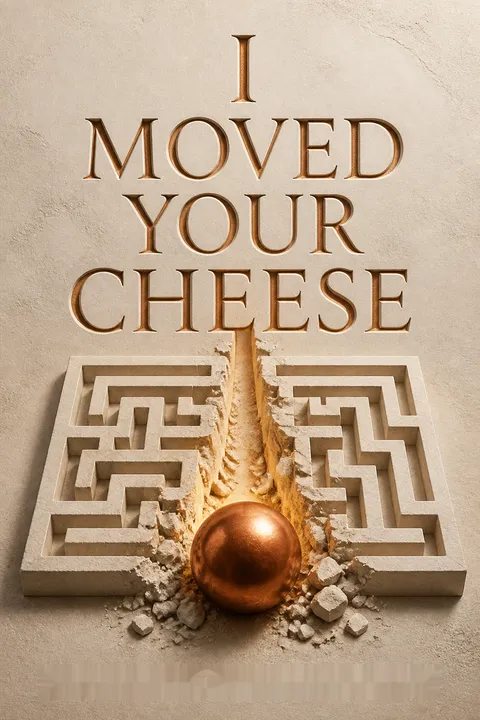
designed system of constraintsThe maze is the book's metaphor for an environment whose paths, rules, and rewards shape what people do. It can represent a workplace, institution, social norm, or set of assumptions. The metaphor emphasizes that conditions often treated as natural may have been designed for particular purposes, and that people can investigate or challenge them.
cheese
reward people are taught to chaseCheese represents the reward that motivates the mice to navigate the maze. It can stand for money, status, security, or another measure of success. The story distinguishes cheese as a practical resource from cheese as an unquestioned life goal, warning that constant pursuit of more may not provide lasting happiness.
the good book
doctrine of adapting to changeThe good book is the mice's widely accepted teaching that change is inevitable, beyond their control, and best met by adapting. The story acknowledges that this guidance can help mice recover and find new cheese. Its limitation is that it directs them to adjust without examining why the maze changes or whether its rules and goals should be challenged.
the maze in the mouse
internalized limits and assumptionsThe maze in the mouse describes the way accepted rules and assumptions can become part of a person's understanding of what is possible. In the story, some limits seem absolute partly because the mice have learned to see themselves only as maze-dwellers. The phrase points to the role of belief and habit, without proving that external barriers disappear through mindset alone.
FAQ
What's "I Moved Your Cheese" about?
- Challenging Assumptions: The book is a fable that challenges the assumptions made in "Who Moved My Cheese?" by Spencer Johnson, suggesting that individuals can change their circumstances rather than just adapt to them.
- Main Characters: It follows three mice, Max, Zed, and Big, who each have unique approaches to dealing with the maze they live in, symbolizing life's challenges and constraints.
- Empowerment and Control: The narrative emphasizes the power of questioning, understanding, and reshaping one's environment to gain control over one's destiny.
- Philosophical Exploration: It explores deeper philosophical questions about purpose, happiness, and the nature of change.
Why should I read "I Moved Your Cheese"?
- Alternative Perspective: It offers an alternative perspective to the popular "Who Moved My Cheese?" by encouraging proactive change rather than passive adaptation.
- Inspiration for Change: The book is designed to inspire readers to question their limitations and take control of their lives.
- Short and Engaging: It's a short, engaging read that combines storytelling with profound insights, making it accessible and thought-provoking.
- Practical Application: It provides practical insights for personal growth, career development, and organizational change.
What are the key takeaways of "I Moved Your Cheese"?
- Questioning the Status Quo: Always question the limitations and constraints imposed by your environment.
- Empowerment through Understanding: Understanding the reasons behind changes can empower you to exert greater control over your life.
- Redefining Success: Success and happiness are not just about adapting to change but about reshaping your environment and goals.
- Personal Growth: Personal growth often requires challenging assumptions and playing by your own rules.
How do Max, Zed, and Big represent different approaches to life's challenges?
- Max's Curiosity: Max represents the curious mind that questions the status quo and seeks to understand and change the maze.
- Zed's Wisdom: Zed embodies wisdom and contentment, showing that happiness can be found by redefining what is important.
- Big's Strength: Big symbolizes strength and self-determination, focusing on personal growth and purpose beyond the maze.
- Unique Paths: Each character's journey illustrates different ways to escape or redefine the maze, offering diverse strategies for dealing with life's challenges.
What is the significance of the maze in "I Moved Your Cheese"?
- Symbol of Constraints: The maze symbolizes the constraints and challenges imposed by society, organizations, or personal beliefs.
- Internal vs. External: The book suggests that the real maze is not external but internal, within the minds of individuals.
- Opportunity for Change: It represents both the limitations and the opportunities for change, depending on one's perspective and actions.
- Metaphor for Life: The maze serves as a metaphor for life's complexities and the pursuit of goals, urging readers to question and redefine their paths.
How does "I Moved Your Cheese" differ from "Who Moved My Cheese?"?
- Proactive vs. Reactive: While "Who Moved My Cheese?" focuses on adapting to change, "I Moved Your Cheese" encourages taking control and changing the environment.
- Questioning Change: It challenges the notion that change is inevitable and uncontrollable, suggesting that individuals can influence their circumstances.
- Deeper Exploration: The book delves deeper into philosophical questions about purpose, happiness, and the nature of change.
- Empowerment Focus: It emphasizes empowerment and the ability to reshape one's environment and goals.
What are the best quotes from "I Moved Your Cheese" and what do they mean?
- "The problem is not that the mouse is in the maze, but that the maze is in the mouse." This quote highlights the idea that limitations are often self-imposed and internal rather than external.
- "I moved your cheese." This statement signifies taking control and making changes rather than being a passive participant in life.
- "I am the purpose." Big's declaration emphasizes self-determination and finding personal meaning beyond societal expectations.
- "You are asking them to be. But they have learned only to do." This reflects the difference between existing authentically and merely following routines.
What lessons can organizations learn from "I Moved Your Cheese"?
- Encourage Questioning: Organizations should foster an environment where questioning assumptions and challenging the status quo is encouraged.
- Empower Employees: Empower employees to take control of their work environment and contribute to shaping organizational goals.
- Redefine Success: Success should be redefined beyond traditional metrics, focusing on innovation, creativity, and personal fulfillment.
- Adaptability and Control: While adaptability is important, organizations should also focus on exerting control over their circumstances and environment.
How can individuals apply the lessons from "I Moved Your Cheese" to their personal lives?
- Challenge Assumptions: Regularly question the assumptions and limitations you face in your personal and professional life.
- Take Control: Identify areas where you can exert more control and make proactive changes to improve your circumstances.
- Redefine Goals: Reflect on whether your current goals align with your true desires and values, and be willing to change them if necessary.
- Seek Personal Growth: Focus on personal growth and development by exploring new paths and opportunities beyond the conventional.
What role does personal reflection play in "I Moved Your Cheese"?
- Foundation for Growth: Personal reflection is emphasized as a crucial aspect of growth and learning, allowing individuals to understand their true desires and limitations.
- Questioning and Understanding: It encourages questioning one's environment and understanding the reasons behind changes and constraints.
- Aligning Actions with Values: Reflection helps align actions with personal values and goals, leading to more meaningful and fulfilling pursuits.
- Continuous Improvement: It fosters a mindset of continuous improvement and adaptation, enabling individuals to navigate life's challenges more effectively.
How does "I Moved Your Cheese" address the concept of happiness?
- Beyond Cheese: The book suggests that true happiness is not found in the pursuit of material goals (cheese) but in understanding and redefining one's purpose.
- Internal Fulfillment: Happiness is portrayed as an internal state that comes from aligning actions with personal values and desires.
- Challenging Beliefs: It challenges the belief that more cheese (success, wealth) leads to happiness, urging readers to find fulfillment in the journey itself.
- Empowerment and Freedom: Happiness is linked to empowerment and the freedom to shape one's environment and goals according to personal preferences.
What is the author's main message in "I Moved Your Cheese"?
- Empowerment and Control: The author emphasizes the importance of empowerment and taking control of one's environment and circumstances.
- Questioning and Redefining: It encourages readers to question assumptions, redefine goals, and challenge the status quo to achieve personal and professional growth.
- Beyond Adaptation: The book argues that adaptation is not enough; individuals should strive to reshape their environment and pursue their own paths.
- Inspiration and Change: The narrative aims to inspire readers to seek meaningful change and find happiness by aligning their actions with their true desires and values.
About the Author


Download PDF
Download EPUB
.epub digital book format is ideal for reading ebooks on phones, tablets, and e-readers.








