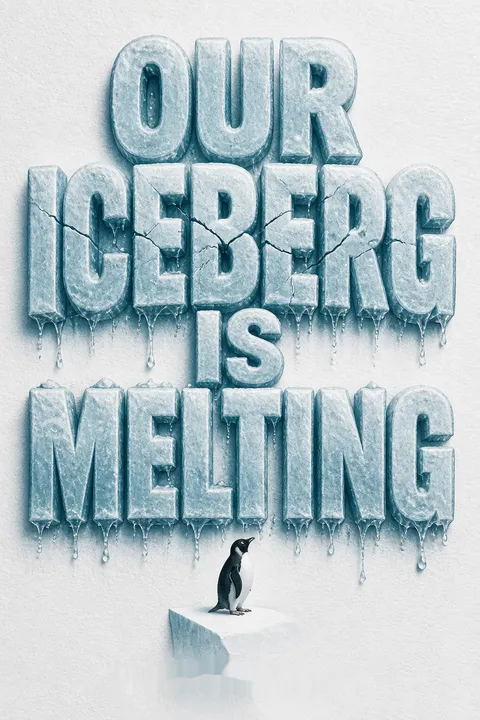


Key Takeaways
When the iceberg starts breaking, waiting for certainty becomes the real risk
Notice what routine hides. Fred, an observant but junior penguin, sees cracks and water-filled spaces inside the colony’s iceberg. He fears that trapped water could freeze, expand, and split their home during winter. His warning is dismissed as speculation, partly because the colony’s routines make danger hard to see and partly because no one wants to challenge a familiar way of life.
Make the evidence tangible. Alice swims down to inspect the damage, then helps Fred demonstrate the danger with a sealed bottle of water that breaks when the water freezes. The test does not prove every detail of Fred’s forecast, but it makes the possible consequences credible enough to justify action. The colony faces a choice between imperfect evidence and a potentially catastrophic delay.
The bottle is a compact lesson in decision-making under uncertainty: evidence need not eliminate doubt to change what a responsible group should do. The relevant question is not whether Fred can guarantee disaster, but how severe the loss would be if he is right and the colony waits. That logic resembles precautionary reasoning used in safety engineering. Still, urgency can be abused when leaders present every risk as existential. The penguins’ case works because the threat is observable, the test is understandable, and the proposed response is open to collective scrutiny.
Build a change team for complementary strengths, not rank or convenience
Choose for the work. Louis, the respected Head Penguin, does not try to solve the crisis alone or simply assign it to the usual senior officials. He gathers Alice, who drives action; Fred, who notices and investigates; Buddy, who earns trust; and the Professor, who analyzes evidence. Their different abilities matter, but the group is not automatically a team. At first, they think and communicate as separate individuals.
Create shared direction. Louis gives them time to talk about their hopes and responsibilities, and even takes them on a group squid hunt, where catching food depends on coordinating rather than competing. He invites them to join rather than issuing an order. Trust and a common purpose begin to turn five capable birds into a functioning guiding team, able to lead beyond the formal leadership structure.
This group works because it combines credibility, execution, analysis, discovery, and trust rather than treating seniority as a substitute for capability. The squid hunt makes coordination physical and memorable: interdependence is experienced, not merely announced. Organizational research often distinguishes a collection of experts from a team with shared mental models, meaning members understand the goal and how their roles fit together. The story also hints at a practical constraint: relationship-building takes time, while crises may not provide much. Leaders can accelerate it, but cannot replace genuine consent with a team label.
Make the future vivid enough that people can leave the familiar
Offer a destination, not just danger. The penguins first imagine repairing the iceberg, drilling into it, or finding a perfect one. These proposals keep them attached to the assumption that a permanent home is possible. Then they see a seagull scouting for places where its migrating clan might live. The penguins do not copy the seagulls exactly. Instead, they recognize a different possibility: move when a home becomes unsafe.
Separate identity from location. Louis helps the colony see that their shared values, including caring for their young and one another, do not depend on staying on one particular iceberg. A vision of a mobile life turns escape from disaster into a future with agency. The new approach is not fully specified at first, but it gives the group a direction worth exploring and a practical question to investigate.
A useful vision changes the mental category of a problem. The penguins stop asking how to preserve this home and start asking how a colony can live safely across changing homes. That shift resembles design thinking, which often reframes a problem before generating solutions. The seagull serves as an existence proof, not a blueprint: another species shows that mobility is possible, while the penguins must adapt the idea to their own needs. A vision should be inspiring, but it also needs a credible route, or hope can become another form of denial.
Repeat the vision where people live, work, and make sense together
Communicate in human forms. The Professor prepares an elaborate presentation, but Buddy gets lost almost immediately. Louis instead connects the change to the colony’s identity, and Buddy tells the seagull’s story. The leaders then use posters around the iceberg and informal talking circles, inviting questions rather than relying on a single announcement. The message reaches penguins who are confused, anxious, skeptical, or simply absent from the first meeting.
Make repetition useful. Posters appear even near fishing grounds, where the penguins regularly gather. These reminders help keep the new idea visible in everyday life. The point is not to repeat a slogan mechanically. Different people need different routes into understanding: a story, a conversation, a concrete image, or a chance to ask what the change means for them.
The failed slide deck and successful story illustrate the difference between transmitting information and helping people make meaning. Communication is not complete when a leader speaks; it is complete when people can explain the change in their own terms and connect it to their daily choices. Repetition across settings can build that shared understanding, much as public health messages use multiple channels. Yet constant messaging can become noise. The talking circles matter because they make communication reciprocal, revealing confusion and practical concerns that posters or speeches alone cannot surface.
Turn willing helpers into doers by removing practical and emotional barriers
Find the real obstacles. As planning begins, NoNo spreads fear, a teacher’s alarming stories give young penguins nightmares, and leaders compete for control of the scout effort. A deeper barrier is an old food-sharing rule: adults feed their own children, not other adults. This makes it difficult to feed scouts returning from dangerous journeys. Repeating the logic of change does little to solve these problems.
Respond to what blocks action. Louis redirects NoNo’s role, Alice publicly recognizes cooperative mid-level leaders, and Buddy reassures the teacher that her work remains valuable. Sally Ann, a young student, helps organize a celebration that gets adults to contribute fish for the scouts. Each response addresses a different barrier, and each broadens participation. Empowerment means making it possible for people who support the change to contribute, even when the solution comes from an unexpected corner.
The obstacles are not all rational objections. Some reflect status anxiety, fear for children, threatened identity, or habits embedded in social rules. Treating every resistance as ignorance would miss the point. Buddy’s conversation with the teacher succeeds because it recognizes her concern and gives her a valued role in the new situation. Sally Ann’s idea shows how participation can cross age and authority boundaries. The story is optimistic about removing barriers, though persistent opposition may require firmer limits than reassurance or redirection can provide.
Give skeptics visible proof through an early win they can witness
Make progress observable. The first scouts are sent to identify possible homes, not to complete the colony’s entire move. Their limited assignment produces a clear result: they return safely with reports of new icebergs. The colony celebrates their work at Heroes Day, where adults bring fish to feed them and children give them handmade medals. The event also challenges the old rule against adults sharing food with other adults.
Let success teach. The returning scouts offer more than reassurance. They provide direct evidence that exploration is possible, make the nomadic vision concrete, and give volunteers recognition. More penguins become interested in scouting after hearing what the first group found. This is a short-term win: a visible, credible achievement that builds confidence and support while the larger change is still underway.
The first scouting trip is well designed as a test: its scope is small enough to attempt, but its outcome speaks directly to the colony’s doubts. The celebration adds social proof, meaning people use others’ visible behavior as evidence that an unfamiliar action is acceptable. It also reinforces the desired norm by rewarding contribution publicly. A caution: celebrations cannot substitute for meaningful results. A win is persuasive when it reflects genuine progress, not when leaders stage a success that conceals unresolved costs.
After the first success, raise the next challenge before urgency fades
Use momentum deliberately. The first scouts return safely, and a second wave explores the most promising options in greater depth. The colony identifies a suitable iceberg with protection from storms, nearby fishing, and safe resting places along the route. Leaders also clear space for the work by cutting irrelevant meetings. When Louis considers slowing down, Alice warns that delay could let old doubts return and make the danger seem exaggerated.
Keep the change moving. The penguins begin their relocation just before winter. The journey is imperfect: a few birds get lost, and the colony faces unfamiliar conditions at its new home. They adapt, then move again when scouts find a better iceberg. The second move is easier because the group has learned from the first. One victory is evidence of capacity, not proof that the challenge is over.
This phase guards against a common organizational trap: treating an early improvement as the finish line. Momentum matters because old routines can reassert themselves when attention shifts elsewhere. The second move also shows that adaptation is iterative, not a single heroic leap. Still, speed is not automatically wise. Alice’s impatience is useful when inertia threatens, but sustainable pace requires noticing fatigue and learning from setbacks. The story balances urgency with a practical cycle of scouting, testing, moving, and adjusting.
Make adaptation a colony-wide habit, not a one-time rescue
Change the structures around behavior. After the move, the penguins adjust who leads, reward scouting, add new subjects to school, and improve weather forecasting. Former scouts and other volunteers take on greater responsibility. Louis helps younger penguins learn the story of the first crisis and the actions that got the colony through it. These choices make the new way of working easier to repeat and teach.
Keep vigilance alive. The colony does not declare its next iceberg perfect and settle permanently. It continues scouting and moving when better options appear. The deepest shift is cultural: more penguins become willing to notice problems, offer ideas, and help lead change. The colony still needs order and continuity, but it also needs people ready to challenge routines when conditions change.
A new practice becomes durable when roles, incentives, education, and stories support it together. The penguins institutionalize scouting while also teaching the memory of how change happened, turning a crisis into shared competence. This resembles organizational learning: groups preserve not only solutions but ways to detect when a solution no longer fits. There is a real tension here. Permanent vigilance can become exhaustion or endless disruption. Adaptive cultures need both the courage to question settled assumptions and the judgment to know when stability is serving people well.
Analysis
Our Iceberg Is Melting turns organizational change into a fable about a colony that must leave the only home it has known. Its central argument is that successful change depends on a sequence of social and practical work, not a leader’s announcement or a polished plan. Someone must notice danger, make it visible, assemble a credible team, describe a different future, communicate repeatedly, clear obstacles, demonstrate progress, maintain momentum, and embed new behaviors in the culture.
The penguins make each function memorable. Fred notices what routine obscures. Alice converts concern into action. Louis lends authority and steadiness. Buddy builds trust and responds to fear. The Professor tests claims. Sally Ann shows that initiative can come from below. NoNo embodies denial and obstruction, but the story also shows that people resist for different reasons: anxiety, status, attachment to tradition, or confusion. Treating all resistance as the same problem would be a mistake.
The fable’s strength is its shared language. A team can discuss its melting iceberg, its Fred, or its NoNo without beginning with an accusation. Stories also connect abstract procedures to emotion and consequence. The book’s sequence is especially useful as a diagnostic: a stalled effort may lack urgency, a convincing alternative, broad communication, or a way to prove progress.
The framework is not a mechanical recipe. Real change often unfolds unevenly, with steps overlapping or requiring revisiting. Leaders cannot manufacture trust by assigning people to a team, and fear-based urgency can produce panic rather than cooperation. The penguins’ response works because they pair the warning with agency, practical experimentation, and a future worth moving toward. Its enduring lesson is not simply to change quickly. It is to build a group capable of recognizing when its assumptions no longer protect it, and of learning together how to act.
Review Summary
Our Iceberg Is Melting receives mixed reviews. Many readers find it a simple yet effective fable about change management, praising its accessibility and practical lessons. Some appreciate its use of penguins to illustrate organizational dynamics. However, critics argue it oversimplifies complex issues and can be condescending. Some readers, particularly those required to read it for work, find it irritating or unnecessary. The book's ratings range from 1 to 5 stars, with an average of 3.77 out of 5 based on over 16,000 reviews on Goodreads.
People Also Read



Glossary
Eight-Step Process of Successful Change
Sequence for leading changeKotter’s change framework, illustrated through the penguin colony’s response to its melting home. It moves from creating urgency and assembling a guiding team to shaping and communicating a vision, enabling action, achieving early results, sustaining effort, and embedding new behavior in the culture. The steps are a practical guide for diagnosing and leading major group change.
Guiding Team
Core group steering changeThe group of people who coordinate and lead a change effort. In the story, it brings together penguins with authority, practical drive, observational insight, analytical skill, and broad trust. Its effectiveness depends not only on members’ individual strengths, but also on their ability to work together around a shared purpose.
Short-Term Wins
Visible early progressClear achievements produced early in a larger change effort. In the story, the first scouts return safely with useful information, demonstrating that exploration is possible. Such wins can strengthen belief in the plan, attract additional helpers, and reward effort. They are most useful when they represent genuine progress rather than a cosmetic celebration.
NoNos
Voices obstructing changeA label used in the fable for penguins who deny the danger, spread alarm, or undermine the colony’s effort to adapt. NoNo, the central example, challenges evidence and predicts disaster. The character represents obstruction, but the story also distinguishes disruptive opposition from anxiety and uncertainty, which may need reassurance or practical support.
Melting iceberg
Threatened status quoThe story’s central metaphor for a condition, strategy, or institution that once seemed dependable but is becoming unsafe or unsustainable. The iceberg’s hidden cracks stand for warning signs that routines can conceal. Recognizing that the familiar foundation is failing is the starting point for deciding whether to repair, replace, or leave it.
FAQ
What's "Our Iceberg Is Melting" about?
- Fable of Change: "Our Iceberg Is Melting" by John P. Kotter is a fable about a colony of penguins facing a melting iceberg, which serves as a metaphor for organizational change.
- Eight-Step Process: The story illustrates Kotter's Eight-Step Process for successful change management, showing how the penguins adapt to their changing environment.
- Characters and Roles: Key characters like Fred, Alice, and Louis represent different roles and attitudes towards change, from the curious observer to the practical leader.
- Universal Lessons: The book provides universal lessons on leadership, teamwork, and the importance of embracing change in any organization.
Why should I read "Our Iceberg Is Melting"?
- Simple Yet Powerful: The book distills complex change management concepts into a simple, engaging story that is easy to understand and remember.
- Practical Insights: It offers practical insights into how to handle change effectively, making it relevant for anyone in a leadership or management role.
- Broad Applicability: The lessons are applicable across various sectors and industries, from business to education and beyond.
- Engaging Format: The fable format makes it accessible to a wide audience, including those who might not typically read business books.
What are the key takeaways of "Our Iceberg Is Melting"?
- Urgency and Action: Creating a sense of urgency is crucial for initiating change and motivating others to act.
- Teamwork and Leadership: Successful change requires a guiding team with diverse skills and a shared vision.
- Communication and Buy-In: Clear communication and gaining buy-in from all stakeholders are essential for implementing change.
- Adaptability and Resilience: Organizations must be adaptable and resilient, ready to face new challenges and seize opportunities.
What is the Eight-Step Process of Successful Change in "Our Iceberg Is Melting"?
- Create Urgency: Help others see the need for change and the importance of acting immediately.
- Build a Guiding Team: Form a powerful group with leadership skills and a sense of urgency.
- Develop Vision and Strategy: Clarify how the future will differ from the past and how to achieve it.
- Communicate for Buy-In: Ensure as many people as possible understand and accept the vision and strategy.
- Empower Action: Remove barriers to enable others to make the vision a reality.
- Create Short-Term Wins: Generate visible, unambiguous successes to build momentum.
- Don't Let Up: Press harder after initial successes to keep the momentum going.
- Make It Stick: Embed new behaviors and practices into the culture to sustain change.
Who are the main characters in "Our Iceberg Is Melting" and what do they represent?
- Fred: Represents the curious observer who identifies the problem and initiates change.
- Alice: A practical leader who helps drive the change process and overcome resistance.
- Louis: The Head Penguin who provides leadership and guidance throughout the change.
- NoNo: Symbolizes resistance to change and skepticism, challenging the change process.
- Buddy and the Professor: Supportive characters who contribute to the change effort with trust and logic.
How does "Our Iceberg Is Melting" illustrate the challenges of change management?
- Resistance to Change: The story highlights common obstacles like skepticism and complacency.
- Communication Barriers: It shows the importance of clear communication to overcome misunderstandings.
- Team Dynamics: The fable emphasizes the need for a cohesive team to guide the change process.
- Cultural Shifts: It illustrates the difficulty of changing long-standing traditions and mindsets.
What are the best quotes from "Our Iceberg Is Melting" and what do they mean?
- "Handle the challenge of change well, and you can prosper greatly." This quote underscores the potential rewards of effectively managing change.
- "We are not chained to this piece of ice." It highlights the importance of adaptability and not being tied to outdated practices.
- "The iceberg is not who we are." This emphasizes the distinction between identity and circumstances, encouraging flexibility.
- "We will prevail!" A rallying cry for resilience and determination in the face of adversity.
How can "Our Iceberg Is Melting" be applied to real-world situations?
- Organizational Change: The book's principles can guide companies through restructuring, mergers, or strategic shifts.
- Personal Development: Individuals can use the lessons to navigate personal or career changes.
- Educational Settings: Schools can apply the concepts to adapt to new educational standards or technologies.
- Community Initiatives: Community leaders can use the fable to inspire collective action and change.
What is the significance of the penguin characters in "Our Iceberg Is Melting"?
- Relatable Metaphors: Penguins are used as relatable metaphors for human behavior in organizations.
- Diverse Roles: Each penguin character represents different attitudes and roles in the change process.
- Engagement and Humor: The use of penguins adds humor and engagement, making the story memorable.
- Symbolic Challenges: The penguins' challenges symbolize real-world organizational issues, making the lessons applicable.
How does "Our Iceberg Is Melting" address the emotional aspects of change?
- Fear and Anxiety: The story acknowledges the fear and anxiety that often accompany change.
- Building Confidence: It shows how building confidence and trust can help overcome emotional barriers.
- Emotional Buy-In: The fable emphasizes the importance of emotional buy-in for successful change.
- Celebrating Success: It highlights the role of celebrating short-term wins to boost morale and motivation.
What lessons does "Our Iceberg Is Melting" offer about leadership?
- Visionary Leadership: Effective leaders create and communicate a compelling vision for change.
- Empowering Others: Leaders empower others to act and contribute to the change process.
- Adaptability: Successful leaders are adaptable and open to new ideas and solutions.
- Resilience: Leaders must be resilient, maintaining momentum and focus despite challenges.
How does "Our Iceberg Is Melting" compare to other works by John P. Kotter?
- Fable Format: Unlike Kotter's other works, this book uses a fable format to convey its message.
- Complementary Lessons: It complements Kotter's "Leading Change" and "The Heart of Change" by providing a narrative example of his Eight-Step Process.
- Broader Audience: The fable format makes it accessible to a broader audience, including those outside traditional business settings.
- Consistent Themes: The book maintains Kotter's consistent themes of leadership, change management, and organizational effectiveness.
About the Author
Other books by John P. Kotter




Download PDF
Download EPUB
.epub digital book format is ideal for reading ebooks on phones, tablets, and e-readers.








