

Key Takeaways
Pair reliable management with distributed leadership when the environment shifts.
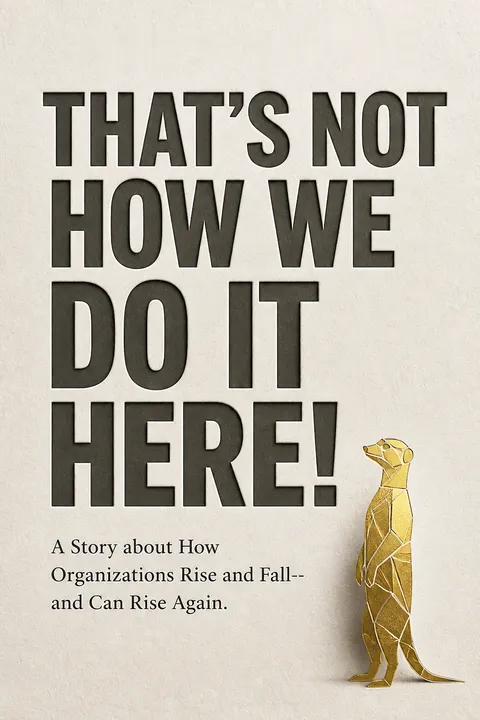
Two jobs, one organization. Kotter and Rathgeber tell their argument through a Meerkat clan. Under stable conditions, its managers keep food gathering, burrow maintenance, and guarding dependable. But when drought and unfamiliar predators arrive, the clan also needs leadership: people who can spot opportunities, generate ideas, and rally others to act. Management makes routine work reliable; leadership helps people move toward a new future. Neither can do the other’s job.
The book’s central claim is that organizations facing both complexity and change need both capabilities at once. Its story follows Nadia as she discovers that disciplined routines alone cannot adapt quickly, while enthusiasm and initiative alone cannot sustain the daily work of a large group.
The distinction is useful because organizations often praise innovation while measuring only operational consistency, or celebrate efficiency while treating experimentation as a distraction. The two demands are not mutually exclusive, but they do compete for attention, authority, and time. A practical implication is to ask which work requires dependable repetition and which requires discovery, then design different ways to support each. The distinction should not become a status hierarchy, with leaders cast as visionaries and managers as clerks. The clan’s survival depends on treating both contributions as skilled, consequential work.
Treat a successful routine as protection, not proof of adaptability.
Competence has a boundary. Nadia’s home clan has grown from a dozen Meerkats to more than 150. Its Head of Guards, Nicholas, schedules posts, trains guards, tracks attacks, and sets procedures. The system works: fewer than one in twenty predator attacks results in a Meerkat being taken or seriously injured. Those results are real, not bureaucratic decoration.
The danger is assuming that success under familiar conditions guarantees success under unfamiliar ones. When vultures appear and food becomes scarce, managers add meetings, measures, task forces, and controls. They improve some responses, but the pace of change overwhelms their established methods. The clan’s systems are good at repeating what works. They are poor at discovering what might work when the old answers no longer fit.
A strong routine is a genuine organizational asset: it preserves attention for work that cannot be automated or standardized. The trap is mistaking operational evidence for evidence of adaptability. In complex systems, yesterday’s success can make current assumptions feel safer than they are. A useful test is whether the organization can notice weak signals, question its own procedures, and run a bounded experiment without treating it as disloyalty. Not every disruption requires reinvention, however. A system that changes every practice at every hint of trouble can lose the reliability that makes adaptation possible.
Let people closest to danger test ideas before hierarchy dismisses them.
A useful idea gets blocked. Ayo, a committed guard, climbs a tree and realizes that a lookout high above the ground can spot a fast-moving vulture earlier. Nadia sees the value immediately. But Nicholas learns that Ayo has broken guarding procedure and removes him from guard duty before hearing the full proposal. The rule is intended to protect the clan, yet enforcing it without examining the new information suppresses a potentially safer approach.
The episode exposes a key failure in rigid systems: people can have a legitimate reason to depart from routine, but lack a safe channel for explaining what they learned. Nicholas eventually adopts the tree lookout after hearing about it from other guards, and it helps. The innovation was not reckless by definition; it needed evaluation, testing, and a path into practice.
Ayo’s case is not an argument for ignoring safety rules. In high-risk work, a deviation can expose others to harm, and good intentions do not establish that a new method is sound. The stronger lesson is procedural: investigate the observation before punishing the deviation. Organizations can preserve safeguards while creating a rapid review route for frontline discoveries, including a small trial and clear criteria for stopping it. This resembles learning systems in which near misses are examined for information, not merely for blame. The challenge is to make experimentation accountable without making it impossible.
Use volunteer networks to create speed, energy, and experiments.
A small clan moves differently. Nadia and Ayo eventually find Lena’s clan, a group of about a dozen Meerkats that meets in a circle and invites members to propose solutions. When rain is late, the group chooses to share surplus food. Volunteers try the idea themselves, and participation spreads. Another volunteer, Tamu, discovers edible bugs in elephant droppings and organizes a small farm. The clan does not wait for a complete plan before learning from action.
Leadership is not reserved for a senior rank: volunteers facilitate discussions, form teams, and lead projects. People can join work they care about without being ordered into it. That arrangement produces energy and experimentation, but it also depends on a small group, high trust, and work that people are willing to take on.
Volunteer networks can surface knowledge that formal reporting lines miss, especially when people with different roles encounter a problem from different angles. The food-sharing and bug-farming experiments also show how visible participation can make an unfamiliar practice easier to try. Yet voluntarism is not automatically inclusive: confident people may dominate, less powerful workers may feel pressure to volunteer, and unglamorous work can be neglected. A healthy network needs room to decline, fair access to influence, and a way to distinguish genuine enthusiasm from invisible overtime. Freedom to act works best when paired with clear boundaries.
Scale exposes the daily work that enthusiasm cannot reliably coordinate.
Good spirit is not enough. Lena’s clan grows from twelve members to around fifty. Its informal approach still generates ideas, but it becomes harder to recruit people for repetitive tasks such as digging and maintaining burrows or standing scheduled guard shifts. Some members are eager to plan improvements but less willing to do routine work. Others quietly cover the gaps and grow resentful.
Then heavy rain floods weak tunnels. Matt’s careful mapping helps him and others rescue trapped Meerkats, but seven die. The disaster makes the cost of unreliable maintenance unmistakable. The problem is not that the clan lacks caring or creativity. It has not built dependable roles and routines for essential work at a larger scale. Informality that once enabled speed now leaves critical responsibilities exposed.
This episode gives the book’s argument an important limit: autonomy cannot substitute for coordination when work is interdependent and failure is costly. Informal arrangements may appear efficient while a group is small because everyone can see what needs doing. Growth increases the distance between intention and execution. Leaders should therefore track not only whether people support a mission, but whether recurring responsibilities have owners, skills, and backup coverage. Still, more rules are not always the answer. The useful question is which tasks need consistency and which should remain open to local judgment.
Build a dual system: hierarchy for reliability, networks for renewal.
Add capacity, do not swap it. After seeing the strengths and failures of both clans, Nadia sketches a way to combine them. The hierarchy keeps essential operations running through roles, plans, procedures, and accountability. Alongside it, a flexible network of volunteers develops responses to new threats and opportunities. The network does not replace managers, and management does not own every new idea.
This arrangement answers the book’s central organizational question: how can a mature organization remain dependable without becoming too slow to adapt? It requires people to contribute to their regular jobs and, when they choose, to cross-group initiatives. Successful experiments can move into formal operations once they need sustained staffing and reliable delivery. The two structures have distinct jobs, but must communicate and support one another.
The design resembles organizational ambidexterity: the capacity to exploit established capabilities while exploring alternatives. Its strength is that exploration does not have to dismantle the systems that keep current work safe and dependable. Its difficulty is governance. A network can compete with the hierarchy for time, resources, or legitimacy, while managers can quietly starve projects they cannot control. The arrangement therefore needs visible sponsorship, negotiated access to people, and a clear route for proven work to become operational. Without those connections, a second structure risks becoming either a shadow bureaucracy or an enthusiasm club.
Make urgency about a credible opportunity, not fear alone.
Anxiety is not momentum. Back home, Nadia describes the new clan’s experiments and argues that the old approach cannot protect the Meerkats from changing threats. Moro, one of the Alphas, recognizes that returning to normal is not a credible plan. He supports trying the bug farm, while Mara and several managers remain doubtful. The proposal connects a specific need, food, with a possible way to improve the clan’s prospects.
The book distinguishes useful urgency from fear that merely exhausts people. A threat can get attention, but anxiety and blame do not automatically produce action. Moro and Nadia communicate a reason to act, show that an experiment is feasible, and invite others to participate. The aim is not panic. It is shared conviction that a worthwhile opportunity deserves effort now.
Urgency is most productive when it gives people both a reason to move and a plausible first step. Threats can focus attention, but persistent alarm can narrow thinking and encourage defensive behavior. An opportunity-centered message is more likely to preserve agency, especially when people can see how their contribution matters. The Meerkat example also suggests that leaders need not be charismatic performers: Moro’s repeated presence and support give the effort credibility. A useful caution is that opportunity language can become spin if leaders conceal costs or uncertainties. Trust depends on treating risks honestly while making action possible.
Mobilize cross-level volunteers, then make small wins visible.
Action earns belief. The bug-farm effort begins with volunteers who keep their usual duties while testing a new food source. Some leave and others take their places. Nadia and Nicholas spread the invitation, Moro visits the team, and early food from the farm gives the clan concrete evidence that the idea can work. Those results draw more attention and make other initiatives easier to imagine.
The network also finds ideas beyond its formal leaders. One member brings forward a sister’s observation that young Meerkats given handmade stuffed animals seem to recover with less intensive care. A volunteer team tests the idea, sees promising results, and develops it into a wider healing initiative. Small, visible successes build confidence, attract help, and show that useful knowledge can come from unexpected places.
Early wins matter not simply because they create optimism, but because they reduce uncertainty about whether a new way of working is practical. A small result can serve as evidence for skeptics and a coordination signal for potential collaborators. The stuffed-animal story is especially useful as a reminder that innovation often begins with noticing and testing an overlooked practice, not inventing something spectacular. Still, a win should not be confused with proof of general effectiveness. The clan’s informal tests are suggestive, not rigorous. Scaling a promising idea requires checking whether the result holds across people and circumstances.
Transfer proven innovations into operations without closing the channel for new ones.
Innovation becomes dependable work. As the bug farm grows, volunteers eventually hand it over to a newly appointed manager and staff. It supplies 25 percent of the clan’s food with seven Meerkats assigned to the specialized work. The experiment has become an operation that needs reliable planning and oversight. Similarly, the healing effort becomes a recognized caregiving role serving the wider clan.
The clan grows to 200 members while continuing to develop ideas and carry out daily work. The transition matters: if every successful experiment stays informal, it may depend on a few exhausted volunteers. If it becomes formal too early, rules may choke off learning. The book’s model keeps the network active even as proven initiatives enter the hierarchy, so stability does not mean innovation has ended.
Institutionalizing a successful experiment protects it from depending indefinitely on heroic effort. It can clarify responsibility, fund ongoing work, and make quality more consistent. But formal adoption can also change incentives: an initiative born from curiosity may become a compliance target, while its original volunteers lose influence. The handoff should therefore preserve the knowledge and purpose behind the experiment, not just its output measures. Continuing networks offer a way to renew the pipeline of ideas. The central design challenge is to let operations standardize what is proven while leaving room to question what has become routine.
Analysis
Kotter and Rathgeber’s fable makes a focused argument about organizational design: systems built for reliable execution do not automatically produce adaptation, and systems that unleash initiative do not automatically produce reliability. The Meerkat story gives each failure a humanly legible cost. Nicholas’s discipline protects a large clan during ordinary conditions, yet his attachment to procedure initially silences Ayo’s observation. Lena’s open, volunteer-led group generates food-sharing, a bug farm, and new caregiving ideas, yet it fails to maintain burrows as it grows. Neither leader is simply wrong. Each has a capability that the other system lacks.
The book’s proposed dual structure resembles organizational ambidexterity, the effort to sustain current operations while exploring new possibilities. Its strongest insight is not merely that organizations need both innovation and efficiency. It is that the two modes require different operating conditions, and should be connected rather than collapsed into one. A network gives people permission to discover and mobilize; a hierarchy gives proven work ownership, resources, and repeatability. Visible wins help the network gain credibility, while successful handoffs prevent every innovation from relying on unpaid enthusiasm.
The fable’s simplicity is also its limitation. It treats volunteer effort as a renewable resource and does not fully examine conflicts over time, status, budget, or which initiatives deserve scarce attention. A real organization may find that a second network creates hidden overtime or that managers endorse experiments publicly while withholding practical support. The book’s own story implies safeguards: meaningful urgency, senior sponsorship, cross-level participation, concrete evidence, and eventual operational ownership. Those are not decorative steps. They are the conditions that keep the two systems from competing destructively.
The most durable lesson is therefore diagnostic. When an organization struggles, the question is not simply whether it needs more control or more freedom. It is which capability is missing, which work requires it, and whether the organization has a credible bridge from discovery to dependable execution. The book offers no universal blueprint, but it gives leaders a sharper way to see why familiar strengths can become liabilities when circumstances change.
Review Summary
That's Not How We Do It Here! receives mixed reviews, with an average rating of 3.84/5. Readers appreciate its insights on balancing management and leadership in organizations, particularly during times of change. The book uses a fable about meerkats to illustrate its concepts, which some find engaging and others find unnecessary. Many praise the book's lessons on adapting to change and fostering innovation, while some critics feel the content is not novel. The book's brevity and accessibility are generally viewed positively.
People Also Read









Glossary
dual system
Hierarchy plus networkAn organizational arrangement that operates a traditional hierarchy alongside a flexible, network-like group. The hierarchy manages recurring work through roles, plans, and procedures. The network mobilizes people across levels and work groups to pursue new opportunities and respond to change. The two structures cooperate, with successful initiatives potentially becoming part of formal operations.
guiding coalition
Cross-level change leadersA group of people who provide direction and coordination for change initiatives. In the book’s model, members come from different levels and parts of the organization, and participate because they want to help advance an important opportunity. They listen for ideas, help choose initiatives, recruit volunteers, communicate progress, and build momentum.
true urgency
Opportunity-focused driveA shared sense that an important opportunity or challenge deserves action now. It is distinct from anxiety-driven alarm, which can increase stress without helping people act effectively. True urgency combines emotional commitment with a credible reason to move, visible possibilities, and practical steps that people can take.
management
Reliable operational executionThe work of organizing people and resources so recurring tasks are completed reliably and efficiently. In the book, management includes plans, roles, procedures, staffing, measures, and accountability. It is especially important as an organization grows more complex, but it does not by itself generate the energy and flexibility needed to address unfamiliar change.
leadership
Mobilizing change and innovationThe work of helping people see a direction, engage with it, and act despite obstacles. The book separates leadership from formal rank: people at many levels can identify opportunities, form teams, and help others move toward change. Leadership supports innovation and adaptation, but without management it may not ensure that essential daily work is done consistently.
FAQ
What's "That's Not How We Do It Here!" about?
- Fable Format: The book is a fable about a clan of Meerkats facing challenges due to environmental changes and internal organizational issues.
- Organizational Dynamics: It explores how organizations rise, fall, and can rise again by balancing management and leadership.
- Main Characters: The story follows characters like Matt, Nadia, and Ayo as they navigate these challenges and seek solutions.
- Core Message: It emphasizes the need for both management and leadership to adapt to rapid changes and ensure organizational success.
Why should I read "That's Not How We Do It Here!"?
- Practical Insights: The book provides practical insights into organizational behavior and change management through an engaging narrative.
- Relatable Story: The fable format makes complex concepts accessible and relatable, offering a fresh perspective on leadership and management.
- Real-World Application: It offers lessons that can be applied to real-world organizational challenges, making it valuable for leaders and managers.
- Engaging and Thought-Provoking: The story is designed to be thought-provoking and engaging, encouraging readers to reflect on their own organizational experiences.
What are the key takeaways of "That's Not How We Do It Here!"?
- Balance of Leadership and Management: Successful organizations need both strong management for reliability and leadership for innovation.
- Adaptability to Change: Organizations must be agile and adaptable to survive and thrive in rapidly changing environments.
- Empowerment and Engagement: Encouraging leadership at all levels and engaging employees can lead to innovative solutions and organizational growth.
- Dual Structure: A dual system combining management and leadership can help organizations handle complexity and change effectively.
How do the Meerkats in "That's Not How We Do It Here!" represent organizational challenges?
- Symbolic Characters: The Meerkats symbolize different roles and challenges within an organization, such as leadership, management, and innovation.
- Environmental Challenges: The clan faces external threats like predators and drought, representing market and environmental changes.
- Internal Struggles: Internal conflicts and resistance to change highlight common organizational issues like rigidity and lack of innovation.
- Journey of Discovery: The characters' journey to find better solutions mirrors the process of organizational learning and adaptation.
What is the significance of the title "That's Not How We Do It Here!"?
- Resistance to Change: The title reflects a common organizational mindset that resists change and innovation.
- Challenge to Status Quo: It highlights the need to challenge traditional ways of thinking and embrace new approaches.
- Cultural Barriers: The phrase represents cultural barriers that can hinder progress and adaptation in organizations.
- Call for Innovation: It serves as a call to action for organizations to innovate and adapt to survive and thrive.
What are the best quotes from "That's Not How We Do It Here!" and what do they mean?
- "The vultures had mysteriously turned from scavengers to killers." This quote symbolizes unexpected external threats that can destabilize an organization.
- "You first learn the rules, then..." It emphasizes the importance of understanding existing systems before innovating or changing them.
- "In the center, we have the group that comes together weekly to talk about what we stand for." This highlights the importance of shared vision and values in driving organizational success.
- "We cannot just settle, each of us doing our daily work or doing it a little better, and hope for the best." It underscores the need for proactive change and innovation rather than complacency.
How does "That's Not How We Do It Here!" define leadership and management?
- Distinct Roles: Leadership and management are defined as distinct roles with different functions and outcomes.
- Leadership: Involves inspiring, motivating, and guiding people towards innovation and change.
- Management: Focuses on planning, organizing, and ensuring reliability and efficiency in daily operations.
- Complementary Functions: Both are essential for organizational success, especially in complex and changing environments.
What is the dual system proposed in "That's Not How We Do It Here!"?
- Combination of Structures: The dual system combines traditional management structures with a network-like leadership system.
- Management for Stability: Ensures reliability and efficiency in handling daily operations and complex systems.
- Leadership for Agility: Provides the agility and innovation needed to respond to rapid changes and new opportunities.
- Integration of Both: The system allows organizations to benefit from both stability and adaptability, crucial for long-term success.
How does "That's Not How We Do It Here!" address the challenges of organizational growth?
- Growth and Complexity: The book discusses how growth can lead to increased complexity and challenges in maintaining efficiency and innovation.
- Need for Structure: As organizations grow, structured management becomes essential to handle routine tasks reliably.
- Innovation and Adaptation: Leadership is needed to foster innovation and adapt to new challenges that come with growth.
- Balancing Act: The book emphasizes the need to balance management and leadership to sustain growth and success.
What lessons can businesses learn from "That's Not How We Do It Here!"?
- Embrace Change: Businesses should embrace change and be willing to adapt to new circumstances and challenges.
- Foster Innovation: Encouraging innovation and leadership at all levels can lead to creative solutions and competitive advantage.
- Build a Dual System: Implementing a dual system of management and leadership can help businesses navigate complexity and change.
- Engage Employees: Engaging employees and empowering them to take initiative can drive organizational success and resilience.
How does "That's Not How We Do It Here!" illustrate the importance of culture in organizations?
- Cultural Resistance: The book highlights how cultural resistance to change can hinder progress and innovation.
- Shared Vision: A strong, shared vision and values are crucial for aligning efforts and driving organizational success.
- Cultural Transformation: Transforming organizational culture to embrace change and innovation is essential for long-term success.
- Role of Leadership: Leadership plays a key role in shaping and transforming organizational culture to support growth and adaptation.
What practical steps does "That's Not How We Do It Here!" suggest for implementing change?
- Create Urgency: Establish a sense of urgency around opportunities and challenges to motivate change.
- Build Coalitions: Form diverse groups that span silos and levels to guide and coordinate change efforts.
- Communicate Relentlessly: Communicate initiatives and successes to build momentum and engage more people.
- Celebrate Wins: Celebrate small and big wins to reinforce progress and sustain motivation for change.
About the Author
Other books by John P. Kotter






Download PDF
Download EPUB
.epub digital book format is ideal for reading ebooks on phones, tablets, and e-readers.








