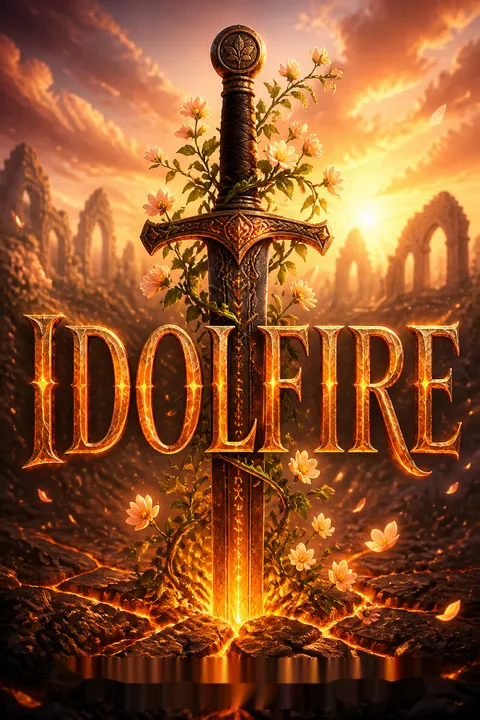


Plot Summary
The Sword Finds Balain
At Wall’s End, a small village built beside the ruins of Balt, Kirby follows her older brother Balain to an abandoned fort. He has found an ancient sword in a hidden weapons chamber, its flawless blade etched with the name of Iona, the spring goddess Balt once worshipped. Balain names it Cursebreaker and becomes convinced Iona is calling him to recover her from Nivela, the distant city that sacked Balt.
Kirby believes in his courage, but she also fears being left behind. Their village is dwindling under the Wither, a wasting affliction that prevents families from having healthy children. Balain sees the goddess’s theft as the cause and imagines her return could restore the people and the land.
The sword does not simply give Balain a destination. It turns the family’s private grief into a mission with a heroic shape. Kirby’s admiration is inseparable from fear: she wants her brother to be extraordinary, but understands that a calling can take him away. Their disagreement over whether Iona is living or lost also sets up the novel’s central distinction between belief and worship. Balain’s certainty offers hope, while Kirby’s caution protects the ordinary life she knows. The Wither makes their debate material: the village’s future is not an abstraction but a dwindling number of children, births, and shared responsibilities.
Ash's Unwanted Heir
In Ash, Aleya Ana-Ulai is nearing the end of years of scholarly training when she faces a hand-to-hand trial required for her royal Calling. Her uncle Eshmer judges the match, and she suspects he wants her to fail so his son Irtu can inherit. Her opponent nearly strangles her, but Aleya uses the arena’s brick boundary to knock him unconscious. Eshmer has to declare her the victor.
Aleya’s past makes the victory precarious: her parents died in the war between Ash and Kuba, and citizens resent her Kubalite appearance and origins. After a girl throws a stone at her in the street, the queen delays Aleya’s Calling until the signs are favorable. Aleya is sent to the city watch instead, still excluded from the future she has trained to claim.
Aleya’s competence is real, but Ash makes competence insufficient. The trial tests combat; the public attack reveals that her deeper obstacle is political memory, a city’s resentment embodied in her face. She responds to exclusion with discipline and sarcasm, treating every setback as a temporary challenge she can outwork. That strategy keeps her moving but leaves little room to ask whether the institution she wants to lead deserves her loyalty. Her aunt’s decision to postpone the Calling is especially destabilizing because it recasts delay as a judgment on her existence, not her performance.
The Wither Names Kirby
Balain eventually abandons his plan to seek Iona and becomes engaged to Eider, a neighbor Kirby has known since childhood. At their celebration, Kirby imagines raising children alongside her brother, until their mother asks whether she has begun menstruating.
Kirby realizes she has the Wither, and that her family and much of Wall’s End already knew. Humiliated, she leaves the feast and rejects Balain’s attempt to bring her to Iona’s ruined temple.
Soon after, the ancient broch collapses, burying the Ionan orchard and seeming to answer Kirby’s anger with divine force. The years that follow bring more losses: Balain dies, Eider’s and Jarrow’s longed-for child survives only two days, and the village’s hope of continuing dwindles toward extinction.
Kirby’s diagnosis collapses a future she had assumed was waiting for her: marriage, children, and a place in a community built around care. The concealment wounds her as much as the illness because it makes her the last person permitted to understand her own body. Her anger at Iona is therefore not a loss of belief but a refusal to confuse belief with submission. The broch’s collapse gives that anger an eerie consequence without proving the goddess caused it. Meanwhile, the deaths accumulate slowly, making communal extinction less like a single catastrophe than a future everyone can see approaching.
A Blade Returns Home
After Eider and Jarrow lose their baby, Kirby retreats to the woodland, unable to remain among Wall’s End’s grief. There, inside an old tree stump, she finds Cursebreaker, the sword Balain once kept hidden. The discovery gives her a way to act on the hope he left behind, though she has little training and no clear plan.
Her mother and friends warn that the journey is dangerous; Eider can barely bear to speak to her. At dawn, Kirby’s mother finally accepts her decision and forgives the old distance between them with a hard, silent embrace. The villagers leave food, a hunting knife, medicine, and a carved token of Iona in Kirby’s pack. Carrying Balain’s sword, Kirby turns toward the old road and leaves home.
Kirby’s departure is not a sudden conversion to Balain’s faith. It is an attempt to reclaim agency after discovering that her body, family, and village have all been discussed as though her consent were optional. The sword offers action, but the gifts in her pack reveal that the journey belongs to the community too: Wall’s End cannot follow her, yet it equips her with its care. Her mother’s near-apology matters precisely because it is incomplete. Neither woman repairs the past with a speech; they make a small physical gesture and let Kirby go.
A False Nivela
Kirby crosses Bern alone, survives weeks of rain, and escapes a threatening household after its drunken son mistakes her for a thief. Near Weavering, she learns that Nivela is supposedly being rebuilt on the coast and joins a recruiter’s party, hoping to reach the real city.
The settlement proves to be a makeshift stronghold, not the ancient capital she seeks. When Kirby refuses to enlist, the recruiter has her bound. In the same courtyard sits Aleya, a royal from Ash who was deceived onto a ship by her cousin Irtu and delivered to the self-proclaimed Worldlord Agrippus.
Aleya and Kirby cooperate to escape, but the pursuing soldiers drive them to a cliff. Aleya spends the last power in her bangle to carry them safely to a ledge below, and the strangers begin their journey together.
The false Nivela compresses the novel’s political critique into a concrete trap: people who promise a grand future use the language of belonging to recruit bodies for their own ambition. Kirby arrives hoping for a lost god; Aleya arrives under royal orders and has been manipulated by her own family. Their first alliance is practical, not sentimental. Kirby’s quick reading of danger complements Aleya’s experience in combat, and their escape requires each to trust the other before either knows the other’s story. The cliff becomes their first shared threshold, where survival begins to depend on cooperation rather than inherited roles.
Bertha Runs on Faith
Aleya and Kirby escape the coastal stronghold under cover of fog, then trek through Gleatland, where carved images and mutilated bodies suggest something is hunting the forest. Aleya admits she is traveling to Nivela to recover the Left Hand of Heaven, the relic that allows Ash to kindle Idolfire.
In a mountain pass, the pair encounter Carthic soldiers led by Nylophon, a young commander who has been pursuing Aleya since their ships collided. A battle breaks out nearby, and an arrow strikes Aleya.
Kirby helps her escape to an old ocean tunnel, but Nylophon follows. The tunnel’s rings power a vast passage beneath the sea. When one is knocked loose, the god Mune begins flooding it. The three survive by praying together and reaching the far shore.
The ship’s earlier miracle establishes both the wonder and the danger of Idolfire: faith can animate an object, but the result is not a controlled tool. That cost becomes stark in Mune’s tunnel, where a damaged ring wakes a god who is lonely and powerful enough to drown them. Nylophon’s pursuit also changes shape. He begins as a representative of militarized entitlement, but the shared peril makes him physically dependent on the people he tried to capture. Kirby’s willingness to include him in the prayer is not absolution. It is a decision that survival should not be reserved for the deserving.
Krull's Stolen God
After the shipwreck, Kirby and Aleya reach a Gleatish settlement with Ermen, a hunter and metalworker who brings them before the clan leaders. The young prophet Lundi recognizes Aleya’s magic and watches the forest through a two-headed lamb with jeweled eyes, an artifact that reveals distant scenes.
Lundi sees Carthic soldiers approaching, while the clans are already divided over a recent wave of murders. At the settlement’s center stands a newly carved image of Krull, the Gleatish war god.
The old stone idol, stolen in Nivela’s conquests, has been worshipped again and returns as a living, bloodstained beast. Aleya defeats Nylophon in single combat, then works with Ermen to draw Krull into a cliff. She touches the animated god and drains its Idolfire, ending its rampage.
The Gleatish episode complicates the idea that recovering a stolen god will automatically heal a people. Krull’s return is a consequence of renewed worship, but it arrives as violence rather than protection. Aleya’s solution is not to claim the god or make it serve Ash; she removes the power sustaining its destructive form. Lundi’s watching artifact further blurs the line between sacred object and instrument of surveillance, while her status as a child makes prophecy socially complicated. The clans want certainty, yet their most reliable seer is still a young person whom adults must learn to hear.
Ramslayer Falls
Nylophon’s memories reveal the burden beneath his title. In his first battle, he was credited with killing a general, though the death came through confusion rather than courage; later, he accepted command when his force was stranded in Gleatland.
He kills civilians for supplies, then barely retains authority when his rival Halion challenges him. Nylophon wins but spares Halion, whose wound becomes fatal. After Krull’s rampage, he trails Aleya and Kirby across Ammol and repeatedly demands another duel.
Aleya sends him away on a mountain ridge, but he attacks again and falls over a cliff when her counterstroke sends him off balance. Soon afterward, Aleya is struck by an arrow while watching a battle. Kirby gets her to a doctor, who reveals the old ocean road as their only route forward.
Nylophon’s title is built around a public story that he cannot inhabit. He has learned to treat survival as proof of merit, yet the story repeatedly exposes how accident, fear, and other people’s decisions shape his victories. Sparing Halion is an attempt to escape the brutal logic that made their childhood a contest of dominance, but it produces a different kind of helplessness. Aleya’s decision to send him away also fails to end the relationship; her later belief that he died becomes a source of guilt. The arrow wound shifts the power balance, leaving Kirby responsible for action and Aleya dependent on care.
The Ocean Road Opens
Aleya recovers enough to travel with Kirby through the ocean road, an ancient tunnel enclosed by seawater and powered by devotional rings. When a pursuing Nylophon strikes one loose, water surges in and Mune’s vast voice asks where it is.
Aleya recognizes the god’s prayer and she and Kirby recite it as they climb toward daylight. Nylophon turns back, then returns when Kirby calls him into the prayer rather than leaving him to drown. The three reach the coast together; Nylophon survives by shedding his armor in the water.
In a nearby town, Aleya’s anger over his earlier attack collides with Kirby’s demand for honesty. Aleya admits she thought she had killed him on the ridge, and the argument ends in a sudden kiss that leaves them estranged for days.
This passage tests whether mercy can coexist with accountability. Kirby saves Nylophon because she cannot accept another person abandoned in darkness, not because he has earned trust. Aleya resists the choice, but follows the prayer, making survival a shared act rather than a reward for virtue. The later argument between the women reveals the cost of Aleya’s protective secrecy: she believes withholding the truth keeps Kirby safe, while Kirby experiences it as a denial of partnership. Their kiss does not instantly repair the breach. Intimacy here creates a new obligation to be honest, which is harder than simply traveling side by side.
A Kiss, Then the Stars
In a coastal town, Aleya seeks counsel at a local temple while Kirby climbs the wall alone. Aleya finds her and uses an astronomy lesson to show that the Earth is round, giving Kirby a new way to understand the world they have crossed.
She also admits she wants to return to Ash and govern it, despite the danger and the city’s hostility. Kirby tells her she wants to remain with her; they make a promise to travel together. Further inland, they discover an ancient ruin with a wall of tiny moving figures.
The living images unsettle Aleya, who recognizes one dancer without understanding why. Nylophon, now traveling with them again, is moved by the people’s ordinary pleasures. Their arrival at the Biylu River brings food, trade, and a route toward Sanasar.
The astronomy lesson is both knowledge and intimacy: Aleya treats Kirby as someone capable of reasoning through an unfamiliar model, not as a dependent companion. Kirby’s new understanding of the Earth echoes the journey’s larger reversal, in which the edge of the world repeatedly becomes another place to live. The moving wall gives the trio an image of civilization stripped of conquest: people eating, working, and dancing. Nylophon’s response suggests that he has begun to imagine a life beyond military usefulness. The promise between Aleya and Kirby makes their relationship explicit, but its future remains uncertain because both have destinations that may pull them apart.
Eshmer Crosses the River
On the river journey toward Sanasar, Nylophon rejoins Kirby and Aleya, asking to accompany them to Nivela in search of magic. Aleya allows it, wary but persuaded by Kirby’s compassion. Later, Eshmer finds Aleya beside a merchant camp and admits that Irtu, not he, arranged the ship deception.
He insists he never wanted Aleya dead, only away from the throne, and explains that he fears her reforms will provoke the powerful elders. He also tells her that water riots in Ash have confirmed her warnings about failing irrigation and rising prices.
Eshmer now believes she may be the ruler the city needs. He reveals that Aleya’s father died of a heart attack, not heartbreak, and recalls the smell of sweat when he once used Idolfire, deepening Aleya’s doubts about its origins.
Eshmer’s change is not a clean conversion into an ally. He still fears Aleya’s political consequences, but now distinguishes his fear from hatred and recognizes the practical accuracy of her concerns. The water riots give her civic arguments a human cost, while his account of her father loosens a myth that had shaped her understanding of abandonment. His memory of sweat introduces a physical, human detail into a system treated as sacred and hereditary. By allowing this conversation to remain unresolved, the novel makes reconciliation less like a verdict than a difficult exchange between people who have misread one another for years.
Sanasar's Last Warning
In Sanasar, Aleya reunites with Ina, her former lover and a city guard. Ina secures passage for the group toward Palgaro, then privately tells Kirby that sailors avoid the island and travelers who approach Nivela often disappear. She begs Kirby to persuade Aleya to turn back.
Kirby refuses because she and Aleya promised to continue together. Nylophon, meanwhile, draws Kirby away while Aleya and Ina talk, recognizing her jealousy before she can name it. The three leave Sanasar by ship, and Kirby realizes that an imagined homecoming feels incomplete without Aleya.
Before they reach Palgaro, Scoria’s history becomes clear: the abandoned daughter became the Widow, then the Worldlord, conquered much of the known world, and took Iona during Balt’s destruction. Now old and afraid of time, she has gathered Nivela’s people around a new idol for a final sacrifice.
Ina gives the danger a credible human voice. She knows Aleya’s stubbornness from intimacy, and her warning is not a rival’s attempt to possess her but a plea from someone who understands what the journey may cost. Kirby’s refusal matters because it is made with knowledge, not innocence. The history of Scoria reframes the quest: Aleya is not merely retrieving a relic from a vanished empire, but approaching the ruler whose conquest caused Balt’s ruin and the Wither. Scoria’s loneliness does not excuse her violence. It explains how a person can turn fear of mortality into a political project that demands other lives.
Palgaro Turns to Ash
Palgaro’s coastal towns close their gates early and offer travelers little welcome. Inland, the three companions cross a wasteland of ash and sucking clay, where even the birds are unnaturally large.
A mounted warrior attacks them and flees, while deserted forts along the old highway provide clean water and food, suggesting someone or something is guiding them. At last the road ends beneath Nivela, a city of immense walls, spires, bridges, and canals, still standing amid the ruined country. As they approach the gate, a colossal bird swoops down and carries Kirby over the wall.
Aleya rushes toward a small entrance, but Nylophon stops her long enough to see the danger. She enters anyway, and the door seals behind her. Nylophon is left outside, with the city’s hidden passages and its watchful force between them.
The landscape makes imperial aftermath tangible: Palgaro is not simply abandoned, but physically transformed by the power that once claimed to civilize it. Nivela’s supply forts complicate the apparent decay, implying a will that can still provision and direct visitors. The giant bird makes that will personal by separating Kirby from her companions. Aleya’s entrance is impulsive, but the urgency is emotionally coherent: she cannot pause while Kirby may be in danger. The decision also creates distinct tests. Aleya must confront the city from within, while Nylophon must decide whether he will follow without command or certainty.
Nivela's Borrowed Lives
Inside Nivela, Aleya passes through locked chambers and encounters soldiers who seem preserved rather than alive. A broken-backed rabbit and a ritual knife test whether she will repeat the city’s demand for blood; she kills the animal humanely, then offers her own blood instead.
The mechanism lifts her toward the palace. Outside, Nylophon finds a sewer entrance and enters the city, where its soldiers ignore him until he grabs one and makes them turn. Kirby wakes in a strange chamber and meets a woman who calls herself Ria, later revealed as Scoria.
Scoria offers food and a place to stay, while Kirby’s memories begin to blur. Kirby reaches Iona’s grove and touches the goddess, but the accumulated pain of centuries overwhelms her. Scoria persuades Kirby that staying would spare her from grief and reunite her with Aleya.
Nivela’s trials work by converting affection into leverage. Aleya is asked to reenact the city’s sacrificial logic, but she redirects the cost onto herself. Kirby is offered precisely what her life has denied her: rest, a home, and freedom from the ache of wanting. Scoria’s manipulation is effective because it does not invent Kirby’s grief; it interprets that grief as proof she should stop choosing. The silent soldiers and the rabbit show two forms of preserved suffering, one political and one intimate. Nylophon’s forced contact with the soldier breaks his invisibility, suggesting that the city responds to intrusion when its routines are disturbed.
Three Names at the Gate
Aleya fights an undead Ashalite ancestor who resents the family that denied him power, then uses the enormous bird to remove him from her path and reaches the Left Hand of Heaven. Kirby, partly awakened by Nylophon’s touch, punches Scoria and breaks the spell of comfort she has been offered.
The three friends run for Iona’s grove, but a mass of silent soldiers blocks the bridge. Nylophon cuts through the gate with Cursebreaker and stays behind to face the advancing ranks. He asks Kirby to preserve his name, including the love he once hid for Nachi.
Aleya and Kirby enter the grove together and address Iona, whose voice reveals that she was once a grieving human mother who carved an image of herself because she needed spring to return. Kirby lifts the idol, and the tower begins to collapse.
The climax joins three acts of recognition. Aleya sees the ancestor’s grievance without allowing it to dictate her future; Kirby recognizes Scoria’s offer as a seductive form of surrender; Nylophon chooses a name that includes love rather than only military achievement. Iona’s revelation then reverses the hierarchy between god and human: the goddess began as a person trying to survive grief, and worship grew around that need. Kirby and Aleya’s shared touch matters because neither can bear the encounter alone. The collapsing tower makes recovery inseparable from loss: they can reclaim Iona, but cannot restore the world that formed her.
The City Lets Go
Kirby and Aleya escape the falling tower with Iona, while Scoria appears on the bridge and mourns the city she has made inseparable from herself. Rather than let them remain, she tears Nivela apart, destroying its streets, temples, and preserved soldiers, then opens the gates.
Kirby and Aleya carry Nylophon’s body out and bury him beneath a sword monument in the ruined land. They part at the coast: Kirby takes Iona back toward Wall’s End, while Aleya returns to Ash. Kirby’s return helps her village grow into a town where the goddess is given a small temple and children are born.
Aleya becomes queen and pursues civic reforms despite resistance from the elite. The final narrative voice reveals that the founding story of Nivelus concealed an abandoned child, still buried beneath the city’s ruins.
Scoria’s destruction is the final expression of her confusion between stewardship and possession. She cannot imagine Nivela existing beyond her rule, so she destroys what she cannot keep. The survivors answer her with different forms of care: Kirby returns a goddess to a community, Aleya returns a political future to a city, and both honor Nylophon by refusing to let his name disappear. The buried child unsettles the book’s founding myth without replacing it with a tidy explanation. Cities, gods, and histories begin in vulnerable human acts, then acquire stories that can conceal as much as they preserve.
Epilogue
Years later, Kirby reaches Ash and is brought quietly to Aleya, now an aging queen confined to bed and nearing the end of her life. Their reunion is immediate: Kirby embraces her, cries, and tells her she is not ready to die. Aleya insists she has lived carefully, but admits she is exhausted.
Kirby lies beside her as sunset colors the western sky, and the two hold hands while Aleya speaks of the city as something its people built and therefore should possess. Kirby stays through the dark and begins to pray. The novel ends with their shared presence, not with a cure or a promise that time can be undone.
The reunion does not reverse the years of separation or grant Aleya a miraculous reprieve. Its emotional force comes from the ordinary fact that Kirby has arrived and can lie beside her. That choice fulfills the promise made on the road in a form neither woman could have planned. Aleya’s final reflection also completes her political transformation: the city is not her possession, even when she has spent a lifetime serving it. Kirby’s prayer is significant because she once rejected worship as a bargain for bodily repair. Here prayer becomes companionship, a practice of staying with someone when control is impossible.
Analysis
Idolfire treats power as something produced through relationships, then asks what happens when institutions claim ownership of those relationships. A god is not merely a source of magic: an image gathers memory, grief, ritual, and communal hope. Nivela’s conquest converts that shared meaning into infrastructure and weaponry, while Ash’s royal monopoly answers theft with its own claim of exclusivity. The novel refuses a simple opposition between legitimate and illegitimate magic. The living masthead saves sailors, Krull becomes lethal, and Mune’s ancient tunnel is both passage and danger. What matters is how people approach power, and whether they recognize the lives bound up in it.
Kirby, Aleya, and Nylophon each begin inside a narrow definition of value. Kirby thinks care means staying useful to her village; Aleya believes she must prove herself worthy of a throne; Nylophon equates survival with military honor. Their journey changes these definitions through concrete acts. Kirby learns astronomy and chooses mercy without confusing it with trust. Aleya’s leadership becomes less about winning approval and more about repairing systems that fail ordinary people. Nylophon discovers that his name can include love as well as command. Their development does not erase grief or political danger. It makes them more capable of choosing what those experiences will mean.
The novel’s cities behave like characters because they are made from accumulated choices. Wall’s End is small but sustains life through mutual care. Ash is brilliant and vulnerable to inherited power. Nivela turns civic achievement into imperial entitlement, then collapses when its ruler cannot distinguish the city from herself. The final revelation that a buried child lies beneath Nivela’s founding myth extends this argument to history itself: stories can preserve origins, but they can also conceal the human vulnerability from which institutions grow. The book’s most durable answer is not a restored empire or a recovered relic. It is the work of making a home where people can live without being treated as fuel.
Review Summary
Idolfire by Grace Curtis receives mixed reviews with an overall rating of 3.61/5. Readers praise the worldbuilding, character development, and unique take on a post-empire fantasy inspired by Rome's fall. The sapphic romance between Kirby and Aleya is described as slow-burn, with many appreciating the journey-focused narrative. However, criticisms include slow pacing, disconnection from characters, confusing second-person POV chapters, and a divisive ending where the protagonists part ways rather than achieving a traditional happy ending. Some found the adventure lacking stakes, while others loved the philosophical, realistic conclusion.
People Also Read


Characters
Kirby
The reluctant road heroKirby grows up in Wall’s End, a close-knit village whose shrinking families make the future feel painfully narrow. She is observant, practical, and practiced at caring for other people’s children, but her quietness is often mistaken for weakness. Her brother Balain’s certainty both inspires and frustrates her, especially when she learns that her own body may close off the family life she imagined. Kirby is not naturally a warrior, yet she can read danger, learn from others, and make difficult choices without pretending fear has vanished. Her attachment to home remains strong even as travel changes her sense of what home could include. She values care as an action, not a reward owed only to those who deserve it.
Aleya
Ash's disputed heirAleya Ana-Ulai is a royal of Ash, trained in scholarship, languages, combat, and the use of Idolfire. Her mother’s Kubalite heritage makes her an object of suspicion in a city whose institutions prize lineage and public approval. Aleya meets exclusion with wit, discipline, and impatience; she would rather argue about failing irrigation than perform the decorum expected of a future ruler. Beneath her confidence is a persistent fear that her family and city will never accept her. She is capable of tenderness but often disguises it as control, especially when she withholds information to protect someone. Her ambition is not merely to occupy a throne. She wants to repair a political system she believes is harming its people.
Nylophon
The stranded commanderNylophon is a young Carthic soldier raised to value courage, discipline, and brotherhood above private desire. His reputation as a commander rests on an accidental battlefield victory, a fact he struggles to admit even to himself. He hides insecurity behind rigid ideas about gender, luxury, and military strength, then becomes unsettled when experience contradicts those beliefs. Nylophon understands loyalty as obedience because that is the form of attachment his culture has taught him. His relationships with Nachi, Halion, Kirby, and Aleya expose the difference between belonging to a band of soldiers and being known as a person. He is proud, easily wounded, and more capable of change than his certainty initially suggests.
Scoria
The WorldlordScoria rises from an overlooked childhood to become the conquering ruler of Nivela. Brilliant at military strategy and skilled at shaping public stories, she treats force as the clearest proof of worth. Her rule brings wealth and astonishing inventions to her city, but those achievements depend on conquest, stolen sacred objects, and the subjection of other peoples. Scoria’s narration reveals a mind that can explain its own violence as generosity and mistake dissent for ingratitude. Age unsettles her because it threatens the identity she has built around being indispensable. Her loneliness is genuine, but she responds to it by demanding that the city and its people belong to her.
Balain
Kirby's heroic brotherBalain is Kirby’s older brother, an energetic explorer of Balt’s ruins and a believer that the stolen goddess Iona can reverse Wall’s End’s decline. Finding the sword Cursebreaker gives his hopes the shape of a quest, and he treats history as a living obligation rather than an old story. At home, however, he can be careless with Kirby’s feelings and benefit from the indulgence their mother gives him. His warmth and conviction make it easy for Kirby to admire him, while his choices leave her wrestling with how much of her own life should be measured against his. Balain represents both the pull of heroic purpose and the cost of leaving ordinary responsibilities unresolved.
Iona
The stolen spring goddessIona is the goddess of spring once worshipped in Balt, associated with fertility, renewal, and the village’s hope of surviving the Wither. Her image appears in a rough wooden carving, a child’s stone token, and the dead orchard at the heart of Balt. Different people approach her differently: Balain sees a divine answer, Kirby resists treating faith as a bargain, and Scoria regards sacred power as something that can be taken and used. The story’s treatment of Iona links divinity to human need, especially grief and the desire for a future after loss. Her presence matters even when she is absent, because the people’s stories about her shape their choices.
Eshmer
Aleya's wary uncleEshmer is Aleya’s uncle and a senior member of Ash’s royal family. He is politically cautious, attentive to the city’s elite, and convinced that an unpopular ruler could be destroyed before her reforms take hold. His opposition to Aleya mixes genuine concern with condescension, making it difficult for her to tell protection from control. He is not simply a rival for power; he has a strategic mind and can revise his judgment when events expose the failures he feared naming. His bond with Aleya carries the weight of family history, withheld explanations, and a city whose survival often becomes an excuse for preserving its existing hierarchy.
Taire
Aleya's exacting trainerTaire is a retired soldier who trains Aleya in combat and restraint. Blunt, observant, and sparing with praise, she offers the kind of practical guidance Aleya trusts more than courtly reassurance. Her relationship with Aleya is maternal without being soft: she corrects her language, teaches her to assess danger, and understands how much fear can hide beneath bravado. Taire’s own grief over her son informs her protectiveness, though she does not let that grief excuse Aleya from responsibility. She is one of the few adults who can challenge Aleya without reducing her to her lineage or political usefulness.
Queen Burana
Ash's ailing queenBurana is Aleya’s aunt and the reigning queen of Ash. She balances affection for her niece with a ruler’s attention to public perception, tradition, and the city’s fragile recovery from war. Her decision to send Aleya on a dangerous Calling is shaped by both political calculation and a belief that a remarkable deed could alter public opinion. Burana rarely explains herself fully, which makes her care difficult to separate from strategy. She understands the danger of Idolfire more deeply than Aleya does and carries the loneliness of office with practiced composure.
Ina
Aleya's former loverIna is an Ashalite city guard and Aleya’s former partner. She values her work and expects reciprocal attention in a relationship, which Aleya’s emotional distance repeatedly fails to provide. Ina can be direct without being cruel; when the women meet again, her concern for Aleya’s safety is sincere even though she knows she cannot control her choices. She functions as a reminder that love is not only longing but also the daily work of showing up. Her perspective helps Kirby understand that Aleya’s guardedness predates the journey.
Ermen
The Gleatish hunterErmen is a Gleatish hunter, warrior, and skilled metalworker who discovers Kirby and Aleya in the forest. She is physically imposing, amused by strangers, and deeply loyal to her community. Her humor can make her seem casual, but she takes the threat to her people seriously and acts decisively when danger arrives. Ermen respects local custom and trusts Lundi’s visions because the child’s warnings have helped save lives. Her hospitality has limits, but she is willing to revise her judgment when guests prove useful and honest.
Lundi
The watching prophetLundi is a young Gleatish prophet who sees distant events through an uncanny two-headed lamb with jeweled eyes. Adults treat her visions as important, yet she remains a child with chores, shyness, and a desire to be included. Kirby earns her trust through stories rather than interrogation, and Lundi responds with information that matters to the whole settlement. Her role unsettles the assumption that authority belongs to the oldest or strongest person in the room. She is both a source of foresight and a child learning how to carry it.
Eider
Kirby's childhood friendEider is a Wall’s End neighbor, Balain’s future partner, and Kirby’s childhood companion. Her quiet manner changes under the pressure of illness and bereavement, making her more guarded and decisive than Kirby remembers. She represents the shared future Kirby imagines before learning about the Wither, and her grief makes Kirby’s departure painful even when she understands its purpose. Eider is not merely a symbol of village loss; she has her own attachments, limits, and ways of enduring what cannot be repaired.
Jarrow
Kirby's first sweetheartJarrow is a gentle young man from Wall’s End who shares an experimental romance with Kirby before the Wither changes their expectations. He is kind, musical, and more comfortable offering quiet companionship than forceful advice. His illness and later grief make him wary of Kirby’s journey, but he does not mistake fear for a right to command her. Through him, Kirby remembers a possible domestic future without being reduced to it.
Kirby's mother
The village's hard motherKirby’s mother is a practical woman who keeps a household functioning in a village with too few hands and too much grief. She expects Kirby to be tough, partly because she is a girl and partly because Balain receives more indulgence. Her silence about Kirby’s illness damages their trust, even if it grows from fear and avoidance rather than malice. She loves her children, but affection does not always make her fair. Her difficult farewell to Kirby shows how care can be expressed imperfectly and still matter.
Agrippus
The counterfeit WorldlordAgrippus, whose ordinary identity is Derk, is a wealthy Bernic trader who buys a coastal fort and dreams of rebuilding Nivela under his own rule. He gathers recruits with extravagant promises and treats disagreement as betrayal. His devotion to the city’s former empire is sincere, but he mistakes nostalgia for political legitimacy and a fortified settlement for a reborn civilization. His deception brings Kirby and Aleya together and exposes how easily imperial myths can be repackaged by would-be rulers.
Irtu
Aleya's ambitious cousinIrtu is Eshmer’s son and Aleya’s cousin, raised with the expectation that he may inherit Ash’s throne. He completes a Calling by bringing back a rhinoceros, a dramatic achievement that draws the city’s attention. His relationship with Aleya is shaped by rivalry and family assumptions, though he is not identical to his father in motive. He can act impulsively to advance himself without grasping the consequences for others.
Nachikartus
Nylophon's closest companionNachikartus, usually called Nachi, is Nylophon’s spear-mate and closest friend in the Carthic military. He is a gifted fighter whose confidence allows him to imagine a life beyond soldiering. His private suggestion that they leave the proving culture behind gives Nylophon a vision of tenderness and freedom that he cannot yet accept. Nachi’s influence remains central to how Nylophon understands loyalty, courage, and the life he might have chosen.
Halion
Nylophon's rivalHalion is a Carthic soldier who grew up sparring against Nylophon and knows the insecurities beneath his commander’s title. He is skilled, proud, and willing to use a public challenge to expose what he sees as Nylophon’s undeserved reputation. Their rivalry reflects the proving yard’s habit of turning childhood vulnerability into lifelong competition.
Mag
Kirby's exhausted neighborMag is Kirby’s neighbor in Wall’s End and a mother of several children. Her exhausted need for help gives Kirby one of her earliest daily caregiving roles. Mag’s family also embodies the ordinary communal life Kirby loves, where work and child care pass between households rather than belonging to one person alone.
Plot Devices
Idolfire
Faith made combustibleIdolfire is magic released by a scarred, trained hand and powered through devotion to a sacred image or object. Aleya can use it through the Queen of Heaven’s bangle and other relics, but the result depends on the object’s identity and accumulated belief. A ship’s figurehead becomes a living creature, while the Gleatish war god becomes a dangerous force. Idolfire turns worship into material power, making the theft or misuse of a god both a spiritual violation and a military act. Its limits and consequences remain important throughout the journey.
The Hands of Heaven
Relics that channel powerThe Right Hand of Heaven is a sacred relic used by Ash to channel Idolfire, and the stolen Left Hand is its counterpart. Aleya’s scarring records her initiation into this tradition. Her Calling requires her to reach Nivela and recover the missing relic, which would prevent the empire from continuing to use the stolen art. The Hands tie Aleya’s personal ambition to Ash’s political history, but the journey also raises doubts about whether any city can claim exclusive ownership of sacred power.
Cursebreaker
A quest carried homeThe ancient sword Balain finds in a fort near Wall’s End bears Iona’s name and becomes the object he believes was sent to him. He hides it, trains with it, and later leaves it to Kirby through the years of the village’s decline. Kirby carries the blade despite lacking the strength or skill to use it well. Its importance grows beyond its combat value: it preserves Balain’s unfinished purpose and eventually gives the travelers the means to cut through a barrier in Nivela.
Mune's Ocean Road
A prayer-bound passageThe ancient tunnel beneath the sea is held open by devotional rings associated with Mune, a god of floods. The passage offers the travelers a route from Gleatland toward Ur, but the rings are tied to the remains of the people who worshipped there. When one ring is dislodged, the tunnel begins to flood and Mune’s consciousness becomes audible. The travelers survive by finding and speaking the old prayer together. The road turns a shortcut into an encounter with the cost of preserving a sacred system after its worshippers are gone.
The Two-Headed Lamb
A window into distanceLundi’s jeweled-eyed lamb is a carefully preserved, unsettling artifact that lets a viewer watch distant places by concentrating on what they want to see. It reveals Kirby and Aleya’s location to Lundi and allows the Gleatish community to detect the approaching Carthic soldiers. The lamb also suggests how Nivela monitored distant lands during its empire. Its function is not simple prophecy: it is an instrument of attention, and the viewer’s desire determines whether it shows a specific person or the overwhelming expanse of the forest.
Download PDF
Download EPUB
.epub digital book format is ideal for reading ebooks on phones, tablets, and e-readers.








