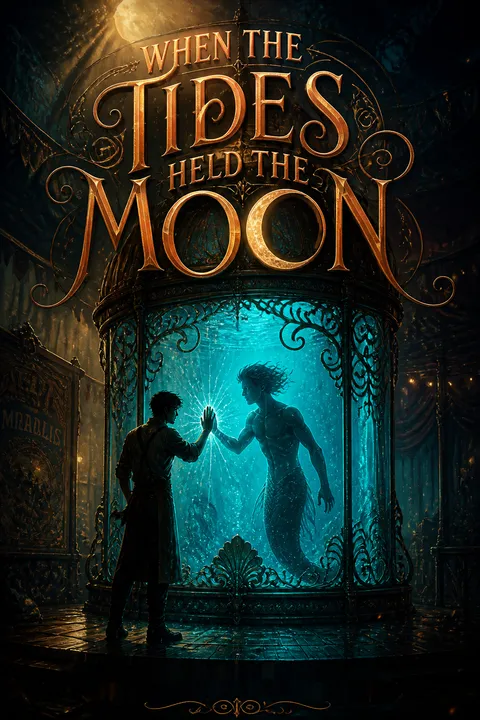


Plot Summary
Prologue
During the 1899 San Ciriaco hurricane, a child is swept through the flooded river at Humacao. He clings to exposed roots, unable to resist the current, until a wave drives him against a tree.
As he loses consciousness, a voice calls for someone to be saved, and a pewter-colored face appears above him. The child survives, but the storm takes his memories. Years later, that lost night will connect his life to a creature he has yet to meet.
The opening makes rescue both a physical event and a mystery. The child survives through an intervention he cannot remember, leaving his later life shaped by an absence he mistakes for ordinary bad luck. The hurricane also establishes water as more than scenery: it destroys homes and histories, but it can carry help across the same violence. The voice’s plea gains meaning only in retrospect, so the story begins with a debt whose debtor and beneficiary do not yet know one another.
A Cage for Coney Island
In 1911, twenty-two-year-old Benny Caldera is working a Brooklyn foundry, far from Puerto Rico and the freedom his late guardian, Titi Luz, hoped he would find in New York. He takes a rush commission for a glass-and-iron tank bound for a Coney Island sideshow, shaping its decoration with the Caribbean designs he misses.
When the owner, Sam Morgan, admires the finished work, foreman Paddy McCoy claims the credit and threatens Benny for correcting him. Distracted and angry, Benny burns his hand on a hot iron bar. Innis, a fellow smith, dresses the injury and tells him the job is over. As Benny is dismissed, he discovers a message hidden in a red-haired performer’s handkerchief, directing him to the ferry.
Benny’s first commission joins two kinds of labor: skilled craft and the work of making a self legible to people who dismiss him. His tank carries his own cultural imagination, yet the foreman can claim it because Benny has little institutional power. The burn makes that imbalance bodily, while the hidden note opens a route out of the foundry. Benny has learned to survive by being useful and quiet; the invitation asks him to risk usefulness for something he cannot yet name.
A Merman in the Net
At the ferry, Benny finds Morgan with the strongman Matthias, contortionist Sonia, and the others. Morgan hires him to help collect a supposed mermaid, paying him to seal the tank and keep silent. Near Lawrence Point, Sonia serves as bait while the crew waits under the full moon. A mermaid pulls her boat safely toward shore, but Morgan’s party attacks.
Benny struggles to help when a second creature drags Eli underwater. The captured mermaid grabs Benny’s burned hand, and a voice in his mind urges him to save her companion. Morgan shoots her; her body dissolves into foam. The crew carries a wounded merman into Benny’s tank. By morning, Benny discovers his burn has vanished, and understands that the mermaid healed him before dying.
The capture turns Benny’s craftsmanship into direct complicity: the tank he made to advance his career becomes a prison. The mermaid’s healing gift complicates his role further. He is not simply an innocent bystander, because he helped build the enclosure, but neither is he beyond obligation, because the dying creature chose to trust him. Morgan’s bullet converts a sideshow adventure into a moral crisis whose cost is visible in both the captive’s wounds and Benny’s restored hand.
The House Behind Luna
Benny returns to Red Hook and finds his landlady has changed the locks and left his belongings in the street. The healed hand and the merman’s frightened face keep him from going back to the foundry, so he spends his remaining money on a trip to Luna Park. There he finds Morgan’s decrepit Menagerie and sees the captive alive in the clear-water tank.
Morgan offers Benny steady pay, lodging at the Albemarle, and responsibility for renovating the show. Benny meets the performers who share the house: Lulu, her young son Timmy, the giant Igor, Madam Navya, Vera, and the Rhodes brothers, Eli and Emmett. Their teasing and uneasy hospitality give him a home, though Emmett mistrusts the newcomer.
Benny’s move to Coney Island begins in practical desperation, not a sudden belief in belonging. Yet the Menagerie offers a different arrangement from the foundry: people who are mocked in public have built private routines of care, work, and mutual dependence. Benny’s welcome is imperfect, especially with Emmett’s suspicion, but it gives him a place where his abilities can be useful without being erased as completely. The captive in the tank remains the unresolved cost of his new shelter.
A Name Through Glass
When Benny first tries to inspect the tank, the merman attacks him through the roof bars, accusing him of helping kill his mother. Benny escapes by striking the merman’s hand with the key ring, then returns that night with sardines and begins building a circulation pump. He admits his part in the capture and explains the mermaid’s dying plea.
The merman eventually eats, and Benny calls him Río, after the river that links their histories. Río accepts the name, then notices Benny’s asthma and teaches him a breathing exercise that eases his attacks. Benny sabotages Morgan’s whistle after hearing it torment Río, and uses his cuatro to earn forgiveness. Their exchange of food, music, and small kindnesses begins a wary friendship.
Trust develops through repeated acts that are modest but costly: Benny returns after being threatened, brings food suited to Río, and risks Morgan’s displeasure by altering the whistle. Río, in turn, offers a bodily skill that lets Benny breathe more freely. Their connection is not founded on innocence. It grows because both acknowledge harm and respond with care. The name Río gives their relationship a bridge between the captive’s lost home and Benny’s own history of survival in a river.
Two Lost Harmonies
As they grow closer, Río tells Benny that his people once lived in a larger harmony in the East River estuary. He and his mother stayed after the 1904 General Slocum disaster, when their elders fled rather than risk human violence by intervening. Río had been haunted by the passengers’ cries and believed he had failed them.
Benny answers with his own story: Titi Luz rescued him after the hurricane, then sent him north to find a future. He also admits that his childhood friend Ramón rejected him after Benny reached for his hand, leaving him afraid to name his attraction to men. Río rejects that shame and comforts him. Benny later learns Eli and Emmett are lovers, not twins, and still struggles to accept what their trust might mean for him.
Their confessions expose parallel injuries without making them identical. Río carries guilt for withholding rescue; Benny carries shame imposed by a society that punishes his desire and displacement. Both have mistaken survival for proof that they deserved what happened. Río’s response gives Benny a first experience of being recognized without correction, while the reveal about Eli and Emmett shows that acceptance is already present in the house. Benny’s difficulty is no longer finding evidence of safety, but believing it.
The Company Claims Him
Benny learns the Menagerie’s members use their acts to survive a world that offers them few safe alternatives. Igor mourns the wife he could not bring from Russia; Lulu struggles to replace the act she shared with the late Saul; and Vera explains how performing gave her an escape from an abusive marriage and a life that did not fit.
Eli describes how Emmett protected him from their violent father, helping Benny understand the source of Emmett’s distrust. Benny also freezes when Eli recognizes his guarded attraction to men, then regrets denying it.
Meanwhile, Morgan leaves for Manhattan with Sonia to court investors, putting Benny in charge of Río and the theater. The company’s belief in mutual loyalty begins to feel like a promise Benny might actually belong to.
The Menagerie’s family is not sentimental shorthand for acceptance. It is a practical structure built by people who know how easily institutions can turn difference into a reason for exclusion. Benny sees how each performer has converted a vulnerability into a chosen role, but he has not yet learned to grant himself the same agency. His denial to Eli shows that safety offered by others cannot instantly undo internalized fear. Morgan’s promotion makes Benny responsible for more, while the company’s everyday care gives him something to lose.
A Kiss and a Debt
At Luna Park’s annual Light the Night, Sonia takes Benny on the rides and tries to draw him into a future she imagines managing the Menagerie together. During a dance, she reveals that Morgan borrowed heavily from Frankie Agostinelli, a Coney Island gangster, and pressured her to placate him.
Frankie has sexually exploited her, leaving Sonia convinced that the show’s survival depends on keeping the debtors satisfied. When Sonia kisses Benny, he cannot return it and tries to explain that his heart is not drawn to women.
She misreads his silence as evidence of another woman and runs away. Benny goes straight to Río, who helps him steady his panic and recognizes that Sonia crossed a boundary. For the first time, Benny is able to speak honestly about what he wants.
Sonia’s predicament and Benny’s concealment are different forms of constrained choice. Morgan uses her public charm as leverage against a debt she did not create, while Benny’s fear of rejection has made him withhold a truth that might connect him to others. The kiss exposes the harm of treating someone’s desirability as permission. Río’s response matters because he does not turn Benny’s distress into a debate about intent. He helps him distinguish kindness from consent, a distinction the Menagerie’s loyalty will later need to honor.
Moonlight Underwater
When Benny breaks down over his guilt, grief, and fear of being alone, Río asks him into the tank and holds him while he finally cries for Titi Luz and the family the hurricane erased. Benny admits he dreams of being with Río; they kiss, and the merman begins teaching him to float and hold his breath.
Their intimacy deepens when Río shares his true name in the language of the sea and they join their breaths in a spiritual bond. Benny recognizes the face from the hurricane as Río’s mother, the one who saved him as a child. He has spent years believing he was merely rescued by chance. Now his love for Río, and the currents that brought them together, feel like parts of the same fate.
The water changes from a threat Benny avoids into a place where he can experience grief without being forced to suppress it. Río’s embrace does not erase Benny’s past; it lets him feel its weight and remain held. Their bond also shifts the story’s question from whether love can cross species to whether a person can accept a history larger than conscious memory. The mother’s intervention reframes Benny’s survival, while the exchange of true names makes intimacy an act of trust rather than possession.
The Whistle and the Shark
Morgan returns to the theater under pressure from Frankie Agostinelli, who demands a return on his investment and has his henchman beat the showman. Morgan lashes out at Río, blaming him for the danger and insisting the captive owes him obedience. He then tests a whistle on Río, hoping to provoke the fabled power of the merman’s voice.
Benny has already damaged the original whistle, but Morgan acquires another and uses it to force Río to swim. Sonia tells Morgan that Benny can make the merman respond, so Morgan makes Benny part of the coming attraction. He separates Benny from Río and treats the new performer as another tool. The Menagerie’s future is now tied to a public spectacle built on captivity.
Morgan’s ambition is not simply commercial greed. He wants the merman to prove that the world’s ridicule of his youthful obsession was wrong, but he pursues vindication by repeating the same violence that injured him. The whistle makes that contradiction audible: he wants wonder, yet tries to produce it through pain. By turning Benny into the presumed handler, Morgan also tries to convert a genuine relationship into an instrument of control. The gang’s debt makes this spectacle dangerous for the whole company, not only its captive.
The Cost of Waiting
Morgan’s preview plan promises a separate show for the performers and a headline attraction starring the Prince of Atlantis, with Sonia and Benny helping draw crowds. Benny cooperates because he thinks keeping the Menagerie afloat might protect his new family and let him stay near Río. But Río’s scales begin to shed, his water clouds, and the unnatural heat across New York worsens as his health fails.
When Río confronts Benny for delaying his release, Benny admits he is afraid to lose the company and the man he loves. Río reminds him that a larger prison remains a prison. Morgan’s whistle and forced rehearsals make the danger immediate. Benny leaves the theater understanding that another week of careful waiting may cost Río his life.
Benny’s hesitation is emotionally understandable and ethically consequential. He has spent his life adapting to whatever danger a paycheck or a safer room demands, so he mistakes compromise for control. Yet the security he hopes to preserve depends on Río’s continued confinement. Río’s declining body makes that contradiction impossible to romanticize. The scene also separates love from possession: Benny’s fear of losing Río has begun to resemble the logic Morgan uses to keep him. Choosing care now requires Benny to risk the very home that made him feel less alone.
A Mutiny in the Menagerie
Emmett, once Benny’s sharpest critic, helps him bring the company together at the theater. Benny admits he loves Río, explains his role in the capture, and tells them the merman is dying without the ocean. The performers see Río’s injury and recognize him as a person rather than Morgan’s attraction. Sonia finally reveals the full extent of Morgan’s arrangement with Frankie, including the danger he has placed her in.
The others comfort her instead of blaming her, and she joins the rescue. They decide to free Río on preview night, when crowds and Dreamland’s rival park can provide cover. Emmett proposes making Dreamland appear responsible for the disappearance, giving the company a chance to survive Morgan’s betrayal.
Benny’s confession changes the company’s position because it replaces suspicion with shared knowledge. He does not ask them to help while hiding the cost or his own complicity; he names both, then risks their judgment. Their response demonstrates that loyalty is not obedience to Morgan or preservation of the show at any price. It is a choice to protect one another, including a stranger harmed by their employer. Sonia’s disclosure also turns her from an apparent accomplice into a person who needs the same solidarity she has been trying to secure for everyone else.
The Prince Performs
The company prepares the theater and disguises Río’s tank with a large patchwork tarp made from costumes and Madam Navya’s saris. On preview day, Benny’s former foundry coworkers arrive among the packed audience, alongside Frankie and his brothers.
Morgan presents the performers first, then opens the curtain on Río, who is too weak to follow the planned routine. Benny stops Morgan from striking the tank and begins singing the song he and Río made together. Río rises, reaches toward Sonia, and draws a wave of astonished applause.
The act succeeds, but the crowd sees a wonder rather than a captive. Outside, Farty mocks Benny’s performance and presumed romance; Benny punches him, and his new family closes around him before the gangsters can leave.
The debut’s success is morally unstable: the audience’s awe brings money and time, but it also confirms that spectacle can make a person’s suffering easier to consume. Benny’s music briefly changes the performance from command to response. Río rises for the people he trusts, not because Morgan has mastered him. Benny’s punch at Farty marks a change in how he meets humiliation, while the company’s intervention shows that this new defiance is supported rather than solitary. The show buys time, but it cannot become a substitute for freedom.
A Voice at Salvatore's
After the show, Frankie’s men remain at the theater, and their presence threatens the escape plan. Benny uses his gift for imitation to make the gangsters believe Morgan is ill in his tent and that the money is waiting elsewhere. He sends them to Salvatore’s restaurant and persuades them to leave a gun behind for protection against supposed saboteurs.
Sonia helps sell the deception, then joins Benny, Matthias, Eli, Emmett, and Vera at Río’s tank. The group retrieves the tank’s wheels and begins preparing to move it. They discover the circulation pump and its hoses have been cut, apparently by Dreamland’s workers. With little time and no functioning pump, Benny decides they must drain the tank by hand and move Río in a water-filled basin.
Benny’s mimicry, once a skill for fitting in with people who mocked his accent, becomes a tool of collective resistance. He does not defeat the gangsters by force; he reads their expectations and gives them a story they are willing to believe. The tactic buys the company a narrow opening, but the cut equipment shows how quickly plans can be disrupted by the rivalry surrounding them. Benny’s choice to continue without the pump signals a decisive shift: practical obstacles no longer justify postponing Río’s release.
Dreamland Burns
As the company drains the tank and fits its wheels, the structure tilts under the shifting water and begins leaking. Benny and the others lift Río through the hatch, but the tank’s viewing pane cracks. They heat the glass with Vera’s torch, break it, and carry Río into a basin lined with water and wet fabric.
The group hides him under their disguise and rolls toward Dreamland, intending to leave the tank there and blame the rival park. Frankie’s men catch up and fire at them. A bullet strikes tar barrels, igniting a blaze that spreads through Dreamland. The company splits to escape; Benny carries Río through smoke and flames to the beach, where he returns the merman to the sea despite the pain of letting him go.
The rescue succeeds only after Benny’s most carefully made object fails. The tank’s strength had seemed protective, but its cracked seal and collapsing support reveal that engineering cannot make captivity benign. The company’s improvised labor replaces the illusion of safety with shared risk. Dreamland’s fire turns commercial rivalry into literal chaos, yet it also creates the cover needed to reach the water. Benny’s final act on the beach is not another attempt to keep Río near him. It is the first time he chooses Río’s freedom over his own fear of separation.
The Sea Takes Them
As Benny lies on the beach, Morgan arrives and shoots him while demanding to know where Río went. Sonia attacks Morgan and fires the gangster’s derringer, killing him before he can finish Benny. Río returns from the water, healed by the sea, and draws Morgan’s body away with a wave. He presses saltwater to Benny’s bullet wound, then carries him below the surface.
Benny can breathe underwater. As Río draws the poisoned blood from his wound, Benny’s buried memories surface: the face in the hurricane belonged to Río’s mother, and his survival was never an accident. The currents have called Benny home to the sea. He and Río are not merely lovers; they belong to one another’s harmony.
The climax resolves the story’s central confusion about rescue. Benny believed he was a human who owed his life to the sea and could only repay that debt by returning Río to it. The final revelation makes the relationship reciprocal: he was also being called toward a home he could not yet remember. Sonia’s action ends Morgan’s immediate power, but it is Río’s return and the water’s transformation of Benny that complete the escape. The resolution refuses a simple rescue fantasy; freedom means that both lovers can belong somewhere together.
Epilogue
Matthias’s later memoir records Dreamland’s fire and the rumors surrounding Morgan and the merman’s disappearance. The Menagerie survives, and Sonia eventually takes over, reopening it as Schneider’s Wonders of the World. The performers find new acts and futures: Vera expands her Phoenix persona, Lulu turns to dressmaking, Igor and Madam Navya marry, and Eli and Emmett reinvent their act.
A year after the escape, Matthias receives Benny’s message in a bottle. Benny reports that he and Río are alive, together, and no longer alone. He invites his friend to the Iron Pier on a full-moon night, where the two can be seen moving with the tide.
The memoir gives the company a future without pretending that its old arrangement was harmless. The performers keep their solidarity but reshape the show under Sonia’s leadership, taking more control of how they present themselves. Matthias’s account also preserves Benny as more than a runaway or romantic hero: he remembers a friend whose courage changed what the company believed possible. The message in the bottle completes the journey from displacement to chosen belonging. Benny does not return to the life he left; he finds a home that can hold both his love and his changing nature.
Analysis
The novel makes displacement more than a change of location. Benny leaves Puerto Rico after colonial upheaval, economic loss, and personal rejection, only to find New York sorting people through race, language, labor, and sexuality. His habit of adapting is a survival skill: he learns English, imitates voices, and makes himself indispensable. But the story asks what that adaptability costs when it becomes self-erasure. Benny’s asthma gives the conflict a bodily measure. He lives in air that damages him, then learns from Río to breathe by imagining it as water.
The Menagerie offers a countermodel to the institutions around it. Its performers are not free from exploitation, and Morgan’s business depends on displaying difference for money. Yet the company’s ethic of mutual responsibility becomes real through concrete acts: feeding one another, altering a house to fit a small resident, making costumes from cherished clothing, and risking work to free Río. Their solidarity is not innocence. It is a chosen practice that requires people to admit harm and revise their loyalties.
Río’s captivity also broadens the story beyond individual prejudice. His people flee poisoned waters and human violence, while his purification gift makes the ecological stakes intimate. The cloudy tank records his illness, and the heat that accompanies his decline connects the damage of one imprisoned being to a larger human environment. Morgan’s desire to prove that merfolk exist does not make him curious in any generous sense. He wants a captive whose existence can serve his reputation.
Romance becomes the opposite of that possession. Benny and Río learn to touch, speak, and share names without demanding that either become ordinary or surrender a self. The final transformation answers the novel’s recurring question of where Benny belongs: not by restoring the childhood he lost, but by revealing a kinship and a home he could not remember. Freedom is therefore both release from the cage and permission to inhabit a self that survival had taught him to conceal.
Review Summary
When the Tides Held the Moon is a beautifully written queer historical fantasy romance set in 1910s Coney Island. It follows Benigno, a Puerto Rican immigrant, who falls in love with Rio, a captured merman. Readers praise the lyrical prose, diverse characters, found family themes, and stunning illustrations. Many consider it a masterpiece, highlighting the author's talent in worldbuilding and character development. While some found the pacing slow at times, most were captivated by the emotional depth and representation. The book has received overwhelmingly positive reviews for its unique blend of romance, fantasy, and historical elements.
People Also Read








Characters
Benny Caldera
The homesick blacksmithA young Puerto Rican blacksmith in Brooklyn, Benny is skilled, observant, and practiced at making himself useful to people who rarely make room for him. He carries the effects of colonial displacement, racism, asthma, and a childhood loss he cannot remember. Titi Luz’s promise sends him north in search of a life, but his fear of rejection makes him hide his language, desires, and needs. His work on the tank brings him into contact with Río and forces him to confront the difference between helping someone survive and letting them be free. Music, craft, and a dry humor are the means by which he reaches others.
Río
The captive keeper of seasA merman from an endangered people, Río is a keen observer of human life and a devoted believer in the living currents that guide merfolk. He has a scholar’s curiosity, a royal bearing, and little patience for human cruelty or foolishness. The loss of his harmony and his mother leaves him grieving and distrustful, while captivity threatens the spiritual bond he has with the ocean. He values his own name as a final private possession and approaches human connection cautiously. Benny’s songs and care challenge Río’s inherited belief that humanity is uniformly dangerous.
Sam Morgan
The ambitious showmanMorgan runs Luna Park’s Menagerie and knows how to sell wonder to a crowd. He is polished, persuasive, and capable of recognizing talent, but his ambition repeatedly outruns his concern for other people. A childhood encounter with a mermaid left him desperate to prove himself right and restore his reputation. He views the Menagerie as a business to preserve and expand, while its performers understand it as a fragile community. Morgan’s ability to charm makes his capacity for coercion more dangerous.
Sonia Kutzler
The flexible showwomanA young contortionist with red hair, a quick wit, and a practiced stage persona, Sonia is one of the Menagerie’s most capable performers. She understands publicity and hopes to learn enough business to guide the show’s future. Her loyalty to the company can make her defend decisions that hurt her, especially when Morgan frames the show’s survival as everyone’s responsibility. Beneath her flirtatious confidence is a young woman who wants to be valued for more than her act and who is carrying pressures she does not know how to share.
Matthias Martin
The strongman with a penThe Menagerie’s powerful strongman is also a writer who studies the people and places around him. Matthias is humorous, perceptive, and willing to challenge Benny when affection clouds his judgment. His bluntness comes with real loyalty: he protects the company, recognizes Benny’s courage, and offers support without demanding that Benny become someone else. He understands that physical strength is only one kind of endurance.
Emmett Rhodes
The guarded protectorA performer who presents himself as one half of a pair of conjoined twins, Emmett is wary, sharp-tongued, and fiercely protective of Eli. His distrust grew from a violent childhood in which love put them both at risk. Though his suspicion makes him cruel to Benny, it does not make him incapable of revising his judgment. Emmett knows what it costs to choose someone over safety, and his experience gives him a practical understanding of desperate love.
Eli Rhodes
The patient companionEli performs alongside Emmett in their staged twins act and is his devoted partner. More open and sociable than Emmett, Eli helps Benny understand the company’s informal rules and sees through his attempts to hide his sexuality. His gentleness is not passivity: he has survived violence, helped build a life with Emmett, and knows the value of a community that does not ask them to deny their bond.
Louisa Porter
The steady house motherKnown in the show as Lulu, she owns the Albemarle and acts as a caretaker for her son Timmy and the Menagerie’s performers. She is warm, practical, and emotionally perceptive, often settling disputes while carrying grief of her own. As a costumer, she understands how public image can be stitched together, but she also knows the strain of being defined by a body others treat as entertainment.
Vera Campbell
The fire-breathing phoenixA fire-breather with a blunt manner and a guarded past, Vera chose performance after escaping a marriage marked by control and abuse. Her gender presentation shifts with her own sense of what fits, and she refuses to let the audience’s expectations define the whole of her. She teases freely but notices when someone needs encouragement. Her insistence that Benny choose what he wants helps him distinguish a life he has accepted from one he might claim.
Madam Navya Attwal
The small, sovereign seerA performer from Punjab, Madam Navya insists on being addressed by her chosen title and is quick to correct anyone who treats her stature as permission to patronize her. She is religious, intellectually curious, and attentive to moral consequences. Her warnings about the merman reflect a sincere fear that the company has committed a spiritual wrong, though she is also capable of turning conviction into practical help.
Igor Rybakov
The Russian giantIgor is a gentle giant whose imposing size contrasts with his tenderness and his grief for a wife lost after he emigrated. He wants to be seen as a husband and a person, not only as a spectacle. His steady generosity makes him a quiet source of security within the household, and his relationship with Navya grows from shared companionship and debate.
Titi Luz
Benny's stubborn guardianThe Puerto Rican woman who rescued and raised Benny, Titi Luz was a tobacco farmer and a supporter of independence for her island. She is generous, politically minded, and forceful in her love, urging Benny to seek a future beyond the place that has exhausted her. Her proverbs and teachings remain part of his inner life, even when he doubts the beliefs behind them.
Timmy Porter
The curious house childLulu’s energetic young son, Timmy is forever investigating books, souvenirs, and anything within reach. His curiosity often causes small disasters, but it also lets him approach the unfamiliar without the suspicion adults bring to it.
Frankie Agostinelli
The Coney Island creditorA gangster who lends money to Morgan and expects both repayment and influence in return. Frankie is calculating and casually threatening, treating people as assets in a business arrangement. His power over the local underworld makes Morgan’s financial desperation dangerous for the entire Menagerie.
Río's mother
The mermaid who intervenesA mermaid from the Caribbean who believes humans can be worth saving, Río’s mother teaches him to trust the currents and to see more than cruelty in the human world. Her compassion puts her at odds with the caution of her people and shapes the choices Río makes.
Ramón
Benny's first heartbreakBenny’s childhood friend in Puerto Rico, Ramón is remembered as handsome, cheerful, and fearless. Benny’s unspoken affection makes their friendship precious to him, while Ramón’s rejection teaches Benny to fear the consequences of being known.
Paddy McCoy
The credit-stealing foremanThe foundry foreman who recognizes Benny’s skill but treats his labor as something the department can claim. McCoy’s praise comes with conditions, and his authority exposes how easily a worker’s accomplishment can be taken from him.
Farty Walsh
The factory bullyBenny’s former coworker, Farty uses mockery to reinforce the foundry’s racial and workplace hierarchy. He regards Benny’s asthma and difference as easy targets, and later tries to humiliate him in front of a crowd.
Dan
The foundry's second hecklerA coworker who joins Farty in ridiculing Benny at the foundry and later at Luna Park. Dan tends to follow the mood of the group rather than challenge its cruelty.
Oscar Barnes
Luna Park's gatekeeperThe underpaid gatekeeper at Luna Park, Oscar helps Benny enter the park and find Morgan’s Menagerie. He is friendly and talkative, but remains outside the secrets Morgan keeps from the staff.
Officer Joey
The night patrolmanA Brooklyn policeman who catches Benny outside Luna Park after hours. His authority makes Benny vulnerable, until Matthias intervenes and explains Benny’s presence.
Jack Morgan
The former show proprietorThe previous owner of the traveling Menagerie and Sam Morgan’s mentor. Jack brought Sam into the sideshow world and left him the operation, establishing the legacy Sam later tries to surpass.
Plot Devices
The iron-and-glass tank
A prison built by its rescuerBenny’s precision-made enclosure begins as a commission meant to display an aquatic curiosity. Its glass, iron frame, hatch, pump, and wheels shape nearly every practical problem in the story. The tank protects Río from immediate exposure to land, but it also cuts him off from the ocean and the currents that sustain him. Benny’s skill makes the prison hard to break, forcing him to confront how useful craft can serve harm as readily as care. Its collapse finally turns the object into a route out.
The living currents
A call beneath conscious memoryRío understands the currents as the shared wisdom of water, a force that guides merfolk toward living beings in need. Benny initially knows them only through the storm that erased his childhood and the guardian who sent him north. The currents connect rescue, ecological interdependence, and intuition, while also raising the possibility that fate can be felt without being understood. The novel uses this belief to link Benny’s survival to Río’s family and, ultimately, to Benny’s own place in the sea.
Song and true names
Trust carried through musicBenny’s cuatro and his songs give him a way to reach Río that does not depend on command. Music becomes their shared language, especially when Benny uses it to comfort Río or communicate during a public performance. Merfolk also experience language as music, and sharing a true name carries the weight of giving another person a private part of the self. The songs therefore move the relationship from cautious companionship toward spiritual intimacy, while their lyrics preserve the idea of a future beyond the tank.
San Cristóbal's medallion
A keepsake for the journeyTiti Luz gives Benny the pewter image of the travelers’ saint before he leaves Puerto Rico. Benny fingers it when fear, asthma, or shame threatens to overtake him, making it a portable connection to his guardian and the promise he made her. It also becomes part of the couple’s shared vocabulary of travel: leaving is not simply abandonment, and home can be something reached rather than inherited. When Benny entrusts the medallion to Río, the object carries his hope beyond the shore.
The Menagerie stage
A refuge shaped by spectacleThe sideshow gives the performers work, public visibility, and a community in a society that might otherwise confine or exploit them. Its acts also require them to turn private realities into paid entertainment, leaving them vulnerable to owners who confuse their livelihoods with ownership. Morgan’s posters and invented stories blur truth and performance, particularly when he markets Río as a prince. The stage therefore embodies both refuge and danger: it can offer belonging, but only if its members retain some say over how they are seen.
Download PDF
Download EPUB
.epub digital book format is ideal for reading ebooks on phones, tablets, and e-readers.








