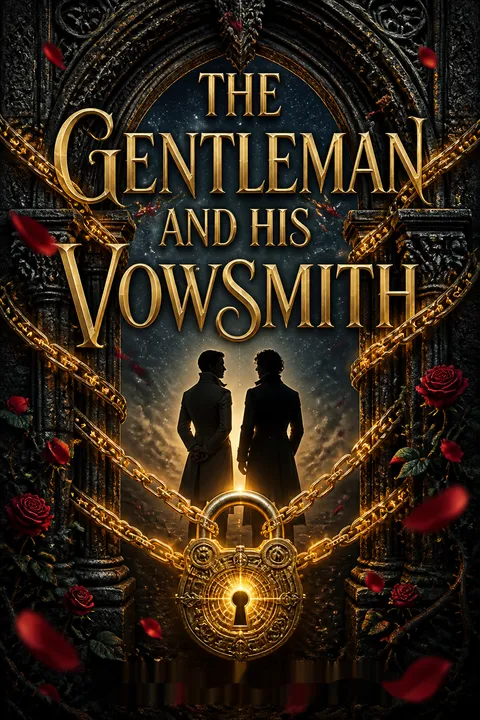


Plot Summary
An Heir Is Bargained
Nicholas Monterris, heir to the Duke of Vale, has learned that his father regards love as weakness and family members as assets. His private refuge is drink, casual lovers, conjuring, and the small mechanical creatures he builds despite his father’s contempt. Then the duke announces that Nicholas will marry Lady Leaf Serral, a match arranged to secure the Serrals’ money and magical standing.
The news is bad enough until he learns that Dashiell sa Vare, the vowsmith who once taught and loved him, will negotiate the contract. Dashiell vanished from Nicholas’s life nine years earlier. The duke gives Nicholas three weeks to prepare for the lock-in, a sealed gathering where families must negotiate and magically bind the marriage terms.
The First Body
The Serrals arrive at Monterris Court, where Lady Leaf greets Nicholas with jokes about the rumours that he has a tail. Their easy, irreverent first meeting unsettles his expectation of a dutiful bride. During the formal binding, Nicholas and Leaf pledge themselves to the negotiations, while Dashiell’s familiar magic makes their old intimacy difficult to ignore.
That night, Nicholas’s valet, Rowerre, returns to him badly injured and dies on the stairs, still clutching a torn page. The duke dismisses Nicholas’s grief as unbecoming, but Leaf questions whether the fall was an accident. The locked house has barely begun its negotiations, yet Nicholas has lost the person who most reliably protected him from its coldness.
The Automaton Knows
Leaf joins Nicholas in searching the abandoned style wing for clues to Rowerre’s death. There, among broken mechanical figures, they find a complete automaton wearing the green and gold waistcoat Nicholas’s father had ordered and someone had mysteriously cut apart.
It advances through the darkness, speaks Nicholas’s name, and drives them onto a balcony to escape. The machine’s appearance confirms that something in the house is moving beyond the guests’ sight.
Nicholas admits that an automaton once killed his uncle, Lord Francis, though his family has hidden the circumstances. Leaf does not retreat from the danger. Instead, she turns their shared fear into a reason to investigate together, making an imposed marriage feel, for the first time, like a possible partnership.
A Kiss, Then Gillingham
After the automaton disappears, Nicholas searches family records and asks his mother about it, but Georgiana drifts between memories and warnings about the house. At dinner, guests trade ghost stories, including one about a faceless figure roaming the Court.
Nicholas later sees a pale face in the dark and runs into Dashiell, whose concern draws them into a furious kiss that Dashiell abruptly ends. The next evening, Nicholas defies his father by singing and conjuring for the company, briefly showing the artistry he has been forced to hide.
The celebration breaks when Rufus Gillingham, an attending vowsmith employed by Lord Ricard, is found hanging from the negotiation chamber chandelier. The guests call it suicide, but the spectacle deepens Nicholas’s suspicion.
Darkness in the Passage
Lady Leaf persuades Dr. Fanshaw to examine Gillingham more carefully. Bruising and the condition of his neck lead the doctor to conclude that Gillingham was likely unconscious or dead before he was hanged. Nicholas and Leaf inspect the chamber’s pulley system, then search the service passages for signs of how the body was moved.
A featureless face appears in the darkness, and a mass of cold shadow swallows Nicholas until Leaf pulls him free. Beside the passage wall, they find silver sigil tape, the magical instructions that guide automata. Nicholas takes it for study. The evidence suggests that the apparent hauntings, the dead vowsmith, and the strange machinery may be connected, but neither investigator can yet tell how.
Two Families, One Old Wound
While investigating the deaths, Nicholas overhears Lord Ricard demanding that his brother, Lord Charborough, invoke the Requisite Care Clause and bring royal officials to the house. Leaf learns from Nicholas that their fathers once had a marriage contract of their own, and a search of Ricard’s papers uncovers its draft.
Lady Theresa confirms that the match collapsed over which man would surrender his title. Millie Radlay, Ricard’s daughter from his first marriage, adds the painful truth: Ricard still loves her mother, Caroline, but a carefully written contract trapped him in a second marriage after Caroline’s family fell into disgrace.
Ricard blames the Duke of Vale for refusing to alter the vow. The old grievance gives his hostility a history, though it does not yet prove he killed anyone.
An Arrow in the Rain
Nicholas and Leaf keep investigating while Dashiell’s affection and his habit of withdrawing leave Nicholas hopeful and wounded in turns. At an archery outing, a sudden storm sends the party rushing for shelter.
Nicholas and Dashiell return to save the Court’s hunting echoes, carrying their cage together to the pavilion. There they find Master Everel, the duke’s indentured vowsmith and secretary, lying in the wet grass with an arrow in his back. Lady Theresa points suspicion toward Georgiana, who is an accomplished archer and has shown disturbing flashes of anger.
Lord Charborough rejects the accusation, while Leaf refuses to accept that three deaths during a marriage lock-in can all be chance. Everel’s death removes the duke’s chief negotiator and makes the hidden danger harder to dismiss.
Tea Turns Deadly
That evening, Millie collapses after drinking tea in the drawing room. Dr. Fanshaw cannot revive her, and the company realises that several people, including Leaf’s father, have tasted from the tray. Lord Ricard clutches his daughter as grief gives way to fury, then demands that Charborough invoke the Requisite Care Clause and end the lock-in.
Charborough finally agrees, so royal officials will come to investigate even as the vowsmiths race to finish the contract first. With three deaths now inside the negotiation party, no one can credibly call the gathering safe. Nicholas also sees how differently the company responds to Millie’s death than it did to Rowerre’s, exposing the rank and family loyalties that decide whose grief counts.
A House Full of Secrets
After Millie dies, guests find their rooms ransacked and Lady Lisbeth tries to force open the magically sealed doors, terrified that she will be the next victim. Nicholas searches the archives with Dashiell and learns that the Monterris fortune has been consumed by debts and land sales. He also discovers Georgiana’s old diaries, which reveal a past romance with Lord Francis and a life she has mentally revisited for decades.
In a separate crisis, Georgiana releases the household echoes and nearly falls from a landing before Nicholas pulls her back. Her maid, Silla, explains that the duchess’s lucid spells can be dark and dangerous. The family’s money, marriages, and memories all prove less secure than Nicholas had been taught.
A Threat Beneath the Door
Nicholas discovers a magically hidden box in Lord Francis’s abandoned rooms and begins deciphering its seals with Dashiell. Before they can open it, someone stabs Nicholas and strangles him with a heavy curtain. He survives only by conjuring a piercing sound that draws Dashiell to the scene. As Nicholas recovers, a note arrives on the paper flower Dashiell had kept, warning that Dashiell will be next unless their intimacy ends.
Nicholas hides the threat, fearing Dashiell will sacrifice his career or ruin Leaf’s future to protect him. He therefore rejects Dashiell cruelly, saying their bond was only physical. Dashiell leaves believing Nicholas no longer wants him, while Nicholas accepts the heartbreak as the price of keeping him alive.
The Ghost Has a Name
At chess, Lord Ricard admits that he fought Rowerre over the stolen ledger page, though he denies pushing the valet down the stairs. He also reveals that he nearly killed Nicholas, confirming that the attack was deliberate. Dashiell finishes opening the hidden box, which contains the missing account page recording a payment to Lord Francis.
Nicholas and Leaf follow the clues to the grotto, where the faceless ghost removes his mask and reveals himself as the supposedly dead Lord Francis. He explains that Ricard paid him to frighten the Serrals away, while the Duke of Vale had used him to disguise the Court’s decay. Francis is Nicholas’s biological father, a revelation that turns Nicholas’s family history into a personal betrayal.
The Heir Chooses Death
Nicholas asks Dr. Fanshaw to write a death certificate so the law will erase Lord Nicholas Monterris from the family contracts and release him from his father’s control. Leaf supports the plan, and the doctor agrees if Dashiell will authenticate it. Nicholas tells Silla to take Georgiana away before dawn, giving her the money he earned by selling automata.
Dashiell initially urges Nicholas to run with him, but Nicholas refuses to abandon Leaf or his mother. To protect Dashiell from the threat, he tells him their love is over. Later, he reveals the note and the certificate, apologises, and proposes a shared future under a new name. Dashiell accepts, agreeing to sign the document once Georgiana is safely on her way.
The Court Was Painted
Before they can escape, Nicholas and Dashiell follow the sigil tape through the Court and discover that it has been creating magical images of polished rooms and prosperous grandeur.
Nicholas had mistaken the staged fire damage and locked parlours for ordinary mishaps; in truth, the duke was hiding the house’s real decay from the Serrals. Nicholas tears the tape apart and confronts his father with the poverty and debts he concealed. Rather than release him, the duke orders the marriage contract signed that night.
Nicholas takes his place at the table, knowing the false death certificate can still void the vow afterward. Lord Francis rushes in to warn them as the chandelier chain begins to give way, but the great fixture crashes down on Nicholas before he can escape.
The Net Breaks
Nicholas wakes battered but alive and accuses his father of arranging the deaths to stop the audit that would expose the family’s failure to meet the duke’s legal financial threshold. The duke holds Dashiell at gunpoint and orders the audit clause removed before the contract is signed.
Lord Francis’s testimony and the duke’s admission reveal a web of culpability: Georgiana shot Everel in a disturbed state, the duke’s attempt to poison a rival killed Millie instead, and Ricard both caused Rowerre’s fatal fall and tried to strangle Nicholas.
The duke’s desperation culminated in the chandelier attack. Nicholas signs the marriage contract to spare Dashiell, then has Dashiell authenticate his prepared death certificate. The contract’s magic dissolves, and Nicholas escapes the name that had bound him.
A Name Chosen Freely
With Nicholas legally dead, Leaf presents her long-prepared sasinage papers and forces her father to sign, winning the right to build a life outside the marriage arranged for her. Lord Ricard calls for a magistrate, while Lord Charborough stays behind with the broken Duke of Vale to face the consequences.
Nicholas leaves with Dashiell, who supports him up the stairs as his injuries begin to hurt. Silla and Georgiana have already been prepared to flee, and loyal valet Ambrose offers to join Nicholas’s new household. The family’s ancient home remains full of ruin and unfinished reckoning, but its heirs no longer have to preserve its name at the cost of their lives.
Epilogue
In London, Nicholas wakes beside his husband, Dashiell, in the ordinary warmth they once believed impossible. Georgiana now lives with Silla, and Leaf is preparing to open her school for young Brilliant women. Nicholas has taken the name sa Vare and builds automata, while Dashiell continues his vowsmithing.
When Dashiell worries that Nicholas may regret surrendering his title, Nicholas makes clear that he has no longing for the rank that once confined him. Dashiell leaves for work, promising to return later. This time, separation is only a pause in a life they chose together.
The epilogue makes freedom tangible through routines rather than grand declarations. Nicholas’s new name does not erase the losses that preceded it, but it gives him a life in which work, marriage, and family are chosen rather than imposed. Georgiana’s cautious recovery and Leaf’s school extend that freedom beyond the central romance, toward forms of care and education previously denied to women. Dashiell’s departure for work now carries no threat of permanent abandonment. The story’s final emotional change is not that danger has vanished, but that absence no longer governs the couple’s future.
Analysis
The novel makes marriage law a technology of ownership. In this world, magic does not primarily grant freedom or spectacle; it formalises who may command whom, whose talents count as family property, and which financial thresholds preserve a title. Nicholas’s father repeatedly calls this arrangement duty, but the Court’s decaying rooms expose the human cost beneath that respectable word. Its apparent grandeur is literally an illusion laid over rot, just as the family’s noble reputation conceals debt, coercion, and old injuries.
The mystery turns on competing explanations for violence. Ghost stories and the automaton offer a supernatural account, while the sealed lock-in encourages suspicion among living guests. The eventual human causes do not make the magic irrelevant. The automaton and shadow effects become instruments for hiding, frightening, and misdirecting, while the contract system gives each character a motive to manipulate what others can know. The book refuses a clean division between magical horror and domestic harm: both flourish where authority is unanswerable.
Nicholas’s development is measured by what he chooses to protect. At first he uses wit and drink to survive a life he assumes cannot change. His friendship with Leaf lets him investigate without surrendering tenderness, and his renewed love with Dashiell forces him to confront the difference between intimacy and possession. Their romance becomes possible only when Nicholas stops treating inherited status as the sole reality and uses legal form against its intended purpose. Leaf’s independent ambitions and Georgiana’s need for care broaden the story’s idea of freedom beyond the couple.
The ending does not suggest that love alone repairs the damage. Deaths remain, the family must answer for its crimes, and Georgiana’s recovery is gradual. Instead, the resolution rejects the claim that sacrifice is automatically virtuous. A family name is not worth preserving if its preservation requires people to disappear inside it. The novel’s hopeful counterpoint is chosen responsibility: affection expressed through protection, honesty, work, and the freedom to leave.
People Also Read



Characters
Nicholas Monterris
The defiant ducal heirNicholas is the witty, high-affinity heir to a powerful name he experiences chiefly as a cage. His father prizes duty and lineage, while Nicholas finds meaning in conjuring, song, travel books, lovers, and the automata he makes with his own hands. He uses humour and drink to blunt the loneliness of a childhood in which affection was rationed and autonomy nearly absent. Beneath his apparent frivolity is an unusually perceptive mind, especially attuned to magic and to the ways contracts shape people’s lives. His relationships with Leaf and Dashiell expose different forms of intimacy: candid friendship and enduring romantic attachment. Nicholas’s central struggle is not simply to escape his family, but to decide what obligations are worth keeping.
Dashiell sa Vare
The vowsmith Nicholas lovesDashiell is a celebrated young vowsmith, trained in magical law and accustomed to making precise, professional decisions. As a boy, he was Nicholas’s closest companion and first love; as an adult, he returns with a career built on travel and disciplined craft. His polish conceals a deep fear that class and rank make him unworthy of the man he loves. Dashiell’s instinct is to retreat before he can be rejected, a self-protective habit that repeatedly injures them both. He is nevertheless attentive to Nicholas’s needs, remembers the details that others overlook, and takes serious risks when someone he loves is in danger. His conflict is between the safety of emotional distance and the courage required to choose a shared life.
Lady Leaf Serral
The sharp-eyed intended brideLeaf is Lord Charborough’s eldest daughter and Nicholas’s intended bride. Quick-witted, irreverent, and impatient with social expectations, she approaches a frightening marriage negotiation with the curiosity of a mystery reader. Her interest in clues is not a game to her: she notices evidence others dismiss and insists that deaths deserve investigation. Leaf wants self-determination, including the freedom to develop her magical abilities and educate other young women. Her relationship with Nicholas grows from comic sparring into a close friendship built on honesty, mutual protection, and respect for each other’s boundaries. She is skeptical of romance as a universal destiny, but deeply loyal to the people she chooses.
Valentine Monterris
The iron-willed dukeThe Duke of Vale is Nicholas’s father and head of House Monterris. He treats family duty as a sacred contract, insisting that preserving the title must outweigh personal happiness. His formal authority, financial secrecy, and emotional restraint shape the atmosphere of the Court. He is capable of tenderness, particularly toward Georgiana, but rarely allows compassion to interrupt his calculations. The duke’s history with Lord Charborough and Lord Ricard gives his rigid commitment to the family name a personal cost as well as a political one. He understands the pressure of inherited obligations, yet his insistence on carrying them forward leaves little room for the people he claims to protect.
Georgiana Monterris
The withdrawn duchessGeorgiana is Nicholas’s mother, a once-social young woman whose marriage draws her into an isolated and emotionally barren household. She now moves between periods of warmth, distraction, and intense lucidity, with Silla providing the care and steadiness the family rarely offers. Georgiana loves Nicholas and takes pleasure in his mechanical creations, even when she cannot remain fully present with him. Her fragile inner life is shaped by years of grief, confinement, and memories she cannot release. She is neither reducible to her illness nor simply a symbol of victimhood: her moments of anger reveal a person still struggling to name what was taken from her.
Lord Francis Monterris
The absent younger brotherLord Francis is the duke’s younger brother, a charming and restless figure whose long absence has left his family with unanswered questions. He is associated with the Court’s old mechanical marvels and with the family’s history of debt. His ease in social situations contrasts with the consequences of his choices, and his absence shapes Nicholas’s understanding of what it means to leave a family behind.
Charles Serral
The bookish marquessLord Charborough is Leaf’s father and the head of House Serral. A scholar of classical texts, he prefers geniality and financial gestures to difficult emotional conversations. His affection for Leaf is genuine, but he often tries to manage her choices rather than hear them. His old connection to the Duke of Vale complicates his role as both a negotiating principal and a father arranging his daughter’s future.
Lord Ricard Serral
The wounded family strategistRicard is Charles’s younger brother, a shrewd businessman and father to Millie. He carries old grievances with the Duke of Vale and often uses leverage where open vulnerability might expose him. His fierce loyalty to Millie sits alongside a talent for manipulation and an abiding resentment over the choices that shaped his family. His second wife, Theresa, and his niece Leaf both know the sharp edge of his temper.
Lady Millie Radlay
Leaf’s widowed cousinMillie is Ricard’s daughter from his first marriage and Leaf’s older cousin. Widowed young, she is perceptive, direct, and more comfortable challenging family hypocrisy than smoothing it over. Her relationship with her stepmother, Theresa, is openly strained, while her closeness with Leaf offers the younger woman a model of female solidarity. Millie’s history makes her alert to the way a woman’s reputation can be shaped by family contracts and other people’s decisions.
Lady Theresa Serral
The sharp-tongued stepmotherTheresa is Ricard’s second wife and Millie’s stepmother. She is socially polished, attentive to reputation, and quick to speak when she believes a family secret might become public. Her relationship with Millie is hostile, and she often mistakes cruelty for candour. Though she can be self-interested, her anxieties about the lock-in are real, revealing how easily social confidence collapses when the rules no longer guarantee safety.
Lady Lisbeth Pomerin
Leaf’s anxious companionLisbeth is Leaf’s friend and companion, gentle in manner and eager for romance. Her growing admiration for Dashiell gives her a light social subplot, while the danger at Monterris Court exposes her fear and vulnerability. She is loyal to Leaf and Millie, and her attempts to find safety make the lock-in’s magical restrictions painfully personal.
Rowerre
Nicholas’s steadfast valetRowerre has served Nicholas since childhood and is the closest thing he has to a dependable parent. Skilled, discreet, and protective, he helps Nicholas preserve small freedoms within the duke’s strict household. His care is practical rather than sentimental: he guards Nicholas’s possessions, manages his clothes, and quietly supports his creative work.
Dr. Edwin Fanshaw
The observant physicianDr. Fanshaw is the physician attending the lock-in and the Serral family. His medical caution initially keeps him at the edge of the investigation, but he takes the evidence seriously when Leaf presses him to examine the bodies. He is thoughtful, professionally conscientious, and more willing than many peers to question the social order that governs magical families. His quiet affection for Leaf is unreturned, but it does not diminish his respect for her.
Master Everel
The duke’s bound vowsmithEverel is the duke’s cousin, secretary, and long-serving vowsmith. His expertise is considerable, but his indentured status limits his professional freedom and keeps him in the duke’s household. Stern and exacting, he represents the system Nicholas resents: a skilled person whose work and rank remain controlled by family ownership.
Silla
The duchess’s loyal maidSilla is Georgiana’s maid and the person most familiar with the duchess’s changing moods. She guards Georgiana’s privacy, speaks plainly when others would rather look away, and offers Nicholas a clearer account of his mother’s suffering. Her loyalty is not passive: she acts to protect Georgiana while urging Nicholas to understand what care can and cannot accomplish.
Ambrose
The new discreet valetAmbrose is a footman learning to serve as Nicholas’s valet after Rowerre’s absence. He is conscientious and initially uncertain, but he proves observant, discreet, and willing to help Nicholas when the household’s danger deepens.
Avery
Nicholas’s watchful echoAvery is Nicholas’s long-tailed magical echo, a birdlike companion who mimics his words and remains near him in his rooms. Her cage and familiar calls offer Nicholas a small, living presence in a house where human affection is scarce.
Rufus Gillingham
Ricard’s ambitious vowsmithGillingham is an attending vowsmith in Ricard’s employ. Charming and flirtatious, he is also known to have crossed professional boundaries and gathered information for his patron. His confidence makes him difficult to read, even before the lock-in turns suspicious.
Plot Devices
The marriage lock-in
A contract-bound pressure chamberA lock-in brings both families and their negotiators to Monterris Court for the duration of a marriage contract. Magical barriers prevent Brilliants from leaving, while the parties bargain over money, status, magical obligations, and heirs. Because breaking the gathering can void the agreement and trigger penalties, the custom gives family heads leverage over their own relatives. It also traps Nicholas, Leaf, Dashiell, and the guests together as deaths accumulate. The device converts a private decision about marriage into a public contest over property and power.
Vow law and the net
Magic that makes status bindingVowsmiths connect marriage agreements to family registers, royal charters, financial thresholds, and other contracts through precise sigils. A signed document can determine who owns property, who inherits a title, and who is permitted to use the Brilliance. The interlocking legal structure is described as a net: altering one clause can affect many others. It makes vowsmiths powerful, but also turns family members into assets governed by the head of their house. The story’s central escape depends on using the same system that has constrained Nicholas to erase his legal identity.
Automata and sigil tape
Mechanical bodies with magical instructionsClockwork gives the Court’s automata physical motion, while inscribed sigil tape tells them how to move, speak, and perform. Nicholas builds small harmless devices, but the old grotto contains machines capable of more disturbing effects. A complete automaton wearing his father’s discarded waistcoat speaks Nicholas’s name and spreads unnatural darkness. A separate length of tape is later shown to create convincing illusions over the decaying rooms. The device links Nicholas’s creative talent to both the house’s apparent hauntings and its carefully maintained facade.
The hidden ledger page
A small record with lethal leverageA torn page from a Serral ledger appears in Rowerre’s hand when he dies. It records a large payment connected to Lord Francis, and the family’s struggle to recover or conceal it drives several lines of the mystery. A magically concealed trick box protects the page from casual discovery. Once Nicholas and Dashiell open it, the account links the supposed ghost to Ricard’s scheme and gives Nicholas a route into the Court’s hidden history. The page matters not because it proves every crime, but because multiple people can use it to threaten or expose one another.
The false death certificate
A legal death becomes an escapeBecause family contracts recognise legal records rather than private identity, Dr. Fanshaw’s certificate can erase Nicholas Monterris from the vows and obligations attached to his title. Dashiell’s vowsmithing is needed to make the document binding. Nicholas’s plan uses the law’s own formal machinery to escape his father’s ownership, cancel the arranged marriage, and choose a life with Dashiell. It also gives Georgiana and Silla time to flee before the duke can stop them. The scheme is risky because its success depends on timing, secrecy, and Dashiell’s willingness to authenticate a living man’s death.
Download PDF
Download EPUB
.epub digital book format is ideal for reading ebooks on phones, tablets, and e-readers.








