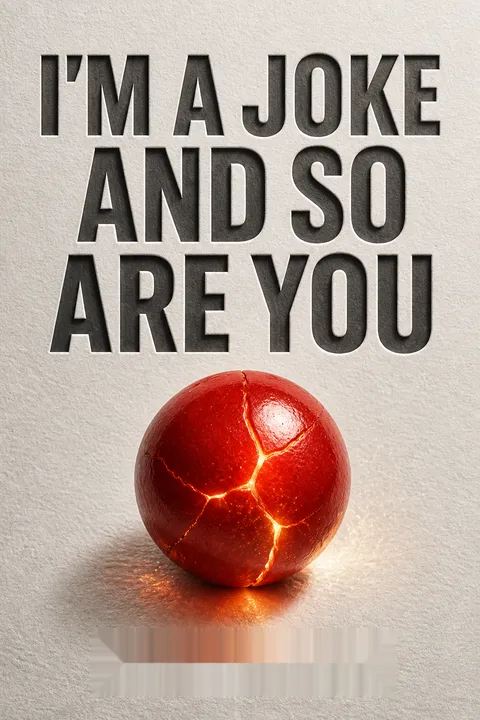


Key Takeaways
Treat your oddness as shared human material, not proof you are broken.
Comedy makes room for the ridiculous. Robin Ince begins with a simple reversal: comedians are not a separate species of damaged geniuses. They are people who make their private contradictions public, giving an audience permission to recognize its own. His love of Laurel and Hardy rests on this: watching them struggle with an ordinary task makes human failure look less shameful and more companionable.
The joke connects, not cures. Ince argues that comedians give voice to feelings many people keep private, from fury and embarrassment to absurd thoughts. Their advantage is often not unusual suffering, but a willingness to expose it. That exposure can help an audience feel less alone, whether the subject is social awkwardness or the fear of being ridiculous. Comedy's value, then, is not proof that pain makes people funny. It is the shared recognition that nobody is entirely composed.
What's striking is the shift from comedy as a symptom to comedy as a social act. A joke can turn private shame into a brief, shared recognition, much like a ritual that lets a group acknowledge what polite conversation avoids. That does not mean every laugh signals safety or agreement. Audiences can laugh from discomfort, conformity, or cruelty. Ince's strongest claim is narrower and more useful: humor can make vulnerability visible without making it uniquely shameful. Its success depends on the relationship between performer and audience, not simply on the comedian's willingness to disclose.
Don't explain your whole self with one wound, one gene, or one childhood.
Origins are not destiny. Ince examines familiar stories about comedians: the bereaved child, the bullied outsider, the youngest sibling, or the person born with an unusual brain. Some performers connect their work to early loss; others describe warm, encouraging childhoods. Ince's own origin story is a car crash he experienced as a toddler, when his mother was badly injured. He remembers blaming himself, but cannot know precisely how the event shaped his adult life.
Development is a tangle. Researchers he interviews describe genes as influences on probabilities, not fixed instructions. Temperament, relationships, culture, and later events interact. Even another person's biology can shape one's experience through a shared life. Ince resists using trauma as either a complete explanation or an excuse: a childhood event can matter deeply without being the single cause of who someone becomes.
This account resists a seductive habit of biography: turning a complicated life into a neat origin story. Such stories offer emotional clarity, but they can confuse sequence with cause. Ince's remembered crash is meaningful to him, yet memory changes with retelling and cannot establish what an alternative life would have been. The useful middle ground is neither denying trauma nor treating it as destiny. Developmental science increasingly describes traits as emerging from interactions among biology and environment, while also warning that broad patterns cannot predict an individual's path with certainty.
Practice builds comic fluency; no scan reveals a born comedian.
The brain adapts to use. In a University College London experiment, comedians and non-comedians improvised short talks inside a brain scanner. The comedians could keep speaking about ordinary subjects long after control participants ran out of things to say. Their brains did not show a special comic structure. Instead, the comedians devoted less activity to the mechanics of speech and more to planning what to say next, consistent with practiced verbal fluency.
A label is not a diagnosis. Another study found that a sample of more than 500 comedians scored higher than comparison groups on measures associated with psychotic traits. That does not mean comedians had psychotic disorders. Ince questions the popular myth that mental illness is required for comedy, noting that performers vary widely and that creative work can train certain habits. His evidence points toward practice and individual difference, not a single comedian's brain or personality type.
The distinction between capacity and specialization matters well beyond comedy. Repeated performance can make a complex task feel automatic, freeing attention for higher-level choices. The scan suggests that comic fluency is partly an acquired allocation of mental effort, not a hidden anatomical gift. Still, the experiment measures brief improvisation in a laboratory, not the full craft of timing, audience trust, or writing. Likewise, personality questionnaires can detect patterns without diagnosing illness. The findings challenge romantic myths, but they do not reduce comedy to brain efficiency.
Protect boredom and play; ideas need room to make strange connections.
Imagination needs unfilled time. Ince describes creativity as work that can look like doing nothing: staring out of a window, gathering scraps of thought, and revising a promising idea until it works. Alan Moore calls the imagined landscape where ideas meet and grow Ideaspace. It is a metaphor, not a proven mental location, but it encourages the creator to explore rather than wait passively for inspiration.
Boredom can prompt invention. In a study described by Ince, participants who copied phone numbers from a directory later found more possible uses for ordinary cups than a comparison group. The tedious task may have encouraged daydreaming. Yet creativity also requires selection and revision: comedian Jerry Seinfeld spent close to a year shaping a new hour of material. Play supplies possibilities; sustained effort decides which ones deserve an audience.
The useful point is not that boredom guarantees brilliance, but that unstructured attention can let remote associations surface. Modern life makes it easy to fill every pause, which may reduce opportunities for mind-wandering. But the evidence described here is modest: one laboratory task cannot establish that boredom reliably improves creativity across settings. The more complete picture joins open-ended thought with deliberate editing. Ideas may arrive in a playful state, but craft depends on returning to them, testing them, and accepting that most will not survive.
Notice your inner voices without letting any single one define you.
Thoughts are not a single narrator. Ince describes an inner commentary that can criticize, rehearse, and generate comic material. Psychologist Charles Fernyhough calls inner speech dialogic, meaning it can feel like an exchange rather than one steady voice. Not every passing thought represents a settled belief or intention. The brain's default mode network, discussed in the book, is active during periods of rest and is associated with internally focused thought.
A persona is a public mask. Jung's term Persona describes the image presented to other people; Shadow refers to parts of the self that a person resists acknowledging. Comedian Nina Conti's puppet Monkey gives a voice to thoughts she might otherwise repress, while she still shapes the performance. The example shows how a creative role can reveal impulses without making them the whole person. Speaking or acting on a thought, however, brings responsibility that merely having it does not.
Separating thought from identity is a powerful form of psychological flexibility. It allows people to inspect an uncomfortable idea without immediately obeying it or condemning themselves for it. Creative practices can make this separation tangible by giving a thought a character, voice, or image. The caution is that a metaphor such as a hidden Shadow can sound more unified than real mental life is. Inner experience is often fragmented, context-dependent, and difficult to interpret. A thought may be meaningful, random, or both, and no single reading should be treated as a diagnosis.
Treat impostor feelings as weather, not a verdict on your ability.
Success does not silence doubt. Psychologist Pauline Rose Clance used the term impostor phenomenon for the experience of feeling undeserving despite evidence of achievement. People may assume others overestimate them, fear that their inadequacy will soon be exposed, and credit success to luck rather than skill. Ince recognizes the pattern in himself and in accomplished people he meets, including a scientist who felt as unsure of her award as he did of his own.
Confidence can mislead in either direction. The book contrasts impostor feelings with overconfidence and discusses the Dunning-Kruger effect, the tendency for people with limited skill in an area to misjudge their competence. Neither extreme is a reliable measure of actual ability. Ince's practical implication is to look at evidence and context rather than treating self-doubt as proof of fraudulence or confidence as proof of expertise.
The metaphor of weather is apt because self-assessment fluctuates with stress, belonging, and the people in the room. Doubt can coexist with competence, especially where a person is new to a field or faces genuine barriers to recognition. But normalizing the feeling should not mean dismissing it: sometimes uncertainty identifies a real skill gap, while sometimes it reflects unfair evaluation or exclusion. The better question is not whether someone feels like a fraud, but what specific evidence supports that conclusion and what evidence complicates it.
A disturbing thought is not a desire; test its meaning before you fear it.
The mind produces alarming material. Ince's audience experiments reveal that people sometimes imagine doing something shocking, such as dropping a baby or stepping into danger, without wanting to act on it. Studies cited in the book suggest that roughly 90 percent of people have experienced intrusive, unwanted thoughts or images. Ince calls the delivery of such extremes the Imp of the Mind. A thought can be a warning, an image, or mental noise, rather than a plan.
Interpretation changes the distress. Some people can dismiss an intrusive thought; others become frightened that it proves they are dangerous. In obsessive-compulsive disorder, that fear can lead to avoidance and repeated attempts to gain certainty. Cognitive behavioral therapy can help examine the evidence behind the feared interpretation. The distinction is important: common unwanted thoughts do not eliminate the need for care when anxiety becomes overwhelming, but having a thought alone does not establish intent.
This is a particularly practical distinction because people often confuse mental content with moral character. In psychology, a related pattern is called thought-action fusion: treating the presence of a thought as evidence that a person wants, or may cause, the imagined event. That interpretation can amplify fear and monitoring. Normalization can loosen the trap, but it is not a substitute for support when obsessive thoughts or compulsions disrupt daily life. The goal is not to prove that every thought is meaningless; it is to avoid treating every mental event as a command or confession.
Choose a joke's target with care, then own its real-world effects.
Intent is only part of a joke. Comedians often rely on an audience understanding who or what is being mocked. Ricky Gervais argues that people can mistake a joke's subject for its target. But that distinction may be unclear to some listeners, and the joke can still reinforce a prejudice. Ince contrasts this with Barry Crimmins, who avoided certain slurs after seeing how jokes could make the parents of a disabled child feel unsafe in a comedy room.
Context is part of the craft. Tim Minchin withdrew material about obesity and race when he concluded that the effect on people in the room did not match his intention. Ince rejects both automatic bans and the excuse that words have no consequences. A useful test is whether the target is clear, whether the likely harm is worth the joke, and whether revision can preserve the idea without making vulnerable listeners pay the price.
The ethical tension is real: comedy needs room to challenge norms, yet a speaker's stated intention cannot control how a joke circulates or whom it emboldens. Research on disparagement humor suggests that jokes can strengthen existing biases in listeners who already hold them, even when the performer intends irony. That does not settle every case, but it complicates the claim that only a foolish listener misunderstands. Responsibility is not a demand for harmlessness. It is the harder work of choosing a target and accepting that impact is part of meaning.
Use humor to tell the truth about loss, not to erase its mess.
Grief has no comic timetable. Ince made a small joke about having freedom to change his hair after his mother died. It acknowledged the loss while noticing an absurd consequence of it. Comedian Jason Cook built a performance around his father's stroke and illness, using the show as a reason for the two of them to speak openly. Their story shows how performance can create a shared form for difficult conversations.
A joke can also hide pain. Psychotherapist Philippa Perry warns that humor may defend against grief rather than help someone face it. Removing that defense without offering another form of support can leave a person exposed. The stages of grief described by Elisabeth Kübler-Ross are not a fixed sequence; people move among reactions in different ways. Humor can be one tool for making loss speak, but it cannot prove that someone has healed or replace care when care is needed.
Humor can help people approach painful experience at a bearable distance. It can also impose a polished ending on an experience that remains unresolved. The distinction is not whether a joke is tasteful, but whether it permits contact with the loss or shuts that contact down. Neither laughter nor tears provides a universal measure of progress. Public storytelling may give a family language and purpose, yet it can also expose private material to an audience. The book's most humane implication is permission: grief can be spoken in different registers, without requiring one correct performance.
Analysis
Ince's book works as a comic inquiry rather than a manual. It begins with the apparent oddity of performers who expose themselves for laughs, then uses that oddity to ask what counts as normal in the first place. Interviews with comics, psychologists, and neuroscientists give the argument breadth, while Ince's own memories supply a recurring test case: a childhood accident, a restless inner commentary, anxiety, and the uncertain boundary between a performance self and a private one.
The book's most valuable move is to resist simple explanations. Childhood adversity may shape a person without explaining a career; unusual thoughts do not automatically reveal intent; creative work does not require mental illness; and a joke's purpose does not guarantee its effect. This refusal of neat causality is also a limitation. The evidence is often anecdotal or drawn from small, context-specific studies, and the book's entertaining voice can make provisional findings feel more conclusive than they are. The reported brain-scan work, for example, illuminates verbal improvisation, not the complete process of comedy.
Still, that tension suits the subject. Comedy itself is a public experiment in interpretation. A performer offers a thought, and the audience tests whether it recognizes the world inside it. That can create companionship, but the same mechanism can exclude or wound when the audience does not share the performer's assumptions. Ince does not resolve this by declaring comedy either therapeutic or dangerous. He shows it as an imperfect social tool, capable of making private experience discussable, and therefore deserving both playfulness and judgment. The book's lasting insight is that self-knowledge need not mean discovering one fixed, authentic self. It can mean becoming less afraid of the strange, contradictory material from which a life is made, and more responsible for what gets expressed.
Review Summary
"I'm a Joke and So Are You" receives mostly positive reviews, with readers praising its insightful exploration of comedy, psychology, and the human condition. Many appreciate Ince's writing style, finding it engaging and relatable. The book's blend of personal anecdotes, scientific research, and interviews with comedians is well-received. Some readers note that certain sections are more engaging than others, and a few mention the book's focus on male comedians. Overall, reviewers find the book thought-provoking and enjoyable, particularly chapters on anxiety, grief, and the boundaries of humor.
People Also Read
Glossary
Ideaspace
Imagined landscape of ideasAlan Moore's metaphor for a mental and cultural realm in which ideas, stories, and beliefs can be explored and developed. Ince presents it as a useful way to picture creative work as exploration rather than as a mysterious gift that arrives fully formed. It is an imaginative model, not a demonstrated physical place.
Impostor phenomenon
Doubt despite achievementA pattern in which a person doubts their competence and feels undeserving of success despite evidence of accomplishment. The person may believe others overestimate them, expect to be exposed as inadequate, and attribute achievements to luck or outside help. The book stresses that it is not a formal psychiatric diagnosis.
Imp of the Mind
Intrusive alarming thoughtsInce's name for sudden, unwanted mental images or impulses that portray an extreme or frightening action. Such thoughts can occur without representing a person's wishes or plans. The term helps distinguish the appearance of a thought from the choice to act, while recognizing that fear about these thoughts can become seriously distressing.
Persona
Public-facing social maskA Jungian term for the image or role a person presents to others. A persona helps someone function in social settings, but it is not necessarily the whole person. Ince uses performance and everyday social roles to explore how people adjust their presentation to fit different audiences and circumstances.
Shadow
Disowned parts of selfA Jungian concept for aspects of a person that the conscious self resists recognizing. These aspects are not necessarily all harmful; they may include impulses, desires, or creative capacities that conflict with a preferred self-image. Ince discusses comedy as one way people can encounter such material at a distance.
Default mode network
Resting, internally focused brain activityA connected set of brain regions associated with internally directed mental activity, including daydreaming and other thought that arises when attention is not focused on an external task. Ince discusses it as a possible source of spontaneous images and ideas, while noting that thoughts emerging during rest are not automatically meaningful or useful.
Download PDF
Download EPUB
.epub digital book format is ideal for reading ebooks on phones, tablets, and e-readers.








