

Key Takeaways
Treat intuition as a starting guess, not a verdict about reality.
Our senses are shortcuts. A baby younger than about six months may not search for a toy hidden under a blanket, because the baby has not yet developed object permanence: the understanding that something still exists when it cannot be seen. Adults learn this and much more, but our instincts still reflect older survival needs. We crave rich food, startle at sudden movement, and readily mistake the Sun’s apparent motion for the truth about the solar system.
Science extends the senses. Measurement and mathematics help test what feels obvious. They have also produced plenty of wrong answers, from mistaken theories of sight to the belief that mice could arise from grain and a sweaty shirt. Scientific progress depends not on never erring, but on finding ways to detect and correct error.
What's useful here is the distinction between perception and reality, without treating perception as worthless. The senses evolved to guide action, not to provide a complete account of the cosmos. In that respect, science resembles a calibrated instrument: it does not replace observation so much as reveal where observation is unreliable. The caution is that scientific tools are also designed and interpreted by people. Their advantage is not automatic objectivity, but the possibility of comparison, testing, and correction.
A library containing every answer is useless without a way to select truth.
Possibility overwhelms knowledge. Jorge Luis Borges imagined a library containing every possible arrangement of letters. Jonathan Basile later made a digital version, where an algorithm can generate a page from its reference number. Somewhere in such a library is every brilliant discovery, every accurate biography, and every plausible falsehood. The difficulty is finding the useful page among an ocean of gibberish, then proving it is true.
Evolution is not a random search. Fred Hoyle’s “Junkyard Tornado” argument treats life as if a working organism had to assemble by chance in one leap. But evolution modifies inherited forms through small variations. A change that harms survival is less likely to persist; one that works can be passed on. Natural selection therefore filters possibilities instead of rummaging blindly through all of them.
The library is a vivid model of a modern information problem: availability is not the same as understanding. Search engines, archives, and generative systems can surface possibilities, but they cannot make every result reliable simply by containing it. Evolution supplies a contrasting lesson in cumulative filtering. Its process is not foresight, and it can produce clumsy outcomes, but each generation is constrained by what came before. The distinction between generating options and selecting viable ones is useful far beyond biology.
Imagine alien life through physics and ecology, not Hollywood anatomy.
Life takes the shape of its world. Familiar movie aliens often stand upright, have two arms, and look like humans with extra eyes. Earth offers little reason to expect that design elsewhere. Most animals do not walk on two legs, and organisms on other worlds would face different gravity, temperatures, atmospheres, and liquids. Saturn’s moon Enceladus, for instance, has evidence of a salty ocean beneath its ice, while Titan has rivers and lakes of methane and ethane. Neither has been shown to host life.
Size has physical limits. The blue whale reaches about 180 metric tons partly because water supports its bulk. Its ancestors, such as Pakicetus, lived on land. Fossil barnacles attached to ancient whales preserve chemical traces that suggest long migrations, linking the whales’ enormous size to their environment and food supply.
This approach turns speculation into a disciplined exercise: first identify the environment, then ask what bodies could function there. It also guards against treating Earth’s evolutionary history as a universal template. Similar physical problems may yield similar solutions, such as streamlined bodies in water, but that does not imply familiar species or anatomy. The book’s examples are strongest when they distinguish plausible constraints from imagined inhabitants. Enceladus may be habitable, but chemical ingredients alone are not evidence that anything lives there.
Use measurement to expose what Earth’s familiar surface hides.
A shadow can measure a planet. More than two thousand years ago, Eratosthenes compared the midday shadows in Alexandria and Syene. One location had no shadow at the summer solstice; the other did. Their difference showed that Earth’s surface curves. By measuring the angle and the distance between the cities, he estimated Earth’s circumference at about 40,000 kilometers, close to the modern figure of 40,075 kilometers.
Round does not mean spherical. Earth’s rotation makes it slightly wider around the equator than at the poles, an oblate spheroid rather than a perfect ball. Even the Sun is not perfectly round. To test Einstein’s prediction of frame-dragging, Gravity Probe B carried extraordinarily spherical quartz and silicon gyroscopes into orbit. Their measured drift supported the predicted effect of Earth’s mass on spacetime.
The striking feature is not simply that ancient scholars reached a good estimate. It is that a carefully designed comparison can reveal a structure too large to inspect directly. This is a recurring strength of science: infer what cannot be seen from patterns in what can. The same logic underlies modern satellite measurements. Yet every measurement depends on definitions and instruments, so apparent precision should not be confused with a view from nowhere. Good measurements make assumptions inspectable.
Date the planet with radioactive clocks, not inherited chronologies.
A precise calculation can still be wrong. In the seventeenth century, Archbishop James Ussher used biblical genealogies and calendar assumptions to place creation in 4004 BCE. His method was systematic for its time; its evidence was not suited to establishing Earth’s age. Later, Charles Darwin argued that geological change required immense spans of time, though his own estimate was also far from accurate.
Radioactive decay supplies a clock. Unstable atoms transform at characteristic rates. In radiometric dating, scientists compare the remaining radioactive material with its decay products. Carbon dating is useful for relatively recent remains, up to roughly 50,000 years. Zircon crystals can preserve uranium and the lead produced by its decay over billions of years. Zircons and meteorites point to an Earth about 4.5 billion years old.
The contrast between Ussher and modern geochronology is not simply faith versus reason. Ussher reasoned carefully from a source treated as authoritative in his intellectual setting; the decisive change was the arrival of evidence that could test the chronology independently. This is a useful account of how knowledge changes: better methods can overturn conclusions without making earlier investigators stupid. Radiometric dating also depends on assumptions about a sample’s history, which is why scientists compare different materials and methods rather than treating one result as final.
Time is a negotiated standard because Earth refuses to keep steady time.
The day is an unreliable clock. Earth’s rotation varies under the influence of the Moon, atmosphere, and movements inside the planet. In 1707, ships wrecked near the Isles of Scilly partly because sailors could not accurately determine longitude, which requires reliable timekeeping. John Harrison’s marine chronometer made it possible to carry a dependable reference time at sea.
Official time is an agreement. Atomic clocks use the stable resonance of cesium atoms and underpin Coordinated Universal Time. Because atomic time can drift from the planet’s rotation, leap seconds have sometimes been added. Financial markets also depend on precise synchronization: after the 2010 Flash Crash, regulators required more accurate time stamps. The answer to what time it is, in practice, rests on shared standards and coordinated clocks, not one perfect clock.
Timekeeping shows how measurement standards are both scientific and social. Atomic clocks provide exceptional consistency, but societies still have to decide how that consistency relates to sunrise, calendars, navigation, and computer systems. This resembles other standards, such as units and accounting conventions: agreement makes coordination possible even when nature offers no convenient boundary. The financial example also shows that precision has consequences. A tiny timing mismatch can distort causal reconstruction when machines trade faster than human observers can follow.
Separate unpredictability from freedom before declaring human choice an illusion.
Behavior has hidden influences. Adolphe Quetelet found that crime totals remained remarkably similar across years, raising questions about how predictable people are. Animals also show fixed action patterns, automatic responses triggered by particular cues. Parasites can manipulate behavior: Toxoplasma-infected rats may approach cat urine instead of avoiding it. Human behavior, too, can be affected by illness or brain injury.
Prediction has limits. Benjamin Libet’s finger-movement experiment found brain activity before participants reported conscious intention, but its interpretation remains disputed. Laplace imagined an all-knowing intelligence that could predict the universe from the exact state of every particle. Chaos makes tiny differences grow into major changes, while quantum mechanics puts limits on what can be known. Neither unpredictability nor randomness, however, proves that a person has free will. The question remains unresolved.
The section usefully resists a false choice between total control and total helplessness. A decision can be influenced by biology without being meaningless, and an unpredictable action is not automatically an act of agency. This distinction matters in debates about responsibility: explanation can inform judgment without requiring either complete excuse or simple blame. The evidence also sits at different levels, from parasite behavior to quantum physics. Moving between those levels is intellectually suggestive, but it does not by itself establish a direct theory of human choice.
Make science test itself, because scientists inherit the biases they study.
Being wrong can be comfortable. When the Seekers’ predicted apocalypse failed to arrive, members concluded that their faith had saved the world. Their commitment made abandoning the belief costly. In a different experiment, students trusted rigged calculators even as the answers grew increasingly implausible. Bertram Forer gave students identical, broadly worded personality descriptions; they rated them as highly accurate because the statements felt personal.
Science needs safeguards. Confirmation bias favors evidence that supports existing beliefs. The File Drawer Problem describes how unexciting or contradictory findings may remain unpublished. Some celebrated findings, including the power-posing claim, failed to replicate. Science can correct itself, but only when researchers publish methods and results, repeat studies, and treat disagreement as useful evidence rather than an attack.
The book’s most important institutional point is that scientific self-correction is a practice, not a magical property. Researchers face incentives to publish dramatic results, while replications can seem less rewarding. That creates a system-level bias even when individual scientists are sincere. Open methods and access to negative results help, but they cannot eliminate judgment calls about what to study or publish. The examples also suggest a personal habit: ask what evidence would change a belief before new evidence arrives.
Do not mistake a face, behavior, or label for another mind’s inner life.
Emotions do not have one reliable face. Darwin and psychologist Paul Ekman helped popularize the idea that a small set of emotions has universal facial expressions. Yet surprise experiments found that most participants did not make the stereotypical surprise face, and research with Trobriand islanders found that expressions were interpreted differently across cultures. Facial-recognition systems built on fixed categories can therefore confuse visible movement with a person’s actual state.
Animal feelings are harder to name. In an experiment called Restaurant Row, rats that missed a preferred food later looked back toward the option they had passed up and adjusted their choices, behavior consistent with regret. Whether a dog’s attachment counts as human love is more difficult: dogs have traits, including expressive eyebrows, shaped by domestication, but their inner experience cannot be directly reported.
This is a valuable warning against treating emotion labels as transparent facts. A face is evidence, but its meaning depends on context, culture, and the observer’s expectations. That caution becomes especially important when algorithms turn facial movement into judgments about attention, pain, or trustworthiness. At the same time, uncertainty need not collapse into skepticism about animal minds. Patterns of attachment, learning, and preference are meaningful evidence, even if they cannot settle whether a dog experiences love exactly as a human does.
Treat perception as a useful edit, not a window onto the whole universe.
Each species inhabits a different sensory world. Umwelt is the subjective environment an organism can detect and use. Dogs navigate through smell, while humans rely heavily on vision. In one training failure, army dogs learned to detect plastic wrapping around banknotes rather than the money itself. The mismatch revealed that successful performance can conceal what a learner has actually learned.
Human vision edits reality too. The retina has a blind spot where the optic nerve exits, and the brain fills in missing information. Peripheral vision detects movement better than color and detail. Our eyes also make rapid jumps called saccades, while the brain suppresses the blur between them. Science extends this narrow view with instruments, from atomic clocks to telescopes, and reveals phenomena human senses cannot directly register.
The dog-training episode captures a general problem in measurement: a system may perform well on a test while tracking the wrong cue. That lesson applies to laboratory measures and automated tools as much as to animal training. Perception is not a passive recording; it is an active construction that prioritizes useful information. Instruments extend that construction, rather than escaping it entirely. Their value depends on calibration, comparison, and recognizing the difference between what a tool detects and what researchers hoped it would detect.
Analysis
The book’s central argument is that human beings are curious but poorly equipped to judge reality by intuition alone. Its stories move from babies learning that hidden objects persist to astronomers measuring Earth, physicists defining time, psychologists testing emotion, and researchers confronting their own biases. Across these subjects, the recurring method is to notice where experience misleads, then build a test that can distinguish appearance from explanation.
The book is not a conventional linear history of science. Its chapters are linked by a shared epistemic problem: how can a species with limited senses and strong cognitive habits know anything beyond its immediate experience? The answers vary. Mathematical abstraction makes dimensions imaginable without picturing them. Radioactive decay turns a mineral into a clock. Atomic standards coordinate time despite Earth’s irregular rotation. Replication and blinding limit the influence of researchers’ expectations. Each tool extends human reach, but none eliminates the need for judgment.
The narrative style matters. Comic detail makes counterintuitive science memorable, while historical mistakes show that error is not confined to the uninformed. Ussher’s chronology was methodical but relied on unsuitable evidence; modern scientists can likewise mistake a striking result for a robust one. This creates a productive distinction between fallibility and relativism. The book does not claim that reality is unknowable. It argues that knowledge becomes more dependable when claims are exposed to measurement, criticism, and revision.
Its strongest implication is institutional as well as personal. A reader can question intuition, but scientific reliability also depends on incentives that reward replication, publication of negative results, and transparent methods. The book sometimes compresses difficult controversies, particularly around free will, animal emotion, and consciousness, into accessible stories. Those topics remain unsettled, and a vivid example cannot settle them. Still, the stories model a sound habit: treat each conclusion as proportionate to its evidence. Science is not a finished inventory of facts. It is a collective set of methods for getting less wrong about a world that exceeds what any single observer can see.
Review Summary
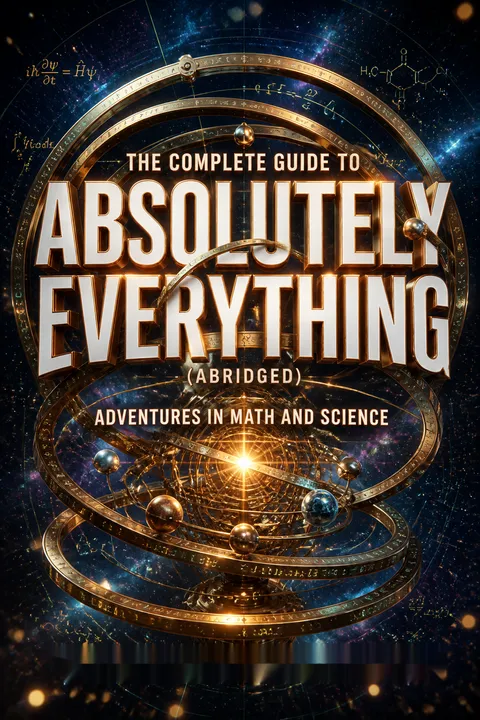
The Complete Guide to Absolutely Everything (Abridged) receives mixed reviews, with an average rating of 4.10/5. Many readers praise its entertaining style, humor, and accessible explanations of scientific concepts. The authors' personalities shine through, making it feel like a fun podcast. Some criticize the lack of cohesion between topics and its basic nature for those well-versed in science. Overall, it's recommended for science enthusiasts and as an introduction to various scientific subjects, though it may not satisfy readers seeking more in-depth exploration.
People Also Read

Glossary
Library of Babel
All possible written pagesA fictional library imagined by Jorge Luis Borges that contains every possible combination of letters and punctuation, including meaningful works, accurate facts, and vast quantities of gibberish. A digital version built by Jonathan Basile uses an algorithm to generate pages from unique references. The library illustrates that containing every answer is not the same as being able to find or verify one.
Junkyard Tornado
A flawed evolution analogyAn argument associated with astrophysicist Fred Hoyle that compares the emergence of life to a tornado assembling an airplane from junkyard parts. The comparison treats evolution as if a complete organism had to appear through one random assembly. The book explains that evolution instead modifies existing organisms through inherited variation and natural selection across many generations.
Umwelt
An organism’s subjective worldA term for the environment as experienced through an organism’s particular sensory and behavioral capacities. A dog’s world is rich in smells that humans barely notice, while human vision captures different information. Umwelt emphasizes that organisms sharing a physical environment may inhabit different perceptual worlds.
Fixed action patterns
Cue-triggered, stereotyped behaviorsRelatively automatic behaviors that are triggered by specific cues and tend to follow a characteristic sequence. The book describes a goose retrieving an egg-shaped object, even when the object is unusual or removed during the action. Such patterns illustrate how behavior can occur without an animal making a conscious, flexible decision.
Laplace’s demon
An imagined perfect predictorPierre-Simon Laplace’s thought experiment about an intelligence that knows the exact position and motion of every particle in the universe. If natural laws were fully deterministic and all information available, this intelligence could calculate the entire past and future. Chaos and quantum mechanics challenge the practicality and, in some interpretations, the assumptions behind this ideal.
Many Worlds interpretation
Quantum outcomes all persistAn interpretation of quantum mechanics in which every possible outcome of a quantum event occurs in a different branch of reality. Rather than one outcome being selected from a range of possibilities, the universe continually branches. The book presents it as one response to quantum measurement, not as an established account of parallel worlds.
Tachypsychia
A felt slowing of timeThe reported experience that time slows during a frightening or traumatic event. Experiments involving a free-fall ride found that participants felt the fall lasted longer, but could not perceive visual information any faster. One explanation is that the brain records more detail under threat, making the event seem longer when remembered.
Belief perseverance
Maintaining a disproven beliefThe tendency to hold onto a belief after evidence has seriously undermined it. Members of a doomsday group whose predicted apocalypse failed explained the failure in a way that preserved their faith. The term also applies to ordinary situations in which people invent explanations rather than revise a strongly held conclusion.
Confirmation bias
Favoring belief-confirming evidenceA tendency to notice, seek, and remember information that supports existing beliefs while overlooking evidence that challenges them. It can make coincidences seem meaningful, help generic descriptions feel uniquely accurate, and steer people toward increasingly one-sided media. The bias affects ordinary reasoning and scientific research alike.
Barnum Statements
Generic claims that feel personalBroad descriptions that many people recognize as accurate accounts of themselves. In Bertram Forer’s classroom demonstration, students received identical personality assessments but believed the descriptions were individually tailored. The effect helps explain why horoscopes and some psychic readings can seem persuasive despite relying on vague statements.
File Drawer Problem
Unpublished unexciting resultsThe risk that studies with null, negative, or unremarkable findings remain unpublished, while dramatic positive findings receive attention. This makes the published scientific record incomplete and can exaggerate the apparent strength of an effect. The problem is reinforced when researchers and journals favor novelty over replication.
Saccadic suppression
Filtering blur during eye movementsThe brain’s reduction of visual processing during rapid eye movements called saccades. Because the eyes continually jump between points rather than recording a smooth image, suppressing the intervening blur helps create a stable visual experience. It is one example of how perception is assembled rather than passively copied.
About the Author
Download PDF
Download EPUB
.epub digital book format is ideal for reading ebooks on phones, tablets, and e-readers.








