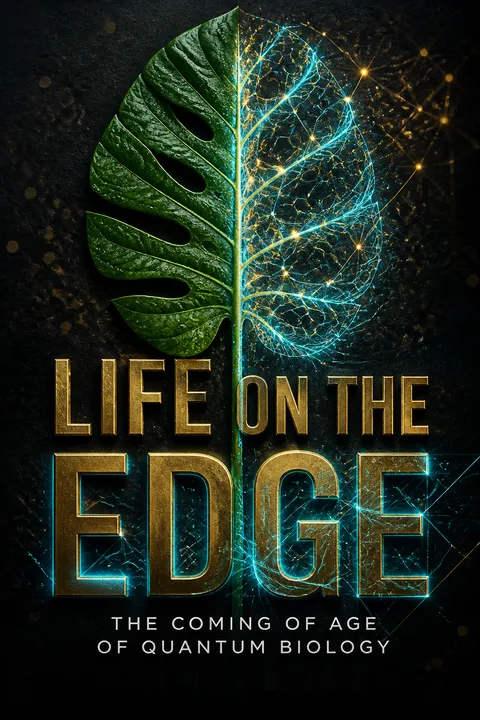


Key Takeaways
Use the robin's compass as a clue to biology's quantum edge
A puzzling compass. Each autumn, European robins can travel roughly 2,000 miles toward warmer regions. Experiments show that their magnetic sense works as an inclination compass: it detects the angle of Earth's magnetic field, indicating the direction of a pole, but not whether it is north or south. The field is exceptionally weak, only 30 to 70 microtesla at Earth's surface.
A proposed mechanism. The radical-pair mechanism proposes that blue light activates cryptochrome, a light-sensitive protein in the bird's eye, producing two linked electrons. Their quantum entanglement makes the chemical reaction sensitive to the magnetic field's direction. Experiments support parts of this account, but electromagnetic noise can disrupt bird orientation, and the full biological mechanism remains unsettled.
What's striking is that the hypothesis turns an invisible sense into a testable molecular story: change the light or magnetic field, and the bird's orientation should change predictably. That is a stronger scientific posture than explaining navigation with a vague appeal to hidden forces. Still, evidence for a magnetic sense is firmer than evidence for every step of this particular mechanism. The distinction matters: a compelling explanation can be a research program before it is a settled account.
Look beneath life's orderly bodies for molecular order, not a vital force
Beyond the life force. For centuries, thinkers attributed living motion to a soul or special vital substance. Chemistry eroded that idea: Friedrich Wöhler made urea in a laboratory, and Louis Pasteur showed that cell extracts could drive fermentation. Living matter uses ordinary atoms and chemical reactions, yet it does more than passively decay. It continually uses energy from its surroundings to maintain and reproduce organized structures.
Order at small scales. Thermodynamics explains how random molecular motion can produce orderly average effects, as in a steam engine. Erwin Schrödinger argued that heredity and other biological processes also depend on small, highly organized systems, where individual molecular events matter. The authors call this order from order, distinguishing life's precise molecular organization from order that emerges only by averaging disorder.
The argument is strongest when read as a refinement of thermodynamics, not a rejection of it. Organisms remain physical systems that consume energy and release heat; their distinctive feature is the organization that directs that flow into repair, growth, and reproduction. This connects naturally to systems biology, which studies how local interactions produce organism-wide functions. The caution is that molecular order alone does not explain life. It identifies a necessary level of description, not a complete definition.
Treat enzymes as quantum-enabled catalysts, not miniature classical machines
Life's molecular tools. Enzymes accelerate the reactions that build, break down, and recycle the molecules of living cells. Mary Schweitzer found flexible collagen-like material in a 68-million-year-old Tyrannosaurus bone; adding collagenase, an enzyme that cuts collagen, rapidly broke the fibers apart. In animals, the same enzyme helps remodel tissue, including during a tadpole's transformation into a frog.
Beyond the energy hill. Enzymes stabilize transition states, short-lived arrangements that reactants must reach before becoming products. Researchers also find evidence that some enzymes move electrons or protons through quantum tunneling, in which a particle has a probability of crossing an energy barrier it could not climb over classically. A kinetic isotope effect, a change in reaction speed when hydrogen is replaced by heavier deuterium, can signal tunneling. The importance of protein motion in these reactions remains under study.
The enzyme story makes quantum biology concrete: the proposed effect is not a mysterious force acting on a whole animal, but a particle-scale event inside a molecule whose work matters to the cell. Isotope substitution is especially useful because it turns an invisible mechanism into a measurable difference in reaction rates. Even so, showing that tunneling occurs is not the same as showing that every enzyme depends on it, or that evolution specifically optimized each enzyme to exploit it.
Photosynthesis may search many molecular routes at once
Energy finds its way. When chlorophyll captures light, it creates an exciton, an energized state that transfers energy through pigment molecules toward a reaction center. This first stage of photosynthesis is remarkably efficient. In 2007, Graham Fleming's team detected oscillating signals in a bacterial light-harvesting complex. The authors interpret these quantum beats as evidence that energy explores several routes simultaneously, a process they call a quantum walk.
Evidence with limits. The first signals came from samples cooled to 77 kelvin, far below temperatures that support life. Later experiments reported similar coherence in photosynthetic systems at warmer, life-compatible temperatures, including systems from plants and algae. Here, coherence means that quantum waves maintain a coordinated relationship long enough to affect energy transfer. The evidence supports a role for quantum dynamics, but describing a photosystem as a quantum computer is an analogy, not proof that it solves a formal computational problem.
The key insight is not that a leaf literally thinks, but that energy transfer may exploit wave-like behavior rather than relying only on random molecular hopping. This recasts photosynthetic efficiency as a problem of transport through a complex network, a question shared with physics and engineering. The distinction between a useful analogy and a demonstrated computation is essential. Quantum signals in a protein do not, by themselves, show that the organism performs a general-purpose calculation.
Smell may detect molecular vibrations, but the quantum nose remains unproven
A scent can guide. Young clownfish can distinguish water from their home reef and swim toward it, suggesting that smell helps them find shelter after drifting out to sea. But the way odor receptors recognize molecules is debated. The familiar shape-based account struggles with examples where similarly shaped molecules smell different, or very different molecules smell alike.
A quantum proposal. Luca Turin proposed that receptors may detect molecular vibrations through inelastic electron tunneling: an electron crosses a molecular gap while transferring energy to a bond vibrating at a matching frequency. Fruit flies have distinguished some ordinary and deuterated odor molecules, whose bonds vibrate differently, but a human test did not find that people could distinguish deuterated acetophenone. The receptor's structure has not been determined, and no experiment has directly established that quantum tunneling explains smell.
The olfaction debate is a useful lesson in how a good theory must explain awkward cases, not just familiar ones. The vibration account offers a possible answer to some weaknesses in shape matching, while the mixed test results warn against treating suggestive patterns as confirmation. A hybrid mechanism could also be possible: molecular shape may determine receptor fit, while vibrations contribute to recognition. The unresolved problem is not merely choosing a metaphor, but finding a mechanism that makes distinct predictions.
Read DNA as quantum-built code, while keeping mutation claims tentative
Copying genetic information. DNA stores instructions in sequences of four bases: A, T, C, and G. The two strands pair predictably, with A opposite T and C opposite G, allowing each strand to guide the copying of its partner. The bonds involved are formed by shared hydrogen nuclei, or protons. In that sense, the physical machinery supporting genetic information is governed by quantum mechanics, as Schrödinger anticipated when he described genes as aperiodic crystals: ordered structures whose repeated units vary to encode information.
A possible source of errors. A tautomer is a rare form of a DNA base in which protons occupy different positions. Such a base may pair incorrectly during copying and cause a mutation. Experiments show that these unusual forms can fit DNA polymerase, the copying enzyme, but the claim that proton tunneling is a major source of natural mutations remains unproven. Quantum mechanics underlies the chemistry; its specific role in mutation is still an open question.
This section distinguishes a broad truth from a narrower hypothesis. Atoms and chemical bonds obey quantum rules, so DNA cannot be fundamentally classical. But that does not establish that quantum tunneling is the main cause of copying errors. Biological accuracy also depends on enzymes and proofreading. The distinction resembles a familiar issue in genetics: knowing the molecular basis of a trait is not the same as identifying which mechanism controls variation in a particular population.
Consider quantum search as a possible shortcut to life's first replicator
The origin problem. The Miller-Urey experiment produced amino acids by simulating some proposed early-Earth conditions, but it did not create life. The resulting mixtures included complex chemical byproducts, and researchers still lack a demonstrated self-replicating molecule that could bridge simple chemistry and the first cells. The RNA world hypothesis proposes that RNA once performed both roles: storing genetic information and catalyzing reactions.
A speculative shortcut. The authors suggest that quantum superposition, the ability of a system to occupy multiple possible states, might have helped a primitive molecule explore many configurations at once. If one configuration could replicate, its replication might preserve that successful arrangement. This is an imaginative proposal, not an established account of life's origin. It does not yet explain how the molecule maintained coherence, found the useful configuration, or reliably captured it through replication.
The proposal addresses a real conceptual difficulty: a purely random search through molecular possibilities appears daunting. Quantum behavior can make some search processes more efficient, so the connection is worth investigating. But parallel possibilities do not automatically produce a usable answer. A successful origin model also needs a mechanism that converts a fleeting molecular state into stable, reproducible chemistry. The book is most persuasive here as a generator of testable questions, not as a solved origin story.
Do not mistake quantum activity in brains for an explanation of consciousness
From nerve to thought. A nerve impulse is a traveling electrical event that helps carry information through the brain and body. The authors trace how signals can lead to muscle contraction, but note that this account does not explain why experience accompanies some brain activity. Roger Penrose and Stuart Hameroff proposed that microtubules inside neurons might act as quantum computers; the book argues that these structures are poor candidates because they are large, vulnerable to decoherence, and not known to perform neural information processing.
A narrower possibility. Computer simulations suggest that ions passing through tiny nerve channels may behave coherently, while the brain's electromagnetic field may help coordinate neural firing. Neither proposal demonstrates that quantum mechanics produces consciousness. They offer possible links between physical brain activity and integrated information, while leaving the central puzzle of subjective experience unresolved.
A disciplined account separates three questions: whether quantum effects occur in the brain, whether they alter neural computation, and whether they explain conscious experience. Evidence for the first would not settle the third. The electromagnetic-field proposal has an appealing feature because a field can integrate activity spread across many neurons, but integration alone may not explain why experience feels like anything. The discussion is valuable precisely because it treats consciousness as an open problem rather than a license for quantum mysticism.
Let biology's molecular noise assist coherence instead of merely destroying it
A useful amount of disturbance. Physicists often protect quantum devices by cooling and shielding them. Photosynthetic systems may use a different strategy: models suggest that environmental noise can help exciton energy move toward its destination. Too little disturbance can leave the energy oscillating without progressing; too much can destroy coherence through the quantum Zeno effect, where repeated interactions suppress quantum change. The most effective transport lies between these extremes.
Vibrations as partners. The authors distinguish broadly distributed thermal noise from specific vibrations in pigments and proteins. Some models suggest those molecular vibrations can restore coherence after it is disrupted. This possibility could inform more efficient solar technologies. The book also imagines synthetic cells that use quantum processes, but existing protocells cannot yet sustain themselves. Such applications are research ambitions, not demonstrated technology.
The counterintuitive claim is that noise can be useful when a system has the right structure and timing. Similar ideas appear across engineering, where controlled perturbation can improve search or prevent a system from becoming trapped. The biological case is especially intriguing because it suggests that robustness need not mean isolation. Yet laboratory observations of coherence do not establish that natural selection tuned every relevant process for maximum efficiency. The strongest next step is to connect measured molecular dynamics to organism-level performance.
Analysis
The book's central achievement is to make quantum biology a biological question rather than a mystical one. Its strongest examples are specific mechanisms: electron or proton tunneling in enzyme reactions, wave-like energy transfer in photosynthetic complexes, and a radical-pair explanation for magnetic sensitivity. These cases give the reader a clear reason to care about quantum mechanics: particular molecular events may affect processes that matter to organisms. The argument needs an evidence hierarchy. Quantum mechanics underlies all chemical bonds, but that fact alone does not make a biological process meaningfully quantum in the book's stronger sense. A convincing case requires evidence that a quantum state persists under biological conditions, changes a relevant function, and cannot be adequately replaced by a classical account. Enzyme tunneling and photosynthetic coherence are presented with experimental support, though their scope and biological importance remain active questions. Quantum smell, quantum mutation, the origin of life, and especially quantum consciousness are more conjectural.
That distinction also clarifies what the book means by life on the quantum edge. The claim is not that organisms escape physics, but that organized molecular systems can sometimes preserve and exploit quantum behavior before their surroundings erase it. The most fruitful conceptual move is to see noise not only as an enemy of coherence, but as a condition that can help particular processes when its strength and timing are right.
The broader lesson is methodological. A spectacular metaphor, such as a plant acting like a quantum computer, can inspire research, but it must not outrun the experiment that supports it. Likewise, finding a quantum effect does not prove that evolution selected it for a purpose. The book is most convincing when it shows how to build and test a mechanism, and least definitive when it extends that mechanism to unresolved questions. Its lasting value is a research map: life may use quantum rules in surprising ways, but each biological claim has to earn its place case by case.
Review Summary
Life on the Edge explores quantum biology, examining how quantum effects may influence biological processes. Reviewers praise the book's accessibility and fascinating subject matter, though some find certain sections overly simplified or repetitive. The authors present evidence for quantum phenomena in photosynthesis, bird navigation, and other biological systems. While some readers found the technical details challenging, many appreciated the book's clear explanations and thought-provoking ideas. Overall, reviewers consider it an intriguing introduction to an emerging field of science.
People Also Read



Glossary
Quantum biology
Quantum effects in living systemsThe study of whether quantum phenomena, such as tunneling, coherence, and entanglement, play functional roles in biological processes. Quantum mechanics governs all chemistry, but quantum biology focuses on cases where its distinctive effects may influence processes such as photosynthesis, enzyme reactions, or animal navigation.
Decoherence
Loss of coordinated quantum behaviorThe process by which interactions with a system's surroundings disrupt quantum coherence. Molecular collisions, vibrations, and other environmental interactions can make quantum behavior difficult to observe or use. The book's central biological puzzle is how some systems preserve useful quantum effects in warm, crowded cells long enough for them to matter.
Radical-pair mechanism
Magnetic sensing through paired radicalsA proposed explanation for light-dependent magnetic sensing in birds and other organisms. Light can create two free radicals with linked electron spins. The balance of their possible spin states is sensitive to an external magnetic field, which could alter chemical products and provide directional information. The mechanism is influential but not fully established in birds.
Kinetic isotope effect
Reaction-rate change with isotope massA change in a chemical reaction's rate when an atom is replaced by a heavier isotope of the same element. Because isotopes have different masses, this comparison can reveal details of a reaction mechanism. A large effect can support the possibility of quantum tunneling, since heavier particles generally tunnel less readily.
Quantum walk
Wave-like exploration of multiple routesA form of transport in which a quantum system's wave-like state can explore multiple paths at once. In the book, this concept is used to interpret energy movement through photosynthetic pigment complexes. It contrasts with a classical random walk, where a particle follows one path through a series of chance steps.
Tautomer
Alternative proton arrangement in a baseA less common structural form of a molecule created when one or more protons shift position. DNA bases can exist in rare tautomeric forms that may pair with the wrong partner during copying. The book discusses proton tunneling as one possible way these forms arise, while emphasizing that their contribution to natural mutation is uncertain.
RNA world hypothesis
Early life based on catalytic RNAAn origin-of-life proposal in which RNA preceded modern DNA and proteins. RNA can store genetic information, and some RNA molecules can catalyze chemical reactions. The hypothesis suggests that early RNA-based replicators may have combined these functions, but no self-replicating RNA system matching the proposed early role has been demonstrated.
Quantum Zeno effect
Repeated interactions suppress quantum changeA quantum phenomenon in which repeated measurement or interaction can inhibit a system's transition between states. In the book's account of photosynthetic energy transport, excessive environmental disturbance can act like continual observation, suppressing useful quantum motion. A moderate level of noise may support transport more effectively than either extreme.
Order from order
Biological organization at small scalesA phrase associated with Schrödinger's view that life's reliable organization cannot be explained only by statistical averages across huge numbers of particles. Biological structures such as genes contain highly ordered molecular arrangements whose details can influence larger-scale traits and processes. The book uses the idea to frame life as unusually sensitive to molecular-scale events.
FAQ
What's Life on the Edge: The Coming of Age of Quantum Biology about?
- Exploration of Quantum Biology: The book explores the intersection of quantum mechanics and biology, examining how quantum phenomena influence biological processes.
- Focus on Living Organisms: It investigates how organisms like birds and plants use quantum effects for navigation and photosynthesis, suggesting life operates at the "quantum edge."
- Interdisciplinary Approach: Written by Johnjoe McFadden and Jim Al-Khalili, it combines insights from physics, biology, and chemistry to make complex concepts accessible.
Why should I read Life on the Edge: The Coming of Age of Quantum Biology?
- Innovative Perspective: The book challenges traditional views by integrating quantum mechanics into biology, offering a fresh perspective on life.
- Engaging Narratives: It uses real-world examples and storytelling to make complex scientific concepts relatable and easier to understand.
- Implications for Future Research: It provides insights into future scientific research, particularly in quantum biology and biotechnology, with potential applications in medicine and technology.
What are the key takeaways of Life on the Edge: The Coming of Age of Quantum Biology?
- Quantum Mechanics in Biology: Quantum mechanics plays a crucial role in biological processes, challenging the notion that biology is purely classical.
- Complexity of Life: Life is a product of both classical and quantum processes, requiring a multidisciplinary approach for full understanding.
- Future of Quantum Biology: The field could lead to revolutionary changes in technology and our understanding of consciousness.
What are the best quotes from Life on the Edge: The Coming of Age of Quantum Biology and what do they mean?
- “Life appears to have one foot in the classical world and the other planted in the strange and peculiar depths of the quantum world.”: This highlights the book's theme that understanding life requires both classical and quantum principles.
- “Quantum mechanics is normal. It is the world it describes that is weird.”: This challenges readers to reconsider their perceptions of quantum mechanics and the natural world.
- “Life’s deep roots allow it to harness those weird phenomena that prowl the quantum edge.”: It emphasizes the intricate connection between life and quantum mechanics.
How does quantum mechanics influence biological processes in Life on the Edge: The Coming of Age of Quantum Biology?
- Photosynthesis Efficiency: Quantum coherence allows plants to capture and transfer energy from sunlight with near-perfect efficiency.
- Magnetoreception in Animals: Quantum entanglement helps animals like birds navigate using the Earth's magnetic field.
- Enzyme Functionality: Quantum tunneling enables enzymes to catalyze reactions more efficiently than classical processes would allow.
How does Life on the Edge: The Coming of Age of Quantum Biology explain photosynthesis using quantum mechanics?
- Exciton Energy Transfer: Chlorophyll molecules capture light energy and transfer it efficiently to reaction centers using quantum coherence.
- Quantum Beats: Excitons follow multiple paths simultaneously, enhancing energy transfer efficiency in photosynthesis.
- Role of Quantum Coherence: It maintains photosynthesis efficiency, allowing near 100% conversion of sunlight into chemical energy.
What is magnetoreception and how is it explained in Life on the Edge: The Coming of Age of Quantum Biology?
- Ability to Sense Magnetic Fields: Certain animals detect the Earth's magnetic field for navigation, linked to quantum processes.
- Role of Cryptochrome: Light-sensitive proteins interact with magnetic fields, possibly involving quantum entanglement and coherence.
- Experimental Evidence: Studies show animals navigate using magnetic senses, supporting the quantum mechanism theory.
What role do enzymes play in quantum biology according to Life on the Edge: The Coming of Age of Quantum Biology?
- Catalysts for Biological Reactions: Enzymes facilitate biochemical reactions by lowering activation energy.
- Quantum Tunneling Mechanism: Some enzymes use quantum tunneling to transfer electrons and protons, enhancing catalytic efficiency.
- Choreographed Molecular Motion: Enzymes maintain quantum coherence through precise molecular motions, crucial for their function.
How does Life on the Edge: The Coming of Age of Quantum Biology address the concept of life itself?
- Defining Life: The authors explore characteristics distinguishing living organisms from inanimate matter, emphasizing complexity.
- Quantum Edge of Life: Life operates at the quantum edge, where quantum mechanics influences biological processes.
- Implications for Understanding Life: Understanding life requires considering quantum effects, leading to new insights into living systems.
What challenges does Life on the Edge: The Coming of Age of Quantum Biology present to traditional views of biology?
- Integration of Disciplines: It advocates for combining physics and biology to understand life fully.
- Complexity of Life: Life involves quantum phenomena, requiring a reevaluation of classical biological studies.
- Implications for Consciousness: It raises questions about consciousness and its potential quantum underpinnings.
How does Life on the Edge: The Coming of Age of Quantum Biology connect quantum biology to technology?
- Synthetic Biology: Quantum biology could inform the creation of new life forms in synthetic biology.
- Quantum Computing: Insights from quantum biology might enhance computational efficiency in quantum computing.
- Biomimetic Technologies: Technologies inspired by biological processes could benefit from quantum principles, improving efficiency.
What are the implications of quantum biology for future research according to Life on the Edge: The Coming of Age of Quantum Biology?
- New Research Directions: Quantum biology opens new avenues for understanding complex biological processes.
- Potential for Technological Advances: It may inspire new technologies, such as efficient solar cells or quantum computers.
- Interdisciplinary Collaboration: Encourages collaboration between physicists, biologists, and chemists for innovative research.
Download PDF
Download EPUB
.epub digital book format is ideal for reading ebooks on phones, tablets, and e-readers.








