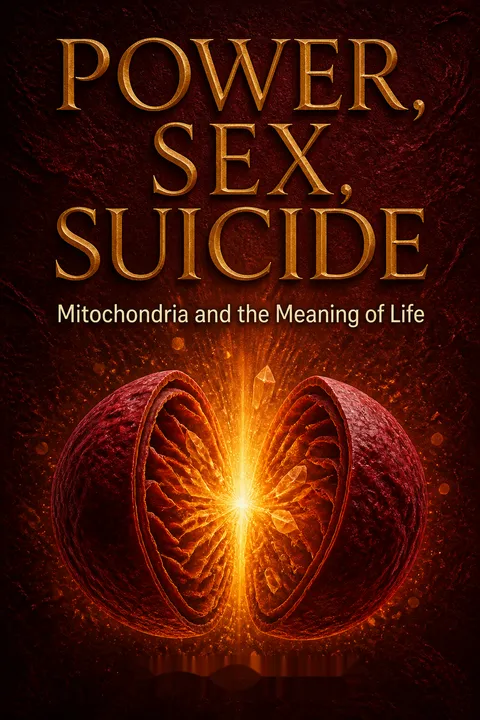


Key Takeaways
Treat mitochondria as evolutionary partners, not cellular batteries
A past inside us. Mitochondria are descendants of bacteria that entered other cells roughly two billion years ago. They still carry a small genome and make most of the energy used by complex cells. In humans, they also help determine whether damaged cells die, influence inheritance, and contribute to ageing. Lane's central argument is that this ancient merger helped shape much more than cellular power: it changed what kinds of life could evolve.
The scale is startling. A human body contains an estimated ten million billion mitochondria, though different cells have very different numbers. Their bacterial ancestry is not just a resemblance: their genes, membranes, and protein-making machinery preserve evidence of that past.
The battery metaphor captures a function but hides the organelle's evolutionary history and its dependence on the cell. Most mitochondrial proteins are encoded in the nucleus, while mitochondria retain only a small set of genes. Their influence is therefore less like a ruler issuing orders than a deeply integrated partner whose local machinery affects the whole system. That distinction helps explain why mitochondria matter: they are neither ordinary cell parts nor fully independent organisms, but a living record of cooperation that never became complete.
Explain complex cells through a rare merger, not a gradual upgrade
A disputed origin story. Genetic evidence suggests that all known eukaryotes, including organisms that lack mitochondria today, either possess them or had ancestors that did. This undercuts the idea that simple, mitochondria-free eukaryotes were an earlier stage on the way to complex cells.
Two lineages, one cell. The hydrogen hypothesis proposes that the host was a methane-producing archaeon, a methanogen, and its partner was a bacterium that released hydrogen. The host could use that hydrogen, while the bacterium benefited from its surroundings. Over time, genes moved between partners, and the bacterium became the ancestor of mitochondria. The proposal helps explain their mismatched oxygen requirements, but the precise sequence of events remains speculative.
The hypothesis is strongest as an explanation of why eukaryotes combine genetic features associated with different branches of life. It also makes the merger central, rather than treating mitochondria as a late accessory. Yet reconstructing a partnership from genes and modern organisms is a form of historical inference, not direct observation. The evidence for shared ancestry is firmer than the proposed ecology of the first partners. Keeping those levels distinct preserves the insight without turning a compelling scenario into settled fact.
Follow proton gradients to see how life captures usable energy
Energy across a membrane. In respiration, electrons move along a chain of proteins, and the released energy pumps protons across a membrane. The resulting difference in proton concentration and electrical charge is the proton-motive force, a store of usable energy. Protons flowing back through a molecular motor called ATPase power the production of ATP, the cell's general energy currency.
A common mechanism. Bacteria, mitochondria, and photosynthetic cells all use versions of this membrane-based system. Lane connects its ancient importance to a proposed origin of life: iron-sulphur mineral bubbles could have supplied natural membranes, chemical gradients, and reaction surfaces. Such mineral compartments offer a possible starting point, not proof of how life began.
This account makes energy a physical organizing principle, not merely fuel for instructions encoded in genes. A membrane does more than separate inside from outside: it allows a cell to store a difference and spend it selectively. That perspective connects cellular biology to familiar engineered systems such as batteries and dams, while preserving the crucial difference that living membranes regulate their own flows. The origin-of-life proposal is suggestive precisely because it begins with gradients that could arise naturally, though a gradient alone does not explain the emergence of heredity.
Internal energy production let cells outgrow bacterial constraints
A geometric bottleneck. Bacteria generate energy at their outer membrane. As a cell grows, its volume increases faster than its surface area, so the energy-producing surface serves a larger mass of cell. This puts pressure on bacteria to stay small and reproduce quickly.
Power moved inside. Mitochondria let eukaryotic cells generate energy across internal membranes, loosening that size constraint and freeing the outer surface for other tasks. Lane proposes that mitochondrial genes remain on site because they help each organelle adjust its respiratory machinery locally. That control could support a much larger energy system than one bacterial membrane can manage. The result, in his account, was a platform for large cells, extensive DNA, predation, and eventually multicellular life.
The key shift is architectural: complexity becomes possible when energy production is no longer forced to share the cell's boundary with everything else. This is a powerful explanation for why merely accumulating useful genes may not be enough to create a larger cell. Still, the argument that mitochondrial genes are essential for local respiratory control is a proposed explanation, not a complete account of every difference between bacteria and eukaryotes. The broader lesson is robust: biological innovation depends on where processes happen, not only on what genes are present.
Treat body size as an energetic bargain, not a universal law
Bigger, slower per gram. A gram of rat tissue can consume about seven times as much oxygen as a gram of human tissue, despite their cells being broadly similar in size. Across animals, metabolic rate rises more slowly than body mass, which means larger animals generally spend less energy per unit mass. The exact scaling rule is disputed: the popular three-quarter-power pattern does not fit every group, and some proposed universal explanations rely on contested assumptions about supply networks.
Endurance before warmth. Lane presents the aerobic-capacity hypothesis for warm-bloodedness: selection for speed and stamina may have increased muscle mitochondria, while organ changes and heat production followed. This makes endothermy a costly consequence of performance, not simply a way to stay warm.
The distinction between a pattern and its cause matters here. Metabolic scaling is real enough to invite explanation, but a single exponent can conceal differences among mammals, birds, reptiles, and tissues. Lane's emphasis on tissue demand challenges the idea that supply networks dictate every metabolic rate. His account of warm-bloodedness is similarly useful because it asks what immediate advantage could pay for such an expensive trait. The hypothesis remains open to debate, but it turns a familiar feature of mammals into a testable evolutionary problem.
Make cooperation durable by removing cells that defect
A body needs enforcement. Apoptosis is programmed cell death: a controlled process that dismantles and recycles cells without the disruptive inflammation associated with violent cell rupture. The body uses it to shape embryos and remove damaged cells. Lane estimates that roughly ten billion cells die this way each day in a human body.
Cancer exposes the alternative. A cancer cell ignores the body's restraints and multiplies for its own immediate success. Mitochondria help govern apoptosis by releasing proteins such as cytochrome c, which can activate the cell's death machinery. Lane proposes that ancient redox signals, once linked to cell fusion and genetic repair, were repurposed to eliminate damaged cells in multicellular organisms. That evolutionary transition is an interpretation, not a directly observed history.
Multicellular cooperation is not just a matter of shared genes; it also requires mechanisms that contain cells whose behavior threatens the whole. Apoptosis supplies one such mechanism, and cancer shows what happens when it fails. The striking evolutionary suggestion is that machinery associated with an older cellular relationship could be reassigned to maintain a new level of organization. The framing should not imply that cells consciously choose to cooperate or defect. Selection can build enforcement without intention, and the system remains imperfect, as cancer makes painfully clear.
Two sexes help align mitochondrial genes with the nuclear genome
Two genomes must cooperate. Mitochondria and nuclei jointly build the machinery of respiration. Their genes change at different rates, and nuclear genes are reshuffled during sexual reproduction. Lane argues that offspring function best when one set of mitochondrial genes is tested against one nuclear background, rather than receiving competing mitochondrial populations from both parents.
The egg carries the organelles. Human eggs contain about 100,000 mitochondria, while sperm usually carry fewer than 100. Mitochondria are generally inherited from the mother, and sperm mitochondria are typically excluded or destroyed. Conflict between mitochondrial genomes may help explain this pattern, but Lane emphasizes a further possibility: compatibility between mitochondrial and nuclear genes could make one-parent inheritance beneficial even when direct competition is limited.
This account gives sex a specific cellular problem to solve, rather than treating it only as a device for producing genetic variation. It also connects reproduction to the same respiratory machinery that powers the cell. The argument is especially interesting because it allows two explanations to coexist: competing mitochondria can be costly, and a single mitochondrial lineage can make coordination easier. Neither point proves that mitochondrial compatibility created two sexes in every lineage. The book's value lies in identifying a plausible pressure whose effects reach from gamete size to inheritance.
Use mitochondrial ancestry as one maternal thread, not the whole past
A narrow but useful record. Mitochondrial DNA is usually passed from mother to child, so researchers can trace a line of maternal inheritance. Comparisons led to the estimate that the most recent shared maternal ancestor of living humans lived in Africa roughly 170,000 years ago. This ancestor, often called Mitochondrial Eve, was not the only woman alive then, nor the ancestor of every part of our genome.
Lineages can mislead. Mitochondrial DNA can mutate, sometimes recombine, and is subject to natural selection. A maternal lineage can disappear while nuclear genes from the same population survive. The Lake Mungo fossil, an anatomically modern human whose mitochondrial line is extinct, illustrates why mitochondrial history alone cannot settle questions such as whether Neanderthals contributed to later populations.
A single genetic marker acts like a tracking device tuned to one inheritance path. Its clarity is also its limitation: it records maternal continuity, not the full movement or mixture of populations. Lane's examples show how easily a neat lineage can be mistaken for a complete family history. The distinction is useful beyond human origins: any measurement method illuminates the dimensions it captures and hides those it does not. Mitochondrial DNA remains powerful evidence, but its conclusions need to be checked against other kinds of evidence.
See ageing as failed mitochondrial regulation, not simply oxidation
Free radicals have two faces. Mitochondria produce reactive molecules that can damage DNA and other cell components, but Lane argues that these molecules also signal respiratory problems and help cells adjust. This revised view rejects the simple expectation that more antioxidants automatically mean longer life. Comparisons in the book show that birds can maintain a fast metabolism yet live far longer than similar-sized mammals, apparently because their mitochondria leak fewer free radicals.
A gradual loss of function. Damaged cells may compensate by changing gene activity and making more mitochondria. When compensation fails, cells can die by apoptosis, reducing the function of organs over time. A proposed route to healthier ageing is to reduce mitochondrial leakage, but the book presents this as a research direction, not an established treatment.
The move from damage-only to signal-and-damage is the book's most important correction to its own early framing. It explains why simply suppressing reactive molecules could disrupt cellular feedback rather than deliver a cure. It also shifts attention from single diseases toward the shared physiology that can make tissues vulnerable. Yet the jump from evolutionary comparisons to a practical anti-ageing intervention remains large. The argument is strongest as a research agenda: understand mitochondrial regulation first, then test whether modifying it improves health without disabling useful signals.
Analysis
The book's unifying move is to make bioenergetics an evolutionary explanation rather than a specialist footnote. A membrane gradient links chemistry to cellular work; mitochondria relocate that energetic system inside the cell; and that altered geometry changes the possibilities for size, predation, multicellularity, sex, and ageing. The narrative's power comes from scale shifts. A tiny change in where protons cross a membrane is connected to the existence of large organisms and the limits of individual life.
Its strongest claims are not all equally secure. The evidence that mitochondria descend from bacteria, and that mitochondrial and nuclear systems remain interdependent, is presented as much firmer than the reconstruction of the first eukaryotic partnership. The hydrogen hypothesis is a plausible historical model, not a witnessed event. Likewise, the proposed roles of mitochondrial genes in complexity, sex, apoptosis, and ageing are explanatory arguments built from patterns and mechanisms, with varying degrees of direct support. The book is most persuasive when it distinguishes known cellular machinery from inferred evolutionary history, and least persuasive when a coherent story risks sounding inevitable simply because its pieces fit.
That tension is part of the book's value. Evolutionary explanation needs narrative, but narrative can smooth over gaps in evidence. Lane repeatedly uses living cells as clues to events billions of years ago, then asks readers to see how a mechanism might have shaped life's larger history. The reader should retain both the mechanism and the uncertainty: mitochondria are central to complex life, but not every grand consequence can be pinned to one cause. The lasting insight is methodological as much as biological. To understand an organism, study not only its information and visible anatomy, but also the constraints imposed by how it gets and distributes energy.
Review Summary
Power, Sex, Suicide is a dense but fascinating exploration of mitochondria's role in evolution and life. Lane argues that mitochondria are crucial for complex life, responsible for sex, cell death, and aging. While challenging for non-scientists, readers praise Lane's clear explanations and engaging style. The book covers topics like energy production, free radicals, and theories on life's origins. Some criticize Lane's assertiveness, but most find the book informative and thought-provoking. It's recommended for those interested in biology and evolution, offering a comprehensive look at mitochondria's significance in life's processes.
People Also Read


Glossary
Chemiosmotic coupling
Links respiration to ATP productionA mechanism in which energy released by electron transport pumps protons across a membrane. The resulting gradient stores potential energy. When protons flow back through ATPase, that energy drives the formation of ATP. Peter Mitchell proposed this explanation for respiration, replacing the search for a transferable high-energy chemical intermediate.
Proton-motive force
Energy stored across a membraneThe potential energy created by a difference in proton concentration and electrical charge across a membrane. Cells use this force to make ATP and to power other processes, including transport. In mitochondria, respiratory proteins build the gradient, while the ATPase enzyme allows protons to flow back across the membrane.
Hydrogen hypothesis
A proposed origin of eukaryotesA model proposing that the first eukaryotic cell arose from a partnership between a hydrogen-using archaeon, likely a methanogen, and a bacterium that produced hydrogen. Gene transfer and increasing dependence between the partners could have produced the first cell with mitochondria. The hypothesis explains a possible route to eukaryotes, but the exact events remain uncertain.
Redox poise
Balanced electron flow in respirationThe condition in a respiratory chain where oxidized components can accept electrons and reduced components can pass them along efficiently. If too many components are in either state, electron flow slows. Lane links this balance to energy production and to the risk that electrons will escape and form reactive free radicals.
Apoptosis
Controlled, programmed cell deathA regulated process by which a cell dismantles itself and is removed, usually without provoking the inflammation associated with cell rupture. It helps shape developing organisms and remove damaged cells. Mitochondria can trigger the process by releasing proteins, including cytochrome c, that activate the cell's death machinery.
Uniparental inheritance
Organelles inherited from one parentA pattern in which offspring receive mitochondria, or chloroplasts, from only one parent. In humans, mitochondria are normally inherited through the egg. The book discusses both reduced conflict between different organelle populations and improved coordination between mitochondrial and nuclear genes as possible explanations.
Mitochondrial bottleneck
A narrowing of inherited mitochondriaA proposed stage in egg development in which only a small number of mitochondria represent the mother's much larger mitochondrial population. Their numbers then expand as egg cells develop. Lane presents the bottleneck as a possible way for selection to favor mitochondrial function compatible with the nuclear genes.
Retrograde response
Mitochondrial signals alter nuclear activityA cellular response in which signals from dysfunctional mitochondria change which nuclear genes are active. The response can shift energy production, stimulate the formation of mitochondria, and increase stress defenses. It offers a way for cells to compensate for respiratory problems, though it does not necessarily restore youthful function.
Aerobic capacity hypothesis
Endothermy follows selection for enduranceA proposed explanation for the evolution of warm-bloodedness. It suggests that selection initially favored greater speed and endurance, requiring more powerful aerobic muscle metabolism. Because resting and maximum metabolic activity are linked, heat production may have risen as a consequence, making stable internal body temperature possible.
FAQ
What's Power, Sex, Suicide: Mitochondria and the Meaning of Life about?
- Exploration of Mitochondria: The book delves into the role of mitochondria, the organelles responsible for energy production in cells, and their influence on biological processes like sex, aging, and life's meaning.
- Evolutionary History: It discusses the evolutionary journey from simple prokaryotic cells to complex eukaryotic organisms, highlighting the pivotal merger between a bacterium and an archaeon.
- Interconnected Themes: The narrative connects energy production, the origin of life, and the evolution of complexity, suggesting that understanding mitochondria is key to understanding life itself.
Why should I read Power, Sex, Suicide by Nick Lane?
- Unique Insights: The book offers a fresh perspective on biology by focusing on often-overlooked mitochondria, challenging conventional views and encouraging readers to rethink life's foundations.
- Engaging Writing Style: Nick Lane's accessible and engaging writing makes complex scientific concepts understandable, weaving storytelling with scientific inquiry.
- Implications for Humanity: It raises profound questions about existence, aging, and life's nature, making it relevant to anyone interested in biology, philosophy, or the human condition.
What are the key takeaways of Power, Sex, Suicide?
- Mitochondria's Central Role: Mitochondria are crucial for energy production and processes like apoptosis and aging, maintaining cellular health and function.
- Unique Evolutionary Event: The evolution of eukaryotic cells was a unique event driven by a bacterium-archaeon merger, essential for complex life forms.
- Energy and Complexity: The internalization of energy generation in mitochondria allowed for greater complexity in eukaryotic organisms compared to bacteria.
How do mitochondria influence sex and gender according to Power, Sex, Suicide?
- Asymmetry of Sex: The book links the existence of two sexes to mitochondria's role in reproduction, with females specializing in passing on mitochondria.
- Mitochondrial Eve: It introduces "Mitochondrial Eve," the most recent common ancestor of all living humans traced through maternal lineage, highlighting mitochondrial DNA's importance in human ancestry.
- Gender Roles: The biological differences in mitochondrial inheritance may have influenced social structures and gender roles throughout history.
What is the Mitochondrial Theory of Aging presented in Power, Sex, Suicide?
- Free Radical Damage: Aging is caused by damage from reactive molecules called free radicals, which leak from mitochondria during respiration, leading to cellular dysfunction.
- Mitochondrial Mutations: Mutations in mitochondrial DNA can lead to degenerative diseases, particularly affecting metabolically active tissues like muscles and the brain.
- Potential for Cures: The book explores targeting mitochondria for therapeutic interventions to combat aging and related diseases, opening new research avenues.
What is the Hydrogen Hypothesis in Power, Sex, Suicide?
- Origin of Eukaryotic Cells: The hypothesis posits that eukaryotic cells arose from a symbiotic relationship between a methanogen and a versatile -proteobacterium, allowing for internalized energy production.
- Chemical Dependency: The mutual dependency between these cells was crucial for complex life evolution, with the methanogen providing stability and the -proteobacterium contributing energy.
- Evolutionary Significance: This challenges traditional views, suggesting the merger was a unique event paving the way for complex life forms, emphasizing symbiosis in evolution.
How does Power, Sex, Suicide connect to the origin of life?
- Chemiosmotic Mechanism: The energy generation mechanism in mitochondria, chemiosmosis, is fundamental to understanding life's origin, possibly present in early life forms.
- Inorganic Membranes: Early life may have used inorganic membranes, like iron-sulphur minerals, to create the first cells, linking life's origins to energy generation principles.
- Proton Gradients: Proton gradients as an energy source are central to both life's origin and modern cells' functioning, suggesting deep evolutionary roots.
What are the implications of mitochondrial research for understanding evolution in Power, Sex, Suicide?
- Evolutionary Significance: Mitochondria have been crucial in complex life evolution, influencing energy production and sexual reproduction.
- Sexual Selection: Mitochondrial dynamics may have influenced sexual reproduction evolution and the development of two sexes.
- Adaptation and Survival: Mitochondrial function affects an organism's adaptability to environmental changes, impacting survival and reproductive success.
How does Power, Sex, Suicide address the concept of free radicals?
- Dual Role of Free Radicals: Free radicals are both harmful and beneficial, serving as signals for cellular processes.
- Impact on Aging and Disease: They contribute to aging and diseases through mitochondrial dysfunction.
- Signaling Mechanisms: Free radicals help regulate mitochondrial function and cellular health, influencing processes like apoptosis.
What are the broader implications of Power, Sex, Suicide for understanding life on Earth?
- Interconnectedness of Life: The book emphasizes interconnected biological processes, from energy production to reproduction and aging.
- Evolutionary Biology: Lane's arguments challenge traditional evolution views, suggesting symbiosis and unique cell mergers played crucial roles in complex life development.
- Future Research Directions: Insights open new research avenues in regenerative medicine, cancer biology, and evolutionary studies, highlighting mitochondria's importance in health and disease.
What are the best quotes from Power, Sex, Suicide and what do they mean?
- “Mitochondria are the clandestine rulers of the world.”: Highlights mitochondria's hidden yet powerful role in biology, influencing aging and reproduction.
- “The origin of the eukaryotic cell was a unique event that happened only once.”: Emphasizes the rarity and significance of the merger leading to complex cells.
- “Without mitochondria, complex life is simply not possible.”: Reinforces mitochondria's essential role in evolving complexity in organisms.
How does Power, Sex, Suicide connect mitochondria to health and disease?
- Link to Chronic Diseases: Mitochondrial dysfunction is implicated in chronic diseases like diabetes and heart disease.
- Role in Aging: Declining mitochondrial function with age increases age-related disease risk.
- Potential for Therapeutic Interventions: Enhancing mitochondrial function could lead to better health outcomes, suggesting a path for future research.
About the Author

Download PDF
Download EPUB
.epub digital book format is ideal for reading ebooks on phones, tablets, and e-readers.








