

Key Takeaways
Trace history down to the molecule, but never mistake a trigger for the whole cause.
Small structures, large effects. A molecule is a group of atoms joined in a particular arrangement. That arrangement can determine whether a substance preserves food, poisons a pest, or gives a material its strength. The book’s central proposition is that such properties can redirect events far beyond the scale of chemistry: pepper helped motivate ocean voyages, and vitamin C affected whether sailors survived them.
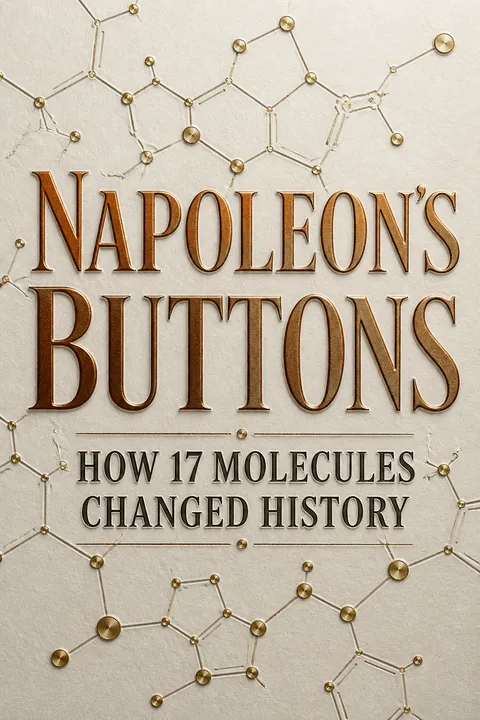
Causation has limits. Napoleon’s retreat from Russia is sometimes blamed on tin buttons crumbling in the cold. The authors present this as an intriguing but uncertain theory, not established fact. That caution matters: molecules shape what people can do, but decisions, institutions, weather, and chance also shape history.
The book’s most useful lens is neither “chemistry explains everything” nor “chemistry is merely background.” Materials and molecules create possibilities and constraints that societies then amplify. A disease-preventing nutrient matters only if people recognize its value and organize supplies; a dye matters historically when production, trade, and fashion make it consequential. The Napoleon button story is a useful warning against neat explanations: a memorable molecular culprit can obscure a tangled military failure. Chemistry is best treated as a causal layer, not a substitute for political and social history.
Let spice molecules explain why Europe risked oceans and empires.
Flavor became strategy. Pepper’s heat comes from piperine, while cloves and nutmeg owe much of their aroma to eugenol and isoeugenol. These compounds made spices valuable for flavoring, preserving, and medicine. European demand helped Venetian traders dominate commerce and spurred Portuguese and Spanish voyages seeking routes that bypassed established middlemen.
Trade redrew maps. The Dutch fought to control nutmeg production in the Banda Islands. In the 1667 Treaty of Breda, England gave up its claim to Run, a nutmeg-producing island, while retaining Manhattan, which became New York. Nutmeg’s supposed protection against plague may have added to its prestige, though the book treats flea-repelling effects as possible, not proven. The trade also rested on violent colonial rule and exploitation of local populations.
The spice story reveals how consumer appetite can become geopolitical infrastructure. A desired product creates shipping routes, financial arrangements, military protection, and colonial violence. It also shows why a molecule’s historical importance is not measured by its modern usefulness: pepper’s role in exploration was enormous even though refrigeration later reduced spices’ importance as preservatives. The proposed flea-repelling effect of nutmeg is a reminder to distinguish a plausible chemical mechanism from demonstrated historical impact. Belief can drive trade even when the claimed benefit remains uncertain.
Treat vitamin C as expedition infrastructure, not a nutritional footnote.
A missing molecule crippled voyages. Ascorbic acid, or vitamin C, is needed to make collagen, a protein that supports connective tissue. Without it, sailors developed scurvy, with bleeding gums, weakness, poor wound healing, and sometimes death. More than 90 percent of Magellan’s crew failed to survive the circumnavigation, with scurvy among the major causes described in the book.
Evidence needed logistics. In 1747, naval surgeon James Lind compared treatments among twelve sailors with scurvy. The two given citrus fruit improved rapidly and were fit for duty within six days. Yet the British Navy took decades to require lemon juice, partly because it was costly and difficult to preserve. Captain James Cook paired fresh foods and sauerkraut with cleanliness, and lost no crew to scurvy.
This episode joins biology to organizational learning. Lind’s small comparison offered unusually clear evidence, but evidence alone did not change naval policy. Storage, expense, prevailing theories, and the habits of crews all stood between a successful treatment and routine prevention. Modern public health faces the same distinction between discovering an intervention and reliably delivering it. The story also complicates heroic accounts of exploration: navigational skill mattered, but so did food, sanitation, and the health of the people doing the work.
Follow glucose and cellulose from plantation labor to industrial power.
Sugar financed expansion. Sucrose contains glucose and fructose. As sugar became a mass-market staple in Europe, plantations in the Americas expanded, relying heavily on enslaved Africans. The book estimates that roughly two-thirds of African slaves in the New World worked on sugar plantations. Profits helped supply capital for European industrial growth, while the trade reshaped populations and economies across continents.
Cotton transformed work. Cotton fibers are mostly cellulose, a chain of glucose units. A small structural difference separates digestible starch from cellulose, which humans cannot digest but can spin into strong, absorbent fabric. Britain’s raw cotton imports rose from 2.5 million pounds in 1760 to more than 140 times that amount within eighty years. Mechanized mills drove industrialization, while slave labor in the American South and brutal factory conditions supplied its human costs.
The paired histories show how one crop can connect distant labor systems. Sugar generated early wealth through plantation slavery; cotton then became a major engine of factory expansion, also tied to slavery. The chemistry explains why these crops could be processed and traded, but it does not explain who controlled the land, who profited, or who was coerced. Those questions belong to political economy. The structural contrast between starch and cellulose also makes a broader point: human usefulness is not the same as biological abundance. A resource can be plentiful and still require technology or labor to become valuable.
A failed quinine experiment launched the age of synthetic dyes.
An error became an industry. In 1856, teenager William Perkin tried to make quinine from coal-tar chemicals. The experiment failed, but left a purple substance that dyed silk brightly and durably. Perkin recognized its commercial promise, named the dye mauve, and built a business around it. His success helped make organic chemistry a source of industrial products and profits, not only academic study.
Coal tar connected fields. German firms developed synthetic dyes and the chemical expertise to make them at scale. Coal tar also supplied phenol, which Joseph Lister used as an antiseptic to reduce surgical infection. Later, phenol and formaldehyde formed Bakelite, an early fully synthetic plastic. The paths from dye to medicine to material show how a waste stream and a chemical technique can seed industries that initially seem unrelated.
Perkin’s discovery is a strong example of useful serendipity, but luck was only the opening. He noticed an unexpected result, tested whether it dyed fabric, and solved the practical problems of making it consistently. The distinction matters in innovation: accidents generate possibilities, while trained attention and manufacturing skill turn them into products. The coal-tar story also shows the value of industrial spillovers. Knowledge, equipment, and skilled workers move between sectors, allowing advances in color chemistry to support later work in medicine and materials.
Use explosive chemistry carefully: one molecule can build or destroy.
Explosions are rapid chemistry. Many explosives contain nitro groups, which help a molecule release hot gases quickly. The expanding gases create the destructive pressure wave. Alfred Nobel made nitroglycerin safer to handle by mixing it with porous kieselguhr, creating dynamite. This controlled power enabled tunnels, railways, mines, and the Panama Canal, as well as military destruction.
The same chemistry serves different ends. During World War I, a British blockade cut Germany off from Chilean nitrate, a key source for explosives and fertilizer. Fritz Haber’s process combined nitrogen from air with hydrogen to make ammonia, which could be used to produce fertilizer and explosives. Haber received recognition for this work, while also directing German chemical warfare research. A molecule’s consequences depend on the systems and purposes that use it.
Explosives make the dual-use character of chemistry unusually visible. The same ability to release energy quickly can remove a mountain or kill people. The Haber process sharpens the tension: nitrogen fixation supports food production, but the resulting ammonia also supports weapons manufacture. Scientific achievement cannot be evaluated only by technical elegance, nor can its applications be cleanly separated from institutions and war. The book’s cases encourage a practical question for any powerful technology: who controls it, what safeguards govern it, and who bears the risks?
Judge materials by their structure and their lasting environmental cost.
Molecular architecture sets performance. Silk’s protein chains, rich in small amino-acid side groups, create a smooth, strong fiber. Nylon, developed by Wallace Carothers, used a different polymer structure to offer a cheaper silk substitute, first in toothbrush bristles and then in stockings and wartime equipment. Natural rubber is made from isoprene arranged in a flexible cis form; heating it with sulfur, a process called vulcanization, adds links that improve its strength and stability.
Convenience can persist too long. Chlorofluorocarbons, or CFCs, made effective refrigerants and aerosol propellants because they were stable and nonflammable. That stability also let them reach the upper atmosphere, where chlorine released from them damaged ozone. Polychlorinated biphenyls, or PCBs, likewise persisted in the environment and accumulated in animals. Useful properties can become hazards when a molecule outlasts its intended use.
Materials science often rewards durability, stability, and resistance to breakdown. Environmental science asks when those same traits become liabilities. CFCs and PCBs illustrate a temporal mismatch: manufacturers value reliability now, while the ecological costs can emerge far away and decades later. This suggests that product assessment should include a molecule’s full life cycle, not merely its performance in a refrigerator or electrical device. The textile examples provide the complementary point: material properties are not abstract. They affect comfort, price, labor demand, and the scale of industries.
Medicines can turn chemical resemblance into a life-saving weapon.
Small changes can alter treatment. Aspirin is a modified form of salicylic acid, a pain-relieving substance associated with willow and meadowsweet. Chemist Felix Hofmann’s acetylated version was easier to tolerate and became a widely used medicine. In another case, sulfanilamide resembles p-aminobenzoic acid, which some bacteria need to make folic acid. Bacteria can mistake one for the other, disrupting growth while human cells rely on folic acid from food.
Penicillin attacks a different vulnerability. Its strained four-membered ring reacts with a bacterial enzyme needed to build cell walls. Human cells lack those walls, so the drug targets bacteria more selectively. Sulfa drugs and penicillin sharply improved treatment of infections that had often been fatal. Their success also brought a new problem: bacteria resistant to antibiotics can spread, weakening medicines that once worked reliably.
These drugs exemplify targeted intervention: a medicine exploits a biochemical difference between a pathogen and its host. That selectivity is a central design principle in pharmacology. Yet the bacterial resistance described in the book shows that treatment changes the environment in which microbes evolve. Antibiotics are not simply tools used against passive targets; repeated use favors organisms that survive them. The lesson is not to discount their lifesaving value, but to treat effectiveness as a resource that can be depleted by overuse and poor stewardship.
The pill made fertility more negotiable and reshaped women's public lives.
A hormone became a social technology. Norethindrone is a synthetic progestin, a compound that imitates progesterone’s role in suppressing ovulation. Chemist Russell Marker developed a practical way to make steroid hormones from Mexican wild yams. Researchers Gregory Pincus and John Rock tested oral contraceptives, while activists Margaret Sanger and Katherine McCormick helped drive the effort and fund the research.
Access changed daily choices. The pill was approved as a contraceptive in the United States in 1960. It offered a reliable way to prevent pregnancy without requiring action at the moment of sex, and its availability spread widely. The book links its use to falling birth rates and women’s increased education and workforce participation. The molecule did not create those changes alone, but it gave women greater control over when to become pregnant.
The pill is best understood as a technology whose consequences depended on access, law, money, and changing expectations about women’s lives. A biological mechanism became socially powerful because it made reproductive timing more controllable. That does not mean contraception automatically produces equality: institutions still shape education, work, health care, and caregiving. The book’s account also resists a simple inventor myth. Chemists made the molecule possible, but advocates, funders, physicians, and trial participants helped make it consequential.
Read plant alkaloids as medicines, intoxicants, and evidence of fear.
Plant chemistry affects perception. Alkaloids are nitrogen-containing plant compounds that can strongly affect the body. Atropine and scopolamine, found in plants such as deadly nightshade and henbane, can cause vivid hallucinations when absorbed through the skin. The book suggests that women using such plants in ointments may have believed they flew or attended supernatural gatherings. Ergot alkaloids in contaminated rye could also cause convulsions and hallucinations; they are proposed as one possible contributor to the Salem accusations, not a complete explanation.
Use has two faces. Morphine relieves severe pain but can be highly addictive. Nicotine and caffeine stimulate the nervous system and became global commodities. British trade in opium helped provoke wars with China, while tobacco and coffee plantations reshaped economies and landscapes. The same compounds can serve medicine, pleasure, commerce, or control.
This chapter’s most important distinction is between a substance’s effect and the meaning people assign to it. Hallucinations may have felt like proof of witchcraft in a society already primed to fear sorcery. That possibility does not erase the role of misogyny, accusation, and legal violence in persecution. Likewise, the harmful effects of addictive drugs do not make their medical uses unreal. A sound account holds chemistry, interpretation, and power together instead of treating any one as the entire explanation.
Salt shows how a basic need becomes a tool of state power.
Necessity creates leverage. Sodium chloride preserves food by drawing water from tissues, and the body needs sodium and chloride ions for nerve signaling, muscle function, and digestion. Before refrigeration, salt was essential for preserving meat and fish. Because nearly everyone needed it and production was visible, governments could tax and control its supply.
Taxation shaped resistance. France’s gabelle required people to buy a set amount of salt at prices fixed by the crown, with rates varying by region. The unpopular tax survived the French Revolution and was later restored by Napoleon. In India, the British salt monopoly made even local salt collection illegal. Gandhi’s 1930 march to the coast encouraged people to make and sell salt in defiance of those laws. Once industrial uses grew, Britain abolished its salt tax in 1825.
Salt illustrates a recurring political asymmetry: the more essential a resource is, the easier it is to tax and the harder it is for ordinary people to refuse. Its history links household survival to state revenue, industrial policy, and civil disobedience. The contrast between the French gabelle and Gandhi’s salt campaign shows that a commodity can become a public symbol when control feels unjust. Salt’s later cheapness can obscure how deeply scarcity and regulation once structured everyday life.
Fight malaria through the parasite, the mosquito, and inherited biology.
Several weak points exist. Quinine from cinchona bark treated malaria for centuries and helped Europeans operate in tropical regions. During World War II, disrupted supplies encouraged development of synthetic antimalarials such as chloroquine. The disease can also be attacked through its mosquito carrier. DDT spraying helped eliminate malaria in many regions, including Europe, but insect resistance and environmental harm undermined simple eradication.
Human biology offers another clue. Sickle-cell anemia results from a tiny change in hemoglobin, the protein that carries oxygen in red blood cells. People inheriting one copy of the altered gene often gain some resistance to malaria, while inheriting two can cause severe disease. The book estimates hundreds of millions of malaria cases each year and millions of deaths, mostly among African children. No single molecule or tactic solves the problem.
Malaria brings the book’s central argument into a systems view. The parasite, mosquito, medicine supply, housing, public health capacity, and human genetics all matter. DDT’s success and limits show why a narrowly effective intervention may fail when organisms adapt or ecological effects are ignored. Sickle-cell biology is an especially stark example of trade-offs: a trait can improve survival in one environment while causing serious illness in another. Disease control is therefore not just a search for a magic molecule, but an effort to manage interacting causes.
Analysis
The book’s distinctive achievement is to make chemical structure narratively legible. It teaches the reader to see an atom arrangement not as a static diagram but as a constraint on what people can eat, wear, build, cure, trade, or weaponize. The recurring explanatory move is elegant: identify a molecular feature, connect it to a physical or biological property, then follow that property into an economic or political consequence. A misplaced double bond can separate elastic rubber from hard gutta-percha; a missing nutrient can decide whether an expedition remains capable of sailing.
That approach is strongest when chemistry clarifies a mechanism and history supplies the human machinery around it. Vitamin C did not itself reform naval provisioning. Evidence, storage, cost, authority, and habit determined whether the discovery changed practice. Likewise, sugar did not independently create slavery or industrial capitalism, but its rising value intensified systems already shaped by imperial power and labor coercion. The molecule is a force multiplier, not a historical agent with intentions.
This distinction also explains the book’s selection problem. Seventeen molecular stories can illuminate large patterns, but they cannot establish a complete ranking of causes. The proposed role of tin buttons in Napoleon’s retreat and the possible contribution of ergot to the Salem accusations are memorable precisely because they are uncertain. Such cases work best as prompts to ask what evidence would distinguish mechanism from myth. They should not be treated as equivalent to better documented links, such as citrus preventing scurvy or chlorine from CFCs contributing to ozone loss.
The broader lesson is methodological. History becomes richer when material properties are included alongside institutions, ideology, and individual choices. Chemistry becomes more socially accountable when inventions are followed beyond the laboratory into trade, labor, health, and environmental persistence. The book invites readers to ask two questions together: what can this molecule do, and which human system makes that capacity matter?
Review Summary
Napoleon's Buttons explores how 17 molecules shaped history, blending chemistry and historical events. Readers appreciate the accessible explanations of complex chemical concepts and their historical impacts. Many find it fascinating and educational, praising the authors' ability to connect scientific discoveries with major historical developments. Some critics note a Eurocentric perspective and occasional oversimplification of historical events. The book's detailed molecular descriptions can be challenging for non-chemists, but overall, it offers an engaging look at the intersection of chemistry and history.
People Also Read

Glossary
cis and trans
Different double-bond arrangementsCis and trans describe two arrangements around a carbon-to-carbon double bond, which prevents free rotation. In a cis arrangement, the relevant parts of the chain lie on the same side; in a trans arrangement, they lie on opposite sides. In the book’s example, cis isoprene forms flexible natural rubber, while trans isoprene forms harder gutta-percha and balata.
Marker degradation
Plant steroid conversion methodA sequence of chemical reactions developed by Russell Marker to remove a side group from plant sapogenins and retain the four-ring steroid structure. The method made it practical to obtain progesterone and other steroid hormones from compounds in Mexican wild yams, rather than relying on tiny amounts extracted from animal sources.
gabelle
French tax on saltThe gabelle was France’s salt tax, a major source of royal revenue and a deeply resented burden. Its rules varied across regions, and at times people were required to purchase a specified quantity of salt at a price set by the crown. The tax was abolished during the French Revolution, restored by Napoleon, and not finally eliminated until after World War II.
Haber process
Industrial ammonia synthesisThe Haber process combines nitrogen from the air with hydrogen to produce ammonia, using high pressure, elevated temperatures, and a catalyst. Developed by Fritz Haber, the method supplied ammonia for fertilizer production and also provided a route to materials used in explosives. Its importance joined agricultural benefits to military applications.
vulcanization
Sulfur-strengthened rubberVulcanization is the treatment of natural rubber with sulfur and heat. Sulfur forms links between rubber molecules, making the material less sticky in warm conditions and less brittle in cold ones. The process, discovered by Charles Goodyear, made rubber more reliable for products such as tires, belts, and other flexible components.
magic bullet
Targeted antimicrobial treatmentPaul Ehrlich used the term magic bullet for a chemical treatment that would attack a disease-causing organism while sparing the patient. His work arose from observing that dyes affected some tissues and microbes more than others. The idea guided searches for selective treatments, including compounds effective against syphilis and other infections.
bioaccumulation
Toxin buildup through food chainsBioaccumulation is the increase of a persistent chemical’s concentration in living organisms, often as it moves through a food chain. The book uses PCBs and DDT-related compounds to show how substances that remain in the environment can build up in animal tissues, exposing predators and other organisms at the top of food chains to higher concentrations.
saponification
Fat converted into soapSaponification is the reaction of a fat or oil with an alkali, producing glycerol and salts of fatty acids. Those fatty-acid salts are soap. Historically, alkalis came from wood ash or other sources; the type of alkali helped determine whether the resulting soap was soft or hard.
FAQ
What is [Napoleon’s Buttons: How 17 Molecules Changed History] by Penny Le Couteur about?
- Central premise: The book explores how 17 specific molecules have profoundly shaped human history, influencing societies, economies, and pivotal events.
- Chemistry in history: It connects the chemical structures of these molecules to major historical outcomes, showing how small molecular differences led to significant societal changes.
- Interdisciplinary approach: The narrative blends chemistry, history, politics, and culture, making complex science accessible and relevant to understanding world history.
Why should I read [Napoleon’s Buttons] by Penny Le Couteur?
- Unique historical lens: The book offers a novel perspective by revealing the hidden chemical forces behind major historical events and societal shifts.
- Accessible science: It makes chemistry engaging for non-scientists, linking everyday substances to global consequences.
- Broader understanding: Readers gain insight into how science, economics, and culture are intertwined, fostering a deeper appreciation for both history and chemistry.
What are the 17 molecules discussed in [Napoleon’s Buttons] and why are they important?
- Diverse selection: The molecules include spices (piperine, isoeugenol), vitamins (ascorbic acid), sugars (glucose, sucrose), fibers (cellulose, silk), explosives (nitro compounds), drugs (penicillin, quinine), steroids (progesterone), alkaloids (morphine, nicotine, caffeine), oils (oleic acid), salt (sodium chloride), and chlorocarbons (CFCs).
- Historical impact: Each molecule played a crucial role in shaping trade, medicine, warfare, industry, and culture.
- Molecular structure matters: Small changes in these molecules’ structures often led to dramatic differences in their effects and uses, altering the course of history.
What are the key takeaways from [Napoleon’s Buttons] by Penny Le Couteur?
- Molecules drive history: Seemingly minor chemical differences can have enormous historical consequences.
- Interconnectedness: Chemistry, economics, politics, and culture are deeply linked, with molecules often at the center of major developments.
- Unintended consequences: The book highlights both the positive and negative impacts of chemical discoveries, from medical breakthroughs to environmental crises.
How did the tin button theory explain the downfall of Napoleon’s army in [Napoleon’s Buttons]?
- Tin disease hypothesis: The book discusses the theory that tin buttons on French uniforms disintegrated in the Russian winter, contributing to the army’s collapse.
- Chemical explanation: Tin transforms into a brittle powder at low temperatures, potentially causing uniforms to fall apart.
- Debate and significance: While the theory is debated, it illustrates how a small chemical property could have large-scale military and political consequences.
How did spices like nutmeg, cloves, and their molecules influence global history according to [Napoleon’s Buttons]?
- Spices as catalysts: Molecules like isoeugenol (nutmeg) and eugenol (cloves) made these spices highly valuable, driving European exploration and colonization.
- Economic and political stakes: Control over spice trade routes led to wars, treaties, and the exchange of territories, such as Manhattan for Run Island.
- Cultural and scientific impact: The pursuit of spices shaped global trade networks, cultural exchanges, and even the development of chemistry.
What role did ascorbic acid (vitamin C) play in exploration and health as described in [Napoleon’s Buttons]?
- Scurvy prevention: Ascorbic acid deficiency caused scurvy, which limited long sea voyages until its importance was understood.
- Historical breakthroughs: Clinical trials and the adoption of citrus fruits by explorers like Captain Cook enabled longer, safer expeditions.
- Broader impact: The discovery and synthesis of vitamin C revolutionized nutrition, medicine, and global exploration.
How did sugar and glucose shape economies and societies in [Napoleon’s Buttons]?
- Economic engine: The demand for sugar, driven by glucose’s sweetness, fueled the transatlantic slave trade and economic growth in Europe.
- Chemical insights: The book explains how glucose’s molecular structure relates to its properties and societal impact.
- Social transformation: Sugar cultivation and consumption influenced migration, colonization, and global health trends.
What is the significance of cellulose and silk in the Industrial Revolution and material science according to [Napoleon’s Buttons]?
- Cellulose’s role: As the main component of cotton, cellulose was central to the Industrial Revolution, driving mechanization and urbanization.
- Silk’s chemistry: The molecular structure of silk inspired the development of artificial fibers like nylon, transforming textiles and fashion.
- Technological advances: Derivatives like nitrocellulose led to innovations in explosives, photography, and plastics, showing the broad influence of these molecules.
How did nitro compounds and explosives alter warfare and industry in [Napoleon’s Buttons]?
- Explosives revolution: Nitro compounds such as gunpowder, nitroglycerin, and TNT changed the nature of warfare and engineering.
- Chemical principles: The book details how the nitro group’s instability leads to powerful exothermic reactions.
- Historical consequences: These molecules enabled new forms of conflict, industrialization, and even the development of synthetic fertilizers.
How did molecules like quinine and DDT impact the fight against malaria as explained in [Napoleon’s Buttons]?
- Quinine’s breakthrough: Extracted from cinchona bark, quinine was the first effective antimalarial, enabling European colonization of tropical regions.
- DDT’s dual legacy: As a synthetic insecticide, DDT helped eradicate malaria in some areas but caused significant environmental harm.
- Ongoing challenges: The book discusses resistance in parasites and mosquitoes, highlighting the complexity of disease control.
What environmental and health issues are associated with chlorocarbon compounds in [Napoleon’s Buttons]?
- CFCs and ozone depletion: Chlorofluorocarbons, once used in refrigeration, were found to destroy the ozone layer, increasing UV radiation risks.
- Toxicity concerns: Compounds like PCBs and DDT caused bioaccumulation, ecological damage, and health problems.
- Regulatory response: The book emphasizes the need to balance technological advances with environmental and health considerations, leading to bans and regulations.
Download PDF
Download EPUB
.epub digital book format is ideal for reading ebooks on phones, tablets, and e-readers.








