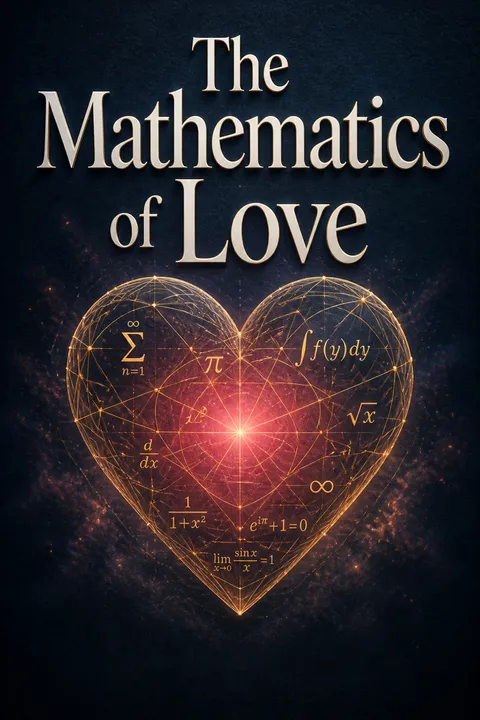


Key Takeaways
Use mathematics to spot love’s patterns, not to predict your destiny
A model is a map. Hannah Fry uses mathematics to make the patterns in dating, attraction, and relationships easier to see. It can estimate how many potential partners might fit a set of criteria, or describe how a couple’s argument can spiral. It cannot calculate the meaning of a particular glance or guarantee a happy marriage. Each equation simplifies reality, leaving out some human detail in exchange for a clearer view of a pattern.
Useful, not infallible. The book’s central promise is that abstraction can reveal something real without reproducing all of reality. Its examples range from matchmaking algorithms to wedding seating plans, and each depends on assumptions that readers should inspect before applying the result.
This is a valuable distinction between prediction and explanation. A model can help people notice what they otherwise miss, much as a map makes a route legible without containing the landscape. The danger is treating numerical output as neutral truth: estimates reflect the categories and assumptions chosen by whoever built them. Fry’s approach is strongest when the math sharpens a question, not when it is mistaken for a verdict on an individual.
Drop minor deal-breakers before they shrink your dating pool to almost nothing
Small filters multiply. Peter Backus adapted the Drake equation, a method for estimating extraterrestrial civilizations by multiplying several uncertain factors, to estimate how many women might meet his dating criteria in London. His assumptions left him with 26 candidates. Fry’s more generous estimates produced 832. The point is not that either count is a verified census. It is that each extra requirement sharply reduces the pool.
Keep only essentials. Backus’s criteria included age, being single, education, attractiveness, mutual attraction, and getting along. Relaxing even one filter, or searching beyond London, expanded his estimate. The practical advice is to distinguish genuine needs from preferences that merely sound decisive on paper. A checklist can screen out promising people before real interaction has a chance to revise it.
This is a compact demonstration of how compound probabilities can make a long list of preferences self-defeating. The method also exposes a subtle issue: the apparent precision of 26 or 832 can distract from how subjective the inputs are. Its real strength is not the final number, but the invitation to ask which filters matter enough to justify their cost. That question applies well beyond dating.
Treat beauty standards as tendencies, not a golden-ratio face formula
One ratio cannot explain beauty. The popular claim that an ideal face follows the golden ratio, about 1.618, sounds scientific but depends on flexible measurements and selective examples. Fry argues that finding a pattern after measuring many facial features does not prove that the pattern causes attractiveness.
Preferences have patterns, too. Research discussed in the book links attractiveness ratings with average facial features, symmetry, and traits associated with sex hormones. Yet preferences differ across people and cultures, and some observers value facial features that depart from the supposed ideal. A face may also appeal because it seems to signal personality traits someone wants in a partner. Beauty, then, has recurring influences, but no single measurement settles the question.
The chapter models an important scientific habit: a theory earns credibility by surviving attempts to disprove it, not by accumulating flattering examples. At the same time, evolutionary explanations can make complicated preferences sound more settled than they are. A proposed link between appearance and health or fertility does not mean every observer is consciously evaluating those traits. The useful conclusion is modest: patterns influence taste, but they do not erase individual judgment.
Notice how the available alternatives change whom people find attractive
Comparison shapes choice. In a decoy effect, adding an inferior option can make a nearby alternative seem more appealing. A cinema’s large popcorn may look overpriced until a medium size makes it seem like a bargain. The book describes an experiment by Dan Ariely in which students compared photos of two men, Adam and Ben, alongside an altered, less attractive version of one of them. Among 600 students, 75 percent preferred the man whose altered look-alike appeared beside him.
Context matters. The effect suggests that people often judge attractiveness relative to the options in front of them, not against every person in the world. Fry presents a slightly less attractive companion as a way to benefit from this comparison. That tactic is deliberately strategic, not a measure of someone’s underlying worth.
The decoy effect reveals that preference is partly relational: people do not always carry a stable ranking into every situation. This insight matters in marketing, interface design, and dating, where the arrangement of choices can shape decisions. Its ethical edge deserves attention. Using a friend as a comparison tool may produce an advantage, but it treats both the companion and potential dates as instruments. Understanding influence is useful; exploiting it is a separate choice.
Approach people instead of waiting for the best available offer
Proposers gain leverage. The Gale-Shapley algorithm solves a matching problem by having one group approach preferred partners in order, while the other accepts or rejects offers. In the book’s party example, changing which group proposes changes who gets their top choices. The proposing group ends up with the best partners available to them; those who wait receive the least bad among the people who approach.
The idea travels. The US National Resident Matching Program uses a version of this matching process to pair doctors with training positions. The book says the system changed who did the proposing after the initial arrangement left doctors dissatisfied. In everyday dating, the lesson is not that every rejection is harmless. It is that initiative creates more opportunities to discover mutual interest.
The matching result makes a useful point about agency: the person who acts first can search more widely, while the person who waits is limited to incoming offers. But the algorithm assumes fixed preferences and orderly, one-to-one matching. Real people change their minds, have unequal power, and may prefer no match at all. The model is best used to challenge passivity, not to treat relationships as a market with guaranteed winners.
Use compatibility scores to start conversations, not certify a future together
Questionnaires have limits. OkCupid’s matching algorithm compares a user’s answers with the answers they want from a partner, weighting questions by importance. It can identify people who fit stated preferences, but the book argues that stated preferences do not reliably predict how two people will feel together.
A revealing test. OkCupid told some users they had a 90 percent match with people whose actual score was 30 percent. The claim raised initial messaging from 12.4 percent to 14.5 percent. Yet longer conversations occurred for 15 percent of the misled pairs and 17 percent of genuinely high-scoring pairs. The small difference suggests a score can encourage contact without proving chemistry or long-term compatibility.
Recommendation systems are good at ranking what users can describe, such as stated tastes, but attraction includes reactions people may not know how to report in advance. The book points to conversational synchrony, including people subtly mirroring language and body movement, as a richer signal. Even that should not be mistaken for certainty: a promising interaction is evidence about a moment, not a guarantee about a shared life.
Show what makes your profile distinctive, even if it divides opinion
Consensus is not the only route. OkCupid cofounder Christian Rudder examined attractiveness ratings and message counts among users. The data described in the book suggests that people who divided opinion could receive more messages than people who were rated as uniformly pleasant-looking. Some people might rate a distinctive profile highly, while others might reject it, but the strong positive reactions can still attract attention.
Choose honest specificity. This challenges the instinct to hide every unusual feature in a dating photo or profile. A carefully generic presentation may be easy to approve of and easy to overlook. Fry’s advice is to show the traits that make a person recognizable, rather than trying to appeal to everyone. The point is not to manufacture controversy, but to let compatible people see something real.
The finding resembles a broader principle in attention markets: distinctiveness helps people become memorable when an audience is overwhelmed with interchangeable options. It also suggests that rejection can be informative, separating genuine fit from broad but shallow approval. Still, message volume is not the same as relationship quality, and a pattern in one platform’s users may not generalize to every dating context. Visibility is a means, not the end.
Begin with cooperation, answer mistreatment proportionally, and forgive quickly
Repeated choices change incentives. The prisoner’s dilemma is a game in which two people can cooperate or defect. Defection can reward someone if the other cooperates, but mutual defection leaves both worse off. Fry applies this logic to relationships, where decisions are repeated rather than made once. A short-term advantage from betrayal can damage trust and make future cooperation less likely.
Use a simple response rule. Robert Axelrod’s tit for tat strategy begins cooperatively, then copies the other person’s previous move. In practical terms: communicate plainly, begin kindly, respond when someone takes advantage, and return to cooperation when the problem is addressed. The response should be proportionate. Endless punishment turns one mistake into an ongoing contest.
This strategy joins generosity with boundaries, avoiding the false choice between trusting everyone and retaliating at every slight. Repetition matters because each action communicates what future behavior can expect. Yet copying a partner’s move can misfire when people misunderstand each other or interpret silence differently. Clear explanation is therefore not a soft extra; it helps distinguish deliberate exploitation from a mistake before retaliation hardens into a pattern.
For disease prevention, find network hubs through the people connected to them
Some connections matter more. A sexual-contact network represents people as nodes and sexual encounters as links. The Swedish survey discussed in the book questioned 2,810 people and found that most reported relatively few partners, while a small number reported many. The authors describe this uneven pattern as a power-law distribution, unlike the tighter spread seen in measures such as height.
Use connections to locate hubs. In a scale-free network, a few highly connected people act as hubs. They can be especially important in the spread of sexually transmitted infections. If the network is hidden, selecting a person at random and asking them to identify a highly connected contact improves the chance of finding a hub. This can help direct limited prevention resources where they may have greater effect.
The network view shifts attention from individual risk to the structure through which risk travels. It explains why a small number of highly connected nodes can have disproportionate influence, and why a random survey may miss them. Targeting hubs can improve efficiency, but prevention must avoid turning people into stigmatized vectors. Network-based outreach works best when it expands access to care and information rather than assigning blame.
Reject an early portion of the field, then choose the next best fit
The stopping rule. Optimal stopping theory studies when to stop searching when rejected options cannot be recovered. In the classic secretary problem, if the total number of candidates is known, the best chance of selecting the top candidate comes from rejecting roughly the first 37 percent, then choosing the next one better than all seen so far. In a dating example with 20 potential partners, the book gives a rejection phase of eight people and a success chance of about 38 percent.
The target changes the timing. If someone would accept a partner in the top 5 percent rather than only the single best, the book’s simulation suggests rejecting 22 percent of the search period raises the chance of success to 57 percent. These results rely on simplified assumptions, including a defined search window.
The rule’s deeper value is to make search costs visible. Without a stopping point, people can keep comparing indefinitely; with too early a cutoff, they may settle without a useful sense of their options. Real dating does not provide a known list or fixed supply of candidates, so 37 percent is not a personal commandment. The model is more helpful as a prompt to decide how much exploration is enough.
Use probabilities and explicit priorities to plan guests and seating
Estimate attendance before inviting. Fry suggests ranking invitees by importance, estimating each group’s chance of attending, and adding those expected attendance counts until the venue limit is reached. Because probabilities create uncertainty, planners can also estimate the risk of exceeding capacity instead of relying only on the average. A couple, Damjan Vukcevic and Joan Ko, used this approach for 139 invitations; their model expected 106 attendees, and 105 came.
Define what a good table means. For seating, assign scores to how well guests would get along and use an optimization algorithm to find a high-scoring arrangement. The number of possible seating plans grows rapidly, so checking each one by hand becomes impractical. The method offers a defensible starting point, not a guarantee of a perfect party.
Wedding planning shows how optimization depends on translating vague goals into measurable ones. A seating plan can only maximize the happiness represented in its scoring system; it cannot know every private tension or changing friendship. The same caution applies to attendance estimates, where inaccurate probabilities can create false confidence. The benefit is still substantial: explicit assumptions make disagreements easier to discuss than intuition disguised as certainty.
Repair small conflicts early instead of saving them for a blowup
Arguments have dynamics. Psychologist John Gottman and mathematician James Murray modeled how each partner’s mood and responses influence the next turn in a conversation. Their work built on observations of couples’ speech, expressions, and physical reactions. The book reports that a more detailed scoring system, the Specific Affect Coding System, helped researchers predict divorce with up to 90 percent accuracy in their observed conversations.
Small repairs matter. A surprising result was that successful couples had low negativity thresholds: they raised minor irritations rather than suppressing them until resentment accumulated. Their interactions also showed more positive than negative behavior. The lesson is not to criticize constantly. It is to raise problems openly and respectfully, while they are still manageable.
This model captures a feedback loop: one partner’s response changes the conditions for the other’s next response, so a conversation can amplify warmth or hostility. It also helps explain why a small repair can matter more than a grand gesture after a conflict has escalated. A low threshold should not be confused with hypervigilance or constant complaint. The crucial distinction is whether raising an issue invites repair or becomes another form of attack.
Analysis
The book’s strongest contribution is not a mathematical recipe for romance. It is a demonstration of what models can do when an emotionally complicated subject is made precise enough to examine. Across dating pools, matching systems, sexual networks, and marital conflict, Fry repeatedly turns an intuitive question into a tractable one: What is being counted? Which choices are constrained? What pattern appears when many individual decisions accumulate?
That method produces memorable reversals. More choice can make selection harder. A person who initiates can gain an advantage over someone who waits. An imperfectly rated dating profile may attract more attention than a broadly approved one. Minor grievances, addressed constructively, may be safer than silence. These are not universal laws. They are conditional findings, useful because their assumptions can be inspected.
The book also reveals a tension inherent in quantifying human relationships. A number can make a hidden mechanism visible, but it can also make subjective inputs look objective. Backus’s partner count depends on what qualifies as attractive or compatible. A wedding seating score reflects whoever assigns the points. A compatibility percentage can accurately calculate agreement with stated preferences while missing what people cannot yet articulate. Precision in arithmetic does not guarantee precision in meaning.
The most responsible way to use these ideas is as a set of lenses. A model can expose the cost of excessive filters, clarify why initiative matters, or show how network structure affects disease prevention. It cannot decide whom to love, nor should it turn partners into optimization targets. The book’s most durable insight is therefore methodological: simplify carefully, learn from the pattern, and then return to the human context the equation had to leave out. Mathematics makes love more legible, not less human.
Review Summary
The Mathematics of Love receives mostly positive reviews for its engaging and accessible approach to applying mathematical concepts to relationships and dating. Readers appreciate Fry's wit, humor, and clear explanations of complex ideas. Many find the book entertaining and thought-provoking, though some wish for more depth or practical advice. The book covers topics like online dating algorithms, game theory in courtship, and statistical patterns in sexual behavior. While some readers question the applicability of math to love, most enjoy the unique perspective and find it a quick, enjoyable read.
Glossary
Fermi estimation
Estimate through smaller questionsA method for estimating a difficult quantity by breaking it into smaller factors that can be approximated separately. In the book, Peter Backus uses this approach to estimate the number of potential partners who meet his criteria. The result is not a precise count; the value lies in making assumptions visible and showing how they combine.
Decoy effect
A choice altered by comparisonA decision-making effect in which adding an inferior or less attractive option changes how people evaluate the other available choices. Fry illustrates it with pricing and an experiment using altered photographs of men. The decoy does not need to be selected itself to influence preference.
Stable marriage problem
Pairing without mutual defectionsA mathematical matching problem in which members of two groups rank potential partners and are paired so that no two people would both prefer to leave their assigned partners for each other. It is an abstract model of matching, not a complete account of real romantic relationships.
Gale-Shapley algorithm
A procedure for stable matchingA method for creating stable pairings through repeated proposals and rejections. One group proposes to its preferred available choices, while the other temporarily holds its preferred offer and rejects the rest. The proposing side receives its best stable matches under the algorithm, making the choice of proposer consequential.
Non-conscious synchrony
Unplanned conversational coordinationSubtle matching between people during interaction, such as similarities in language patterns, body movement, pupil response, or laughter. The book discusses this as a possible indicator of connection that questionnaires may not capture. It is an observed pattern, not a guarantee of long-term compatibility.
Scale-free
Network with highly connected hubsA network structure in which most nodes have relatively few links, while a small number have many. This uneven distribution can produce a power-law pattern. In the book’s discussion of sexual-contact networks, highly connected people can play an outsized role in how infections spread.
Tit for tat
Cooperate, then mirror behaviorA strategy for repeated interactions that begins cooperatively and then responds in kind to the other party’s previous action. Applied to relationships, it means acting plainly and kindly, resisting exploitation with a proportionate response, and returning to cooperation after the issue is addressed.
Optimal stopping theory
Choose when to stop searchingA branch of mathematics concerned with selecting the best time to stop a sequence of options when rejected choices cannot be revisited. The book applies it to dating through a simplified search problem, where an initial period of observation is followed by choosing an option better than those seen before.
Monte Carlo simulation
Compare outcomes through random trialsA computational technique that repeats a process many times using randomized inputs to estimate how different strategies perform. Fry uses it to compare rejection periods when a searcher would accept a partner from a high-ranked group, rather than insisting on selecting the single best possible partner.
Specific Affect Coding System
Codes behavior during couple conversationsA system used by Gottman and colleagues to classify emotional behaviors in couples’ interactions, including positive signals such as affection and humor, and negative signals such as contempt or defensiveness. The book describes how a detailed version helped researchers study conflict patterns and predict relationship outcomes.
FAQ
What’s "The Mathematics of Love" by Hannah Fry about?
- Explores love through mathematics: The book examines how mathematical concepts and models can be applied to understand patterns in dating, attraction, relationships, and marriage.
- Real-world scenarios: Fry uses relatable examples, from online dating to wedding planning, to illustrate how math can provide insights into human behavior.
- Accessible and engaging: Written for a general audience, the book demystifies mathematics and shows its relevance to everyday life, especially in the context of love.
- Not a replacement for romance: Fry clarifies that her aim is to offer a new perspective, not to replace the emotional or artistic aspects of love.
Why should I read "The Mathematics of Love" by Hannah Fry?
- Unique perspective on love: The book offers a fresh, analytical approach to the age-old topic of love, making it appealing to both math enthusiasts and romantics.
- Practical advice: Readers gain actionable insights, such as how to improve online dating profiles, optimize wedding guest lists, and decide when to settle down.
- Demystifies mathematics: Fry aims to show the beauty and relevance of math, helping to overcome its negative reputation and make it more approachable.
- Entertaining and insightful: The book is filled with humor, real-life anecdotes, and surprising findings that make complex concepts enjoyable to learn.
What are the key takeaways from "The Mathematics of Love" by Hannah Fry?
- Patterns govern love: Mathematical models reveal underlying patterns in dating, attraction, and relationships that can inform better decision-making.
- Openness increases chances: Being less rigid with dating criteria significantly expands the pool of potential partners, as shown by the adaptation of the Drake Equation.
- Initiative pays off: Those who take the initiative in dating scenarios (e.g., approaching others) statistically achieve better outcomes, as demonstrated by the stable marriage problem.
- Math can optimize romance: From choosing profile pictures to planning weddings, mathematical thinking can help maximize happiness and minimize stress in love-related situations.
How does Hannah Fry use mathematics to calculate your chances of finding love?
- Adapts the Drake Equation: Fry discusses Peter Backus’s adaptation of the Drake Equation (originally for estimating alien civilizations) to estimate the number of potential partners.
- Breaks down criteria: The method involves multiplying probabilities for each criterion (location, age, education, attractiveness, mutual interest, compatibility) to estimate the pool size.
- Highlights selectivity: The more criteria you add, the smaller your pool becomes—sometimes to near zero if you’re too picky.
- Encourages flexibility: Relaxing certain requirements (e.g., education level or location) can dramatically increase your chances of finding a partner.
What does "The Mathematics of Love" by Hannah Fry say about the importance of beauty and attraction?
- Debunks the golden ratio myth: Fry explains that while the golden ratio is often linked to beauty, scientific evidence for its role in human attractiveness is weak.
- Evolutionary factors: Preferences for average faces, facial symmetry, and hormone-related features are rooted in evolutionary signals of health and fertility.
- Personal preferences matter: Despite universal trends, individual tastes and personality cues play a significant role in attraction.
- The decoy effect: Mathematical concepts like the decoy effect show how context and comparison can influence perceptions of attractiveness in social settings.
How does "The Mathematics of Love" by Hannah Fry explain the best strategies for approaching people and maximizing success in dating scenarios?
- Game theory insights: The book uses game theory (e.g., the stable marriage problem) to show that those who do the asking (approaching others) end up with better matches.
- The Gale-Shapley algorithm: This algorithm demonstrates that the group initiating contact secures more favorable outcomes, whether in dating or job placements.
- Take the initiative: Fry’s advice is to be proactive—approaching people increases your chances of finding a desirable partner.
- Real-world applications: The principles apply beyond dating, influencing systems like medical residency placements and school assignments.
What mathematical advice does Hannah Fry give for online dating in "The Mathematics of Love"?
- Matchmaking algorithms: Fry explains how sites like OkCupid use algorithms based on user questionnaires to calculate compatibility scores.
- Limitations of data: She notes that while algorithms can filter for preferences, they struggle to predict real-life chemistry and long-term compatibility.
- The power of perception: Experiments show that users are more likely to engage when told they’re a good match, even if the algorithm disagrees.
- Stand out, don’t blend in: Statistical analysis reveals that polarizing profile pictures (ones some people love and others dislike) attract more messages than universally “pretty” ones.
How does "The Mathematics of Love" by Hannah Fry use mathematical models to analyze sexual networks and the spread of STDs?
- Power-law distributions: Fry discusses how the number of sexual partners follows a power-law distribution, with a few individuals (hubs) having many partners.
- Network theory: These hubs play a critical role in the spread of sexually transmitted diseases, making them key targets for intervention.
- Efficient targeting: A simple algorithm—asking people to name a partner—can quickly identify hubs for vaccination or education, maximizing impact.
- Broader implications: The same network principles apply to social media, language, and other human connections, illustrating the universality of mathematical patterns.
What is the "optimal stopping theory" and how does Hannah Fry apply it to deciding when to settle down in "The Mathematics of Love"?
- The secretary problem: Fry introduces optimal stopping theory, which provides a strategy for choosing the best option (e.g., life partner) from a sequence of candidates.
- The 37% rule: The math suggests you should reject the first 37% of your dating window, then choose the next person who’s better than all previous ones.
- Balancing risk and reward: This approach maximizes your chances of picking the best partner, but comes with risks if your ideal appears early or late.
- Adaptable strategy: The theory can be adjusted for those willing to settle for “good enough” rather than the absolute best, increasing the odds of satisfaction.
How can mathematics help optimize wedding planning, according to "The Mathematics of Love" by Hannah Fry?
- Guest list management: Fry suggests using probability and expected value calculations to estimate how many guests will actually attend, reducing stress over RSVPs.
- Table seating optimization: Assigning happiness scores to guest pairings and using optimization algorithms can help create harmonious seating arrangements.
- Real-world examples: The book shares stories of couples who used mathematical models and software to plan their weddings efficiently.
- Minimizing risk: Mathematical planning helps balance the risk of over- or under-attendance and avoids social faux pas like seating enemies together.
What does "The Mathematics of Love" by Hannah Fry reveal about long-term relationship success and conflict resolution?
- Mathematical modeling of arguments: Fry discusses John Gottman and James Murray’s equations that model how couples influence each other’s positivity or negativity during conflict.
- The negativity threshold: Successful couples have a low threshold for addressing issues, meaning they resolve small problems before they escalate.
- Positive reinforcement: Happy couples interpret each other’s actions positively and repair negativity quickly, preventing downward spirals.
- Practical self-assessment: Fry encourages couples to score their own interactions to identify patterns and improve communication.
What are the best quotes from "The Mathematics of Love" by Hannah Fry and what do they mean?
- “All models are wrong, but some are useful.” – George E. Box: Fry uses this quote to emphasize that mathematical models simplify reality, but can still provide valuable insights.
- “Mathematics is the language of nature.”: This highlights Fry’s central thesis that math can describe patterns in even the most human of experiences, like love.
- “If you can handle the occasional cringe-inducing rejection, ultimately, taking the initiative will see you rewarded.”: Fry encourages readers to be proactive in love, as math shows it leads to better outcomes.
- “So be proud of that bald patch, show off that ill-advised tattoo and get that belly out. Because standing out online just means being yourself.”: This quote encapsulates the counterintuitive finding that being polarizing (rather than universally appealing) can make you more successful in online dating.
About the Author

Download PDF
Download EPUB
.epub digital book format is ideal for reading ebooks on phones, tablets, and e-readers.








