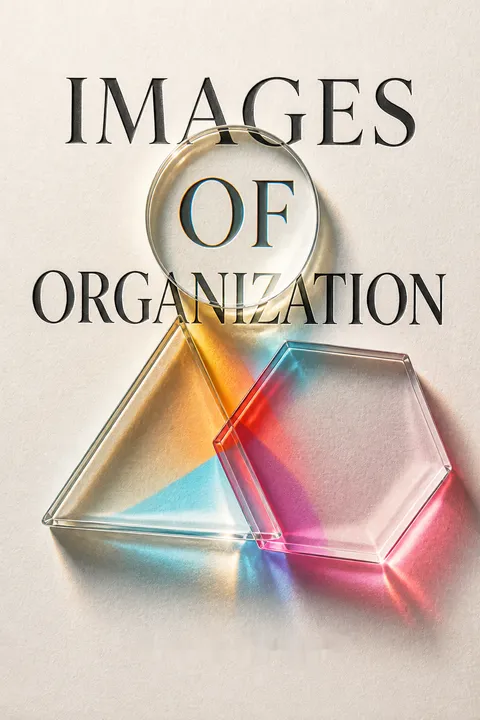


Key Takeaways
Treat every management theory as a useful lens, never the whole organization
A lens, not a verdict. Morgan's central claim is that theories of organization work like metaphors: each helps people notice some features while pushing others out of view. Calling a company a machine highlights structure and efficiency, but obscures its people, politics, and culture. No single image provides a complete account, and each can mislead when treated as literal truth.
The gardener's warning. In an old Chinese story, a traveler offers an exhausted gardener a water-lifting device. The gardener refuses, fearing that dependence on machinery will change the way he works and thinks. The tale introduces the book's recurring question: What does a way of organizing make possible, and what does it crowd out? The practical task is to move between perspectives, not pledge allegiance to one.
What's striking is that the book treats interpretation as a management skill, not an academic prelude. A perspective can uncover a neglected problem, but its usefulness depends on what it helps people understand and do. This is more disciplined than simply calling every theory partly true. The harder question is which lens best serves the situation, and what it hides in the process. That keeps analysis open without reducing it to relativism.
Reserve machine-like control for stable work with repeatable outputs
Where machinery excels. The machine metaphor treats an organization as coordinated parts designed to produce a defined result. Frederick the Great applied military methods such as ranks, standardized equipment, and drills to make soldiers more predictable. Later, classical management theorists applied similar principles to businesses, while Frederick Taylor broke jobs into measured tasks and left planning to managers.
Efficiency has a price. Standard procedures work well when tasks are predictable, precision matters, and products should be nearly identical. Fast-food chains illustrate the advantage of tightly specified service. But when Taylorist methods reached an automobile plant, worker turnover reportedly rose to about 380 percent; Ford doubled daily wages to stabilize the workforce. Mechanistic designs can be efficient, yet brittle in changing conditions and dehumanizing when people are treated as replaceable components.
The machine image is powerful because it identifies the genuine value of repeatability. In safety-critical operations, clear procedures and defined responsibility can prevent serious errors. The risk begins when efficiency becomes the only measure of performance. A workplace can meet its output targets while losing initiative, learning, and worker commitment. The useful distinction is not between good and bad control, but between controls fitted to a task and controls that outlive their purpose.
Match structure to uncertainty, then keep testing the fit
Organizations need a habitat. The organism metaphor views firms as living systems that depend on exchanges with their surroundings. The open-systems approach asks managers to consider customers, technology, suppliers, and other conditions, as well as the organization's internal needs. Contingency theory follows from this: there is no universally best structure; effectiveness depends on the fit among environment, strategy, technology, people, and organization.
Different conditions, different forms. Burns and Stalker contrasted a stable rayon mill, with clearly defined roles and rules, with electronics firms facing rapid technological and market change. The latter needed flexible communication and less rigid job boundaries. Lawrence and Lorsch added that different departments within one organization may need different degrees of structure. The lesson is to diagnose conditions at both organizational and subunit levels, then revise arrangements when the work or environment changes.
This perspective replaces the search for a universal management recipe with a diagnostic question: what demands is this unit actually facing? It also connects strategy to work design, rather than treating structure as an end in itself. A caution is necessary, though. Environments do not dictate organizational form like weather dictates a species' habitat. Leaders and institutions help shape the conditions they later describe as external constraints.
Teach the organization to question its rules, not just correct errors
Two levels of learning. Cybernetics studies how systems use information and feedback to regulate their behavior. A thermostat corrects deviations from its preset temperature, but cannot decide whether that temperature should change. Organizations can behave similarly: budgets and targets help keep operations on course, yet may preserve outdated assumptions. Single-loop learning corrects performance within existing rules; double-loop learning questions the rules themselves.
Build learning into decisions. Japanese firms' ringi process circulates proposals among managers, inviting revisions before agreement. It can test assumptions and expose problems from several viewpoints, though it may take time. More broadly, a learning organization scans its environment, tests its operating assumptions, and makes room for local initiative. Holographic organization is a design ideal in which each part carries important capacities of the whole, rather than depending entirely on central control.
The distinction between correcting an error and questioning the standard that defines error is consequential. It helps explain why a company can become more efficient at doing something increasingly irrelevant. The ringi example also shows that learning is social: assumptions become visible when people with different roles examine the same proposal. Yet consensus procedures are not automatically wise. Their value depends on whether dissent can change a decision, rather than merely decorate it.
Make shared meaning visible in the routines people actually live
Culture is practiced. An organizational culture is a shared system of meanings, values, and habits through which members interpret events and decide how to act. It is not just a slogan or a leader's preferred image. Matsushita, for example, used stated business principles and recurring employee rituals to connect work with service, cooperation, and improvement.
The informal pattern matters. An insurance company studied by Linda Smircich publicly celebrated harmony while employees privately expressed deep dissatisfaction. Meetings and rituals maintained the appearance of unity, but discouraged frank discussion. The case shows why managers should observe everyday language, routines, and subcultures, not just formal statements. Culture can support flexibility when people share a clear purpose, or conceal conflict when public agreement becomes more important than honest debate.
Culture makes organization possible without requiring a rule for every interaction. Shared assumptions help people coordinate and adapt. But the insurance company example warns against mistaking visible harmony for genuine agreement. A strong culture can make collaboration easier while also making dissent costly. Because meaning is created across daily interactions, leaders influence culture, but cannot simply manufacture it by announcing new values.
Map task, career, and personal interests before calling conflict dysfunctional
Politics is already present. Morgan uses the political metaphor to view organizations as systems where people have different interests and unequal sources of power. An individual's interests may concern the task, career ambitions, or personal life outside work. These motives can overlap, compete, or remain separate, so the same proposal may look useful to one person and threatening to another.
Follow the power. In the Multicom case, four partners disagreed over whether a successful public-relations firm should retain its informal style or become more structured. The disagreement reflected different preferences, life circumstances, and control over the company. Organizational power can come from formal authority, scarce resources, information, expertise, technology, or alliances. Mapping these forces helps distinguish substantive conflict from the claim that everyone should simply share one goal.
This frame helps explain why apparently technical choices, such as who controls a budget or approves a project, can carry personal stakes. Naming those stakes can make negotiation more honest and expose who has influence. The pluralist view, however, can overstate how freely interests compete. In workplaces marked by large differences in status or security, some people have far fewer ways to make their preferences count.
Question the identity that makes your organization mistake itself for its environment
Identity shapes attention. Autopoiesis is the idea that a system continually reproduces its own organization through interconnected processes. Applied as a metaphor, it suggests that organizations interpret their surroundings through the identities they are trying to preserve. An organization that sees itself as a typewriter maker may overlook changes that redefine what its business could be.
The environment is not wholly separate. American automakers were slow to recognize the opportunity in smaller, fuel-efficient cars, while IBM's focus on large computer hardware made the personal-computer shift harder to see. In each case, familiar strengths helped define a narrow picture of reality. Morgan's challenge is to examine how an organization's actions help shape its context, and whether preserving an old identity is blocking a more viable one.
The idea of self-reference is a useful corrective to the habit of blaming every difficulty on an external environment. Organizational expectations shape what leaders notice, measure, and treat as possible. That does not mean firms can control their surroundings, or that every failure is self-created. It means external analysis should be paired with a candid examination of the identity and assumptions through which the organization interprets change.
Treat small interventions as probes into systems, not guaranteed fixes
Trace the pattern. Feedback loops and dialectical change offer ways to explain how events amplify or counteract each other. In Britain's mad-cow crisis, government reassurances, media attention, public fear, and delayed action reinforced one another until the beef market collapsed. Looking only for one culprit would miss the interaction that escalated the crisis.
Change the context. Chaos and complexity theories suggest that small events can sometimes shift a system toward a different pattern, but the result is uncertain. Dialectical analysis adds that each solution can create a new problem: a drive to reduce costs, for example, can weaken the workforce or the market on which future success depends. Managers can map key feedback and tensions, then test interventions that may alter the pattern, rather than assume they control the outcome.
The strongest practical contribution is a shift from asking which isolated factor caused a problem to asking which relationships keep reproducing it. This encourages interventions that generate information as well as action. The caution is that attractors and feedback loops are explanatory models, not reliable prediction machines. Their value lies in improving attention to connections and unintended consequences, not in promising that a manager can steer a complex system precisely.
Follow the profit trail to see who pays for corporate efficiency
Rational for whom? The domination metaphor asks who gains from organizational decisions and who carries their costs. Arthur Miller's salesman Willy Loman gives this pattern a human face: after decades of service, his employer no longer sees a use for him. The wider concern includes unsafe work, occupational disease, and the transfer of production to lower-wage regions.
Look beyond the balance sheet. Morgan reports that multinational corporations accounted for over 70 percent of world trade and describes how their decisions could reshape communities and host economies. The 1984 Bhopal gas disaster, which killed more than 2,500 people according to the text, illustrates the stakes of industrial hazards. Efficiency can be valuable, but its social consequences should be assessed alongside profits, including who is exposed to danger and who has power to seek accountability.
This lens forces a question that efficiency measures often leave unanswered: whose welfare counts in the calculation? It connects workplace conditions, community stability, and corporate strategy instead of treating them as separate topics. The frame is most useful when it distinguishes deliberate exploitation from harmful outcomes produced by incentives and weak accountability. Either way, tracing costs beyond the firm makes responsibility harder to evade.
Analysis
Images of Organization is less a management manual than a guide to changing the questions managers ask. Its eight metaphors move from the machine's demand for precision through the organism's concern with adaptation, the brain's capacity to learn, and the culture's shared meanings, then into politics, unconscious constraint, transformation, and domination. The sequence broadens the reader's field of vision. Each image has explanatory force, but no image can stand as a complete theory of organizational life.
The book's most durable contribution is its method of disciplined pluralism. A manager facing conflict can examine interests and power, but also ask whether the organization is trapped by an identity, a culture, or a structure designed for more stable conditions. This does not mean applying every metaphor mechanically. The point is to use competing images to reveal overlooked mechanisms and then select a practical course of action with awareness of what that choice leaves unseen.
The framework is especially relevant where organizations operate through data systems, digital platforms, and distributed teams. Such systems can make work more adaptable, but they can also centralize surveillance and decision power. The brain metaphor's promise of distributed intelligence therefore sits in tension with the political and domination metaphors: connectivity alone does not create participation. Who controls information, defines performance, and can challenge the rules remain decisive questions.
A limitation is that the metaphors do not supply equal levels of evidence or equally precise predictions. The organism image can make historically created arrangements sound natural, while the political and domination images can tempt readers to interpret every action as strategic self-interest. Morgan's own method offers the correction: treat each view as partial, test it against the particular situation, and look for the consequences of acting on it. The book's final lesson is practical and demanding. Better management begins not with a perfect model, but with the ability to see what a favored model hides.
Review Summary
Images of Organization receives mostly positive reviews, with readers praising its insightful metaphors for understanding organizations. Many find it thought-provoking and valuable for analyzing business structures. Some criticize its idealistic approach and lack of empirical evidence. Readers appreciate the book's creative perspectives but note it can be dense and academic. It's considered essential reading for those interested in organizational theory, though some find it challenging as an introductory text. Overall, reviewers commend its ability to provide new lenses for examining organizational behavior and management.
People Also Read






Glossary
Metaphor
A lens for understandingMorgan uses metaphor as a way to understand one aspect of experience through another. Calling an organization a machine, organism, or brain directs attention to different qualities and suggests different actions. Every metaphor illuminates some features while obscuring others, so it should be treated as a partial interpretive tool, not a literal description or complete theory.
Autopoiesis
Self-producing system organizationA theory of living systems developed by Humberto Maturana and Francisco Varela. It describes systems as reproducing their organization through interconnected, self-referential processes. Morgan applies it metaphorically to organizations: their identities shape how they interpret and engage their environments. The concept draws attention to how an organization can reproduce its familiar patterns, even when circumstances are changing.
Single-loop learning
Correcting errors within rulesA learning process in which a system detects a gap between performance and an established standard, then corrects the gap without questioning the standard itself. A thermostat that restores a preset temperature illustrates the basic logic. In organizations, monitoring budgets or targets can support this kind of correction while leaving the assumptions behind those targets unchanged.
Double-loop learning
Questioning the rules themselvesA learning process in which people examine not only whether actions meet existing standards, but whether those standards and assumptions remain appropriate. It allows an organization to revise the rules that guide its behavior. Morgan presents it as essential for adapting to changing conditions and as more demanding than simply correcting errors within established procedures.
Requisite variety
Match internal capacity to complexityA cybernetic principle associated with W. Ross Ashby. It holds that a system needs sufficient internal variety to respond to the variety of challenges in its environment. In organizational design, a team or unit needs the relevant skills, information, and decision capacity to deal with its work, rather than depending on distant authorities to manage every variation.
Holographic organization
The whole represented in partsAn organizational design ideal inspired by holography and the brain. Important capacities of the whole are distributed across its parts, enabling local units to respond and reorganize rather than relying entirely on central direction. Morgan connects this ideal to shared purpose, accessible information, overlapping skills, redundancy, and enough autonomy for learning and innovation.
Psychic prison
A self-made mental constraintA metaphor for the way people and organizations can become trapped by their own assumptions, beliefs, identities, or unconscious defenses. Familiar arrangements may feel inevitable even when they are damaging or obsolete. The image encourages examination of the hidden psychological and cognitive processes that shape organizational behavior and resistance to change.
Attractor
A pattern drawing system behaviorIn chaos and complexity theory, an attractor describes a pattern or range of states toward which a system's behavior tends. Morgan uses it as a metaphor for organizational contexts shaped by assumptions, structures, culture, and other rules. A system can remain within an established pattern or, under changing conditions, shift toward a different one.
Dialectical change
Change driven by opposing forcesA view of change in which a situation contains tensions that can generate its own transformation. Drawing on dialectical thought, Morgan emphasizes that actions may produce opposing reactions, that one solution can create new problems, and that cumulative changes can alter the character of a system. It directs attention to contradictions rather than isolated causes.
Sociotechnical system
Interdependent social and technical workA way of understanding work as a joint arrangement of technical processes and human relationships. Changes in machinery, task design, or organizational structure affect people's roles and interactions; human needs also influence how technology works in practice. The approach encourages managers to design social and technical elements together rather than optimize one while ignoring the other.
Organizational ecology
Interdependent organizational relationshipsA perspective that examines organizations as parts of a wider field of relationships, rather than as isolated entities adapting to external forces. It emphasizes that organizations can both compete and collaborate, and that their interactions help shape the conditions in which they operate. The concept encourages attention to shared problems and possibilities for coordinated action.
FAQ
What's Images of Organization about?
- Exploration of Metaphors: Gareth Morgan's Images of Organization explores various metaphors to understand organizations, such as machines, organisms, brains, cultures, and political systems. Each metaphor offers a unique perspective on organizational dynamics.
- Focus on Change and Learning: The book emphasizes the importance of adaptability and learning in organizations, advocating for a shift from rigid structures to more flexible, organic models.
- Cultural and Contextual Influences: It discusses how culture and societal contexts shape organizational behavior, contrasting Western and Japanese organizational practices.
Why should I read Images of Organization?
- Comprehensive Framework: The book provides a robust framework for analyzing organizations through different metaphors, making it valuable for both students and practitioners.
- Practical Applications: Insights from the book can be applied to improve management practices, enhance learning, and foster adaptability in organizations.
- Timely Relevance: Its concepts remain relevant in the face of globalization and technological change, offering guidance for contemporary managers and leaders.
What are the key takeaways of Images of Organization?
- Metaphors Shape Understanding: Different metaphors lead to different theories of organization and management, each with its strengths and limitations.
- Importance of Adaptability: Organizations must learn and adapt to their environments, focusing on double-loop learning that challenges existing norms.
- Cultural Context Matters: The cultural context significantly influences organizational structure, behavior, and effectiveness.
What are the best quotes from Images of Organization and what do they mean?
- "Metaphors Create Ways of Seeing": This quote emphasizes that the metaphors we use shape our perceptions and actions within organizations, suggesting new insights can be gained by changing metaphors.
- "Organizations are open systems that need careful management": It highlights the necessity for organizations to be aware of their environments and adapt accordingly, underscoring flexibility and responsiveness.
- "Learning organizations must develop capacities that allow them to scan and anticipate change": This stresses the proactive nature of successful organizations, which must continuously monitor their environments and adjust strategies.
How does Gareth Morgan define a learning organization in Images of Organization?
- Continuous Learning and Adaptation: A learning organization actively seeks to learn from experiences and adapt to environmental changes, emphasizing double-loop learning.
- Empowerment and Autonomy: Such organizations empower members to take initiative and make decisions, fostering collaboration and innovation.
- Integration of Knowledge: They create systems that facilitate knowledge sharing across all levels, ensuring insights flow freely to support decision-making.
What is the significance of culture in Images of Organization?
- Culture Shapes Behavior: Culture is a fundamental aspect of organizational life, influencing interactions, decision-making, and role perceptions.
- Cultural Differences Matter: The book contrasts Western and Japanese management approaches, illustrating how cultural differences impact effectiveness and engagement.
- Creating a Cohesive Identity: A strong corporate culture unifies members around shared values and goals, enhancing commitment and performance.
How does Images of Organization address the concept of power within organizations?
- Organizations as Political Systems: The book discusses organizations as political entities where power dynamics play a crucial role in decision-making and resource allocation.
- Conflict and Cooperation: It highlights inherent conflicts from differing interests, suggesting management through negotiation and collaboration.
- Empowerment and Control: The text explores balancing empowerment and control, suggesting effective management requires navigating these tensions.
What is the machine metaphor in Images of Organization?
- Organizations as Machines: This metaphor views organizations as mechanistic entities with structured processes and hierarchies, emphasizing efficiency and control.
- Limitations: While useful for certain aspects, it can overlook human and social dimensions, potentially leading to rigid structures.
- Historical Context: Rooted in the Industrial Revolution, it highlights ongoing influences in contemporary management practices.
How does the organism metaphor differ from the machine metaphor in Images of Organization?
- Focus on Adaptability: The organism metaphor views organizations as living systems that evolve in response to their environments, contrasting with the rigid machine metaphor.
- Interconnectedness: It highlights the importance of relationships and interactions within the organization and with its environment.
- Management Implications: Suggests fostering a culture of learning and adaptability rather than strict control, promoting collaboration and innovation.
What is the brain metaphor in Images of Organization?
- Cognitive Processes: The brain metaphor likens organizations to cognitive systems that process information, learn, and adapt.
- Emergent Intelligence: It suggests organizations can exhibit emergent intelligence, where collective knowledge leads to innovative solutions.
- Practical Applications: Managers can enhance learning and adaptability by encouraging collaboration, knowledge sharing, and continuous improvement.
What are the implications of the domination metaphor for management in Images of Organization?
- Power Dynamics: Highlights power dynamics within organizations, emphasizing awareness of these dynamics to create equitable environments.
- Ethical Considerations: Encourages consideration of ethical implications in decisions, advocating for socially responsible management.
- Organizational Change: Informs strategies for change, addressing issues of inequality and exploitation, focusing on inclusive practices.
How can managers use metaphorical thinking in practice according to Images of Organization?
- Broaden Perspectives: Metaphorical thinking helps explore different organizational dimensions, leading to comprehensive insights.
- Integrate Insights: Drawing on multiple metaphors allows managers to develop effective strategies for complex challenges.
- Foster a Learning Culture: Encouraging metaphorical thinking promotes a culture of learning and exploration, empowering employees to contribute to growth.
Download PDF
Download EPUB
.epub digital book format is ideal for reading ebooks on phones, tablets, and e-readers.








