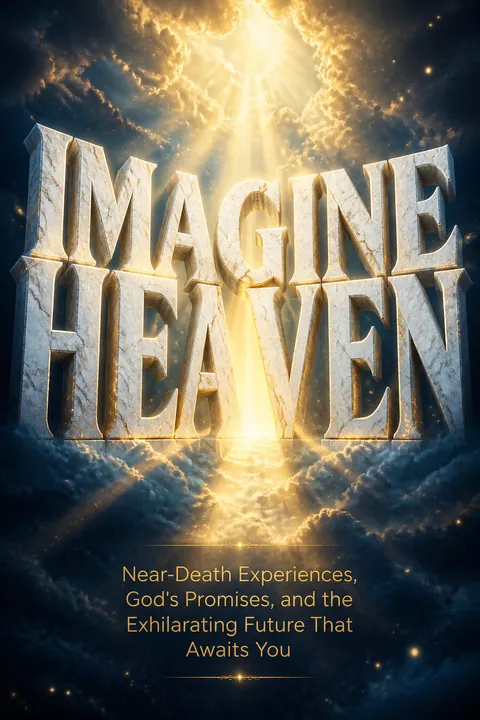


Key Takeaways
Read recurring NDEs as suggestive testimony, not settled proof of Heaven
A pattern, not a transcript. A near-death experience, or NDE, is a report from someone revived after a life-threatening crisis who describes consciousness apart from the body. John Burke opens with George Ritchie, an Army recruit who said he watched his own body, encountered a radiant presence, and returned after being declared dead. Ritchie’s account helped Raymond Moody popularize the term NDE in 1975.
The overlap is striking. In one collection of 1,300 reports, 75 percent described an out-of-body experience, 65 percent a brilliant light, and 22 percent a life review. Blind NDErs such as Vicki also reported visual-like perceptions, some checked against witnesses. Burke sees these recurring accounts as coloring in the Bible’s picture of Heaven, while warning that individual memories and interpretations can be mistaken.
What's striking is the distinction between a recurring report and an explanation of that report. Similar stories across different people deserve attention, especially when a witness describes details that others can check. But convergence alone does not establish that consciousness left the brain or that the destination was Heaven. The book is strongest when it treats accounts as testimony worth examining, and less conclusive when it treats their resemblance to Christian scripture as confirmation. That difference matters: readers can take the experiences seriously without being asked to treat them as laboratory proof.
Imagine Heaven as embodied life, not a cloud-bound escape
A body, but changed. Burke argues that the afterlife described by scripture and NDErs is not endless existence as a disembodied spirit. People report feeling recognizable, sensing more vividly, and moving without the injuries and limitations of their earthly bodies. Orthopedic surgeon Mary Neal, trapped underwater in a kayak accident, described leaving her injured body and feeling newly alive. Retired banker Marv Besteman said his age-related aches had vanished.
The hope is restoration. Burke distinguishes the spiritual body people may experience immediately after death from the later resurrection of the body and renewal of the earth. He reads Jesus’s resurrected body as the model: physical and touchable, yet no longer bound by ordinary limitations. This is a theological claim, not a medical finding. Its practical force is to make the body, nature, and ordinary pleasures part of the hoped-for future rather than things to escape.
An embodied vision of eternity counters the idea that spiritual life requires contempt for physical life. It also gives suffering bodies a place in the story: disability and pain are not treated as a person’s whole identity. Still, promises of perfect future bodies can land differently for people who cherish disability culture or fear that their present selves are being dismissed. The most humane reading holds both ideas together: bodies matter now, and hope for healing need not make present care, access, or inclusion less urgent.
Make love, not achievement, the measure of a life
Worth is not a résumé. Crystal, a teacher with a history of childhood abuse, said shame had become central to how she understood herself. During her NDE, she felt known without being reduced to what others had done to her or to the mistakes she had made. Burke connects this to George Ritchie’s life review, where the central question was not how impressive his career might become, but how he had loved.
Love gives purpose. The book presents the Being of Light as personal, fully aware of a person’s life, and radically compassionate. Burke identifies this figure with the God revealed through Jesus. He argues that secure worth comes from being loved by God, freeing people to love those around them rather than performing for approval. In this framework, purpose begins with relationship and shows itself in practical care for others.
This account offers a useful challenge to achievement-based self-worth: accomplishments can describe what someone has done without settling what that person is worth. Its emphasis on love also shifts morality from rule-keeping alone toward attention to other people’s experience. Yet affirming a person’s inherent worth should not erase responsibility for harm. The book’s most compelling version joins compassion with honest recognition: people can be loved, wounded, accountable, and capable of change at the same time.
Expect reunion to deepen relationships, not erase earthly bonds
The welcome is personal. Many NDErs describe meeting deceased relatives or friends. Don Piper, after a catastrophic car crash, said he was greeted by people who had shaped his life, including a beloved grandfather and a childhood friend. Burke cites the Kelly Study, in which 95 percent of people who reported meeting someone in an NDE said they encountered deceased relatives. He presents these accounts as support for relational continuity beyond death.
Family remains meaningful. The book addresses the fear that Heaven would dissolve close bonds into an undifferentiated love for everyone. Burke reads Jesus’s statement that people will not marry in the resurrection as a claim that marriage will not continue in its earthly form, not that loved ones become strangers. Reunion, family history, and the possibility of meeting relatives never known in life all form part of his picture of a larger spiritual family.
The promise of reunion speaks directly to grief, where the fear of losing a relationship can overshadow abstract arguments about an afterlife. The idea that love can widen without making particular bonds meaningless is psychologically and morally attractive. The cited study, however, describes reports from a selected group, not a census of what happens after death. The pastoral value of these stories can be real even for readers who remain uncertain about their evidential force.
Audit each choice by its ripple effects on other people
A life seen from outside. In a life review, an NDEr describes revisiting events from their life, sometimes with awareness of how other people felt and how actions affected them. Howard Storm, a former atheist, said he saw not only his own choices but their effects on his family. Mary Neal described seeing consequences that extended well beyond the people immediately involved. Burke says the review’s recurring moral focus is love expressed or withheld.
Small acts count. The review is not presented as the final judgment or as a simple tally of good and bad deeds. Instead, it offers a vivid picture of how ordinary decisions, private motives, and brief moments of kindness can matter. Burke uses this to challenge status-driven definitions of success: being present for a child or treating a stranger with care may have more lasting significance than public recognition.
The life-review idea turns empathy into a form of accountability: actions are judged not only by intent, but by their effects on people who may never have been able to explain the harm. That is a powerful corrective to self-serving memory. It also cautions against treating good intentions as proof that no injury was done. As a spiritual image, the review invites perspective-taking; as evidence about an afterlife, its vividness does not by itself verify that the event occurred outside the person’s mind.
Take disturbing NDEs seriously as warnings, while resisting certainty
Not every account is peaceful. Howard Storm, a skeptical professor, described a frightening experience in darkness with hostile figures before he called out for help and encountered a loving presence. Burke groups distressing accounts into experiences of emptiness, torment resembling earthly conflicts, and confinement in a threatening place. A survey of twelve studies involving 1,369 people found that 23 percent reported an NDE ranging from disturbing to terrifying.
Burke’s explanation is theological. He interprets hell as separation from God, the result of freely rejecting divine love and leadership. He also argues that suffering arises in a world where people can make harmful choices, while God suffers with people and intends suffering to end. These ideas help explain the book’s Christian framework, but the accounts themselves cannot establish that they describe hell, or explain why particular suffering occurs.
Including distressing experiences complicates the popular picture of NDEs as uniformly comforting. It also resists the temptation to dismiss testimony simply because it is frightening. The free-will explanation has force when suffering follows human cruelty, but it does not fully account for illness, natural disaster, or suffering imposed on those without meaningful agency. The book’s theological answer is best understood as a framework for hope, not a complete explanation that makes every tragedy intelligible.
Invest today's time and resources in work that outlasts you
Acceptance and reward differ. Burke distinguishes salvation, which he describes as a gift rather than payment for good behavior, from the rewards he believes follow a faithful life. He calls the evaluation of believers the bema seat, drawing on the ancient judge’s platform at athletic contests. In his reading, it is a recognition of what people have done, not a verdict on whether they deserve God’s love.
Faithfulness looks ordinary. The book says perseverance, seeking God, caring for people who are overlooked, developing others, doing honest work, and using money generously all matter. Jesus’s parable of servants entrusted with money illustrates the principle: those who used what they were given responsibly received greater responsibility. Burke’s point is that time, influence, and possessions are temporary trusts, so use them in ways that serve people and reflect love.
This framework gives everyday work moral weight without making fame the measure of its value. It can encourage people whose contributions are largely invisible, and it links responsibility to the capacities a person has actually been given. A tension remains: rewards can make generosity sound like a transaction. The book counters that by grounding faithful action in love, but readers can usefully ask whether an act remains generous when its main motive is future status.
Use a vivid hope of Heaven to live generously now
Picture a lively future. Burke rejects the stereotype of Heaven as a static, disembodied church service. Drawing on scripture and NDE accounts, he imagines a renewed world with natural beauty, friendship, learning, creativity, meaningful work, and a city centered on God. Some accounts describe animals and pets; others describe music, gardens, rivers, or new ways of moving through space. Burke treats these details as imaginative glimpses, not a definitive map.
Hope changes present priorities. The book’s central claim is that people struggle to live for eternity when they cannot picture it. A vivid expectation of life with God, Burke argues, can make love, sacrifice, and service more compelling than status or possessions. His Christian invitation is to seek relationship with God through Jesus and to begin living that relationship through care for others now.
The imaginative method is a strength: a future made concrete can shape present choices more effectively than a vague promise of survival. Burke’s landscape of art, nature, community, and purpose gives readers material to picture rather than asking them to desire an abstraction. The details remain speculative, and cultural expectations inevitably influence what people imagine as paradise. The durable insight is less about predicting Heaven’s architecture than asking which present habits would make a life of love feel worth hoping for.
Analysis
Imagine Heaven works as Christian apologetics, pastoral counsel, and imaginative theology. Its narrative engine is a detective-style comparison: collect accounts from people who say they approached death, identify recurring features, then compare those features with biblical descriptions. The approach gives the book momentum and makes a difficult subject accessible through individual stories. Its clearest ethical conclusion is also its most portable one: relationships, compassion, and responsibility matter more than visible achievement.
The evidence deserves finer distinctions than the book’s confident conclusion sometimes allows. A report of clinical death is not necessarily proof that the brain was irreversibly incapable of activity, and a person’s later account is not the same thing as a contemporaneous observation. Verifiable details, when well documented, can challenge simple explanations such as deliberate fabrication or ordinary guessing. They do not, on their own, identify the source of perception or establish a particular religious account of the afterlife. Sample selection, memory, interviews, and the difficulty of defining the precise period in which an experience occurred all matter.
Burke acknowledges uncertainty about individual accounts, but his Christian framework shapes which reports he emphasizes and how he interprets them. He treats cross-cultural variation as differences in interpretation around a shared core, then reads that core through scripture. That is coherent as a theological method, though it is not a neutral test of competing religious explanations. The book is most persuasive when it distinguishes reported experience from the narrator’s interpretation, and when it uses those reports to illuminate themes already central to its faith: love, moral consequence, hope, and human dignity.
The title’s invitation to imagine is ultimately a practical argument. A concrete hope can reorganize attention: the reader is asked to invest in people, use resources responsibly, and endure hardship without surrendering to cynicism. This does not require every reader to accept Burke’s account as proven. The adaptation’s lasting value lies in the moral question his stories repeatedly raise: if a life were understood through its effects on others, what would deserve more attention today?
People Also Read
Glossary
near-death experience (NDE)
Reported experience near deathA near-death experience is a report of unusual awareness during a life-threatening crisis, often after a person has been resuscitated. Accounts may include observing the body from outside, encountering a light or deceased people, entering an unfamiliar environment, or reviewing one’s life. Burke treats recurring features as evidence worth examining, while distinguishing the experience reported from the person’s interpretation of it.
Life review
Relived life and its effectsA life review is an NDE feature in which a person reports seeing events from their life, sometimes in rapid sequence and sometimes with insight into the effects of their actions on others. In Burke’s account, the review emphasizes motives, relationships, and consequences rather than public accomplishment. He presents it as a preview of moral reflection, not as the final judgment described in Christian scripture.
mindsight
Visual-like perception without sightMindsight is a term used by researchers Kenneth Ring and Sharon Cooper for visual or visual-like perception reported by some blind people during near-death or out-of-body experiences. Their study examined reports from blind and visually impaired participants, including people blind from birth. Some described details that researchers said could be corroborated, though the authors characterized the evidence as preliminary.
intermediate Heaven
Heaven before bodily resurrectionIntermediate Heaven is Burke’s term for the state of existence between a person’s death and the final renewal of the earth. He distinguishes it from the future resurrection of the body and the joining of Heaven and a renewed earth. In his account, NDEs mainly describe this present heavenly state, though their details remain reports rather than a complete theological map.
bema seat
Believers’ evaluation for rewardThe bema seat is Burke’s name for the judgment of believers described in the New Testament. The term refers to a judge’s platform at ancient athletic contests, where competitors received recognition. Burke interprets this judgment as an evaluation of a believer’s actions and faithfulness, with rewards for work of lasting value. He distinguishes it from the question of salvation, which he describes as a gift.
great white throne
Final judgment of humanityThe great white throne is the judgment scene in the Book of Revelation in which the dead are judged and books are opened, including the Book of Life. Burke distinguishes it from the bema seat: the great white throne concerns whether a person belongs to God, while the bema seat concerns rewards for believers. He places both judgments at the conclusion of human history.
Book of Life
Record of those belonging to GodThe Book of Life is a biblical image of a heavenly record containing the names of those who belong to God. In Burke’s interpretation, it is distinct from the books that record human deeds and appears in the final judgment described in Revelation. The image represents belonging and salvation, not a list of achievements by which a person earns divine acceptance.
New Jerusalem
Heavenly city in RevelationThe New Jerusalem is the holy city described in the Book of Revelation as coming from God and illuminated by divine glory. The vision includes a great wall, gates, precious materials, and the presence of God among people. Burke connects some NDE descriptions of a radiant city with this biblical image, while acknowledging that reported details may be partial or interpreted too literally.
Download PDF
Download EPUB
.epub digital book format is ideal for reading ebooks on phones, tablets, and e-readers.








