

Key Takeaways
A neurosurgeon's seven-day coma made consciousness his hardest medical question.
The medical crisis. Eben Alexander had spent decades treating the brain as the source of consciousness. In November 2008, at age fifty-four, he contracted an exceptionally rare form of E. coli meningitis. His spinal fluid glucose fell to 1 milligram per deciliter, and he remained comatose for seven days. His doctors considered his chances of survival extremely poor. He later argued that the infection had disabled the neocortex, the brain region associated with language, memory, and reasoning, while he experienced a vivid world beyond his body.
A question, not a verdict. Alexander's experience overturned his personal certainty that consciousness stops when the brain fails. The book turns that reversal into its central question: could conscious experience persist without a functioning brain? His medical crisis gives the question urgency, but the answer depends on how the experience is interpreted.
The case is compelling because it places a first-person account beside a grave, documented medical emergency. Yet clinical coma and severe cortical dysfunction are not equivalent to proof that every brain process had ceased at every moment. The distinction matters: the illness supports the claim that Alexander was profoundly impaired, while the claim that consciousness existed independently is a further inference. A careful reader can take his testimony seriously without treating one patient's interpretation as a settled finding about consciousness.
A near-death journey can move from terror to belonging without erasing either.
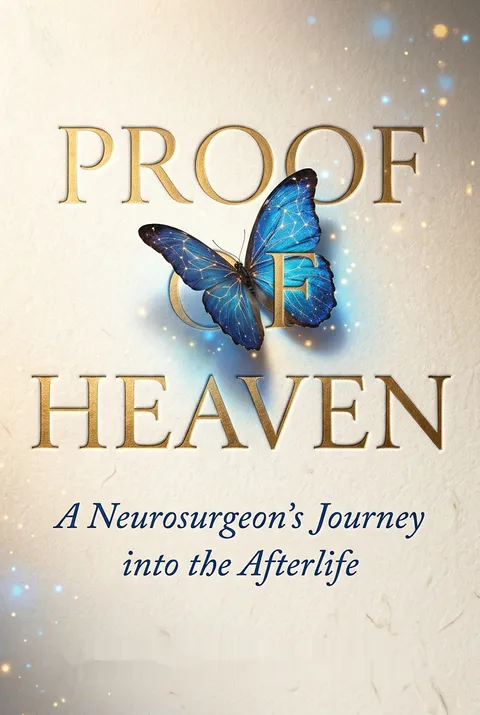
Three changing worlds. Alexander recalls first inhabiting what he named the Realm of the Earthworm's-Eye View: a muddy, dark place filled with pounding sounds and threatening shapes. He then describes the Gateway, a radiant landscape of streams, trees, people, and music, where a girl on a butterfly wing communicates reassurance without words. Finally, he enters the Core, an immense darkness that he experiences as both luminous and comforting, close to God.
A narrative of return. The journey does not simply leap from horror to paradise. Alexander returns to the murky realm repeatedly, now less frightened because he believes he has seen what lies beyond it. The sequence gives form to a radical change in perspective: the frightening place remains real to him, but no longer seems to contain the whole of existence.
The three-part landscape gives readers a useful map of an experience that Alexander says resists ordinary language. It also resembles a common feature of transformative narratives: distress is not erased but reinterpreted within a larger frame. That structure can explain why an experience feels coherent and life-changing without deciding whether its setting was external or internally generated. The map helps readers understand Alexander's account; it should not be mistaken for an independently verified geography of an afterlife.
Make unconditional love the experience's practical lesson, not merely its cosmic claim.
The central message. In the Gateway, Alexander's companion conveys three ideas: he is cherished, he need not be afraid, and he is not condemned for imperfection. He later condenses the message to unconditional love. In the Core, he understands love not as romance or sentimentality, but as the foundation of reality and the force that makes compassion meaningful.
Bring it into conduct. The book's most usable implication is less about proving a particular picture of heaven than about acting with greater care on earth. Alexander connects the experience to his family, his patients, and the people whose accounts he once dismissed. He argues that love and compassion are not ornamental virtues, but ways of living in alignment with the reality he believes he encountered.
This claim has ethical force even for readers who do not share Alexander's theology. Care ethics, for example, treats attention to another person's vulnerability as a central moral practice, not a secondary feeling. The practical test of a revelation is partly what it changes in ordinary relationships. At the same time, a powerful experience of love cannot establish that love is the universe's metaphysical substance. The ethical insight and the cosmic explanation can be considered separately.
In coma, family made care tangible through an unbroken bedside vigil.
Love as presence. While Alexander lay unresponsive, his family and friends took turns holding his hand and keeping watch. His sister Phyllis promised that the family would maintain a connection with him. His wife, Holley, and others prayed, spoke to him, and repeated messages intended to encourage his return. Their vigil continued through a week in which doctors warned that he might die or survive with profound disability.
The return to the room. Near the end of the week, when Alexander's doctors were preparing the family for the possibility of stopping antibiotics, his eyes opened. He began moving, the breathing tube was removed, and he spoke. During his descent through the experience, he recalls seeing faces of people who had been with him, including his young son Bond, whose presence helped draw him back toward life.
The family's vigil matters whether or not prayer caused the recovery. In critical illness, presence gives relatives a concrete role when medicine offers few actions they can control. The account also shows how care is shared across a network, rather than delivered by clinicians alone. A necessary caution is that the medical record cannot establish that the vigil produced the awakening. Its human value does not depend on proving that causal claim.
A birth-family reunion exposed the old wound beneath Alexander's unexplained despair.
A hidden grief. Adopted at four months, Alexander grew up deeply loved by his adoptive parents and siblings. Yet in 2000, learning that his biological mother was not ready to meet him unsettled him more than he expected. For years, he struggled with depression and a sense of being unwanted, without fully recognizing how the unanswered questions about his origins were affecting him.
A different understanding. In 2007, his biological family welcomed him and explained that his birth mother had loved him but had been unable to raise him as a teenager. He also learned about a biological sister, Betsy, who had died before he could meet her. After his coma, he recognized her photograph as the face of the girl who had accompanied him in the Gateway. Alexander sees this recognition as evidence that the worlds he experienced were connected to his life on earth.
The reunion gives the spiritual narrative an intimate psychological context: a person can be secure in present relationships and still carry unanswered questions about early separation. Adoption research and clinical practice often emphasize that identity can involve both gratitude for a chosen family and curiosity or grief about origins. The photograph's role is emotionally persuasive for Alexander, but retrospective resemblance and recognition cannot independently verify the guide's identity. The healing of the family wound remains significant even if that interpretation stays uncertain.
Record the experience before borrowing other people's explanations.
Observation before comparison. After leaving the hospital, Alexander wanted to read about near-death experiences and discuss his memories with others. His son Eben IV advised him to write down what he remembered first, before reading other accounts or theories that might shape his interpretation. Alexander followed the advice, spending weeks recording his recollections before immersing himself in the literature.
A useful discipline. The approach reflects a basic research principle: preserve observations before fitting them into a preferred explanation. It helps distinguish what a person remembers from what later comparisons or beliefs may add. Alexander's account was still written after the coma, rather than recorded during it, so it cannot eliminate ordinary memory limitations. Even so, separating initial recollection from later interpretation makes the reasoning easier to inspect.
This is one of the book's strongest methodological instincts. In science, field notes, preregistration, and contemporaneous records help researchers notice when expectations shape what they report. The same discipline can help people examine unusual experiences without immediately forcing them into either a supernatural or a neurological story. The limitation is important: writing soon after recovery can reduce later influence, but it does not make memory a recording device. Good method improves scrutiny; it does not guarantee accuracy.
Skepticism means examining NDE reports, not ruling them out by reflex.
Three positions. Alexander divides responses to near-death experiences, or NDEs, into believers, firm dismissers, and people who are curious but unsure. He admits that before his illness he had dismissed such accounts without reading much of the relevant literature. Afterward, he studied reports and found recurring descriptions of vivid landscapes, unusual time, encounters with beings, and overwhelming love.
Test explanations fairly. He reviews proposed brain-based accounts, including dreamlike activity, medication effects, and memory fragments assembled during recovery. He argues that these do not explain his own experience because his neocortex was severely affected. The book presents this as a challenge to dismissive certainty, while acknowledging that the competing explanations and his medical interpretation remain debated.
The distinction between open-minded skepticism and reflexive dismissal is valuable. A claim should be assessed against evidence, not rejected solely because it feels implausible. But intellectual openness cuts both ways: recurring reports and a patient's conviction deserve attention, while proposed explanations still need to be tested against timing, physiology, and alternative accounts. Showing that familiar theories do not explain one case is not the same as proving an afterlife. It does, however, make inquiry more responsible than automatic ridicule.
The brain-as-filter model remains a hypothesis, not a demonstrated mechanism.
A different model. Before his coma, Alexander thought the brain produced consciousness. Afterward, he proposed that the brain might instead limit or filter a wider consciousness, much as attention screens out the flood of sensory information arriving from the world. On this account, ordinary life benefits from forgetting a larger spiritual identity because people can focus on immediate choices and relationships.
What the model claims. Alexander presents this reducing-valve idea as a way to reconcile brain science with his experience of awareness during severe illness. He also describes using Hemi-Sync, an audio method based on differences between tones played to each ear, as a way to explore altered states. These proposals are part of his interpretation, not established evidence that consciousness exists separately from the brain.
The filter model is philosophically attractive because it makes room for consciousness without reducing it to neural activity. Yet an analogy is not a mechanism. Changes to the brain reliably alter perception, memory, and personality, which any account of consciousness must explain. Those facts do not logically settle whether the brain produces or modulates experience, but they place a substantial burden on the filter hypothesis. A stronger theory would specify what evidence could distinguish filtering from production.
A vivid experience can transform belief without proving consciousness survives death.
Experience and conclusion. Alexander describes his time in the Gateway and Core as more real than ordinary waking life. He believes he remained conscious while his neocortex was effectively offline, and he treats his survival from a usually devastating infection as extraordinary. Together, these events persuaded him that consciousness continues beyond bodily death and that a loving God cares for people.
What the case can establish. His account documents a profound personal experience and a dramatic recovery that challenged his former beliefs. It does not, by itself, establish that consciousness left the body or that the experience occurred after death. Alexander's own term N of 1 describes a case with no comparable patient to serve as a control. The title's promise of proof therefore reaches beyond what a single memoir can conclusively demonstrate.
The book's emotional achievement and its scientific claim should not be collapsed into one judgment. A single case can expose an unanswered question, generate hypotheses, and change a person's life. It cannot alone establish a universal conclusion about survival after death, especially when the timing of experience cannot be independently verified. This distinction does not trivialize Alexander's testimony. It allows readers to respect what happened to him while keeping open the difference between powerful evidence for a personal transformation and proof of a metaphysical claim.
Analysis
Proof of Heaven works simultaneously as a medical memoir, a spiritual testimony, and an argument against the assumption that the brain fully explains consciousness. Its strongest narrative choice is to keep the hospital crisis and the transcendent account in dialogue. The family waiting beside an unresponsive body gives the abstract question of mind and brain human stakes. Alexander's adoption history adds another layer: the experience of being loved answers a private wound as well as a theological question.
The book's persuasive power comes from the convergence of three things: a rare and severe illness, the author's expertise as a neurosurgeon, and his certainty that the experience felt more real than ordinary life. Those features make his account worth examining. They do not make his interpretation inevitable. Medical evidence of coma and cortical dysfunction does not itself establish that no neural activity supported experience, while the story cannot precisely locate when each remembered scene occurred. The distinction between the experience and its explanation is essential.
Alexander's appeals to quantum physics also require care. Quantum mechanics challenges simple pictures of isolated objects, but it does not show that human consciousness creates reality or survives the death of the body. Likewise, weaknesses in a proposed neurological explanation do not automatically confirm a spiritual one. A compelling single case can reveal where current knowledge feels incomplete, but it cannot resolve a general question without independent evidence and methods capable of testing competing accounts.
The book remains valuable as a record of intellectual conversion. Alexander moves from dismissing reports he had not investigated to asking how they should be evaluated. That shift is more defensible than the certainty of the title. Readers can carry away the humane core of his message, the importance of love, presence, and intellectual humility, while distinguishing those lessons from the unsettled scientific claim that consciousness exists apart from the brain.
Review Summary
Proof of Heaven received mixed reviews. Many readers found it compelling and comforting, particularly those seeking evidence of an afterlife. They appreciated Alexander's scientific background and his detailed explanation of his near-death experience. However, some critics felt the book lacked scientific rigor and relied too heavily on personal anecdotes. Skeptics argued that Alexander's experience could be explained by natural phenomena. Despite the criticisms, many readers found the book thought-provoking and inspiring, praising its message of love and interconnectedness.
People Also Read






Glossary
Near-death experience (NDE)
Conscious experience near deathA reported experience associated with a life-threatening crisis or a state close to death. Accounts vary, but Alexander describes features such as vivid environments, encounters with beings, altered experience of time, and intense feelings of connection or love. The term identifies a class of reports; it does not itself establish what causes them or whether consciousness survives death.
Realm of the Earthworm's-Eye View
Alexander's dark lower realmAlexander's name for the first environment he remembers during his coma experience. He describes it as dim, muddy, and claustrophobic, with pounding sounds and frightening shapes. He initially felt trapped there, then returned to it after visiting more luminous realms. The name is his personal label for a reported experience, not an established scientific or religious location.
Gateway
Luminous landscape in his NDEAlexander's name for a vivid, pastoral realm he says he entered after leaving the dark lower environment. He recalls green fields, streams, people, music, and a girl riding beside him on a butterfly wing. In his account, the Gateway is a place of welcome and communication without ordinary speech, and a passage toward the deeper realm he calls the Core.
Core
The experience's divine centerAlexander's term for the deepest spiritual realm in his account. He describes it as an immense, dark space that is also filled with light and comfort, and as the presence of a loving Creator. He says that knowledge and answers arrived there directly rather than through ordinary reasoning. The term reflects his interpretation of a personal experience.
N of 1
A single-patient caseA research or clinical situation in which one patient is the only case available for examination. Alexander's doctors and colleagues used the phrase to emphasize how unusual his spontaneous E. coli meningitis and recovery appeared. A single case can be medically informative and can raise new questions, but it does not provide a comparison group or establish that the same explanation applies to other people.
reducing valve or filter
Brain as consciousness filterAlexander's proposed alternative to the view that the brain produces consciousness. In this model, consciousness exists more broadly, while the brain restricts or filters it into the narrower experience needed for ordinary life. The analogy helps him interpret his coma experience, but the book does not establish a measurable mechanism by which the brain performs this filtering.
Hemi-Sync
Audio-based altered-state methodAn audio technique associated with Robert Monroe and discussed by Alexander as a way to explore altered states of consciousness. It uses slightly different tones in each ear to create perceived beats at the difference between the tones. Alexander believes the method may help access unusual states of awareness. That proposed effect does not demonstrate that awareness exists independently of the brain.
FAQ
1. What is "Proof of Heaven" by Eben Alexander about?
- Personal Near-Death Experience: The book recounts Dr. Eben Alexander’s extraordinary near-death experience (NDE) during a seven-day coma caused by a rare case of E. coli bacterial meningitis.
- Journey Beyond the Brain: Alexander, a neurosurgeon, describes his consciousness traveling to realms beyond the physical world, including encounters with spiritual beings and a loving, divine presence.
- Challenge to Materialism: The narrative challenges the materialist view that consciousness is solely a product of the brain, suggesting instead that consciousness exists independently and survives bodily death.
- Integration of Science and Spirituality: The book blends Alexander’s medical expertise with his spiritual revelations, aiming to bridge the gap between science and faith regarding the afterlife.
2. Why should I read "Proof of Heaven" by Eben Alexander?
- Unique Perspective: The author is a Harvard-trained neurosurgeon who was previously skeptical of NDEs, making his transformation and testimony especially compelling.
- Detailed Medical Context: The book provides a thorough medical account of Alexander’s illness, coma, and recovery, offering credibility and context for his experience.
- Exploration of Consciousness: Readers interested in the nature of consciousness, the mind-brain relationship, and the possibility of life after death will find the book thought-provoking.
- Hope and Comfort: The story offers reassurance and hope to those grappling with mortality, grief, or spiritual uncertainty, emphasizing unconditional love and the continuity of existence.
3. What are the key takeaways from "Proof of Heaven" by Eben Alexander?
- Consciousness Survives Death: Alexander’s experience suggests that consciousness is not produced by the brain and continues after physical death.
- Unconditional Love at the Core: The central message received during his NDE is that we are all loved and cherished unconditionally, and there is nothing to fear.
- Science and Spirituality Can Coexist: The book argues that scientific inquiry and spiritual understanding are not mutually exclusive and can inform each other.
- Personal Transformation: Alexander’s journey led to a profound shift in his worldview, from skepticism to a deep conviction in the reality of the spiritual realm.
4. How does Eben Alexander describe his near-death experience (NDE) in "Proof of Heaven"?
- Stages of the Experience: Alexander describes moving through several realms: a dark, primordial underworld (“Earthworm’s-Eye View”), a vibrant “Gateway” filled with beauty and love, and a “Core” of infinite, divine presence.
- Encounters with Beings: He meets a beautiful, loving female guide (later revealed to be his deceased biological sister) and experiences communication with a divine entity he calls “Om.”
- Nonverbal Communication: Information and understanding are conveyed instantly and wordlessly, bypassing language and logic.
- Ultra-Real Sensations: The experience is described as more real than ordinary life, with heightened clarity, vividness, and a sense of timelessness.
5. What scientific and medical context does Eben Alexander provide in "Proof of Heaven"?
- Medical Impossibility: Alexander’s neocortex—the part of the brain responsible for thought and consciousness—was severely compromised, making conventional explanations for his vivid experiences unlikely.
- Review of Hypotheses: He systematically examines and rejects neuroscientific explanations such as hallucinations, REM intrusion, drug effects, and brainstem activity, based on his medical records and knowledge.
- Unique Case: His case is described as “N of 1,” meaning it is virtually unprecedented in medical literature for someone to survive and recover fully from such a severe illness and coma.
- Expert Testimony: The book includes statements from his treating physicians, confirming the severity and improbability of his recovery.
6. What are the main spiritual and philosophical messages in "Proof of Heaven" by Eben Alexander?
- You Are Loved: The core message Alexander receives is that every person is deeply loved and cherished by the divine, forever.
- Nothing to Fear: He is told there is nothing to fear and nothing one can do wrong in the ultimate sense.
- Purpose of Life: Earthly life is seen as an opportunity for growth, learning, and the exercise of free will, with challenges serving a higher purpose.
- Interconnectedness: All beings and universes are interconnected, with love as the fundamental fabric of reality.
7. How does "Proof of Heaven" by Eben Alexander address the relationship between science and spirituality?
- Critique of Materialism: Alexander critiques the materialist paradigm that consciousness arises solely from brain activity, arguing that his experience demonstrates otherwise.
- Call for Open Inquiry: He encourages scientists to seriously investigate NDEs and other spiritual phenomena rather than dismissing them out of hand.
- Integration of Disciplines: The book advocates for a new paradigm where science and spirituality inform and enrich each other, especially in understanding consciousness.
- References to Quantum Physics: Alexander references concepts from quantum mechanics and consciousness studies to support the plausibility of non-material realities.
8. What specific concepts and realms does Eben Alexander describe in "Proof of Heaven"?
- Earthworm’s-Eye View: A dark, primitive realm representing a state of existence without memory, identity, or language—possibly analogous to the early stages of death or deep unconsciousness.
- The Gateway: A beautiful, hyper-real landscape filled with vibrant life, music, and a sense of overwhelming love and joy, guided by a female companion.
- The Core: An infinite, dark-yet-light realm where Alexander encounters the divine source (“Om”) and receives direct, wordless knowledge about the universe.
- The Spinning Melody: A musical, spinning light that serves as a portal between realms, symbolizing the power of love and connection.
9. How did Eben Alexander’s NDE in "Proof of Heaven" affect his personal life and worldview?
- Transformation from Skeptic to Believer: Alexander moves from being a secular, materialist neurosurgeon to someone convinced of the reality of the spiritual realm.
- Healing of Emotional Wounds: His experience helps him resolve feelings of abandonment related to his adoption and brings a sense of wholeness and belonging.
- Renewed Relationships: He reconnects with his biological family and finds new meaning in his relationships with loved ones.
- Sense of Mission: Alexander feels called to share his story to help others overcome fear of death and to encourage a more open-minded approach to consciousness and spirituality.
10. What advice or methods does Eben Alexander offer for spiritual growth in "Proof of Heaven"?
- Meditation and Prayer: Alexander recommends meditation (specifically mentioning Hemi-Sync audio technology) and prayer as ways to access deeper states of consciousness and spiritual insight.
- Openness to Experience: He encourages readers to remain open to the possibility of spiritual realities and to seek direct personal experience rather than relying solely on secondhand accounts.
- Cultivating Love and Compassion: Manifesting love and compassion in daily life is presented as the most effective way to align with the spiritual realm.
- Integration of Knowledge: He suggests that true understanding comes from integrating both scientific and spiritual perspectives.
11. What are some of the best quotes from "Proof of Heaven" by Eben Alexander and what do they mean?
- “You are loved and cherished, dearly, forever. You have nothing to fear. There is nothing you can do wrong.” – This is the central message Alexander receives during his NDE, encapsulating the book’s core spiritual insight.
- “Love is, without a doubt, the basis of everything.” – Emphasizes that love is not just an emotion but the fundamental reality underlying all existence.
- “Science—the science to which I’ve devoted so much of my life—doesn’t contradict what I learned up there.” – Suggests that true science is open to new evidence and can coexist with spiritual truths.
- “The brain is a reducing valve, not a producer, of consciousness.” – Challenges the conventional neuroscientific view and proposes that the brain filters a much larger, nonphysical consciousness.
12. How does "Proof of Heaven" by Eben Alexander address skepticism and criticism regarding near-death experiences?
- Systematic Rebuttal: Alexander addresses and refutes common neuroscientific explanations for NDEs, using his own medical data and expertise.
- Personal Transformation as Evidence: He presents his own radical shift from skeptic to believer as a testament to the authenticity of his experience.
- Encouragement of Open-Mindedness: The book urges readers, especially scientists and doctors, to examine the evidence for NDEs with genuine curiosity rather than dismissive skepticism.
- Acknowledgment of Doubt: Alexander openly discusses his own lingering doubts and the process of reconciling his experience with his scientific background, making his account relatable and credible.
About the Author
Other books by Eben Alexander

Download PDF
Download EPUB
.epub digital book format is ideal for reading ebooks on phones, tablets, and e-readers.








