

Plot Summary
Kathryn Returns to Paris
In occupied Paris, OSS agent Kathryn Hammond carries troop movements hidden in invisible ink on sheet music. She delivers the music to Claudette, a trusted resistance contact, then catches sight of a blonde woman whose stride briefly convinces her that Jenny, the woman she left behind, has returned.
The stranger is not Jenny, and Kathryn pushes the longing aside to resume her assignment: posing as the American lover of Dr. Thierry Bouchaule, who directs a Nazi biological weapons program.
At a lavish dinner, Kathryn sings for German officers and meets Albrecht Vogel, Bouchaule's Gestapo overseer. Vogel uses her performance as leverage to place her at a nightclub favored by German officers. The job offers a new cover and a room full of careless listeners.
Kathryn's return is driven by a double refusal: she will not abandon Paris, and she will not allow grief for Jenny to derail her work. Yet the false recognition of Jenny shows that emotional loss is not safely contained just because Kathryn has decided it must be. Her sheet music makes art both camouflage and infrastructure, while the nightclub invitation turns performance into forced proximity with the occupiers. The scene also establishes the moral texture of the city: survival requires contact with people who serve the regime, but contact does not make everyone equally complicit.
A Knife at Closing Time
After Kathryn's first shift at L'Heure Bleue, the displaced singer and two men ambush her in an alley. Kathryn disarms the knife-wielding attacker, then recognizes the others as desperate French people rather than enemies.
She promises the singer her nightclub wages, since losing the job may leave the young woman without any other way to support her family. Kathryn also invites the men to make contact if they can help her reconnect with resistance work. At home, Bouchaule sees her wound and demands a driver for her safety.
Kathryn stops him from flaunting extra fuel rations, arguing that it would alienate ordinary Parisians. Soon afterward, Marie arrives seeking medical help for her wounded resistance husband. Kathryn persuades Bouchaule to treat him secretly.
Kathryn's response to the alley attack reveals a form of courage less dramatic than killing an opponent: she refuses to mistake desperation for treachery. Her promise to the displaced singer acknowledges that her own opportunity has imposed a cost on someone poorer and less protected. Bouchaule's impulse to secure Kathryn through privilege contrasts with her insistence that safety cannot be purchased without political consequences. When she draws him into treating a wounded partisan, their relationship shifts from a staged romance toward a partnership, though they disagree sharply about the risks each should accept.
The Cellar of Names
Bouchaule's decision to help Marie's husband brings his careful distance from the resistance into conflict with Kathryn's insistence on acting. When he forbids her further involvement, she tells him how the Nazis killed her friends after she refused to betray them, and why she left Paris the first time.
He responds by showing her his hidden cellar laboratory. Its files document prisoners infected by Vogel's men during trials of the weapon. Bouchaule admits he ends the suffering of those already dying, including his sister Adele, whom the Nazis used to force his cooperation.
He cannot produce a vaccine without the missing biological reservoir, but he refuses to abandon his countrymen. Kathryn stays, recognizing his burden without absolving his choices.
The laboratory forces Kathryn to revise her judgment without surrendering it. Bouchaule's work is neither simple villainy nor clean resistance: he is both an unwilling witness to Nazi cruelty and a scientist whose research depends on its victims. His account of mercy killing reveals how extreme coercion can make care resemble violence, but it cannot erase the moral danger of his position. Kathryn's decision to stay is not a declaration that he is innocent. It is a recognition that intimacy under occupation can begin with seeing another person's constraints clearly, while still remaining alert to the harm those constraints produce.
Vogel Finds His Contact
At Vogel's birthday gathering, Kathryn photographs a briefcase and files naming resistance fighters from his office. Vogel catches her with the miniature camera and identifies her as an OSS agent, but then gives her a coded message proving that he is her long-awaited SOE contact.
He orders her to photograph Bouchaule's research because he suspects the doctor is deceiving the Germans. Kathryn cannot tell whether Vogel's brutality is a mask or his true nature, and Bouchaule's anger at finding them together deepens her unease.
Later, Bouchaule tells Kathryn that Vogel revealed something about her, then surprises her by proposing marriage. Kathryn accepts the connection they have built, even as she continues to work as an agent and hides the full extent of her activities.
This section makes trust an operational problem rather than a purely romantic virtue. Vogel's coded proof is persuasive enough to compel action, but his cruelty leaves Kathryn unable to treat institutional authentication as moral reassurance. Bouchaule's proposal adds another layer of risk: affection is real, yet both partners are still interpreting one another through cover stories and surveillance. Kathryn's work depends on compartmentalization, but the marriage promise suggests she wants a life in which she can be known. The tension between those desires prepares the later rupture between her private attachment and the consequences of her choices.
The City Begins to Break
As Paris grows hungrier and resistance activity intensifies, Kathryn keeps sending Bouchaule's harmless research notes to Vogel while watching the doctor's work. Bouchaule believes his research has stalled because he lacks the missing reservoir.
In late July, news of the Allied breakthrough sends him burning files and packing his laboratory. Kathryn sees a communiqué among the papers: the reservoir is arriving, and it is Jenny. Before she can confront him, the Gestapo summons Bouchaule. He sends Kathryn toward the countryside, promising to follow within days.
She boards the train with his driver, concealing what she has learned, then trades her fine clothes and supplies for a bicycle and practical clothing. She rides through bombed farms toward Jenny's rendezvous, determined to warn her before the Germans arrive.
The city's changing military situation transforms a long-running deception into an immediate moral emergency. Kathryn's discovery makes clear that her effort to protect Jenny has not removed her from danger; it has only delayed the moment when the two women's paths collide. Her choice to conceal the message from Bouchaule is tactical, but it also marks a decisive break from the domestic life she has built with him. She gives up the symbols of her protected status, including fine clothes and plentiful supplies, to reach Jenny on foot and bicycle. Her movement toward danger is also movement toward the person she tried to leave behind.
The Farmhouse Ambush
Jenny arrives in France for her first field mission carrying what she believes is a communications radio. At the isolated farmhouse, she discovers a cardboard decoy and sand. German vehicles approach before she can make sense of the betrayal.
Kathryn races across the open field and crashes through a window as Jenny fires at the intruder, recognizing her only after Kathryn praises her training. They escape with help from local partisans, then argue over Kathryn's attempt to keep Jenny safe and Jenny's refusal to abandon her duty.
Their anger gives way to a desperate embrace. When the resistance truck arrives, Jenny climbs aboard, but Kathryn slips from a partisan's grasp and falls onto the street. Jenny fires Kathryn's pistol toward her as German soldiers close in, believing she must prevent her capture.
The decoy radio exposes the institutions that claim to protect agents as capable of betraying them, while the farmhouse encounter strips away the distance Kathryn tried to impose between herself and Jenny. Their argument concerns duty, but beneath it lies a conflict over who has the right to decide what risks another person may take. The truck forces Jenny to make the very calculation Kathryn has made before: sacrifice one person to preserve a larger mission. Her shots are not a simple act of rejection. They are an awful attempt to honor operational training while facing the possibility that the person she loves is already lost.
Pascal's Betrayal
The resistance fighters take Jenny to a mountain hideout, where she breaks down under the belief that her shots killed Kathryn. A young partisan arrives with news that Kathryn survived and is being held at an abandoned factory.
Jenny rides back with him, but the supposed rescue is a trap: Pascal has traded the women for his captured brother and friends. An SS officer promises to free Pascal's companions, then has him shown their hanged bodies and shot. The Germans bind Kathryn and Jenny in painful restraints and interrogate them.
When the officer threatens Kathryn to force Jenny to talk, Jenny stays silent. Kathryn endures the beating rather than expose Jenny. Bouchaule arrives in civilian clothes, calls Kathryn his wife, and angrily confronts the SS officer over her injuries.
Jenny's return is an attempt to repair a choice she already believes unforgivable, but the trap turns her loyalty into another vulnerability. Pascal's betrayal is not presented as abstract villainy: the Germans exploit his attachment to his brother and friends, then discard him as soon as he has served them. In the interrogation room, Kathryn and Jenny protect one another through silence, reversing their earlier dispute over whether the mission should outweigh personal bonds. Bouchaule's declaration of marriage is both protective cover and evidence of his emotional claim on Kathryn, leaving Jenny to face a complicated alliance at the worst possible moment.
The Kiss of Death
Bouchaule learns that Kathryn concealed her continued interest in Jenny and, after ordering the young agent taken away, tells a guard to kill his wife without prolonging her suffering. Jenny hears automatic fire and believes Kathryn is dead.
Before Bouchaule can leave the area, armed rescuers seize him and knock him unconscious. Jenny escapes her German guard, then discovers that Cal, the supposed American Southerner she once knew, is working with the rescuers. He opens the trunk and reveals Kathryn alive but near death, after using an injection that makes her appear dead.
Cal administers the antidote, and the group takes them toward an airfield. During the escape, Cal's men kill Bouchaule. Smitty joins them on the plane, and the wounded Kathryn is carried to England for treatment.
The false death reverses Jenny's earlier certainty, but survival does not erase the damage of believing she had killed Kathryn. Cal's intervention depends on a device that makes rescue indistinguishable from execution until its antidote arrives, echoing the story's repeated collapse of moral appearances. Bouchaule's final betrayal is personal as well as political: he orders Kathryn's death when he realizes that her deepest loyalty was never his. His own death by the rescuers ends his immediate threat, but it does not instantly free Kathryn or Jenny from the institutions and secrets that shaped their ordeal.
The Long Hospital Vigil
In an English hospital, doctors treat Kathryn's fractured ribs, head injury, and damaged hand, but the death-simulating drugs leave her unconscious. Smitty keeps watch, while Jenny and Sister Vivienne Barclay wait through the uncertain prognosis.
A surgeon repairs Kathryn's hand, yet days pass without her waking. Vivienne supports Jenny and Smitty, and her growing closeness with Smitty begins in the pressure of their shared vigil. Kathryn finally opens her eyes, but the Allied agencies immediately demand reports.
Jenny is dismissed from intelligence service after a hostile debrief, then taken toward a meeting arranged by an unknown group. Before leaving, she entrusts Vivienne with a note for Kathryn. The separation is unavoidable: Kathryn needs medical care, while Jenny has been drawn into a deeper secret.
The hospital shifts the story from survival in the field to survival after the emergency, when no action can guarantee recovery. Kathryn's silence is frightening precisely because it cannot be interpreted as a choice; Jenny and Smitty can only wait. Vivienne's practical nursing becomes a counterforce to the agencies' appetite for information, while her emerging bond with Smitty shows intimacy forming not through adventure but through shared care. Jenny's dismissal compounds her distrust of official institutions. Her departure leaves Kathryn with both a bodily recovery and an emotional reckoning ahead, while Jenny faces a new set of authorities who claim to know her better than she knows herself.
The Institute's Hidden History
At an English country estate, Jenny meets Arthur Wheaton and William Rhoades, who reveal that her father helped found the Wheaton-Rhoades Institute. They explain that Jenny's mother, Bess, survived the 1918 influenza while pregnant, then died after Jenny's birth.
The Institute has long studied the unusual physiology that resulted. Jenny also learns that its covert protection involved killings and manipulations, including operations that touched her earlier life. She demands an end to further killing, but accepts a civilian microscopy post in Switzerland so she can contribute to medicine and keep her secret from hostile hands.
Meanwhile, Kathryn returns to New York, where her brother Clay and sister-in-law Nan shelter her through recovery. She begins helping refugee children and teaching, though trauma and despair still threaten to undo her progress.
Jenny's biological inheritance becomes inseparable from a history of institutional control. The Institute offers education and protection, but its methods repeat the paternalistic logic that has shaped her life: others decide what she must become because they believe they understand the stakes. Her demand to stop killing is an attempt to enter the organization without surrendering her moral judgment. Kathryn's parallel return to family life does not erase trauma; it gives her a place where relapse can be witnessed rather than hidden. The two women move toward different forms of responsibility, one scientific and collective, the other intimate and restorative.
Bouchaule Walks Back In
While Jenny is still reckoning with the Institute, a newspaper reports that Bouchaule has escaped Nazi custody and will be honored at a London club. The Institute insists it believed him dead, but Jenny suspects its plans are again beyond her control.
Kathryn sees the same news and fears Bouchaule will resume his work or target Jenny. Still recovering, she steals Vivienne's evening clothes and pain medication, then travels to London. She invents a battered-wife story to gain entry to the exclusive club, carrying an ice pick beneath her scarf.
Jenny arrives separately, intent on killing Bouchaule herself. The women do not know they are both there until Kathryn spots Jenny in the crowd. Their reunion interrupts Kathryn's solitary plan and leaves them with a narrow chance to act together.
Bouchaule's reappearance demonstrates that apparent closure can be another instrument of control: the women were told the threat was gone, and now must decide whether to trust any account of his fate. Kathryn's decision to pursue him comes from responsibility as much as revenge; she believes his future victims would be partly her burden. Jenny's parallel pursuit reflects the same moral urgency, but the two plans risk recreating the isolation that has repeatedly endangered them. Seeing one another changes the situation from a private execution into a shared decision, allowing their bond to interrupt the logic of solitary sacrifice.
A Toast to Justice
At the London celebration, Kathryn is too injured and exhausted to reach Bouchaule without help. Jenny guides her through the crowd and takes a glass of champagne. As Bouchaule raises a toast to victory, Jenny drinks with the guests and reveals that she has poisoned his glass.
He recognizes the women, then collapses before he can act. Kathryn's ice pick never leaves her scarf. Smitty finds them as the crowd surges toward the exits, and Vivienne drives them to her empty flat. There, she treats Kathryn's dehydration and overuse of pain medication.
The women have survived another separation only to face a new one: Jenny must return to the Institute's work, while Kathryn must go home and recover. This time, they leave each other with honesty rather than a manufactured goodbye.
The climax denies Bouchaule the private laboratory and controlled demonstrations through which he exercised power. He dies in public, surrounded by people prepared to celebrate him, while Jenny turns the ritual of the toast against him. Kathryn's abandoned ice pick matters: she came prepared to kill, but the outcome depends on Jenny's intervention and their mutual recognition. The rescue also gives care a concrete form after violence. Vivienne's treatment of Kathryn and Smitty's presence do not undo the injury, but they make survival communal. The coming separation remains painful, yet it is no longer produced by deception.
A Voice Across Years
After Bouchaule's death, Jenny takes the Swiss research post and spends eighteen months building a life at the Institute, while Kathryn returns to New York. With Clay and Nan's support, Kathryn endures a severe psychological collapse, accepts their care, and gradually finds purpose tutoring and teaching children.
Jenny's repeated delays keep their reunion just out of reach. In March 1946, Kathryn performs at The Grotto's final night, honoring its late owner, Dominic Vignelli, and preparing to leave her singing career behind.
Jenny's flight is delayed, but she reaches the club during the performance. Kathryn sees her at their old table and finishes the song before they meet in Luc's office. Their embrace begins the life they had postponed, grounded in letters, patience, and the ordinary work of healing.
The reunion is earned through time rather than delivered as a cure. Kathryn's recovery depends on accepting care from family and finding meaningful work that does not require her to perform invulnerability. Jenny's scientific life fulfills an old ambition, but the delays reveal the emotional cost of turning purpose into relentless labor. The Grotto, where they first met, closes as they reunite, making the setting a hinge rather than a sentimental loop: their old life ends, but they return to one another with changed identities. Love becomes less a rescue fantasy than a practice of choosing each other while allowing each person to continue becoming.
Epilogue
In 1949, Kathryn and Jenny share a week at their beach house between teaching, scientific travel, and the demands of work. They exchange rings on the island where their relationship began, privately affirming a marriage the law will not recognize. Kathryn has built a life in teaching, music, and service; Jenny leads scientific work and still pursues answers about her physiology.
They have learned to speak honestly about absence and ambition, rather than treating either as proof that love is failing. Before Jenny leaves for another trip, the two women repeat the small ritual engraved inside their rings: each belongs to the other, and each knows the way home.
The epilogue measures victory through routine rather than public recognition. The women cannot make their union legally legible, yet the rings and their private ceremony establish a durable form of commitment beyond state approval. Their careers keep them moving in different directions, but the relationship no longer depends on one person abandoning purpose to prove devotion. The repeated exchange of belonging counters the novel's histories of possession: Bouchaule treated people as instruments, and institutions treated Jenny as a resource. Kathryn and Jenny instead affirm mutual choice. Their life is not free of distance or uncertainty, but neither is mistaken for a failure of love.
Analysis
In the Shadow of Victory treats victory as a military event that does not automatically repair the people who survive it. Kathryn and Jenny escape immediate danger, but they carry forward the habits danger taught them: secrecy, self-sacrifice, and the belief that love can be protected by making decisions alone. Their relationship improves when they stop treating pain as proof of devotion and begin speaking plainly about what they have done to each other. Kathryn's recovery especially resists the idea that romance can cure trauma. Her family, meaningful work, and willingness to accept help give her a life beyond the crisis, while Jenny's scientific work gives her a route toward purpose without erasing the ethical danger of her inheritance.
The novel's political morality is deliberately unstable. Bouchaule is both implicated in a weapons program and constrained by the Nazis' use of prisoners; the Institute offers real protection while relying on manipulation and killing. Neither scientific ambition nor patriotic intent guarantees ethical conduct. The women are repeatedly asked to decide whether loyalty means obedience, sacrifice, or the right to refuse another person's plan. Kathryn's decision to leave Jenny, Jenny's choice to return for Kathryn, and their later decision to build lives across distance are not equivalent acts, but each exposes the limits of deciding what another person can endure.
Music, coded books, laboratory files, and rings all carry information about identity and possession. The papers and experiments can turn a person into evidence or raw material; the rings, by contrast, mark a bond chosen without institutional recognition. The final image of the women affirming one another's belonging answers the book's central threat. Their love does not defeat history or end their responsibilities. It gives them a relationship in which neither must disappear to make the other safe.
Review Summary
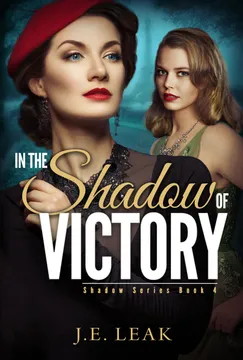
In the Shadow of Victory is the highly anticipated conclusion to J.E. Leak's Shadow series. Readers praise the book for its emotional depth, character development, and satisfying resolution to Kathryn and Jenny's love story. The novel skillfully blends romance, suspense, and historical elements, creating a captivating narrative that keeps readers engaged. While some found certain plot points unnecessary, most agree that the series finale delivers a fitting end to the beloved characters' journey. Abby Craden's narration in the audiobook version receives particular acclaim for enhancing the overall experience.
Characters
Kathryn Hammond
The guarded resistance singerKathryn is an American OSS agent, resistance operative, and gifted singer whose work depends on composure and improvisation. She is fiercely protective, especially of Jenny, but often turns that instinct into secrecy and decisions made on another person's behalf. Her history with Nazi imprisonment leaves her alert to danger and vulnerable to shame, while her sense of responsibility can drive her toward risks she would forbid others to take. Kathryn's relationship with Jenny brings out both her capacity for tenderness and her fear that love will become another person she can endanger. She seeks purpose in action, yet must learn that survival also involves receiving care and facing the parts of herself she has hidden.
Jenny Ryan
The scientist in the makingJenny is a young American with a strong scientific aptitude and an intense desire to serve a cause larger than herself. Her loyalty to Kathryn and her father shapes her choices, but her early certainty about duty can become rigid, especially when she believes sacrifice is required. She wants to understand her origins and make meaningful use of the knowledge her father left behind. Jenny's bond with Kathryn is passionate and sometimes strained by their competing definitions of protection: Kathryn withholds information to keep Jenny safe, while Jenny resists being excluded from danger or decision. Beneath her determination is a need to claim authorship of a life that others have repeatedly tried to direct.
Thierry Bouchaule
The compromised scientistBouchaule is a French physician and scientist directing research for a Nazi biological weapons program. Intelligent, controlled, and attentive to Kathryn, he presents himself as a man trying to limit the harm around him. His work places him inside a system of coercion and atrocity, and his explanations expose the moral compromises that can grow from fear, ambition, and a belief that continued research might still serve a good end. He values his country and his scientific purpose, yet struggles to separate those commitments from the people used to sustain them. His relationship with Kathryn mixes genuine affection with secrecy, making trust between them both intimate and politically dangerous.
John Smith, called Smitty
Kathryn's steadfast old friendSmitty is Kathryn's longtime friend and fellow operative, devoted to her safety after years of shared danger. His loyalty is generous but sometimes overprotective, and he struggles to distinguish helping Kathryn from keeping himself close to her. He offers humor and practical support when circumstances become unbearable. His connection with Vivienne suggests a life beyond his role as Kathryn's rescuer, though his care for Kathryn remains central to his sense of responsibility.
Vivienne Barclay
The clear-eyed nurseVivienne is a British military nurse who treats Kathryn after the French countryside ordeal. She is direct, competent, and emotionally perceptive, with little patience for evasions that endanger a patient. The losses of war have made her wary of attachment, but they have not extinguished her capacity for tenderness. She supports both Jenny and Smitty without confusing sympathy with false reassurance.
Albrecht Vogel
The dangerous overseerVogel is the German official overseeing Bouchaule's work and moving comfortably among the occupiers' elite. Sophisticated manners conceal a capacity for intimidation and cruelty. He treats people and appearances as instruments, making Kathryn's effort to read him unusually difficult. His presence reminds her that polished civility can coexist with political violence.
Claudette
The music-shop resistance linkClaudette runs a music shop that provides cover for resistance activity. She has learned to accommodate German customers to preserve both her livelihood and her usefulness to the underground. Her frankness helps Kathryn distinguish practical survival from genuine collaboration, and their trust gives Kathryn a first foothold in occupied Paris.
Clay Hammond
Kathryn's protective brotherClay is Kathryn's brother and the center of the family home she returns to after the war. He responds to her distress with patience rather than rejection, offering a place where she can recover without pretending to be well. His steady acceptance helps make family feel possible again after years in which Kathryn has expected abandonment.
Nan Hammond
The stubborn family anchorNan, Clay's wife, is a practical and sometimes formidable presence in the household. Her own family history gives her a personal understanding of how dangerous isolation can become. She refuses to mistake Kathryn's desire for privacy as evidence that she should be left alone, and her persistence helps hold the family together during a crisis.
Arthur Wheaton
The Institute's elder spokesmanWheaton is an older scientist and a founding figure in the network that has watched over Jenny's family. He believes strongly in the Institute's mission and in the protection it can provide, but his candor about its methods reveals how easily paternal concern can become control. He tries to persuade Jenny through facts, history, and opportunity.
William Rhoades
The Institute's measured advocateRhoades is Wheaton's colleague and a senior representative of the Institute. More measured than some of his associates, he explains the organization's history and Jenny's family's connection to it. He regards Jenny as both a person to protect and a person with unusual potential, a tension that shapes his appeals for her cooperation.
Jenny's mother, Bess Ryan
The absent motherBess Ryan is an Irish woman whose survival of the 1918 influenza brings her into contact with the scientists who later form the Institute. She is remembered as courageous, intelligent, and determined to help during a catastrophe. Her story gives Jenny a human connection to the scientific mystery surrounding her birth.
Luc Vignelli
The Grotto's devoted heirLuc is the son of Dominic Vignelli and inherits responsibility for The Grotto, the nightclub that helped shape Kathryn's earlier life. He admires music and loyalty, and he tries to preserve the club as a tribute to his father even as his own ambitions lead elsewhere. His affection for Kathryn makes the club's final night a personal farewell.
Dominic Vignelli
The nightclub's exacting patronDominic owns The Grotto and sets its musical standards. He values discipline and tradition, helping create the professional world in which Kathryn develops as a singer. His influence remains present in the club's final celebration.
Cal
The hidden operativeCal is a skilled operative who once entered Jenny's life under an assumed identity. He is resourceful and capable of working inside dangerous groups without revealing his purpose. His actions during the French rescue show the value and cost of intelligence work carried out beyond official recognition.
Plot Devices
Coded sheet music
Resistance messages in plain sightKathryn carries troop movements concealed in invisible ink on ordinary sheet music. Her work as a voice tutor and her connection to Claudette's music shop make the papers credible in a city where searches and identity checks are routine. Music also supplies Kathryn with a public role, first at elite gatherings and later in a German-favored nightclub. The device joins her artistic skill to espionage: the same object can pass as a lesson, a performance prop, or a channel for information.
The biological reservoir
A body becomes contested evidenceThe secret biological property associated with Jenny's physiology is the missing element in the work sought by Bouchaule and the reason the Institute has monitored her family. It gives her extraordinary scientific and political significance, but it also makes her vulnerable to people who view her as a resource rather than a person. The story links this secret to her mother's influenza survival and to Kathryn's earlier survival after exposure. It shapes the central conflict between scientific possibility, personal autonomy, and the danger of weaponization.
The false death injection
Escape disguised as executionCal uses an experimental injection to slow Kathryn's body until she appears dead, then administers an antidote during the escape. The tactic allows rescuers to remove her from a German-controlled site after Bouchaule orders her execution. It also places Kathryn's survival in danger, since the drug is unreliable outside laboratory conditions and the antidote must arrive in time. Jenny and the audience experience the apparent death before learning that the body in the trunk is not yet a corpse.
Wheaton-Rhoades
Protection with hidden costsThe Institute presents itself as a network of scientists prepared to protect Jenny and develop her potential. Its reach extends into her family history and covert operations around her life. The organization offers education, security, and a research career, but its members also manipulate events and accept lethal methods in the name of protection. This device complicates the usual distinction between official allies and enemies: Jenny must judge whether joining the organization gives her agency within it or simply makes her more valuable to its plans.
The coded volumes
Knowledge hidden behind keysJenny's father leaves scientific material encoded across a set of books. The code conceals dangerous research while allowing trusted readers to reconstruct it with the proper key. Jenny uses a forged, damaged volume to mislead officials into believing the original keys have been lost, keeping crucial papers beyond their reach. The books turn family inheritance into both scientific opportunity and a security problem, while their hidden pages embody the story's recurring question of who should control knowledge with potentially catastrophic uses.


Download PDF
Download EPUB
.epub digital book format is ideal for reading ebooks on phones, tablets, and e-readers.








