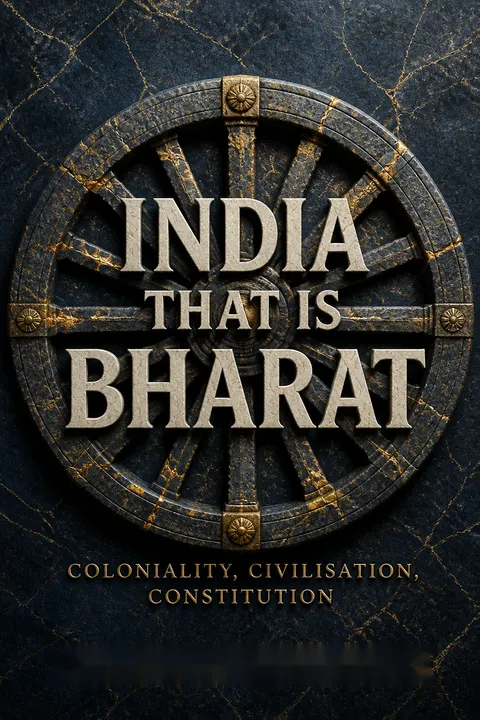


Key Takeaways
Treat political independence as the beginning, not completion, of decolonisation.
A courtroom question widened. Sai Deepak begins with his legal arguments in the Sabarimala Ayyappa Temple case, where he defended the temple’s religious practices. Critics called the position traditional or irrational. He began asking why those labels seemed to place Indian traditions below a supposedly neutral modern standard. That question led him from constitutional law into decolonial scholarship.
Power can outlive empire. The book calls this continuing influence coloniality: the persistence of colonial assumptions and structures after formal colonial rule ends. In the author’s account, political freedom can coexist with institutions and habits of thought that still treat European ideas as the default. The first volume follows this argument from the European expansion beginning in 1492 through the Government of India Act of 1919.
The distinction between a change of rulers and a change in governing assumptions is valuable beyond this particular history. Political science often finds that institutions persist because rules, professional habits, and incentives survive the regime that created them. That does not prove every postcolonial institution is merely colonial in disguise. It does make a useful diagnostic question possible: who benefits from a rule, what problem was it designed to solve, and whose experience does it recognize? The book’s legal starting point gives that question practical force, though its broad account of colonial influence requires case-by-case evidence.
Question who gets to define what counts as modern, rational, or universal.
Categories carry histories. Deepak argues that terms such as modern and rational are not always neutral descriptions. In the decolonial framework he adopts, they became linked to European power, allowing European institutions to present their own history as humanity’s standard path and other societies as backward or irrational. He distinguishes colonialism, a policy of rule and extraction, from coloniality, the thinking that gives that policy legitimacy and can outlast it.
Critique the frame too. Postcolonial analysis, in the book’s account, often criticizes colonial rule while retaining some of its categories. Decoloniality instead asks who created those categories and whether they fit local histories. It is not a demand to restore an untouched past. It is a call to recover the ability to define present priorities and future possibilities on locally grounded terms.
This argument connects to the sociology of classification: categories do not merely describe populations, they can shape administration, access, and self-understanding. A benchmark such as development may therefore look technical while quietly ranking societies by resemblance to a particular model. Yet a category’s European origin alone cannot establish that it is useless or oppressive. The stronger test is empirical: examine how the category works, who can contest it, and whether alternatives explain local realities better. That approach preserves the book’s challenge to intellectual hierarchy without turning provenance into a substitute for analysis.
Reconnect knowledge, language, and land before calling indigenous traditions irrational.
A different view of nature. The book contrasts a relational understanding of land, where people see themselves as part of nature and bound by obligations to it, with a colonial model that treats land primarily as property or resource. It uses accounts of Native American traditions to illustrate how community, spirituality, oral knowledge, and place can form one connected system. In the author’s view, this pattern also helps make sense of Indic traditions.
Education changes more than vocabulary. Colonial schools often privileged European languages and curricula while devaluing oral traditions and local knowledge. The author presents these policies as ways of redirecting cultural authority, not simply adding useful subjects. When a community loses the language and practices through which knowledge is transmitted, it can lose part of its ability to interpret its own history and environment.
Environmental humanities and anthropology both show why knowledge cannot always be separated from the relationships that produce it. Local ecological practices may encode generations of observation, even when they are transmitted orally rather than through formal scientific institutions. That does not mean every inherited practice is sustainable or beyond scrutiny. The useful lesson is methodological: test knowledge claims in their context, compare them with other evidence, and avoid treating written documentation as the only sign of rigor. The book’s account is strongest when it asks what forms of knowledge were excluded, rather than assuming that every local tradition offers a ready-made solution.
Trace legal neutrality back to the theology that shaped its categories.
Neutrality has an origin story. Deepak argues that modern distinctions between religious and secular life developed within Christian debates, especially the Protestant Reformation and its political settlement in Europe. He traces the idea of separate spiritual and temporal spheres through the Peace of Westphalia in 1648, arguing that later versions of secularism did not simply emerge outside religion. They carried assumptions formed within Christian political thought.
The Indian legal question. The book connects this history to constitutional categories used to regulate religion. For example, it argues that the Supreme Court’s Essential Religious Practices test, which asks whether a practice is central to a religion, can impose a scriptural model on traditions whose authority also rests on custom and practice. The point is not that every legal rule is Christian, but that rules called neutral deserve examination.
Genealogies of law can reveal why a framework feels self-evident to its creators but foreign to others. Comparative constitutional law similarly warns that importing a rule without its institutional context can produce unexpected effects. Still, historical ancestry and present-day meaning are not identical: a concept with religious origins can acquire new uses, and a neutral rule may protect people who disagree deeply. The practical question is whether the legal test treats different traditions fairly in operation. That requires examining judgments and outcomes, not relying on origin stories alone.
Read Bharat as a civilization held together by practice, not uniformity.
Unity through movement. Drawing on historian Radhakumud Mookerji, the book presents Bharat as a civilisational whole with diverse regional and religious communities. Pilgrimage routes, sacred rivers, mountains, and cities helped connect distant places in a shared cultural geography. This unity did not require one language or one centralized faith. The author describes it as federal: distinct groups could retain their character while participating in a larger whole.
The constitutional name matters. In the Constituent Assembly, members debated whether the new country should be called Bharat, India, or both. The adopted wording, India, that is Bharat, linked the new state to an older identity. The book treats this as evidence that the Constitution’s framers did not simply imagine a country created by British rule, though a civilisational society and a state organized around it are not automatically the same thing.
The emphasis on practices that connect regions offers a richer account of unity than a checklist of shared traits. Pilgrimage, trade, institutions, and stories can create durable ties without erasing local difference. This resembles the idea of a networked polity, where relationships matter more than uniformity. But evidence of cultural connection does not settle every question about political continuity or the boundaries of membership. Nor does a civilization have a single uncontested voice. A careful account must ask whose practices are treated as central, whose are marginalized, and how historical unity can coexist with disagreement.
Read colonial education as cultural engineering, not simply a transfer of useful skills.
Policy had competing aims. The East India Company supported some existing schools and institutions, while British evangelicals pressed for English education as a route to European literature, science, and Christianity. The book cites a 1823 account from Bellary describing schools where students learned regional languages and studied texts including the Ramayana, Mahabharata, and Bhagavata. In 1835, Governor-General William Bentinck endorsed Thomas Macaulay’s preference for English education and European learning.
The intended transformation. Macaulay argued that colonial schooling should form an English-educated Indian intermediary class. The author reads this as a project to change whose knowledge carried status and authority. The policies were not uniform, and the Company’s commercial priorities sometimes conflicted with missionary goals. Still, the record shows that education debates concerned power and culture as well as curriculum.
Education systems always make choices about which knowledge receives time, prestige, and public funding. The history here is a sharp reminder that curriculum can shape political imagination, not just employability. At the same time, English education also gave Indians tools for argument, administration, and political organizing, outcomes not fully controlled by its designers. That complication matters: institutions can be appropriated by the people they were meant to train. A balanced history should track both intended purposes and unintended uses, rather than treating education as either pure benevolence or a perfectly executed scheme of domination.
Audit inherited categories of caste and tribe before treating them as timeless social facts.
Classification reshaped society. Citing scholars including Nicholas Dirks and Susana Devalle, Deepak argues that colonial administration and missionary writing helped consolidate categories such as caste and tribe into fixed, official identities. Census practices, ethnographic accounts, and policies such as recruiting soldiers by supposed martial groups gave these labels administrative consequences. The book does not claim that social distinctions began with British rule. It argues that colonial systems reorganized and hardened how those distinctions were described and governed.
Law can preserve the frame. The author also examines how courts classify religious practices. He traces the Essential Religious Practices test to a distinction between core religion and secular activity, then questions whether it fits traditions grounded in evolving custom. These examples invite readers to separate social realities from the later categories used to manage them.
The distinction between inventing a social practice and standardizing its official description is essential. Administrative categories can make fluid identities appear fixed, then influence how people organize politically and claim resources. But colonial reclassification does not erase earlier hierarchies or the lived harms people may associate with them. Historical critique and social reform need not be competitors. The most productive inquiry asks which features predate colonial rule, which changed under administration, and what evidence supports each account. That approach avoids both nostalgia and the assumption that present-day categories transparently describe an ancient, unchanging system.
Inspect international standards before mistaking them for neutral rules.
Civilisation as a test. The book describes a Standard of Civilisation used by European powers to decide which societies counted as eligible members of international society. In practice, it rewarded institutions resembling European states, including codified law and constitutional government, while judging other customs by European norms. The League of Nations continued this hierarchy through mandates that placed some peoples under the tutelage of supposedly advanced nations.
The 1919 constitutional moment. The Government of India Act of 1919 followed the Montagu-Chelmsford reforms and expanded limited Indian participation while keeping ultimate authority in British hands. Deepak links this law to the League’s wider political order and to the claim that Indians needed training before self-government. The Act therefore appears in the book not only as a constitutional milestone, but as a framework that carried colonial ideas into later institutions.
International standards can coordinate action and protect people, but their authority depends on who created them and who gets to revise them. The historical example exposes how language about tutelage can legitimize unequal power while presenting itself as public service. Modern institutions are not identical to the League or its mandate system, so the analogy has limits. Its value lies in prompting scrutiny: are rules reciprocal, are affected communities represented, and can the standard be challenged? Those questions help distinguish useful common norms from inherited hierarchies disguised as universal requirements.
Make decolonisation locally defined, plural, and answerable to evidence.
No return to a frozen past. The book presents decoloniality as a locally defined effort to recover agency over knowledge and institutions, not a restoration of a pristine precolonial world. For Bharat, Deepak argues that this inquiry must include both European and earlier Middle Eastern forms of colonial influence. He calls for examining their distinct histories rather than assuming one template fits every society.
Constitutional choices follow. A decolonial approach could replace inherited structures or reinterpret them through local traditions, depending on what is workable. The author urges legal and public institutions to examine their assumptions before judging Indic practices by imported categories. He also argues that India’s Constitution should be treated as a means of protecting the society, not as an end beyond historical scrutiny. The book leaves that constitutional assessment open beyond 1919.
The insistence on local definition guards decolonial thought against becoming another universal doctrine. Its strongest form welcomes comparison while allowing each society to identify its own histories and priorities. The difficult question is how to decide which voices speak for a plural society, especially when appeals to civilisational unity can obscure internal differences. Evidence, open debate, and protection for dissent are essential safeguards. Without them, reclaiming agency can reproduce the exclusions it opposes. The book offers a productive starting point: investigate inherited assumptions, but require any proposed alternative to explain how it serves a diverse population in practice.
Analysis
India That Is Bharat is a lawyer’s intervention in history and constitutional theory, not a neutral survey of every debate it touches. Its narrative moves from a courtroom dispute over Sabarimala to a broad claim: colonial rule may end while its categories, institutions, and standards continue to shape public reasoning. The author’s key move is genealogical. He follows ideas commonly treated as universal, such as secularism, modernity, and the nation-state, back through European religious and political history, then asks how they were applied in India.
The book is especially effective when it places primary records beside familiar claims. Parliamentary debates and education policies reveal that British officials and evangelicals often described their work in explicitly civilising or religious terms. The evidence complicates the image of colonial administration as purely commercial or religiously neutral. The account of the 1919 Act also shows how constitutional change could expand participation while preserving imperial control.
The argument is less conclusive when it moves from evidence of colonial influence to the claim that a contemporary institution is therefore colonial in substance. Historical origin does not determine present function. Nor does evidence that colonial officials hardened caste classifications establish that earlier social hierarchies were benign or merely misunderstood. Those questions require separate evidence, including testimony from people affected by the systems under discussion.
The book’s value is therefore not that it resolves every contested history, but that it changes the questions readers ask. It encourages scrutiny of who defines legal categories, whose knowledge becomes official, and how a diverse society can adapt institutions without treating inherited European models as inevitable. A strong decolonial inquiry needs both historical recovery and safeguards against romanticizing the past. It must make room for disagreement within Bharat as well as disagreement with colonial inheritances. That balance would turn the book’s provocation into a durable method of constitutional debate.
Review Summary
India that is Bharat is a scholarly work examining the impact of European colonialism on India's consciousness and constitution. Reviewers praise its extensive research and thought-provoking analysis of decoloniality, though some find it dense and biased. The book challenges readers to question Western-centric views and explore India's indigenous perspectives. While critics argue it oversimplifies history, supporters hail it as groundbreaking in addressing India's colonial hangover. The book's complex language and academic approach may be challenging for casual readers, but it is considered essential for those interested in Indian politics and history.
People Also Read




Glossary
Coloniality
Colonial assumptions that persistThe book uses coloniality for the worldview and power structure that supports colonial rule and can survive its formal end. It shapes ideas about modernity, reason, religion, race, knowledge, and political organization, often making European standards appear universal. In this account, coloniality is not identical to colonialism, which is the policy or practice of establishing and governing colonies.
Decoloniality
Recovering local intellectual agencyA framework for identifying and challenging coloniality by restoring a society’s ability to interpret its own history, knowledge, and institutions. The book treats decoloniality as locally defined and plural, not as a universal program or a return to an untouched past. It may involve replacing inherited structures or reinterpreting them through indigenous concepts and experience.
Colonial consciousness
Internalized colonial worldviewA pattern of thought in which people in a formerly colonized society continue to judge themselves through the colonizer’s standards. The book connects it to feelings that local culture is backward, a desire to imitate the colonizer, and reliance on external descriptions of the past. It can persist in public institutions and across competing political positions.
Onto-epistemology and theology (OET)
A worldview of being and knowingThe book’s combined term for a society’s assumptions about what exists, how knowledge is produced, and how humans relate to the divine or sacred. These assumptions inform practices, institutions, and social organization. Deepak uses OET to distinguish Indic ways of life from Christian and Islamic frameworks, while arguing that colonial categories often distort those differences.
Relationality
Human life within natureIn the book’s discussion of indigeneity, relationality describes an understanding of humans as part of nature, with reciprocal obligations toward land and other forms of life. It contrasts with treating land chiefly as an object of ownership or extraction. The author links this relationship to indigenous knowledge, spirituality, community practices, and ecological responsibility.
Standard of Civilisation
A colonial test of statehoodA set of expectations historically used by European powers to determine whether a society qualified as civilized and could participate in international society. The criteria favored European-style institutions, law, diplomacy, and social norms. The book argues that this standard helped legitimize unequal treatment and encouraged colonized societies to reorganize themselves along European political lines.
Downward Filtration Theory
Educate elites to influence allA colonial education policy that prioritized advanced schooling for upper social groups, on the assumption that European knowledge would then spread from them to the wider population. In the book’s account, British policy used this approach to extend English education and European curricula without attempting to educate everyone directly. It also helped create intermediaries between colonial government and Indian society.
Essential Religious Practices (ERP) test
A test of religious centralityA legal test used by Indian courts to decide whether a religious practice is essential to a religion and therefore receives constitutional protection. The book traces its development to the Supreme Court’s distinction between religious practice and secular activity. Deepak questions whether this framework fits traditions whose authority may rest on custom and practice as well as written scripture.
FAQ
1. What is India that is Bharat: Coloniality, Civilisation, Constitution by J. Sai Deepak about?
- Exploration of coloniality: The book investigates the concept of coloniality, distinguishing it from colonialism and colonisation, and examines its enduring impact on Indian (Bharat’s) society, consciousness, and institutions.
- Civilisational and constitutional analysis: It traces how European Christian colonial frameworks have shaped India’s civilisational identity and constitutional structures, arguing that coloniality persists even after political independence.
- Decolonial imperative: The author advocates for a decolonial approach to reclaim indigenous knowledge, subjectivity, and ways of living, aiming to restore Bharat’s civilisational agency and dignity.
2. Why should I read India that is Bharat by J. Sai Deepak?
- Unique Indian perspective: The book fills a gap in decolonial scholarship by offering a detailed, empathetic Indian viewpoint on coloniality and its lingering effects.
- Interdisciplinary approach: J. Sai Deepak combines legal expertise with civilisational scholarship, providing a rigorous, fact-based critique of colonial myths in law, polity, religion, and education.
- Call for civilisational reclamation: Readers are invited to understand and participate in the decolonisation of India’s mind and institutions, presented as essential for true freedom and dignity.
3. What are the key takeaways from India that is Bharat by J. Sai Deepak?
- Coloniality’s persistence: Coloniality, as a mindset and structure, continues to shape Indian society, law, and consciousness even after independence.
- Civilisation-state vs. nation-state: Bharat is presented as a civilisation-state with unique group-based social organisation, contrasting with the European nation-state model.
- Decoloniality as necessity: The book argues for a decolonial framework to restore indigenous agency, knowledge systems, and civilisational values, moving beyond postcolonial critiques.
4. What is the difference between colonisation, colonialism, and coloniality according to India that is Bharat?
- Colonisation: Refers to the process of establishing control over another territory, exploiting it economically and politically.
- Colonialism: The policy or practice of maintaining colonies and expanding dominion, often through direct rule.
- Coloniality: The underlying mindset and power structures that persist beyond formal colonial rule, aiming at cultural and mental domination, especially through the imposition of European Christian worldviews.
5. How does J. Sai Deepak define “coloniality” and “decoloniality” in India that is Bharat?
- Coloniality as ongoing structure: It is the enduring pattern of power, knowledge, and being imposed by colonialism, shaping worldviews and social orders even after decolonisation.
- Decoloniality as response: Decoloniality seeks to unshackle societies from these patterns, restoring indigenous dignity, subjectivity, and knowledge systems.
- Plural and contextual: Decoloniality rejects universal definitions, allowing each society to define its own path based on unique histories and experiences.
6. How does India that is Bharat explain the impact of European Christian coloniality on Bharat’s indigenous consciousness?
- Christian theological roots: European coloniality was deeply influenced by Christian beliefs, viewing indigenous faiths as ‘false religions’ to be reformed or eradicated.
- Secularisation as a mask: The secular and mercantile motives of colonialism often concealed religious and racial supremacist underpinnings.
- Internalisation of coloniality: Post-independence, many Indian elites internalised colonial narratives, crediting the British for nationhood and progress, which undermines indigenous agency.
7. What is “colonial consciousness” in India that is Bharat, and how does it relate to postcolonial and decolonial thought?
- Definition and effects: Colonial consciousness is the internalised belief in the inferiority of one’s own culture, leading to shame and acceptance of the coloniser’s worldview as universal.
- Critique of postcolonialism: Postcolonial thought often remains within Eurocentric frameworks, celebrating hybridity but failing to challenge the roots of coloniality.
- Decolonial alternative: Decoloniality, as advocated by Deepak, seeks to awaken indigenous consciousness and reclaim the right to define one’s own narratives and frameworks.
8. How does India that is Bharat describe the impact of coloniality on caste, tribe, and social categories in India?
- Colonial invention of caste: The British conflated varna and jati into a rigid, hierarchical system, largely through missionary ethnography and administrative convenience.
- Creation of tribal identity: The ‘tribal’ category was a colonial construct used to classify and control indigenous populations, often facilitating conversion efforts.
- Legacy in social perceptions: These colonial categories continue to shape contemporary debates and identities, often obscuring indigenous understandings of social organisation.
9. What role did colonial education policy play in shaping consciousness, according to India that is Bharat?
- Orientalist vs. Evangelical schools: Competing colonial policies either sought to preserve indigenous knowledge or promote English education as a means to Christianise and ‘civilise’ natives.
- Macaulay’s Minute of 1835: Advocated for English education, dismissing indigenous knowledge and aiming to create a class of Indians loyal to colonial interests.
- Entrenchment of colonial consciousness: Education was used as a tool for social engineering, internalising colonial narratives and marginalising indigenous traditions.
10. How does India that is Bharat critique the Indian Constitution and legal system as products of coloniality?
- Constitution as colonial instrument: The Constitution is seen as a secularised, Protestant-inspired document that perpetuates coloniality by imposing Western norms on indigenous society.
- Essential Religious Practices (ERP) test: This legal doctrine, rooted in Christian theological distinctions, allows the State to regulate Hindu religious institutions more than others.
- Continuity of coloniality: Despite independence, the legal system often marginalises indigenous perspectives and privileges secular or non-Indic frameworks.
11. What is the significance of the “Standard of Civilisation” and the League of Nations in India that is Bharat?
- Imposition of European norms: The ‘Standard of Civilisation’ required non-Western societies to adopt European legal, political, and economic models to be recognised as ‘civilised nations’.
- League of Nations as enforcer: Bharat’s constitutional reforms were shaped by the League’s Christian European framework, promoting ‘responsible government’ rather than true self-rule.
- Legacy in constitutions: These standards embedded coloniality into the legal and political structures of former colonies, including India.
12. How does India that is Bharat by J. Sai Deepak propose a decolonial framework for Bharat’s future?
- Recognition of colonial biases: The book urges critical examination of colonial assumptions in discussions on religion, caste, tribe, education, and constitutionalism.
- Revival of indigenous knowledge: Decolonial reform should aim to revive and respect indigenous ontology, epistemology, and theology, rather than perpetuating colonial frameworks.
- Civilisational vigilance: The author warns against complacency, highlighting the need for ongoing efforts to decolonise consciousness and institutions for Bharat’s civilisational survival.
Bharat Trilogy Series
About the Author
Other books by J. Sai Deepak
Download PDF
Download EPUB
.epub digital book format is ideal for reading ebooks on phones, tablets, and e-readers.








