

Key Takeaways
Judge secularism by how the state treats Hindu institutions, not by slogans
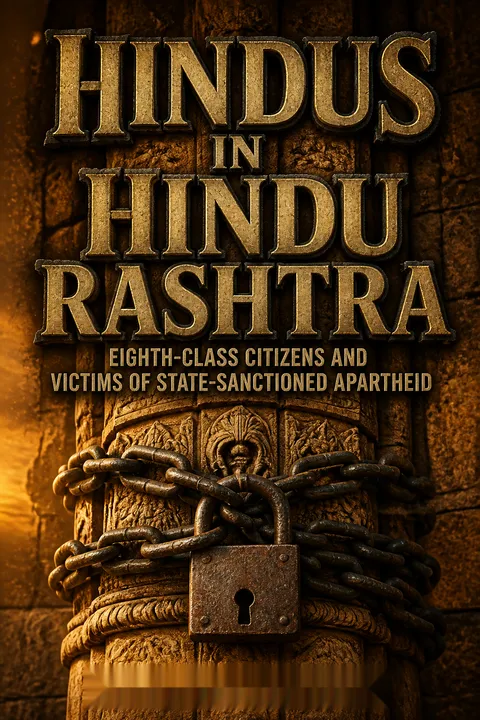
The central charge. Anand Ranganathan argues that Hindus can face structural disadvantage even in a Hindu-majority country. He calls this condition being eighth-class citizens: a rhetorical description of unequal treatment in law, policy, and public memory, not a legal category. His case spans temple administration, Kashmiri Hindu displacement, religious endowments, education rules, family law, court decisions, and historical commemoration. He also faults the BJP-led government for leaving important arrangements intact, so the book's target is not only one party.
A test of fairness. The book distinguishes minority benefits from what it regards as more damaging discrimination against Hindus. Its central question is whether comparable religious institutions and communities face comparable rules. The chapters offer examples meant to show that the answer is no. Their force depends on whether each legal and historical claim survives independent comparison, not simply on the accumulation of grievances.
The book's strongest organizing idea is that majority status does not automatically guarantee equal treatment by institutions. That is a useful prompt for examining who controls property, who receives exemptions, and who carries regulatory costs. A careful audit would compare equivalent cases across states and religious communities, while distinguishing constitutional protections from preferential treatment. The book raises a serious question about asymmetry, but its charged label can make a conclusion seem settled before the evidence is tested. Readers gain most by treating the examples as claims to investigate, rather than as proof that every policy has the same cause.
Separate temple worship from state control, while making finances auditable
A large institutional stake. The book argues that state governments exercise extensive authority over Hindu temples, including control of property, appointments, rituals, and revenue. It cites more than 110,000 temples under state control across ten states, and reports that Tamil Nadu's temple trusts own 478,000 acres. For one example of alleged poor returns from temple land, it contrasts an activist's estimate of 6,000 crore rupees in potential annual rent with 58 crore rupees reportedly collected.
Autonomy as remedy. Ranganathan traces temple regulation from colonial-era laws into post-independence legislation, and asks why a government that calls itself secular should administer Hindu institutions. He favors releasing temples from state control and even proposes public share ownership as a way to answer questions about management. That proposal is his, not a demonstrated solution to the governance problem.
The argument connects religious freedom to institutional stewardship: communities may reasonably want authority over worship and assets associated with their traditions. Yet autonomy alone does not guarantee good management. Temples hold public-facing responsibilities, and devotees, employees, and beneficiaries may need safeguards against opaque accounts or capture by local elites. The proposed corporate-share model is provocative, but it risks treating a sacred institution like an ordinary firm, with ownership questions that the book does not resolve. The practical issue is how to combine religious self-governance with transparent accounting, enforceable duties, and protection of the institution's stated purposes.
Treat Kashmiri Hindu return as rehabilitation, not tourism
Exile remains unresolved. Ranganathan argues that Kashmir's tourist economy can thrive while the displaced Kashmiri Hindu community remains unable to return safely and permanently. He cites an estimate of 700,000 displaced Hindus, while noting that government records count 62,000 registered families. The book also points to slow delivery of promised housing and jobs, and describes transit camps where residents fear for their safety. It presents the refusal to reopen old cases of violence as another form of abandonment.
A ticket becomes testimony. The chapter recalls a father who kept his bus ticket from January 19, 1990, the date his family fled. He eventually passed it to his son as a record of their departure and an insistence that their history not disappear. The story gives the policy argument a human scale: return requires security and practical rehabilitation, while remembrance keeps displacement from becoming politically invisible.
The distinction between visitors and residents is a powerful way to expose what a tourism statistic cannot show. A destination can welcome consumers without restoring the security, housing, livelihoods, and civic standing of people who were driven away. The preserved ticket also illustrates how family objects can function as informal archives when official recognition feels inadequate. At the same time, return is not a single measurable endpoint: it depends on individual choice, safety, and the conditions people would return to. Policy should therefore track both meaningful options for return and support for those who do not choose it.
Demand due process before any religious endowment can claim private land
The law in dispute. A waqf is property dedicated in perpetuity for a religious or charitable purpose under Islamic law. Ranganathan cites government data reporting hundreds of thousands of waqf properties and argues that the Waqf Act, 1995, gives waqf boards unusually powerful tools in property disputes. He focuses on provisions allowing boards to inquire into whether property is waqf, on the role of waqf tribunals, and on limits to ordinary civil-court jurisdiction.
The author's concern. He reads these provisions, including the exemption from limitation periods for certain recovery suits, as shifting the burden onto people whose property is challenged. He argues that litigation can be costly and slow, making even a disputed claim intimidating. The chapter's core demand is procedural parity: property ownership should be decided through a process that gives all parties a fair chance to present evidence and seek review.
Property disputes are a test of state legitimacy because both wrongful appropriation and arbitrary eviction can destroy a person's security. The book usefully directs attention to the route by which a claim is made, who bears the burden, and what appeal is available. But the size of an endowment portfolio does not establish that claims are routinely invalid, just as statutory powers alone do not show how often they are abused. A sound assessment needs case-level evidence and a comparison with other property regimes. The durable principle is not suspicion of one religious institution, but accessible, impartial adjudication for every claimant.
Make education obligations consistent across minority and non-minority schools
An exemption with consequences. The Right to Education Act requires covered schools to reserve 25 percent of seats for children from economically weaker sections and disadvantaged groups. The book argues that minority-run schools receive exemptions that Hindu-run schools generally do not, citing constitutional protections for minority educational institutions. Ranganathan says this leaves a disproportionate share of the admission obligation and regulatory burden on non-minority schools.
Rules can strain small schools. The chapter points to reports of thousands of schools in Maharashtra receiving closure notices, delayed government reimbursements, and reimbursement delays of as much as 307 days in one audit cited by the author. It also cites a much larger estimate of Hindu-run school closures attributed to the law. The book treats these figures as signs that a policy intended to expand access may burden some schools more than others, especially when compensation arrives late.
This is a concrete policy-design problem: a social guarantee can be weakened if the schools required to deliver it cannot afford the cost. Minority protections also serve a distinct purpose, namely preserving the ability of communities to shape education. The hard question is how to protect that freedom without leaving other schools with uncompensated obligations. State-level minority status, school finances, and actual closure data matter; a national claim can obscure important variation. Transparent reimbursement schedules and comparable reporting would help distinguish a defective design from a broader pattern of discriminatory intent.
Apply social reform consistently, without trading women's rights for votes
Reform and political retreat. Ranganathan argues that Indian law has repeatedly reformed Hindu personal practices while leaving other communities' family laws less exposed to change. His central example is Shah Bano, a divorced Muslim woman who sought maintenance under a generally applicable provision of criminal procedure. The Supreme Court ruled in her favor, but the 1986 Muslim Women Protection of Rights on Divorce Act changed the legal framework after political opposition to the judgment.
The equality question. The book presents this episode alongside Hindu Code legislation and debates over a Uniform Civil Code. Its point is not that reforms to Hindu law were mistaken, but that women's rights should not depend on which community's leaders object most loudly. The chapter argues for a common standard of legal protection, while portraying vote-bank politics as a reason governments avoid difficult reforms.
Shah Bano's case reveals the tension between individual rights and group-based legal autonomy. A government can invoke cultural protection to shield a community from majoritarian pressure, yet the same protection can preserve unequal treatment within the community. Uniform rules are not automatically just, however: equal wording may have unequal effects when people begin with different vulnerabilities or resources. The relevant test is whether every person can secure basic protections and meaningful legal recourse, while affected communities participate in reform. That standard is more demanding than either blanket exemption or one-size-fits-all legislation.
Require courts to explain religious interventions by one consistent standard
Courts shape religious practice. The book objects to what it sees as selective judicial scrutiny of Hindu customs. It highlights the 2018 Sabarimala ruling on women's entry, court restrictions on animal sacrifice in some Hindu temples, and limits on bells or chanting at Amarnath. Ranganathan contrasts these interventions with practices in other religions that he argues receive less scrutiny. He frames the conflict through constitutional protections for religious practice and for life, dignity, and liberty.
Consistency matters. The chapter's concern is not simply that courts intervene, but that the grounds for intervention appear uneven. It asks whether judges should decide which practices are essential, harmful, or irrational, and argues that religious traditions should not be treated as uniquely open to correction. Its examples make a case for transparent reasoning about harm, rights, and the limits of state authority rather than casual mockery or unexplained exceptions.
Judicial consistency is essential, but consistency does not mean treating every ritual as legally identical. Courts may need to consider evidence of harm, the practice's context, and the rights of people who participate or are excluded. Religious freedom protects belief and practice, but it does not erase other constitutional interests. The book is right to ask whether judges explain their standards clearly; its comparisons are less persuasive when distinct practices are presented as interchangeable without examining their legal or factual differences. A principled test should be explicit, evidence-based, and applied across traditions.
Revisit historical memory with evidence, not inherited political scripts
Names carry arguments. Ranganathan says public memory often honors rulers and figures associated, in his account, with violence against Hindus, while giving less attention to Hindu resistance and scholarship. He points to road names, public celebrations, and portrayals of figures such as Babur and Tipu Sultan. He also disputes accounts that minimize the destruction of Nalanda, arguing that claims about its history should be grounded in sources rather than ideological convenience.
Memory needs method. The chapter's wider claim is that selective commemoration can make past violence seem negligible and present-day grievances unspeakable. It urges readers to examine who is honored, whose suffering is remembered, and which historical accounts become conventional. The stakes are not only symbolic: the author argues that public narratives shape national identity and political judgment. His examples are presented as evidence of bias, though many of the underlying historical interpretations remain contested.
Public commemoration is a form of civic education, so names and anniversaries deserve scrutiny rather than automatic deference. But a street named for a ruler does not by itself prove that residents endorse every act attributed to that ruler. Historical claims require source criticism, attention to disagreement among specialists, and distinctions between evidence and present-day political use. The chapter's call to recover overlooked violence can widen the archive; it is strongest when it applies the same evidentiary discipline to celebrated Hindu figures as to rulers it condemns. Memory becomes more credible when it resists both erasure and selective certainty.
Preserve legal remedies for historical wrongs without inviting endless communal litigation
A fixed legal status. The Places of Worship Act, 1991, generally bars changing the religious character of a place of worship from how it stood on August 15, 1947, with the Ayodhya dispute treated as an exception. The Supreme Court affirmed the law's role in its 2019 Ayodhya judgment. Ranganathan argues that the cutoff blocks Hindus from seeking legal remedies for earlier temple destruction, particularly in disputes involving Kashi and Mathura.
Justice versus closure. The author portrays historical redress as a matter of continuity and justice, not only religious devotion, and insists that courts should hear evidence rather than close cases categorically. He points to the Ayodhya litigation as an example of a dispute resolved through adjudication rather than mass action. The chapter therefore challenges the Act's balance between protecting existing places of worship and allowing claims about historical conversion to be tested.
The law embodies a real tradeoff. A fixed baseline can reduce incentives to reopen old disputes and protect vulnerable sites from repeated contestation. It can also leave people without a forum to establish a well-supported historical claim. The book emphasizes the second cost, while the law's defenders emphasize civic peace and continuity. Neither value is trivial. A workable debate must separate peaceful judicial inquiry from coercive reclamation, and specify what evidence, deadlines, and remedies would prevent litigation from becoming permanent communal mobilization.
Analysis
This book is best understood as a polemical brief for institutional parity, not as a balanced survey of Indian secularism. Its organizing move is to connect separate disputes, temple administration, waqf property law, school regulation, family law, judicial decisions, Kashmiri Hindu displacement, and historical commemoration, under one claim: formal majority status does not prevent a community from experiencing state-enabled disadvantage. The breadth creates momentum, and the Kashmiri family's preserved bus ticket gives that argument an intimate human anchor.
The same breadth creates an evidentiary problem. A legal exemption, a property dispute, a court ruling, and a historical interpretation are different kinds of evidence. Showing that rules differ does not by itself establish discriminatory purpose, nor does a policy's stated goal establish that its burdens are fair. The book often moves quickly from disparity to motive, and from a reported estimate to a broad conclusion. Its citations provide leads for inquiry, but citation density is not equivalent to independent corroboration or representative data.
The most productive way to read it is as a challenge to testable institutional questions. Which communities control their religious assets? How are the costs of public programs distributed? What appeal exists when a property claim is made? Are constitutional protections applied consistently across states? Such questions can be answered with comparative legal analysis, administrative records, and case-level evidence, without accepting every inference in the book.
Its strongest normative contribution is to insist that secularism be assessed through actual rules and consequences, not merely political self-description. Its weakest tendency is to treat complex groups as unified actors and to present unlike practices as equivalent when making claims of selective treatment. A rigorous account of equal citizenship should protect Hindu institutions from unfair state control, preserve minority protections against majoritarian pressure, and scrutinize both through the same standards of evidence and accountability. The book matters less as a final verdict than as an agenda for that examination.
Review Summary
"Hindus in Hindu Rashtra" presents a controversial perspective on the status of Hindus in India, arguing they face systematic discrimination despite being the majority. Reviewers praise the book's research and eye-opening insights, while critics argue it's one-sided and lacks nuance. The book covers topics like temple control, education laws, and judicial bias. Many readers find it thought-provoking, though some question its tone and factual accuracy. Overall, it's seen as a passionate call to address perceived injustices against Hindus in contemporary India.
People Also Read








Glossary
eighth-class citizens
rhetorical label for unequal statusRanganathan's description of what he sees as entrenched legal, political, and social disadvantages faced by Hindus in India. The phrase is deliberately more severe than second-class citizenship and is used to frame the book's examples. It is a political characterization, not a formal category in Indian law.
Waqf
perpetual religious endowmentA dedication of property for a religious, charitable, or other purpose recognized under Islamic law. The book focuses on waqf property and the statutory boards and tribunals that administer related claims in India. The author argues that the applicable legal powers create an imbalance in property disputes, a claim that requires separate legal and case-level assessment.
Right to Education Act (RTE)
law on children's educationIndia's Right of Children to Free and Compulsory Education Act, 2009, which provides for free and compulsory education for children aged six to fourteen. The book focuses especially on the requirement that covered private schools reserve a share of seats for disadvantaged children, and on exemptions available to minority educational institutions.
Places of Worship Act, 1991
law fixing worship-site statusAn Indian law that generally bars changing the religious character of a place of worship from its status on August 15, 1947, with an exception for the Ayodhya dispute. The book argues that the law prevents judicial remedies for historical conversions. Its defenders regard the fixed date as a safeguard against reopening religious disputes.
essential religious practice
protected core of religious practiceA legal concept discussed in the book in connection with Indian constitutional protections for religion. Courts have used the idea when considering whether a practice is integral to a religious tradition and how it relates to other rights or public interests. The book objects to what it sees as inconsistent judicial judgments about which practices qualify.
FAQ
What’s "Hindus in Hindu Rashtra" by Anand Ranganathan about?
- Central Thesis: The book argues that Hindus, despite being the majority in India, face state-sanctioned discrimination and are treated as "eighth-class citizens" in their own country.
- Eight Illustrations: Ranganathan identifies and analyzes eight key areas—legal, legislative, and societal—where Hindus are systematically disadvantaged.
- Focus on Policy and Law: The book critiques both historical and current governments, including the BJP, for perpetuating or failing to address this discrimination.
- Evidence-Based Approach: The author uses legal documents, historical references, and contemporary examples to substantiate his claims.
Why should I read "Hindus in Hindu Rashtra" by Anand Ranganathan?
- Unique Perspective: The book offers a contrarian view to the mainstream narrative that India is becoming a "Hindu Rashtra" hostile to minorities, arguing instead that Hindus are institutionally disadvantaged.
- Comprehensive Analysis: It provides detailed, referenced discussions on laws, policies, and court judgments affecting Hindus.
- Awareness and Advocacy: Readers interested in Indian politics, law, and society will gain insight into lesser-discussed aspects of secularism and minority rights.
- Call to Action: The book encourages Hindus and policymakers to recognize and address these systemic issues.
What are the key takeaways from "Hindus in Hindu Rashtra" by Anand Ranganathan?
- State Control of Temples: Hindu temples are uniquely subject to state control and financial exploitation, unlike places of worship of other religions.
- Legal and Constitutional Discrimination: Laws like the Waqf Act, RTE Act, and Places of Worship Act institutionalize discrimination against Hindus.
- Judicial and Legislative Bias: The judiciary and legislature often target Hindu practices for reform while avoiding similar scrutiny of other religions.
- Historical Narrative Manipulation: The book claims that Indian history education and public memory glorify invaders and downplay atrocities against Hindus.
How does Anand Ranganathan define "state-sanctioned apartheid" against Hindus in "Hindus in Hindu Rashtra"?
- Legal Discrimination: The author uses the term to describe laws and policies that explicitly or implicitly disadvantage Hindus, such as state control of temples and selective application of educational regulations.
- Political Tokenism: He argues that political parties, including those seen as pro-Hindu, offer only symbolic gestures without substantive policy change.
- Entrenched in Constitution: Ranganathan claims that this discrimination is embedded in constitutional amendments and legal frameworks.
- Societal Impact: The result is a Hindu majority that is fragmented, marginalized, and denied equal rights in key areas.
What are the eight main areas of discrimination against Hindus identified in "Hindus in Hindu Rashtra"?
- State Control of Hindu Temples: Government management and financial exploitation of Hindu religious institutions.
- Injustice towards Kashmiri Hindus: Lack of justice and rehabilitation for victims of the Kashmiri Hindu exodus and genocide.
- The Waqf Act, 1995: Special legal privileges and powers granted to Muslim religious endowments, often at the expense of Hindu property rights.
- The RTE Act: Selective application of the Right to Education Act, burdening Hindu-run schools while exempting minority institutions.
- Legislations Targeting Hindus: Laws and bills that reform or restrict Hindu practices but avoid similar reforms for other religions.
- Judicial Reform Focused on Hinduism: Courts disproportionately target Hindu customs for reform while sparing others.
- Celebration of Historical Perpetrators: Glorification of figures who committed atrocities against Hindus in public spaces and education.
- Places of Worship Act, 1991: Legal barriers to reclaiming Hindu sites destroyed or converted by invaders.
How does "Hindus in Hindu Rashtra" by Anand Ranganathan critique the State control of Hindu temples?
- Financial Exploitation: The book details how state governments control temple revenues and properties, often diverting funds away from Hindu causes.
- Selective Application: Only Hindu temples are subject to such control, while mosques and churches manage their own affairs.
- Impact on Community Services: State control limits temples’ ability to fund educational, cultural, and charitable activities for Hindus.
- Legal Challenges Ignored: Petitions to free temples from state control have languished in courts without resolution.
What is Anand Ranganathan’s analysis of the Waqf Act, 1995, in "Hindus in Hindu Rashtra"?
- Parallel Legal System: The Waqf Act creates a powerful, autonomous system for managing Muslim religious properties, with its own tribunals and enforcement mechanisms.
- Discriminatory Provisions: The Act allows Waqf Boards to claim property as Waqf with minimal oversight, often shifting the burden of proof to non-Muslim owners.
- No Equivalent for Hindus: There is no similar legal framework for Hindu, Sikh, or Christian religious properties.
- Political and Judicial Support: Attempts to challenge the Act have been dismissed by courts and ignored by successive governments.
How does "Hindus in Hindu Rashtra" address the Right to Education (RTE) Act and its impact on Hindu-run schools?
- Selective Enforcement: The RTE Act’s requirements, such as the 25% EWS quota, are enforced on Hindu-run schools but not on minority institutions.
- Financial Strain: Delayed government reimbursements and strict regulations have led to the closure of thousands of Hindu schools.
- Constitutional Loopholes: Articles 30 and 15(5) of the Constitution are cited as enabling this discrimination.
- Long-Term Consequences: The author argues this leads to the decline of Hindu educational institutions and increased conversion pressures.
What examples does "Hindus in Hindu Rashtra" give of judicial and legislative bias against Hindus?
- Reform Targeting Only Hindus: Laws and court judgments often focus on reforming Hindu practices (e.g., Sabarimala, animal sacrifice) while avoiding similar scrutiny of other religions.
- Overturning Pro-Hindu Judgments: Political interventions have reversed court decisions that favored Hindu interests, such as the Shah Bano case.
- Selective Outrage: The judiciary and activists are portrayed as quick to criticize Hindu customs but silent on issues within other communities.
- Impact on Religious Freedom: The book argues this bias undermines the constitutional right of Hindus to manage their own religious affairs.
How does "Hindus in Hindu Rashtra" by Anand Ranganathan critique the historical narrative taught in India?
- Glorification of Invaders: The book claims that Indian history textbooks and public spaces honor figures who perpetrated violence against Hindus.
- Distortion and Erasure: Atrocities against Hindus are downplayed or blamed on Hindus themselves, while the achievements of Hindu heroes are minimized.
- Impact on Identity: This narrative, according to the author, fosters self-loathing and weakens Hindu civilizational consciousness.
- Call for Reclamation: Ranganathan urges a re-examination and correction of historical narratives to reflect the true experiences of Hindus.
What is the significance of the Places of Worship Act, 1991, according to "Hindus in Hindu Rashtra"?
- Legal Freeze on Injustice: The Act mandates that the religious character of places of worship as of 1947 cannot be changed, except for the Ram Janmabhoomi site.
- Blocks Redressal: This law prevents Hindus from reclaiming sites that were converted or destroyed by invaders, regardless of historical evidence.
- Judicial Endorsement: The Supreme Court’s Ayodhya judgment is cited as having ratified this Act, further entrenching the status quo.
- Civilizational Implications: The author argues that denying justice for historical wrongs undermines the continuity and dignity of Hindu civilization.
What are the best quotes from "Hindus in Hindu Rashtra" by Anand Ranganathan and what do they mean?
- "Hindus were and continue to be eighth-class citizens, regardless of who holds the reins of power."
This encapsulates the book’s central argument that discrimination is systemic and not limited to any one political party. - "Appeasement may rankle, but Indians have learnt to accept it... The issue is of apartheid."
The author distinguishes between political appeasement and deeper, structural discrimination. - "History that is written by the victors is peddled by the vanquished."
Ranganathan critiques the way history is taught and remembered in India, arguing it perpetuates Hindu marginalization. - "The concept of justice is like memory. It keeps getting passed on until realised."
This quote reflects the book’s call for historical redress and the enduring nature of the quest for justice.
About the Author
Other books by Anand Ranganathan
Download PDF
Download EPUB
.epub digital book format is ideal for reading ebooks on phones, tablets, and e-readers.








