



Plot Summary
The City Behind Kailash
Prithvi14 resumes his account for Mrs Batra11 with a startling claim: he is Om’s son.14 His story returns to Om,1 unconscious after Ross Island, waking in a Himalayan monastery with his wounds healed and his face newly shaved. Ashwatthama3 explains that Om1 has returned to the place where he first awoke, the hidden city of Gyanganj, concealed within Mount Kailash.
Beyond its boundary, Om1 sees extinct animals and plants preserved in a living refuge for the lost species of the world. When a sabre-toothed tiger attacks, Vrishkapi,8 the last of the Kapi,8 drives it off and becomes Om1’s first unexpected ally. Ashwatthama3 then reveals that Nagendra2 has the books of Mrit Sanjeevani but still needs Om’s blood.
Gyanganj answers one of Om’s oldest questions, but its welcome is not simple comfort: the place is both his lost home and a territory whose rules he does not yet understand. Its extinct creatures make disappearance tangible, while Vrishkapi’s rescue shows that protection here depends on relationships, not merely on sacred geography. The parallel cut to Nagendra keeps the reunion from becoming a refuge from the plot. Even as Om finds a possible origin, his blood remains the object of another man’s design.
Milarepa's Double Life
The green-skinned sage5 Milarepa5 explains why he came to Kailash: centuries earlier, he searched for Nanshaad, only to learn that the name reversed into Dashaanan, one of Ravana’s titles, and that Nanshaad was Nagendra.2 Nagendra2 recruited Milarepa,5 then sent him undercover to the captive physician Dhanvantari, whom he was torturing into rewriting Mrit Sanjeevani.
Dhanvantari told Milarepa5 about Om1 and asked him to reach Parashurama.4 Milarepa5 freed the dying physician by killing him, then crossed the impossible mountain to find help. Om,1 furious that Dhanvantari is dead and the books are gone, declares the cause lost. Ashwatthama3 insists Om1 is still needed and begins training him to command ancient astras.
Milarepa’s history recasts the search for a teacher as a chain of mistaken loyalties. He once followed Nagendra because he believed obedience could serve a larger purpose, then learned that silence had made him an instrument of cruelty. His decision to end Dhanvantari’s suffering is morally painful precisely because it cannot restore what captivity destroyed. Om’s anger is also grief for a lost witness to his own beginning. Ashwatthama counters that despair with responsibility: Om must become more than the person others seek to use.
Mansarovar's Broken Mirror
Nagendra2 brings Parimal6 and LSD7 to Lake Mansarovar on a crescent moon night, where they must locate a hidden word before the moon sets. Parimal6 dives beneath the narrow land divide between Mansarovar and the turbulent Rakshastal, but his first bomb fails to break through.
LSD7 risks a second blast, which finally opens the barrier and leaves her unconscious; Parimal6 drags her to shore and revives her. In the joined waters, moonlight reveals the word Avinasi, which Nagendra2 absorbs.
The operation destroys Mansarovar’s stillness and leaves its sacred lake overwhelmed by Rakshastal. Nagendra2 then orders Parimal6 to father a child with LSD,7 giving the mission a new, coercive purpose. Elsewhere, Dr Tej Batra12 tests Om’s unusual blood while his wife11 Amrita’s11 multiple sclerosis worsens.
The lake operation turns an abstract contest between good and evil into a physical alteration of the landscape. Nagendra does not merely steal a word; he removes the boundary that kept two waters distinct, and Parimal and LSD pay for that change with bodily danger. His order to conceive a child extends his control beyond the mission and into another generation. The Batra subplot echoes this struggle on a smaller scale: Tej treats Om’s blood as a possible cure, while the experiment forces him to decide what scientific hope can justifiably demand of others.
Nine Words, Nine Moons
The destruction of Mansarovar sends Parashurama4 to awaken Ved Vyasa,10 who explains that Dhanvantari preserved a prophecy about nine hidden words, sought from nine locations over successive lunar months. Together, the words will open a door and release powerful beings; the prophecy’s timetable suggests someone is trying to bring the end of Kali Yuga forward to 2020.
Nagendra2’s first success confirms that the threat is real, and the defenders learn that the books’ pages contain clues to the locations. Vyasa10 identifies Roopkund, the Skeleton Lake, as a likely target. Parashurama4 sends Vrishkapi8 there, while Milarepa5 and he prepare to watch other possible sites. Om1 remains behind with Ashwatthama,3 still unready for combat.
The prophecy changes the scale of the conflict from a contest over immortality to a race against a threatened cosmic deadline. Its lunar structure makes time measurable: each crescent marks another opportunity for Nagendra and another failure for the defenders. The prophecy also turns sacred geography into a vulnerable map. Parashurama’s refusal to send Om is protective, but it leaves Om facing the familiar wound of exclusion. His training must now answer not only how to fight, but how to participate in a crisis that began with his own lost history.
The Skeleton Lake
At Roopkund, Nagendra2 uses radar and diving equipment to search beneath the ice for a skull that holds the next inscription. As the crescent moon rises, the surrounding skeletons begin to stir, and Vrishkapi8 charges down to stop the theft. LSD’s7 guns cannot halt him, but a net briefly traps him; Parimal6 then dislodges the skull as Vrishkapi8 throws him aside.
Nagendra2 tears into Vrishkapi’s8 neck, takes the skull, and drinks the dissolved inscription. A grenade triggers an avalanche that buries the lake, the skeletons, and Nagendra2’s team. Vrishkapi8 escapes by flying, then crashes into a small aircraft and disappears beneath the snow. Milarepa5 later finds him alive and brings him home with help from a Yeti named Ballhaar.17
Roopkund exposes the cost of treating guardians as obstacles rather than persons. Vrishkapi is powerful but inexperienced in deceit, so Nagendra exploits the very trust that makes him a protector. His injury turns the defenders’ shortage of time into a shortage of people. The avalanche also gives Nagendra and his agents no clean victory: they escape into mortal danger, leaving the rescue of LSD and Parimal uncertain. Milarepa’s search for Vrishkapi provides a counterweight to Nagendra’s predation, as he uses attention and persistence to recover someone who cannot save himself.
The Boy Behind the Door
With Kripacharya’s9 strength helping Ashwatthama3 hold open Om’s memory door, the three enter a shadowed past. They find a child marked on his left heel,15 first gentle with a rabbit and then suddenly cruel, and later see the same boy15 set crops ablaze. The visions suggest that the boy,15 called Devdhwaja,15 is central to Om1’s buried history.
As the trio tries to retreat, attackers overwhelm them; Kripacharya9 stays behind to protect Ashwatthama,3 and Milarepa5 closes the door before the assailants can cross into Gyanganj. During this same stretch, Parimal6 takes LSD7 to his ancestral village of Shetpal. They marry and attend a private rite in which a great serpent tests LSD’s7 willingness to carry their child and blesses the pregnancy.
The memory journey offers no stable biography, only scenes that resist easy moral interpretation. The child’s abrupt violence sits beside his earlier play, unsettling any assumption that identity can be read from a single act. Kripacharya’s entrapment makes Om’s past dangerous to everyone around him, while the door’s closure repeats the larger conflict between knowledge and safety. In Shetpal, LSD’s pregnancy is likewise made subject to a ritual and a lineage she barely understands. Both threads ask whether inherited identities can be chosen, or only endured.
Milarepa's Last Offering
Nagendra2 reaches the Taj Mahal, where Milarepa5 has enlisted animals and people to watch every approach. Rather than raid the monument on the crescent night, Nagendra2 waits for sunrise to reveal a hidden passage.
He uses a hypnotized woman to seize control of Milarepa,5 then makes him enter a chamber protected by flames and retrieve its word. Milarepa5 obeys against his will, burns alive, and hands Nagendra2 the prize. The Taj Mahal turns black, and the entranced people and animals fall into the burning pit.
Parashurama4 and Ashwatthama3 arrive too late to recover Milarepa’s5 body. In the frame story, Amrita11 recalls that Tej’s12 experiment revived her after her apparent death, but his growing ambition and the danger around his discovery soon drive them apart.
Milarepa’s end completes the reversal of his earlier service to Nagendra: the man who once acted as a spy becomes the unwilling means by which his former master takes a word. His hypnotized surveillance force, meant to protect the site, becomes a channel for Nagendra’s control. The blackened monument makes that reversal publicly visible, while the loss of Milarepa removes one of the few people able to connect Om’s history to the present. Tej and Amrita’s parallel story introduces a different danger: a rescue can become a discovery that its maker no longer knows how to relinquish.
Kuldhara's Blood Fountain
At Kailash, the wounded Vrishkapi8 manages to warn Om1 that Nagendra2 is not alone. Ashwatthama3 has already gone to Kuldhara, where he waits among the abandoned houses for the next raid. Nagendra2’s team kills the guards and awakens an old temple by pouring blood into its ritual pit.
The blood spreads through the ruins and rises as a fountain, revealing the word Sakal Jagat. Om1 arrives in time to see Parimal’s6 weapon pin Ashwatthama3 to a wall with a metal grappling hook.
He cuts Ashwatthama3 free, but Nagendra2 attacks him, and a bullet strikes Nagendra2 during the struggle. A drop of Nagendra2’s blood reaches Om1’s lips, flooding his mind with images from the past. Nagendra2 falls, apparently dead, while the desert settlement collapses into sand.
Kuldhara brings the conflict’s two central vulnerabilities together: Ashwatthama’s immortality can be turned into a trap, and Om’s blood remains dangerous even when he is not the target. Om finally leaves the protected city, choosing action despite Parashurama’s orders, because Vrishkapi’s warning gives him something concrete to prevent. Yet the act that opens Om’s memories is accidental, not a triumph of control. The ruined village becomes an apt setting for that return: its buried history rises briefly through blood, then the buildings themselves disappear.
The Pet Behind the Throne
While Om1 and Ashwatthama3 lie incapacitated, LSD7 drives Nagendra2’s body to the submarine with Parimal.6 She tells him that she is Latika, an ancient being who has lived through animal forms, including the pets kept by Parimal’s ancestors.6 Her service to Nagendra2 began long before her human life, and the promise made by Parimal’s family6 binds him to Nagendra2 as well.
In the submarine, Shukracharya13 examines Nagendra2’s remains. LSD’s7 search for Om’s blood instead leads her to Dr Tej Batra,12 who has been separated from Amrita11 after refusing to surrender his discovery. Tej12 reveals that the guinea pig, Pooh, also carries Om’s blood. LSD7 takes the animal, then orders Tej12 drowned in the ocean despite having promised he would not be harmed.
Latika’s revelation turns the apparently secondary operative into a living archive of the story’s past. Her memory spans species and generations, but that continuity has not given her freedom; she has been bound to Nagendra through a bargain she inherited. Parimal’s lineage is similarly described as both privilege and captivity, making their forced marriage part of a larger system of inherited obligation. Tej’s fate sharpens the book’s distrust of bargains made under pressure: LSD secures the material she needs, but her false reassurance converts negotiation into another form of coercion.
Two Men Named Devdhwaja
On Kailash, Om1 wakes beside Ashwatthama3 and learns that Parashurama4 and Kripacharya9 have returned from the memory realm. With the barrier to his past gone, Om1 remembers who he is: Devdhwaja,15 the boy whose birthmark and childhood15 the immortals had witnessed. Elsewhere, Shukracharya13 uses Pooh’s blood to revive Nagendra’s2 body.
The restored man2 bears the same black birthmark on his left heel, and Shukracharya13 welcomes him as Devdhwaja too. The ending leaves the two revelations uneasily side by side. Meanwhile, Prithvi’s14 account brings Mrs Batra11 to the knowledge that Tej12 did not return to her: LSD’s7 crew drowned him after taking Pooh. His story closes not with reunion but with the truth she had been waiting decades to hear.
The final revelation makes identity less a solved riddle than a destabilizing fact. Om’s recovered past and Nagendra’s renewed body share the name Devdhwaja, while the birthmark once used to distinguish the boy now links the two men. The book withholds a neat explanation, leaving the reader to feel the danger in that overlap. Mrs Batra’s frame story reaches a more intimate, brutal closure: she receives certainty about Tej, but certainty cannot restore him. Memory returns, yet neither personal knowledge nor immortality guarantees repair.
Analysis
The novel makes memory and preservation tangible. Gyanganj keeps extinct creatures alive; Om1’s mind keeps a sealed past; the books preserve instructions that powerful men convert into a route toward release. These are not passive archives. Each becomes a contested space, and the act of opening or exploiting it carries consequences. Nagendra2 alters landscapes to extract hidden words, while Om1 must enter his own past without knowing whether the knowledge will free him or endanger his allies.
Its moral conflicts are built around bargains that outlive their makers. Parimal6 inherits a vow that restricts his life, LSD7 carries the consequences of an ancient exchange, and Milarepa5’s earlier service to Nagendra2 shadows his later attempts to help Om.1 The book repeatedly asks whether obedience can be ethical when the original consent was coerced, inherited, or made in ignorance. Even acts of care become unstable: Tej12 saves Amrita11 but turns their shared life into a public experiment, while Nagendra2’s command over his agents reaches into their future family.
The frame story gives these mythic stakes a human measure. Mrs Batra11 wants to know what became of her husband,12 not simply whether his discovery mattered to history. Her grief exposes the price of treating a person as proof. At the same time, Om1’s search for identity refuses an easy split between a recoverable past and a chosen present. The ending joins that personal question to the larger plot by giving two men the name Devdhwaja. Rather than resolving the mystery, it makes identity itself the next danger: memory has returned, but its meaning remains contested.
Review Summary
The Hidden Hindu 2 continues the saga with improved character development and intricate mythology. Readers praised the blend of science, history, and Hindu philosophy, appreciating the attention to detail and suspenseful storytelling. Some found the narrative complex and occasionally disjointed, while others criticized the portrayal of immortal characters. The book's exploration of ancient Indian knowledge and mysterious quests captivated many, though a few felt overwhelmed by the information. Overall, it's seen as a compelling sequel that leaves readers eager for the final installment.
People Also Read



Characters
Om
The searching immortalOm is an immortal man whose memories before his resurrection have been sealed away. His search for his origin makes him vulnerable to anyone who claims to know what he was, but his long life has also given him a deep store of observation and combat experience. He is curious, capable of tenderness toward the living world, and increasingly impatient with being treated as a protected object rather than a participant. His relationships with Ashwatthama3 and Milarepa5 offer different forms of guidance: one trains his body, the other carries knowledge of his past. Om’s central drive is not simply to survive, but to understand what his survival means.
Nagendra
The relentless seekerNagendra pursues immortality and the hidden words with cold discipline, treating people, sacred sites, and even geography as instruments. His decaying body makes time a personal enemy, yet he rarely allows urgency to show except when a plan is threatened. He commands Parimal6 and LSD7 through fear and bargains, and his long history with Milarepa5 reveals that he can recruit loyalty as easily as he can punish disobedience. His interest in Om’s blood makes the conflict intimate: Om1 is not merely an opponent but a necessary piece of Nagendra’s survival. Nagendra’s patience is strategic, not merciful.
Ashwatthama
The wounded warrior-teacherAshwatthama is an immortal warrior cursed with pain and a body that bears the consequences of his past. He serves as Om1’s teacher, introducing him to the astras and insisting that ancient knowledge demands discipline rather than bravado. His authority can become impatience, especially when Om1’s questions interrupt urgent training, but he understands the isolation of carrying a past that cannot be undone. His bond with Om1 grows through instruction, honesty about his own suffering, and the effort to keep his student alive without denying him agency.
Parashurama
The uncompromising protectorParashurama is an immortal warrior and strategist who divides his attention between guarding threatened sites and preparing Om1 for a larger conflict. He gives direct orders because he sees how quickly a single mistake can cost lives, but his protectiveness can leave Om1 feeling excluded from the fight. Parashurama understands that strength alone is insufficient; he recruits allies, consults Ved Vyasa10, and accepts risks when the mission requires them. His discipline is rooted in responsibility, though the pressure of choosing who faces danger can make his decisions severe.
Milarepa
The repentant mysticMilarepa is a green-skinned sage whose legendary life began in revenge and violence before turning toward repentance and spiritual discipline. His training under Marpa taught him to accept arduous work without knowing its purpose, a lesson that shapes his patient approach to others. He carries knowledge connecting Nagendra2, Dhanvantari, and Om1, but his past service to Nagendra2 complicates his role as guide. Milarepa seeks to use what he learned in the service of liberation rather than power, and his quiet resolve makes him one of the few people able to move between ancient history and the present crisis.
Parimal
The bound heirParimal is a historian and Nagendra’s2 capable operative, raised within a serpent-linked lineage whose descendants owe Nagendra2 lifelong service. He bears a strange mark on his palm and has no palm lines, signs of a family history he does not fully control. His loyalty is reinforced by inherited fear, yet his growing attachment to LSD7 and concern for their child complicate his obedience. Parimal often supplies the practical knowledge that makes Nagendra’s2 plans work, but he also wants to understand the people beside him. His life is caught between royal privilege, hereditary obligation, and a desire for a relationship chosen freely.
LSD
Nagendra's guarded operativeKnown by the alias LSD, she is a skilled, observant operative who rarely receives the full purpose of Nagendra’s2 plans. She responds to danger with quick decisions and practical competence, as when she uses a monitor to track Parimal6 underwater or treats a crisis as a problem to solve. Her guarded manner protects more than information: it conceals a long history and a complicated dependence on Nagendra2. The order to have a child with Parimal6 forces her into a future neither of them planned, while her responses suggest that obedience has never erased her capacity to make choices of her own.
Vrishkapi
Gyanganj's gentle guardianVrishkapi is the last of the Kapi, a powerful ape-like being who protects Gyanganj and its preserved creatures. His strength is matched by an open, almost childlike manner: he gives his pet a playful name and asks simple questions without suspicion. That innocence is not weakness, but it leaves him less prepared for enemies who use deception rather than direct force. Vrishkapi’s loyalty to Ashwatthama3 and the hidden city brings him into the conflict beyond his familiar territory.
Kripacharya
The principled teacherKripacharya is an immortal archer and teacher known for his adherence to law and principle. As Ashwatthama’s uncle3, he brings both family connection and formidable discipline to the effort to enter Om’s memories. He is cautious about altering the past and insists that the immortals observe rather than interfere. His judgment is not passivity: when danger closes in, he places himself between the attackers and the others. Kripacharya’s presence gives the memory expedition a steadier balance than Ashwatthama’s3 urgency alone can provide.
Ved Vyasa
The keeper of cluesVed Vyasa is a sage whose extraordinary hearing lets him gather echoes of words spoken across time. He interprets the prophecy and identifies likely locations from the clues hidden in Mrit Sanjeevani. Rather than wielding force in the field, he supports the defenders through research, meditation, and careful inference. His knowledge is extensive but incomplete, so he must distinguish what he can establish from what remains uncertain. That limitation makes his guidance valuable without making the threat easy to solve.
Mrs Batra
The rescued wifeMrs Batra is a woman who survived a devastating illness through her husband12 Tej’s12 experiments with Om’s blood. Prithvi’s14 account gives her a way to understand the events surrounding her recovery and separation from Tej12, but she listens with the skepticism of someone who has already been turned into a medical subject. She loved Tej12 and wants the truth about his absence, not another explanation that treats her life as evidence. Her frame story grounds the mythic conflict in the cost borne by ordinary intimacy.
Dr Tej Batra
The driven physicianTej is a physician whose devotion to his wife11 Amrita11 leads him to investigate the unusual properties of Om’s blood. He is methodical and inventive, but the possibility of a world-changing discovery begins to compete with the private purpose that first drove his work. His choices reflect the strain between medical duty, ambition, and the safety of the person he loves. Tej believes his research could help others, yet he underestimates how quickly powerful interests may turn a cure into a weapon.
Shukracharya
The asura preceptorShukracharya is the ancient guru of the Asuras and a master of the knowledge associated with overcoming death. He remains physically hidden in the submarine’s restricted chamber, where even Nagendra’s2 closest agents suffer under the force surrounding him. His authority is expressed through controlled, exacting commands rather than constant presence. The methods and loyalties of this preceptor make him a formidable influence behind Nagendra’s2 campaign.
Prithvi
The story's living witnessPrithvi recounts the events to Mrs Batra11 and claims to be Om’s son14. He guides her through parallel stories she could not have witnessed, including the events at Kailash and the submarine. His calm manner gives the account structure, even when the revelations test Mrs Batra’s11 patience and grief.
The birthmarked boy
The unsettling childThe boy appears in Om’s memories with a black mark on his left heel. At different ages, he plays, harms animals, and sets crops alight, leaving the immortals unsure how these fragments fit together. His scenes make him a central mystery within Om’s1 search for his own past.
Vishnuyasha
The boy's village guardianVishnuyasha appears in the memory realm as a villager who cares for the birthmarked child15. His presence connects the boy15 to an ordinary community and gives the immortals an early glimpse of the life surrounding him.
Ballhaar
The mountain rescuerBallhaar is a Yeti who helps Milarepa5 transport the critically wounded Vrishkapi8 toward Gyanganj. He is a quiet presence in the rescue, offering strength when the injured guardian8 cannot be carried alone.
Plot Devices
Mrit Sanjeevani
The stolen life manualThe books of Mrit Sanjeevani contain knowledge linked to resurrection and the hidden route to the nine words. Nagendra2 possesses the books but still needs Om’s blood for his larger plan. Their pages also preserve clues that Ved Vyasa10 uses to identify possible destinations. The books therefore serve two purposes: they motivate Nagendra’s2 pursuit of Om1 and provide the defenders with evidence about where the next attack may occur.
The Nine Hidden Words
A lunar countdownA prophecy describes nine words concealed at mysterious locations, sought over successive lunar months. The collected words are intended to unlock a hidden door and release powerful beings. Nagendra2 finds the clues in the books and races from site to site, while the crescent moons mark each deadline. The device turns a sprawling search across India into a timed contest: each successful extraction damages a sacred place and leaves the defenders with fewer safe locations.
Gyanganj
A refuge outside ordinary mapsHidden within Mount Kailash, Gyanganj exists beyond ordinary mapping and holds sages, immortals, and species declared extinct elsewhere. Its boundaries create a clear contrast between the protected interior and the human world Nagendra2 traverses. The city gives Om1 a place to recover and train, but it cannot keep the conflict outside forever. Its existence also makes the preservation of lost life literal, tying the threatened lakes and their stolen words to the possibility of survival.
Om's Memory Door
A locked route to identityOm’s1 memories before his resurrection appear behind a door in his mind. Ashwatthama3 and Kripacharya9 enter his astral state to hold it open, but the scenes are fragmented and dangerous. The door gives the story a way to reveal the birthmarked boy15 and the events surrounding Om’s1 past without immediately explaining their connection. It also makes knowledge physically risky: the immortals can be trapped inside, and a memory expedition may expose them to forces that can attack from within.
Om's Unusual Blood
A cure and a targetOm’s1 blood contains unusual black cells that resist disease and extreme conditions. Tej12 studies it as a possible way to save Amrita11, while Nagendra2 needs it for his own pursuit of life beyond decay. Tej’s12 experiments suggest a medical breakthrough, but the same discovery attracts people willing to seize it by force. The blood links the intimate Batra11 story to the immortal conflict and makes Om’s1 body both a potential source of healing and a strategic vulnerability.
FAQ
Synopsis & Basic Details
What is The Hidden Hindu 2 about?
- Quest for Ancient Power: The story follows Om, an immortal with amnesia, as he races against the antagonist Nagendra to collect nine mystical words hidden across India, which are key to a catastrophic prophecy tied to the cycle of yugas.
- Unraveling Forgotten Identity: Om, guided by other immortals like Ashwatthama and Parashurama, delves into his fragmented past to understand his origins and connection to the prophecy, discovering he was once known as Devdhwaja.
- Cosmic Battle for Control: Set against the backdrop of ancient Hindu mythology and hidden locations like the mythical Gyanganj, the narrative explores a high-stakes conflict between forces seeking to manipulate time and destiny.
- Struggle Against a Cursed Foe: Nagendra, driven by a dark curse and a desperate need for Om's unique blood, employs cunning tactics and allies to acquire the words, leading to confrontations across sacred and mysterious sites.
Why should I read The Hidden Hindu 2?
- Deep Dive into Mythology: The book intricately weaves elements of Hindu mythology, ancient science, and philosophical concepts like the yugas and immortality into a modern thriller narrative.
- Complex Character Journeys: Readers interested in character development will find compelling arcs, particularly Om's search for self, Ashwatthama's struggle with his curse, and the morally ambiguous motivations of characters like Nagendra, Milarepa, and LSD.
- Mystery and Suspense: The plot is structured as a treasure hunt across India, filled with hidden clues, unexpected twists, and a constant race against time, keeping readers engaged with its blend of action and mystery.
What is the background of The Hidden Hindu 2?
- Ancient Indian Lore: The story is deeply rooted in Hindu scriptures and legends, featuring characters like Ashwatthama, Parashurama, Ved Vyasa, and Kripacharya, who are among the seven Chiranjeevis (immortals), and referencing concepts like astras, yugas, and sacred sites.
- Integration of Science and Myth: It explores the idea that ancient Indian knowledge contained advanced scientific principles, presenting mythological elements like flying vehicles (Vimana Purana) and gravitational understanding (Brahmagupta, Bhaskara II) as precursors to modern science.
- Geographical and Cultural Tapestry: The narrative spans diverse and significant locations across India, from the Himalayas (Mount Kailash, Amarnath) and coastal regions (Digha beach, Mandvi beach) to historical sites (Taj Mahal/Tejo Mahalaya) and mysterious places (Roopkund, Kuldhara, Bheemkund, Shetpal), grounding the fantasy in real-world geography and local legends.
What are the most memorable quotes in The Hidden Hindu 2?
- "Today can never win over yesterday, and neither can tomorrow.": Ashwatthama's statement to Om about the power of ancient science over modern technology encapsulates a core theme of the book – the enduring relevance and superiority of ancient knowledge.
- "It is not about the size of the pot, but what is preserved within.": Parashurama's grim observation on the destruction of Mansarovar highlights the symbolic significance of the lake's 'soul' being taken, emphasizing that true value lies beyond physical form.
- "The only emotion that would have dragged you to that door without my permission would be love.": Nagendra's chilling observation to Parimal reveals his cynical view of human connection and his manipulation of his followers' deepest feelings.
What writing style, narrative choices, and literary techniques does Akshat Gupta use?
- Alternating Perspectives & Timelines: The narrative frequently shifts between concurrent events happening in different locations (Om/Immortals in Kailash, Nagendra/team traveling, Dr. Batra's experiments) and incorporates flashbacks (Milarepa's past, Om's memories, Parimal's lineage), creating a multi-layered and dynamic reading experience.
- Integration of Exposition through Dialogue: Complex mythological concepts, historical theories (like Tejo Mahalaya), and character backstories are often explained through conversations between characters (e.g., Ashwatthama explaining astras, Parimal narrating his lineage to LSD, Milarepa recounting his past to Om), making dense information accessible within the plot.
- Symbolism and Motif: Gupta employs recurring symbols such as the number nine, specific animals (serpents, birds, extinct creatures), geographical features (lakes, mountains, deserts), and physical marks (Om's scar, Parimal's palm, Devdhwaja's birthmark) to add deeper layers of meaning and foreshadowing to the narrative.
Hidden Details & Subtle Connections
What are some minor details that add significant meaning?
- The 6666 km Distances: Parimal's research revealing the precise 6666 km distance between Mount Kailash and various ancient global sites (North Pole, Stonehenge, Bermuda Triangle, Easter Island, Tazumal) subtly hints at a hidden, possibly ancient, interconnectedness of powerful locations, suggesting a grander, perhaps cosmic, design or network beyond human understanding.
- Extinct Animals in Gyanganj: The presence of dodos, great auks, Steller's sea cows, and sabre-toothed tigers in Gyanganj isn't just exotic scenery; Ashwatthama explains they are "preserved here, every last one of them," symbolizing Gyanganj as a sanctuary for all life forms across yugas, a literal ark of existence outside the normal flow of time and extinction.
- Parimal's Eyeball Birthmark & Palm Lines: The detail that Parimal was born with an eyeball on his palm that falls off after nine days, leaving a scar resembling a keyhole pupil, and that he has no palm lines, is a unique physical manifestation of his lineage's curse and boon, symbolizing their lack of personal destiny ("I don't have a destiny") and their inherent connection to the serpent/Nagavanshi identity.
What are some subtle foreshadowing and callbacks?
- Milarepa's Tower Building: Milarepa's arduous task of building and demolishing towers for Marpa foreshadows his later role in building Ravana's shrine for Nagendra (Nanshaad), subtly linking his past penance for destruction to his unwitting service to a destructive force.
- The Old Man Talking to a Leaf: Milarepa's initial encounter with Nanshaad (Nagendra) talking to a dry leaf, which turns out to be a butterfly (Malti), is a subtle hint at Nagendra's ability to interact with and control nature, foreshadowing his later use of animals and even hypnotized humans as his 'eyes' and tools.
- The Black Birthmark on the Heel: The repeated appearance of a black birthmark on the left heel, first on the infant in Om's memory, then on the teenage Devdhwaja, and finally revealed on the resurrected young Nagendra, is a crucial visual callback that subtly links Om's forgotten past identity (Devdhwaja) to Nagendra's true nature and resurrection.
What are some unexpected character connections?
- Milarepa and Nagendra's Shared Past: The revelation that Milarepa, the revered Tibetan mystic, was once a close disciple and accomplice of Nagendra (Nanshaad) is a significant and unexpected connection, highlighting the complex history and potential for both redemption and betrayal among powerful beings.
- Parimal's Lineage and Nagendra's Oath: Parimal's detailed explanation of his Nagavanshi ancestry, tracing back to Aghasur and Sarputi, and revealing that his entire lineage is bound by an ancient oath to serve Nagendra, establishes a deep, inherited connection that explains his unwavering, albeit sometimes reluctant, loyalty.
- LSD's Past Lives as Nagendra's Pets: The shocking confession by LSD (Latika) that she has lived multiple past lives as various animals and creatures, including those mentioned earlier in the book (Malti the butterfly, Kark the lizard, Kuroop the hyena, Baadal the deer), and that she was Nagendra's 'second pet' alongside Parimal, reveals an ancient and bizarre connection to Nagendra spanning centuries.
Who are the most significant supporting characters?
- Milarepa: Beyond being a redeemed ally, Milarepa is crucial as the link between Dhanvantari, Parashurama, and Om, facilitating the transfer of vital information about Om's existence and the prophecy. His sacrifice at the Taj Mahal is a pivotal moment, directly leading to Nagendra acquiring a word and changing the course of the conflict.
- Parimal: More than just a minion, Parimal represents the weight of inherited duty and curse. His internal conflict, his unexpected connection to LSD, and his role in carrying out Nagendra's plans while grappling with his own identity make him a significant, albeit morally compromised, supporting character.
- LSD (Latika): Initially appearing as Nagendra's loyal lieutenant, LSD's true identity and ancient connection to Nagendra as his 'pet' across multiple lives, coupled with her role in carrying the child and her strategic actions (like finding Dr. Batra), reveal her as a complex and vital player with her own hidden history and motivations.
Psychological, Emotional, & Relational Analysis
What are some unspoken motivations of the characters?
- Om's Desperate Search for Identity: Beyond the quest for the words, Om's deepest unspoken motivation is his profound need to fill the void of his lost memories. His frustration ("Who am I? Where was I born?") and willingness to undergo dangerous astral journeys ("explore your inner self") highlight this core psychological drive for self-knowledge.
- Nagendra's Fear of Decay: While seeking immortality, Nagendra's actions are subtly underscored by a deep-seated fear of his own body's inevitable decay, a consequence of his curse. His description of his body "decaying from within" and his need for Om's blood to prevent ageing reveals a vulnerability driving his ruthless pursuit.
- Parimal's Need for Acceptance: Despite his inherited loyalty, Parimal's attempts to connect with LSD ("We have to learn to trust each other") and his explanation of his lineage seem driven by an unspoken need for understanding and acceptance, perhaps seeking validation beyond his predetermined role as Nagendra's servant.
What psychological complexities do the characters exhibit?
- Ashwatthama's Trauma and Dual Self: Ashwatthama exhibits psychological complexity through his lingering trauma from Krishna's curse and the terrifying encounter with his 'negative alter ego' ("He still haunts me"). This reveals a fractured psyche, where his immortal existence is burdened by past actions and a constant internal struggle between his 'good' and 'evil' selves.
- LSD's Detachment and Adaptation: LSD displays a complex psychological state shaped by her numerous past lives and her current role. Her ability to nonchalantly discuss her past as animals and her pragmatic approach to her relationship with Parimal ("falling in love is not a part of the natural procedure") suggest a form of emotional detachment or extreme adaptation developed over centuries of varied existences.
- Dr. Batra's Obsession and Moral Conflict: Dr. Batra's transformation from a loving husband seeking a cure to a man obsessed with scientific recognition ("aspiration of winning the Nobel Prize") and wealth ("elaborate plans of minting money") highlights the psychological complexity of ambition overriding personal values, leading to morally questionable decisions and ultimately, his demise.
What are the major emotional turning points?
- Om's Grief over Dhanvantari's Fate: Om's reaction to Milarepa's confession about killing Dhanvantari ("Om felt like someone had lit a fire in the pit of his stomach," "came charging at Milarepa with burning rage") is a major emotional turning point, revealing the depth of his connection to his past and his capacity for intense grief and anger despite his amnesia.
- Mrs. Batra's Realization of Tej's Betrayal: Mrs. Batra's emotional journey culminates in the heartbreaking realization that her husband, Tej, prioritized his scientific discovery and ambition over her safety and their shared future ("That was the first time he broke a promise. And along with it he broke everything, forever. He never returned. He betrayed me"), marking a profound turning point in her perception of their relationship and his legacy.
- Parimal's Witnessing of Nagendra's Death: Parimal's reaction to Nagendra's sudden death ("Parimal was shattered") is a significant emotional turning point, as his master and the figure his lineage is bound to serve is gone, leaving him lost and questioning his purpose ("Nagendra is dead and the cause is lost forever").
How do relationship dynamics evolve?
- Om and Ashwatthama's Guru-Shishya Bond: The relationship between Om and Ashwatthama evolves from a rescuer-rescued dynamic to a formal guru-shishya (master-disciple) tradition ("With this, we start the guru-shishya tradition"), deepening their bond through shared meditation, training, and Ashwatthama's efforts to help Om recover his memories.
- Parimal and LSD's Forced Partnership to Complex Connection: What begins as a professional, albeit awkward, partnership under Nagendra's command ("slept with each other... no matter how awkward it was") evolves into a complex relationship marked by shared experiences, vulnerability (Parimal sharing his lineage, LSD her past lives), and the impending parenthood, creating a dynamic beyond simple servitude.
- Nagendra's Control over his Allies: Nagendra's relationships with Parimal and LSD are consistently defined by control and manipulation. He uses their inherited oaths, personal histories, and even their potential child to ensure their obedience, highlighting a power dynamic based on dominance rather than genuine connection, culminating in his chilling treatment of Milarepa and his 'pets'.
Interpretation & Debate
Which parts of the story remain ambiguous or open-ended?
- The Full Extent of the Prophecy: While the prophecy of the nine words and the ninth immortal is revealed, the exact nature of the "mysterious door" they unlock and the complete consequences of the demons following the ninth immortal remain somewhat ambiguous, leaving the ultimate outcome of the cosmic struggle open-ended.
- The Fate of Kripacharya: Kripacharya is left trapped inside Om's memories, and while Parashurama attempts a rescue, his success is not confirmed by the end of the book, leaving the fate of this immortal sage uncertain and a key plot thread unresolved.
- The Identity and Motivations of the "Shadow Figure" (Shukracharya): Although revealed as Shukracharya, his ultimate goals beyond resurrecting Nagendra and his full history with Om/Devdhwaja and the Nagavanshi lineage are not completely explained, leaving his role as the mastermind and his long-term plans open to interpretation.
What are some debatable, controversial scenes or moments in The Hidden Hindu 2?
- Milarepa's Killing of Dhanvantari: Milarepa's act of killing Dhanvantari is presented as an act of mercy to liberate him from torture ("I didn't kill him, Om. I liberated him"), but it can be debated whether this was a justified action or a betrayal, especially since it resulted in the loss of a key source of information (Dhanvantari) and the books of Mrit Sanjeevani.
- Nagendra's Treatment of his Allies: Nagendra's ruthless manipulation and disregard for his followers, such as choking Parimal as a warning ("Next time you lie, you die") or sacrificing Milarepa to acquire a word ("Consider this as the reward for your betrayal"), are highly controversial moments that highlight his cruelty and raise questions about the morality of his quest and the loyalty he commands.
- The Sacrifice at the Taj Mahal: The scene where Nagendra sacrifices hypnotized people and animals by having them jump into the pit to burn on Milarepa's body is a shocking and controversial act, symbolizing the desecration of a sacred/historical site and raising debates about the depths of Nagendra's depravity and the symbolic victory of 'evil' over 'good' (represented by the blackening Taj Mahal).
The Hidden Hindu 2 Ending Explained: How It Ends & What It Means
- Om's True Identity Revealed: The climax reveals that Om is, in fact, Devdhwaja, the boy with the black birthmark from his suppressed memories. This means Om was not just a random subject of Dhanvantari's experiment but a figure of significant power and a key player in the ancient conflict, explaining why his memories were locked and why he is central to the prophecy.
- Nagendra's Resurrection as Young Devdhwaja: Nagendra is killed by Ashwatthama but is resurrected by Shukracharya using Om's blood (acquired from the guinea pig, Pooh) and the acquired words. The twist is that Nagendra is resurrected not just alive, but transformed into a young, powerful version of himself, explicitly identified by Shukracharya as "Devdhwaja," complete with the black birthmark. This implies that Nagendra is the original Devdhwaja, or perhaps a corrupted version, and Om is somehow a separate entity or a later manifestation/copy, setting up a complex dynamic for the next book.
- Shukracharya as the Mastermind: The figure in the restricted chamber is revealed to be Shukracharya, the guru of the Asuras and Nagendra's preceptor. His ability to resurrect Nagendra and his ancient connection to the lineage (shown by the frames in the chamber) confirm him as the true orchestrator behind Nagendra's quest for the words and the prophecy, positioning him as the ultimate antagonist. The ending signifies that the immediate battle is lost for the immortals, Nagendra is reborn stronger, and the race for the remaining words continues with higher stakes and a clearer understanding of the forces at play.
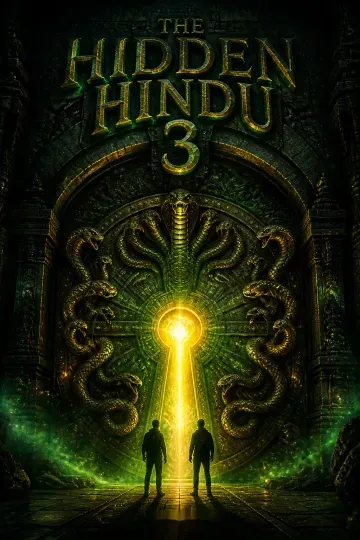
The Hidden Hindu Series

About the Author


Download PDF
Download EPUB
.epub digital book format is ideal for reading ebooks on phones, tablets, and e-readers.








