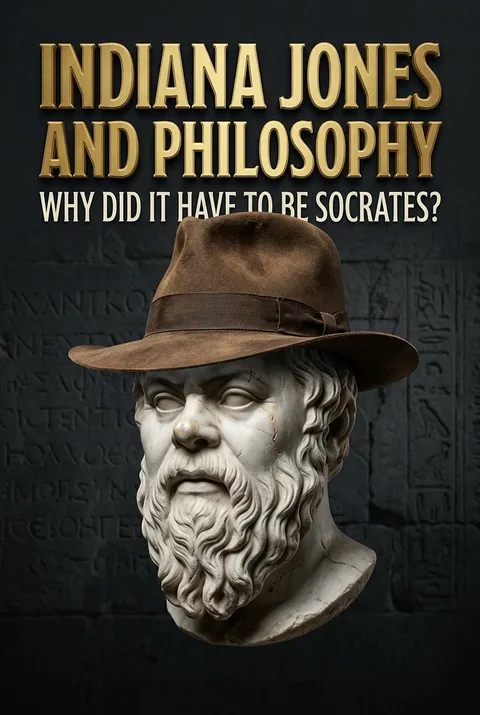


Key Takeaways
Train your character until sound action becomes quick, not careless.
Practice builds judgment. Stoic virtue ethics asks what kind of person acts, not only whether an act produces a good result. Virtue, or arete, means excellence in the capacities that make humans distinctively human, especially reason and social concern. The chapter treats Indy’s apparently improvised escapes as practiced judgment: years of learning and experience can make a good response fast without making it thoughtless. Young Indy’s travels show the education behind that instinct, including confronting mistaken beliefs and learning alongside mentors.
The hero is unfinished. Indy’s courage and compassion look sage-like, but his terror of snakes, flashes of greed, and strained relationships reveal limits. Research on people honored for extraordinary rescues similarly describes many decisions as intuitive and fast. The point is not that outcomes never matter, but that admirable character can persist even when a hero cannot control the outcome.
What's striking is the distinction between trained intuition and mere impulse. Expertise in fields from emergency medicine to music often looks spontaneous because practice has compressed deliberation into skill. That connection makes Indy’s speed intelligible without treating it as magic. Yet character cannot be the only moral test: good intentions and admirable traits can still produce preventable harm. The strongest reading combines the book’s focus on virtue with attention to consequences, especially when the stakes include other people’s lives.
Judge an artifact by public benefit and the claims of living communities.
A museum is not automatic. Indy’s belief that important artifacts belong in museums rests on the idea that public access, research, and preservation benefit more people than private ownership. That logic helps explain his pursuit of the Cross of Coronado and the Ark. But it does not settle every case. With the Sankara Stone, Indy concludes that returning it to Mayapore serves the village better than placing it in a museum as one more display object.
Context changes the answer. The chapter uses consequentialism, which judges choices by their effects on everyone affected, to explain why a general rule may have exceptions. A hidden government warehouse might protect the Ark from misuse, while also denying public study. The answer depends on evidence about risks, access, cultural meaning, and who has a legitimate claim.
This conflict resembles current debates over museum collections: preservation and access matter, but so do colonial histories, religious meaning, and the authority of communities connected to an object. Consequentialist reasoning usefully forces those interests into view. It can also conceal injustice if the benefits of a majority are allowed to outweigh a community's rights. A sound decision therefore needs both an account of likely consequences and a clear explanation of whose claims count, rather than the convenient assumption that a prestigious museum is neutral.
Never let a noble mission turn people into equipment.
Kant sets a boundary. Immanuel Kant’s categorical imperative tests whether a person’s rule for acting could apply to everyone, and whether the action respects people as ends rather than mere tools. Belloq fails by manipulating the Hovitos, Nazi officials, and Marion for his own ambitions. Indy is not exempt: in Raiders, he leaves Marion bound while pursuing the Ark, and his earlier relationship with her raises serious questions about consent and responsibility.
Good outcomes are not enough. Kant’s view explains why rescuing the world cannot automatically justify using a person as a sacrifice. It also creates hard cases. The chapter contrasts Kant’s absolute opposition to lying with the audience’s sympathy for Captain Katanga, who lies to Nazis in an effort to protect Indy. Moral rules can protect dignity, but rigid rules can collide with urgent duties to defend people.
The force of Kant’s boundary is that it prevents a grand objective from making individuals disposable. This principle has clear relevance to institutions that justify surveillance, coercion, or experimentation in the name of collective benefit. The difficult cases matter too: refusing every lie, even one that could thwart an attacker, can seem to protect a rule at the expense of a person. Ethical judgment must identify both the danger of instrumentalizing others and the cost of absolutism.
Build a life you can affirm, then let relationships revise it.
Identity is made in action. Existential self-affirmation means taking ownership of the life one forms through choices. Indy’s fedora and his decades-long search for the Cross of Coronado become signs of a chosen identity, not just props or prizes. Nietzsche’s idea of amor fati, or loving one’s fate, asks whether a person can embrace the life they are actually living. Aristotle’s eudaimonia means flourishing or fulfillment, not a passing mood or simple pleasure.
A life is not a solo project. Camus’s Sisyphus keeps pushing a boulder that rolls back down, finding meaning in conscious persistence despite an indifferent world. Gabriel Marcel adds that authentic commitment requires being genuinely present to others. In The Last Crusade, Indy and his father move from estrangement toward recognition; in Crystal Skull, Indy must confront what fatherhood asks of him.
The chapter’s strongest existential insight is that identity is neither a fixed label nor a trophy waiting at the end of a quest. It takes shape through repeated commitments, including commitments that change as relationships deepen. This aligns with narrative accounts of identity, where people make sense of themselves by revising the stories they live. Persistence alone, however, is not proof that a project is worthwhile. The father-son arc matters because it shows a purpose being reconsidered, not merely pursued harder.
Use evidence to map facts, while admitting what evidence cannot settle.
Archaeology needs truth. A correspondence account says a statement is true when it accurately describes reality. The claim that archaeology seeks facts but not truth sounds self-defeating if facts are what make true claims possible. A more charitable interpretation is that archaeology uses evidence and scientific methods to make revisable claims, while philosophy and theology address broader questions those methods may not settle.
Method is not metaphysics. Methodological naturalism means investigating the world through natural, testable explanations without deciding whether God or other supernatural realities exist. Indy’s experiences with the Ark, the Sankara Stones, and the Grail make his fictional world crowded with evidence for competing beliefs. The book considers three responses: remain agnostic, commit to a faith, or interpret conflicting stories symbolically. None removes the need to examine evidence and assumptions.
This distinction is useful well beyond archaeology: a research method can limit itself to testable explanations without claiming that nothing else exists. It helps prevent a practical rule of inquiry from being mistaken for a complete worldview. The fictional abundance of supernatural evidence also exposes a genuine problem: evidence does not interpret itself, and different traditions may explain the same event differently. The book’s account is strongest when it treats uncertainty as disciplined judgment, not as a refusal to decide anything.
Curiosity needs a brake when knowledge becomes a route to power.
Knowledge can be misused. Belloq wants the Ark to grant him access to God, while Irina Spalko wants the crystal skulls to let the Soviet Union control other people’s minds. Both turn inquiry into possession: they assume that whatever can be learned or reached should be taken. Their ambition differs from Indy’s scholarly curiosity, but Indy too is tempted by the Ark and struggles to destroy it when its power might threaten others.
Prudence sets limits. The chapter invokes the idea that curiosity becomes a vice when it ignores respect for others and treats no knowledge as off limits. Indy shows restraint by warning Marion not to look at the Ark and by leaving before Spalko receives the answer she demands. The contrast is not between curiosity and ignorance, but between inquiry guided by judgment and inquiry driven by control.
The contrast anticipates a modern concern in science and technology: capability does not itself establish permission. Research can create public goods, but tools for prediction, persuasion, or control also affect people who never consented to their use. The book’s emphasis on prudence gives curiosity an ethical dimension without making inquiry suspect by default. Its useful question is not simply what can be known, but who may be harmed, who decides, and whether the knowledge serves understanding or domination.
Respect sacred things without confusing holiness with moral approval.
The holy can overwhelm. Rudolf Otto’s term numinous describes an experience of a presence that feels real, powerful, and beyond ordinary control, often producing both fascination and dread. In Raiders, the Ark’s force is terrifying, and survival depends on not looking at it. Otto’s account separates this sacred experience from moral judgment: the Ark’s power does not simply reward good people and punish bad ones.
Boundaries carry meaning. Durkheim’s sacred-profane distinction describes sacred things as set apart by prohibitions and rituals. The Grail must remain within its temple, while the Sankara Stone belongs in a village where it has a living role. Yet the films bring Jewish, Hindu, and Christian sacred objects into one adventure-world and attach dramatic consequences to their misuse. The book asks readers to notice both the power of these images and the danger of flattening distinct traditions.
The distinction between sacredness and moral goodness is valuable because religious awe does not always fit tidy ethical explanations. It also cautions against treating a story’s supernatural consequences as proof of a tradition’s beliefs. Popular fiction can make unfamiliar religions vivid, but dramatic simplification can turn complex practices into props. A respectful reading holds two ideas together: sacred symbols can organize real communities and meanings, while a film’s version of them remains an interpretation, not a reliable account of religious life.
Preserve archaeological context, not just the object you can carry away.
Context is evidence. Professional archaeology records where objects are found, what surrounds them, and how the site changes across layers. Excavation is destructive because removing an object permanently alters its original setting. A looter who takes the gold but leaves no records destroys information that future researchers cannot recover. Indy’s Golden Idol escape is thrilling cinema, but it is almost a lesson in how not to excavate.
Stewardship is shared work. Archaeological stewardship means caring for the whole record, including material still underground, and preserving knowledge for the public and future research. The professional archaeologists in the book also stress that an artifact’s best home may be a local museum or the community connected to it, not necessarily a major institution abroad. Indy’s greatest real contribution is less his technique than his ability to inspire public interest in archaeology.
The contrast between the Hollywood raid and careful excavation makes an abstract professional norm memorable: an artifact detached from its context loses part of its meaning. The same principle applies to data, archives, and environmental samples, where provenance is essential to interpretation. Stewardship still requires scrutiny, since institutions can claim expertise while withholding objects from communities with stronger cultural ties. The chapter wisely treats public education as part of the profession, not a distraction from research.
Enjoy flawed adventure films without mistaking their stereotypes for history.
Agency matters on screen. The feminist chapter asks whether women in the films make choices and pursue goals of their own, rather than merely helping the male hero. The Bechdel Test asks whether at least two named women speak to each other about something other than a man. The series generally fails that basic test. Marion has moments of resourcefulness, while Elsa has a more independent story, but both are given limits and stereotypes.
Representation has consequences. Temple of Doom presents Willie as squeamish and comic, and its banquet of snake, insects, and monkey brains is not an accurate picture of Indian food. The film also misrepresents Kali and Thuggee practice. The chapter argues that audiences can love the adventure while questioning how its gender and cultural images shape what viewers think they know.
The distinction between enjoying a work and endorsing every element avoids a false choice between uncritical fandom and total rejection. Representation tests are useful prompts, not complete verdicts: a film can pass a checklist yet still flatten a character, and a film that fails can still contain meaningful agency. The stronger habit is to ask who gets complexity, whose culture becomes spectacle, and how confident audiences should be when fiction is their main source of knowledge.
Fight stronger powers strategically, but notice what dirty tactics cost.
Indy avoids the strong point. Asymmetric warfare means a weaker opponent avoids direct contests of strength and uses surprise, movement, or a target’s vulnerability. Indy shoots the scimitar fighter instead of accepting a duel, slips into enemy territory, and turns vehicles and terrain into weapons. These tactics make sense against vastly stronger opponents such as the Nazi state, but they complicate the image of a conventionally honorable hero.
Strategy has moral weight. Indy’s enemies exploit what he will not sacrifice: Marion, his father, and the artifacts themselves. Nor does Indy usually deliver the final defeat. In Raiders and Crusade, supernatural forces destroy the antagonists; in Temple, British troops rescue the group. The chapter asks whether a good cause permits dishonorable methods, and notes that Indy’s victories depend partly on luck and outside intervention.
The analysis separates strategic effectiveness from moral legitimacy. A weaker side may have sound reasons to avoid a fair fight when fairness simply preserves the stronger side’s advantage. Yet the language of necessity can excuse almost anything if it is not tested against limits on harm, especially to civilians. Indy’s imperfect heroism is therefore instructive: audiences can sympathize with resistance while still asking whether each tactic serves protection, revenge, or personal gain.
Listen to the score: it directs emotion as surely as the image.
Music shapes attention. John Williams’s score does more than accompany the action. In the opening of Raiders, tense rhythms build suspense as Indy reaches for the Golden Idol, then the familiar heroic theme turns escape into exhilaration. Marion’s musical theme shifts with the relationship: it can sound warm during intimacy, then mournful when Indy believes she is dead.
Emotion is part of form. The chapter draws on aesthetics, the philosophical study of art and appreciation, to show how musical associations, melody, rhythm, and changes in orchestration guide feeling. During the truck chase, familiar motifs help viewers track danger and momentum. The score can therefore shape the story’s meaning even when the audience is focused on the whip, the boulder, or the next narrow escape.
The score functions like an emotional map: it tells viewers when to feel suspense, tenderness, or triumph, often before a scene has fully explained why. This is a useful reminder that film meaning is produced by sound and editing as well as dialogue. Musical cues also carry cultural associations, so the same passage may not move every listener in the same way. The chapter’s close attention to form helps explain why these adventures remain memorable beyond their plot mechanics.
Analysis
This is a philosophical anthology rather than a single argument, and its organizing method is to make familiar scenes bear competing interpretations. Indy can be read as a virtuous agent whose trained instincts matter more than outcomes, a Kantian violator who sometimes treats Marion as a means, a Camus-like figure persisting through absurd failure, and a raider whose tactics fall short of conventional honor. These readings do not resolve into one verdict. Their friction is the book’s central value: the hero is a testing ground for moral concepts, not a mascot for one doctrine.
The most productive tension concerns possession. Indy claims artifacts should be publicly accessible, yet his own methods often destroy context and bypass the communities that may have stronger claims. This makes the archaeology chapters more than a reality check on movie stunts. They expose how preservation, scholarship, national heritage, and restitution can conflict, and how a museum’s claim to serve everyone may conceal unequal power. Similarly, the chapters on religion distinguish sacred experience from moral reasoning, while the films themselves sometimes compress several traditions into a convenient cosmic justice system.
The collection’s range is also its limitation. Some chapters treat a movie’s internal logic as a basis for ethical judgment, while others stress that fictional worlds cannot establish claims about real history or religion. The best reading keeps those levels separate: a scene can illuminate a concept without proving the concept true. Its strongest practical lesson is intellectual hospitality joined to skepticism. Let popular stories make difficult ideas vivid, then test the story’s assumptions, the philosopher’s framework, and the real-world consequences of taking either too literally.
Review Summary
The book Indiana Jones and Philosophy receives positive reviews, with an overall rating of 3.60 out of 5 based on 10 reviews. One reader praises it as an enjoyable entry in the Blackwell Philosophy and Pop Culture series, giving it 4 out of 5 stars. They appreciate how the book analyzes Indiana Jones' actions through a philosophical perspective, finding it thought-provoking and entertaining. While noting that some sections focus heavily on archaeology, the reviewer still considers it a delightful read that encourages deeper reflection on the iconic character.
People Also Read
Glossary
arete
excellence in a capacityAn Ancient Greek term often translated as virtue or excellence. In the book’s discussion of Stoic and Aristotelian ethics, something displays arete when it performs well what it is suited to do. Human excellence involves developing reason, social understanding, and the ability to choose and act well.
eudaimonia
human flourishingAn Aristotelian term often translated as happiness, though it means more than pleasure or a pleasant mood. Eudaimonia is a life of flourishing or fulfillment, achieved through sustained human activity and virtue. It is the ultimate end that organizes other aims, such as wealth, power, or immediate gratification.
Categorical imperative
universal moral testKant’s principle for assessing whether an action is morally permissible. A person should act only on a rule that could be adopted consistently by everyone, and should treat humanity in each person as an end, never merely as a tool. The book applies these tests to Belloq’s manipulation and Indy’s treatment of Marion.
creative fidelity
responsive commitment to othersGabriel Marcel’s idea that authentic commitment must remain responsive as people and relationships change. Being truly present to another person means more than offering temporary help or treating the person as an object. The relationship affects both people, so fidelity requires continuing attention, honesty, and availability.
Teleological suspension of the ethical
faith beyond ordinary ethical dutyKierkegaard’s term for the paradoxical possibility that a person’s direct relationship with God could take priority over universal ethical duties. In Fear and Trembling, Abraham’s willingness to sacrifice Isaac is presented as a unique case of faith, not as a general license for violence or a rationally defensible rule.
numinous
awe before sacred powerRudolf Otto’s term for an experience of the holy as a real, overwhelming presence beyond ordinary control. It can produce both fascination and dread, and cannot be reduced to moral approval or disapproval. The book uses the Ark’s frightening power to show how sacred experience may feel distinct from ethical judgment.
methodological naturalism
natural explanations in researchA research stance that seeks explanations through regular, testable features of the natural world. It does not, by itself, claim that supernatural realities do not exist. The distinction matters in the discussion of Indy’s scientific work: an archaeologist can use naturalistic methods without settling broader metaphysical questions.
Stewardship
care for the archaeological recordA guiding principle in professional archaeological ethics. Stewardship treats archaeologists as caretakers of the entire archaeological record, including objects, sites, and material still underground. Its purpose is to preserve both artifacts and the contextual information needed for future research and public understanding.
Bechdel Test
basic test of women's presenceA measure of female representation in a film. To pass, a story must include at least two named female characters who speak to each other about something other than a man. It is a minimal diagnostic, not a full judgment of whether women characters have depth, agency, or meaningful stories.
Mako Mori Test
test for an independent arcA representation test asking whether a film has at least one female character with her own story arc that does not exist to support a male character. The book uses it to consider Elsa in The Last Crusade, while noting that a character can have agency and still be shaped by sexist conventions.
Adventure time
story time bent by adventureMikhail Bakhtin’s term for the compressed and elastic time of adventure narratives. Events can unfold with improbable speed, and ordinary chronology or historical accuracy can yield to the story’s momentum. The Indiana Jones films use this form to pack distant journeys and repeated dangers into cinematic time.
Download PDF
Download EPUB
.epub digital book format is ideal for reading ebooks on phones, tablets, and e-readers.








