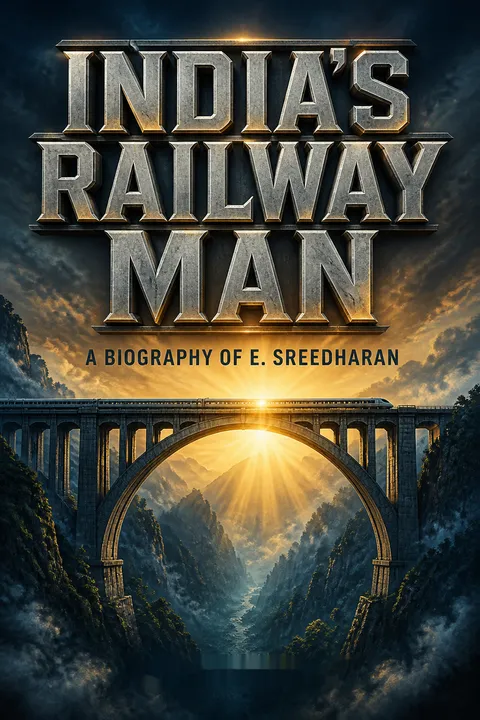


Key Takeaways
Pair engineering excellence with integrity and service to make delivery credible
A career built on values. E. Sreedharan grew up in Kerala in a family where his father treated education as more valuable than acquiring land. He graduated in civil engineering with honours, ranked seventh in the national railway engineering exam, and spent decades moving through demanding posts across India. His work crossed railways, bridges, shipbuilding, and urban transport, but he returned to four guiding principles: integrity, commitment and hard work, professional excellence, and responsibility to society.
Competence needs a purpose. These values took practical form in projects such as the Konkan Railway and Delhi Metro. For Sreedharan, public infrastructure was not merely a technical challenge. It was taxpayers' money, citizens' time, and a promise to improve daily life. The biography's central claim is that reliable delivery depends on joining technical skill to ethical conduct and public purpose.
What's striking is how the book treats integrity as part of project capacity, not simply a private virtue. Trust can reduce the need for repeated approvals, make delegation possible, and encourage partners to act quickly. That is especially valuable where many agencies must coordinate. Still, integrity alone cannot guarantee a good outcome: sound engineering, adequate funding, and independent review matter too. The strongest version of Sreedharan's model is therefore not that a virtuous leader can overcome every obstacle, but that ethical conduct makes capable institutions easier to build.
When disaster hits, combine local knowledge with engineering improvisation
A bridge under pressure. In 1964, a cyclone devastated the Pamban rail bridge linking mainland India with Rameswaram Island. Most of its spans were destroyed, and officials initially gave the restoration team a six-month deadline, later shortened to three. Sreedharan went to the site and consulted local fishermen, who told him that many of the missing steel girders lay underwater nearby.
Make ingenuity operational. The team salvaged the girders, used a floating crane Sreedharan designed, and built a launching structure that let work advance from both ends. They also prepared track sections in parallel, rather than waiting for the bridge to be complete. The rail link reopened in 46 days. The episode shows engineering at its best: technical knowledge mattered, but so did listening to people who knew the water and acting quickly on what they knew.
The Pamban story is a useful reminder that expertise is not confined to formal credentials. Fishermen supplied site-specific knowledge that the project team could turn into an engineering solution. This resembles a broader principle in disaster response: local information is often faster and more granular than centralized reporting. Yet improvisation becomes reliable only when it is tested against safety standards. The lesson is not to replace engineering with instinct, but to widen the circle of people whose observations count, then convert those observations into disciplined action.
Give local project leaders authority, then measure them against shared deadlines
Put decisions near the work. The Konkan Railway crossed roughly 760 kilometres of difficult coastal and mountain terrain, with 91 tunnels and 1,880 bridges. Instead of running the whole undertaking through a distant central office, Sreedharan divided it into seven zones aligned with local administrative districts. Each zone had a chief engineer who could work directly with district officials and make many decisions without waiting for headquarters.
Contrast changes the design. Sreedharan had seen the opposite pattern in the Kolkata Metro, where a 17-kilometre line took 22 years to complete and its cost rose fourteenfold. He believed fragmented responsibility and unreliable funding had helped stall the project. The Konkan structure aimed to make responsibility and authority coincide. It did not eliminate political or geological delays, but it gave local teams a clearer path from problem to decision.
This is a strong case for subsidiarity, the idea that decisions should sit at the lowest level capable of making them well. Local leaders see conditions sooner and need less translation between a problem and a response. But decentralization can also produce inconsistent standards or territorial silos. The Konkan design addressed that risk with a common mission and defined zones. In complex public works, the valuable balance is not central control versus local freedom; it is central agreement on goals and safeguards, paired with local authority over execution.
Make contractors and residents partners in execution
Remove practical bottlenecks. A railway line cannot be built on engineering plans alone. The Konkan project had to secure land from more than 40,000 owners. When homes had to be acquired, the team sometimes offered temporary rent support and let residents recover usable materials from their old houses. Engineers also adjusted parts of the route to avoid homes where possible. In Goa, careful changes meant that only 35 houses were disturbed, according to the book.
Help the builders succeed. Contractors received prompt answers, specialized tunnelling equipment, and a payment system that released most of a verified bill within 48 hours. The corporation also arranged critical supplies, including fuel. When the 1990 Gulf War disrupted fuel availability in India, those reserves helped construction continue. These choices treated contractors and residents as participants in delivery, rather than obstacles to be managed.
The approach recognizes that consent, cash flow, and logistics are not peripheral to construction. They are part of its operating system. In public projects, delays often arise not from a lack of technical knowledge but from unresolved coordination costs: a household waiting for compensation, or a contractor waiting for payment. Making those costs visible can improve both speed and legitimacy. The difficult question is whether accommodations are applied consistently. Personal intervention may solve a problem quickly, but transparent rules are needed so fair treatment does not depend on who happens to be in charge.
Treat deadlines as an operating system, not a poster
Make time visible. At Konkan Railway offices and work sites, countdown clocks showed how many days remained before a target. The clocks were one part of a broader routine: weekly meetings reviewed progress, identified delays, and assigned next steps. Sreedharan also expected urgent technical decisions within 48 hours, so contractors would not lose time waiting for an answer.
Connect urgency to capacity. Delhi Metro used similar methods. Sreedharan estimated that each day of delay in its first phase cost the corporation ₹1.5 crore. Phase I, a 65-kilometre network, was completed within its allocated cost and almost three years ahead of the government's ten-year mandate. A visible deadline can focus attention, but only when funding, supplies, decision rights, and honest progress reporting support it.
A countdown clock is more than a motivational prop when it connects individual tasks to a shared schedule. It makes delay observable and gives teams a common reference point. This resembles feedback systems in manufacturing, where timely information lets managers correct small deviations before they compound. The method has a limit: visible pressure can reward speed while hiding quality problems. Milestones therefore need companion measures for safety, workmanship, and public disruption. Time discipline is valuable when it sharpens judgment, not when it replaces judgment.
Protect technical judgment with public safety checks
Expertise can be overruled. For Delhi Metro, Sreedharan recommended standard-gauge tracks, commonly used by metro systems internationally. Indian Railways pressed for broad gauge, arguing that it lacked experience certifying the alternative. The government chose broad gauge, so the team redesigned the system and carried on. Sreedharan considered the decision technically wrong, but judged that leaving would harm the project.
Results do not erase risk. In 2009, a construction collapse near Zamrudpur killed seven people and injured 15. Sreedharan announced his resignation, accepting responsibility, but stayed after Delhi's chief minister urged him to continue. The biography also includes critics who questioned safety, oversight, and his wide discretion. His record demonstrates the value of technical leadership, while the accidents show why leaders need independent safety review and clear accountability.
The tension here is real: a capable leader needs room to make decisions, but public infrastructure carries risks that cannot be managed by personal confidence alone. The fatal collapse makes the distinction between delivery performance and system safety impossible to ignore. In safety engineering, near misses, independent inspections, and stop-work authority help prevent small failures from becoming disasters. A project leader's willingness to resign can signal responsibility, but it cannot substitute for institutions that detect hazards before lives are lost.
Challenge unfair rules through documentation, even when work is urgent
A matter of principle. When Sreedharan became head of Konkan Railway Corporation after retiring from Indian Railways, the government deducted his pension from his new salary. He calculated that, after deductions, his monthly take-home pay would be only ₹1,080, less than the pay of many executives he led. He objected through official correspondence, rather than seeking an informal intervention from senior politicians.
Follow the record. The dispute lasted for years, including after the Konkan project was complete. In 2008, the Delhi High Court ruled that the appointment was not re-employment under the rules cited by the government and ordered repayment with interest and costs. The recovered sum exceeded ₹9 lakh, and Sreedharan donated half to charity. The episode shows that procedural persistence can matter as much as public influence.
This dispute turns an abstract principle into a testable question: does the organization apply its rules consistently, including to someone with a celebrated record? Sreedharan's choice to use written representations and the courts gave the claim a paper trail that could be examined independently. That is a powerful form of accountability, especially in bureaucracies where oral assurances are easy to deny. The case also shows a limit of formal fairness: litigation took years, so a just remedy can still arrive too slowly to feel just.
Use spiritual discipline to stay composed without abandoning responsibility
A demanding rhythm. At 84, Sreedharan's day began around 4 a.m. with breathing exercises, meditation, reading, and yoga. He worked from a home office, walked with his wife, and usually went to bed around 9:20 p.m. The routine reflected his belief that health and character support sustained work. His daughter describes a father who also made time for family conversations, grandchildren, and their everyday concerns.
Service beyond salary. Sreedharan interpreted the Bhagavad Gita as guidance to work energetically without becoming consumed by personal credit or fear of results. He created a charity trust in his mother's name to support students, and donated an increasing share of his salary, ultimately giving away his full salary near retirement from Delhi Metro. The point is not withdrawal from ambition, but work joined to perspective and generosity.
The combination of routine, reflection, and family attention presents stamina as something cultivated rather than assumed. Psychological research often distinguishes useful commitment from identity fusion, where a person's self-worth becomes inseparable from a project's outcome. A practice of perspective may help leaders remain steady under pressure. But a disciplined individual cannot compensate indefinitely for an unhealthy workload or weak organizational safeguards. The useful lesson is twofold: personal habits can sustain service, and institutions should not depend on one person's unusual stamina to function.
Analysis
This biography is most compelling when it treats infrastructure delivery as a problem of institutional design, not simply individual brilliance. Sreedharan's achievements are tangible: the Pamban bridge reopened in 46 days, the Konkan Railway connected difficult coastal regions, and Delhi Metro demonstrated that a public agency could build a major urban system on a demanding schedule. The recurring methods are equally concrete: teams with clear responsibility, authority close to the work, rapid decisions, reliable contractor payments, and visible deadlines.
The book also makes a persuasive ethical argument. Integrity helped Sreedharan secure trust, yet his salary dispute shows that trust cannot replace fair rules. His technical objections to the Delhi Metro gauge decision reveal the cost of allowing institutional prestige to outrank engineering judgment. At the same time, the fatal Delhi Metro construction collapse complicates any simple celebration of autonomy. Speed and competence are not complete measures of public value; safety, transparency, and independent scrutiny must count alongside schedule and cost. As a biography, the narrative relies heavily on Sreedharan's recollections and on admiration from colleagues, family, and associates. It includes criticism and institutional disputes, but some critics remain anonymous, while many of the strongest endorsements come from people close to him. That imbalance does not erase the engineering record, but it suggests caution about treating the subject's methods as a universal recipe. A leader granted exceptional freedom may deliver unusually well, yet an organization that depends on one exceptional leader is difficult to reproduce and vulnerable to succession.
The durable contribution is therefore a set of design principles, not a personality cult: give capable teams bounded authority, connect authority to responsibility, make delays and decisions visible, and protect the public through serious safety review. Sreedharan's career shows what disciplined execution can achieve. Its hardest questions concern how to preserve those gains without depending on extraordinary individuals or excusing the risks that come with speed.
Review Summary
India's Railway Man receives mixed reviews, with an average rating of 3.86/5. Readers appreciate the insights into E. Sreedharan's accomplishments and integrity, particularly regarding the Konkan Railway and Delhi Metro projects. However, some criticize the book for focusing too heavily on technical details and railway history rather than Sreedharan's personal life. The writing style is described as plain and sometimes repetitive, but the book is generally considered informative and inspiring, especially for those interested in Indian railways and infrastructure development.
Glossary
Corporate Mission
Shared project objectivesThe stated outcomes an organization commits to achieving. For Konkan Railway, the mission linked a completion date with control of cost growth and high technical quality. Delhi Metro used a related statement of objectives for its initial network, then revised it as the system expanded. The mission gave staff, managers, and contractors a common definition of success.
Corporate Culture
Shared operating standardsThe working principles intended to shape daily decisions across an organization. In the railway corporations described in the book, these included integrity, punctuality, economy, a lean structure, public consideration, and responsibility for workforce welfare. The purpose was to make the mission actionable in routine conduct, rather than leave it as a slogan.
countdown clock
Visible deadline trackerA clock displayed in project offices and important work sites that showed the time remaining before a project target. It updated as the deadline approached, making schedule pressure visible to managers, engineers, contractors, and suppliers. In Sreedharan's projects, it reinforced time awareness alongside regular progress reviews and rapid decisions.
ballastless track
Track without loose ballastA railway track system in which the loose stone bed traditionally supporting sleepers is replaced by a fixed base, such as concrete. The Konkan Railway used it inside tunnels, where ordinary ballast would be difficult to maintain. The book presents this as one of the technologies adopted to reduce maintenance demands in challenging locations.
FAQ
1. What’s "India’s Railway Man: A Biography of E. Sreedharan" by Rajendra B. Aklekar about?
- Comprehensive Biography: The book is a detailed biography of Dr. E. Sreedharan, one of India’s most celebrated engineers, known for his transformative work in Indian Railways and urban infrastructure.
- Focus on Major Projects: It covers his leadership in landmark projects like the Konkan Railway and Delhi Metro, as well as his early life, career, and personal values.
- Insights into Character: The book delves into Sreedharan’s work ethic, principles, and the spiritual and ethical foundations that guided his professional journey.
- Blend of Personal and Professional: It combines anecdotes from family, colleagues, and Sreedharan himself, offering a holistic view of the man behind the engineering marvels.
2. Why should I read "India’s Railway Man" by Rajendra B. Aklekar?
- Inspiration for Professionals: The book is a source of inspiration for engineers, managers, and anyone interested in leadership, project management, and public service.
- Lessons in Integrity: Sreedharan’s unwavering commitment to integrity, punctuality, and excellence provides valuable lessons for personal and professional growth.
- Behind-the-Scenes Stories: Readers gain access to untold stories and challenges behind some of India’s most ambitious infrastructure projects.
- Broader Relevance: The biography also addresses issues of governance, bureaucracy, and the role of spirituality in high-pressure careers.
3. Who is E. Sreedharan, and why is he significant according to "India’s Railway Man"?
- Renowned Engineer: E. Sreedharan is an Indian engineer celebrated for revolutionizing public transport and railway infrastructure in India.
- Key Projects: He led the construction of the Konkan Railway and the Delhi Metro, both considered engineering marvels completed within time and budget.
- National and International Recognition: Sreedharan has received numerous awards, including the Padma Vibhushan, Padma Shri, and international honors from France and Japan.
- Role Model: He is revered for his integrity, leadership, and ability to navigate and reform bureaucratic systems.
4. What are the key takeaways from "India’s Railway Man" by Rajendra B. Aklekar?
- Four Pillars of Success: Sreedharan attributes his achievements to integrity, hard work and commitment, professional excellence, and commitment to society.
- Leadership in Adversity: The book highlights how Sreedharan overcame bureaucratic hurdles, political interference, and technical challenges through innovative management and ethical leadership.
- Importance of Work Culture: He established unique work cultures in organizations like KRCL and DMRCL, emphasizing punctuality, transparency, and accountability.
- Spiritual Foundation: Sreedharan’s reliance on spiritual principles, especially teachings from the Bhagavad Gita, played a crucial role in managing stress and maintaining focus.
5. How did E. Sreedharan approach project management and leadership, as described in "India’s Railway Man"?
- Countdown Clocks: He introduced countdown clocks in offices to instill a sense of urgency and time management in project teams.
- Delegation and Trust: Sreedharan delegated authority to trusted team members, empowering them to make decisions and learn from mistakes.
- Transparent Processes: He insisted on transparency, quick decision-making, and minimal bureaucracy, especially in finance and contractor management.
- Social Responsibility: Projects were managed with a focus on minimizing public inconvenience, environmental impact, and ensuring long-term societal benefits.
6. What were the major challenges and innovations in the Konkan Railway project, according to "India’s Railway Man"?
- Difficult Terrain: The project involved constructing 760 km of railway through the challenging Western Ghats, requiring 1,880 bridges and 91 tunnels.
- Innovative Funding and Structure: Sreedharan proposed a special purpose vehicle (KRCL) and innovative funding through market borrowings and state participation.
- Technological Firsts: The project introduced new technologies like ballastless tracks, incremental bridge launching, and fiber-optic communications.
- Community Engagement: Land acquisition and local cooperation were achieved through direct engagement and practical compensation solutions.
7. How did E. Sreedharan transform urban transport with the Delhi Metro, as detailed in "India’s Railway Man"?
- World-Class Standards: Sreedharan set out to make the Delhi Metro a world-class system, focusing on safety, punctuality, and customer satisfaction.
- Overcoming Bureaucratic Hurdles: He navigated political and bureaucratic resistance, especially regarding the choice of track gauge, and insisted on technical merit.
- Timely and Cost-Effective Delivery: The Delhi Metro was completed ahead of schedule and within budget, a rarity for large public projects in India.
- Replicable Model: The success of the Delhi Metro became a template for metro projects in other Indian cities.
8. What role did spirituality and personal values play in E. Sreedharan’s life and work, as per "India’s Railway Man"?
- Spiritual Discipline: Sreedharan’s daily routine included yoga, meditation, and study of spiritual texts, which he credits for his resilience and clarity.
- Bhagavad Gita Influence: He drew strength from the teachings of the Bhagavad Gita, especially the principle of detached action and duty.
- Ethical Leadership: His commitment to integrity and social responsibility was deeply rooted in his spiritual beliefs.
- Mentorship and Giving: Sreedharan established charitable trusts and emphasized the importance of character and service to society.
9. What criticisms and controversies are discussed in "India’s Railway Man," and how does Sreedharan respond?
- Accountability Questions: Critics have questioned the safety record of the Konkan Railway and construction accidents during the Delhi Metro project.
- Bureaucratic Resistance: There was resistance from bureaucrats and IAS officers regarding technocrat-led projects and delegation of authority.
- Financial and Technical Debates: Some argued that the Konkan Railway’s financial model and single-line design were flawed.
- Sreedharan’s Rebuttal: He addresses criticisms with detailed explanations, emphasizing technical constraints, long-term benefits, and the need for systemic reforms.
10. What are some of the best quotes from "India’s Railway Man," and what do they signify?
- "Integrity is the secret of my success." – Emphasizes the foundational role of honesty and ethics in leadership.
- "Mukta sango nahamvadi dhrty-utsaha-samanvitah, siddhy-asiddhyor nirvikarah karta sattvika uchyate." – A favorite shloka from the Bhagavad Gita, highlighting detached, duty-bound action.
- "A team leader must take full responsibility for the results. He must be given complete freedom to resist political interference." – Advocates for accountable and empowered leadership.
- "Every city of more than three million people needs a metro immediately." – Stresses the urgency of modern urban transport solutions.
11. What advice and solutions does E. Sreedharan offer for India’s infrastructure and transport challenges in "India’s Railway Man"?
- Public Transport Focus: He advocates for expanding metro and suburban rail networks to address urban congestion and pollution.
- Affordable and Practical Solutions: Sreedharan suggests smaller, frequent buses and penalizing excessive car ownership to reduce traffic.
- Technical Recommendations: For projects like the Konkan Railway, he recommends electrification and centralized traffic control over costly doubling.
- Policy and Governance: He calls for greater delegation of powers, professional management, and minimizing political interference in technical projects.
12. How does "India’s Railway Man" portray E. Sreedharan’s legacy and impact on future generations?
- Role Model for Youth: The book positions Sreedharan as a role model for young professionals, emphasizing character, health, and dedication.
- Institutional Change: His work has led to lasting changes in project management, organizational culture, and public expectations of infrastructure delivery.
- National and Global Recognition: Sreedharan’s methods and achievements are studied internationally, including at Harvard Business School.
- Ongoing Influence: Even post-retirement, he continues to advise on major projects, serve on national and international committees, and inspire reforms in governance and engineering.
Download PDF
Download EPUB
.epub digital book format is ideal for reading ebooks on phones, tablets, and e-readers.








