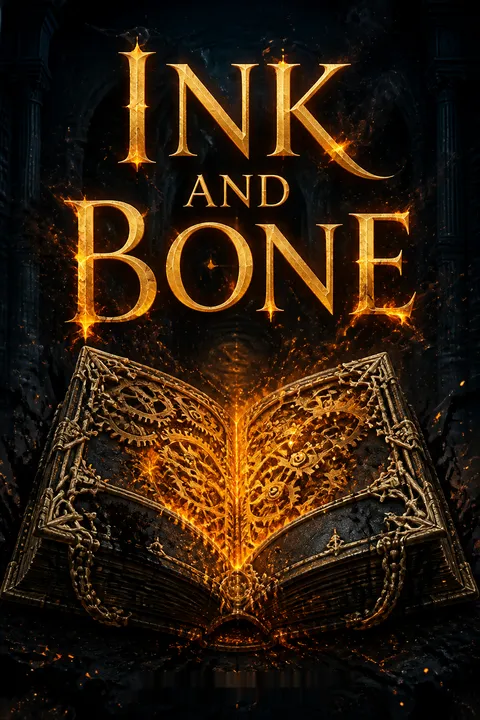


Plot Summary
Prologue
At ten, Jess Brightwell runs a stolen book through London while the Garda close in. He escapes them by crossing the Great Library’s grounds, where its mechanical lions kill several fleeing people before stopping at the boundary.
Jess delivers the book, Aristotle’s unique On Sphere Making, to a wealthy buyer who tears out its pages and eats them to claim it completely. Back at the warehouse, Jess tells his father what happened. Callum is more interested in the successful delivery than the ruined book, leaving Jess to record his grief alone in his journal.
The prologue gives Jess two competing lessons about books. The Library’s guardians treat human lives as expendable around their collection, while the buyer treats a book as a possession to be destroyed once no one else can share it. Callum’s indifference completes the damage: even Jess’s own family makes the book a transaction. His private journal becomes the one place where he can name what the adults around him refuse to acknowledge. That tension between preservation and ownership, and between a person’s inner life and the institutions that claim it, drives the larger story.
A Brightwell in Service
At sixteen, Jess hides away with an old book, while his twin Brendan finds him and reports that the man who ate Aristotle’s pages has been murdered. Their father, Callum, summons Jess and makes clear that the family expects him to earn his keep. Since Jess loves books more than the smuggling trade, Callum has purchased him a place in Library training, intending to use him as a spy.
Refusal means losing the family home and support. Jess takes the entrance examination and earns acceptance, the highest score in London. His mother marks the news with a gift, but Brendan warns that the Library may claim Jess for good. The next morning, Callum sends him toward Alexandria with a threat and a trace of emotion Jess cannot quite recognize.
Jess’s acceptance is both opportunity and coercion. He wants access to the books the Library protects, but his father has already defined that desire as a family asset. The bargain gives Jess a route out of the Brightwell business while binding his future to another powerful institution. His instinct to read privately is not mere escapism. It is the first form of self-direction he has found in a life where adults decide what his skills are for. Leaving home therefore begins as a choice made under pressure, not a clean break from family loyalty.
Fire at St Pancras
At the station, a young Burner condemns the Library’s control of books, then drenches himself in Greek Fire and dies in front of Jess. The scene recalls the destruction Jess witnessed as a child, but this time he understands that the protester has deliberately erased his own journal as well as his life.
After Garda questioning, Jess boards the delayed train to Alexandria. There he meets Thomas Schreiber, a gentle, gifted German postulant; Khalila Seif, whose examination score is perfect; and Glain Wathen, a Welsh student wary of the English.
He also encounters Dario Santiago, a proud Spanish rival. At the Alexandrian station, their proctor, Scholar Christopher Wolfe, announces that only a handful of the incoming students will earn placements.
The Burner’s death makes the Library’s political conflict physical before Jess has even entered its training. His self-destruction is meant to expose the cost of censorship, yet it also prevents anyone from knowing the full person behind the protest. Jess is caught between horror at the method and unease at the grievance. The train then gives him a first experience of intellectual displacement: he is no longer the standout London student. His new companions embody different forms of competence and inherited conflict, while Wolfe’s limited placements turn learning into a competition for survival.
Wolfe’s First Cull
Wolfe begins training in Alexandria by questioning the postulants about the Library’s history and its control of original works. Jess admits that a blank copy cannot replace holding a handwritten original, revealing the attachment that separates him from the doctrine he is meant to serve.
Wolfe then traps the class in an old chamber with a suspended bottle of Greek Fire. Jess recognizes the danger and gets the others out without causing a crush; Dario helps. Wolfe dismisses students who fail to notice or respond.
The remaining postulants study through exhaustion. Dario’s Codex is stolen with a threat demanding his departure, exposing how his contempt has alienated the others. Jess helps him search, and the rivalry begins to give way to wary respect.
Wolfe’s exercises test judgment rather than obedience, though their cruelty makes the distinction difficult to trust. Jess succeeds because his criminal childhood has trained him to read danger in neglected details, a skill the Library benefits from even as it would condemn its source. Dario’s stolen Codex turns social arrogance into concrete vulnerability: without access to the Library’s knowledge, even a gifted student can be pushed out. Their uneasy cooperation begins not with affection but with recognition. Both boys understand that competence alone cannot protect them from other people’s decisions.
The Aristophanes Errand
A message from Callum arrives disguised as a harmless family letter. Jess deciphers its literary clue and learns that his father wants an old, lost play by Aristophanes recovered from an Alexandrian collector.
Jess finds the owner, Abdul Nejem, and steals the work rather than attempt a purchase he cannot afford. At the agreed handoff, he expects a local contact and instead finds Brendan, who has come from London to carry the book onward himself. Jess objects to the danger, but Brendan insists their father trusted no one else with the delivery.
His twin’s arrival comforts Jess and alarms him in equal measure. Brendan leaves with the stolen work, while Jess returns to training, now caught between the Library’s rules and a family operation that reaches into Alexandria.
The errand makes Jess’s new identity unstable before he has settled into it. His father’s code gives him the familiar satisfaction of solving a problem, but the task also turns his Library placement into a channel for the black market. Brendan’s arrival sharpens the emotional cost: Jess loves his twin, yet cannot trust the motives that bring him into danger. Their closeness is built on shared knowledge and shared risk, but neither can speak plainly about care. Jess’s training is no longer simply a route away from home. It is a position from which home can still use him.
The Raid on Nejem
New postulant Morgan Hault reaches Alexandria after escaping fighting near Oxford, and Wolfe gives her little time to recover before assigning the class to a confiscation raid. Jess recognizes the target as Nejem’s house, where he recently stole the Aristophanes play.
During the search, he locates a concealed cache of original books. Nejem’s wife takes Guillaume Danton hostage with a knife, but Khalila slips behind her and forces her to release him. Wolfe orders Jess to tag the recovered volumes for transfer to the Archive.
Jess activates too many at once, sending the books safely away but draining his strength until he collapses outside. Wolfe later tests Jess with Library restraints and a tracking map, confirming that Jess can use its tools unusually well, though the strain nearly overwhelms him.
The raid strips the Library’s ideals of their clean public face. Jess sees how preservation can mean invasion, arrest, and the collapse of a household, even when the owners have violated the law. His knowledge of the hidden compartment makes him useful and incriminates him at once. Khalila’s intervention shows that her scholarship includes decisive action under threat, while Jess’s overuse of the tags exposes the bodily cost behind the Library’s apparently effortless systems. Knowledge here is never immaterial: it is guarded by force, moved through human energy, and purchased through physical risk.
The Lottery That Wasn’t
After the raid, Wolfe declares the entire class unsuccessful and orders a lottery to determine who remains. Izumi Himura points out that they never asked what the Archive does with confiscated books, a question that makes their apparent success look incomplete.
On lottery morning, several students refuse to draw, believing Wolfe has no grounds to dismiss them all. Jess, Thomas, Khalila, and Morgan draw tiles and receive numbers that seem fatal. Wolfe reveals that the numbers never mattered.
He wanted to see who would follow instructions and who would challenge his authority without understanding the test. He sends the protesters home and keeps nine students, including Jess. The survival of the class depends less on luck than on interpreting the purpose behind an arbitrary-looking ritual.
Wolfe’s lottery converts institutional power into a psychological trap. The students are not judged on whether they obey or rebel in the abstract, but on whether they can read the situation accurately before acting. That standard is intellectually demanding and ethically compromised: Wolfe withholds the information needed to make a fair choice, then treats the resulting mistakes as evidence of character. Izumi’s question about the Archive anticipates the larger conflict over what the Library conceals. Jess survives through suspicion and pattern recognition, habits learned outside the institution that now claims to educate him.
Morgan’s Unwritten Secret
Wolfe sends the nine students to a disused shop, where a tripwire and a bottle of Greek Fire turn the assignment into a dangerous test. Glain spots the first trap, and Guillaume recognizes the wire before Dario walks into it.
Inside, the students find pages torn from books and components for firebombs disguised in hollowed covers. Wolfe explains that the Burners planned to have trapped books confiscated and sent to the Archive, where the devices could destroy it. That night, Jess finds Morgan secretly manipulating the glowing formulae inside a blank.
She admits she is an Obscurist, hiding from the Library because she fears being confined in the Iron Tower. Jess agrees not to expose her, recognizing in her flight the same fear of being claimed by someone else.
The shop makes the Burners’ methods more complex than public self-immolation: they intend to use the Library’s own procedures as a delivery system for destruction. The hidden bomb-books turn preservation into vulnerability. Morgan’s secret then shifts the threat inward. Her talent is exactly what the Library depends on, but she experiences that dependence as a sentence to confinement. Jess’s choice to protect her is an act of identification, not political conversion. He knows what it means to be valued for usefulness and fears that revealing her would repeat the family’s habit of trading people for advantage.
The Translation Chamber
The Artifex Magnus orders Wolfe’s class to help evacuate rare books from Oxford, where Welsh forces are besieging the city. Wolfe objects, but the Artifex treats the students as expendable personnel.
Instead of taking the long route, the group enters a hidden Translation Chamber and travels through an Obscurist process that tears bodies apart before reassembling them elsewhere. Guillaume volunteers first and dies during the transfer. Izumi survives a failed translation, but is left traumatized and cannot continue.
The others arrive in Aylesbury shaken, with Wolfe and Captain Niccolo Santi trying to keep the mission moving. The deaths make the Artifex’s order more than a hard assignment: the class has already paid for it before reaching the battlefield.
Translation turns the Library’s miraculous infrastructure into a visible bodily cost. The system can move books and people, but it cannot guarantee that a person will survive being converted into its process. Guillaume’s death and Izumi’s trauma reveal the gap between institutional claims of control and actual human vulnerability. Wolfe’s objections matter because he understands the students as people he is responsible for, while the Artifex sees a replaceable cohort. Their disagreement establishes the central political fracture: the Library’s stability is maintained by those willing to treat individual lives as acceptable losses.
Oxford’s Impossible Cache
Wolfe’s party reaches Oxford through the Welsh lines and finds a city weakened by siege. The English commander grants them only until nightfall, while civilians crowd the Serapeum gates, convinced the Library is hoarding food and water.
Senior Librarian Naomi Ebele admits that her staff have barely enough supplies to last, but they have uncovered a vast cache of original books. Wolfe divides the students into teams to sort unique, rare, and common works, then begins transferring what they can.
Jess pushes himself through repeated tagging sessions, while Ebele and the others work until exhaustion. Outside, the mob breaks the courtyard defenses and overwhelms Santi’s soldiers. With the Library surrounded and the building about to be lost, the group must abandon the safe, familiar work of sorting.
The Oxford cache places two kinds of hunger at the same gate. The civilians need food and shelter; the librarians are charged with saving books that cannot ask for help. The Library’s principle of neutrality prevents its personnel from feeding or admitting the crowd, but that neutrality looks like cruelty to people who see supplies behind locked doors. Jess’s physical effort to tag books makes the conflict intimate: preserving the collection drains bodies already exposed to war. The scene refuses an easy moral ranking. The books matter, yet the human beings outside the gate are not abstractions or enemies.
Escape Through the Graves
With the courtyard lost, Jess offers a rare Aristotle volume to his smuggler cousin Frederick in exchange for an escape route. Outside the Turf Tavern, Morgan’s father appears with Greek Fire and demands her return.
He has become a Burner and tries to destroy the Library party; Morgan catches the bottle before it breaks, then refuses to leave with him. Frederick guides the group through old underground tunnels, but attackers reach them in a graveyard and kill Portero.
At the city gate, Jess carries a mother’s baby through the crush as the English gates close and the Welsh begin their assault. Wolfe passes the child through a gap to Frederick, who escapes with her. Jess and the others cross into the mud as Greek Fire ignites Oxford behind them.
Escape requires Jess to spend a book, confront a parent’s violence, and carry a child he cannot keep. Each exchange tests what the Library’s hierarchy cannot easily calculate: the value of a particular life in a particular moment. Morgan’s father frames love as possession, echoing the Library’s claim that its control protects her. Morgan rejects both claims, but has no safe refuge from either. Jess’s instinct to save the baby clashes with the rule of neutrality, and the image of Wolfe returning her to the city’s edge makes the rule’s human cost impossible to soften.
The Wound Beneath the Coat
The survivors reach the Welsh camp, where warmth and coffee briefly replace the battlefield’s cold. Jess then notices blood spreading from a knife wound he did not feel during the escape. While he recovers, he learns that Oxford has been devastated and that no one knows whether Morgan’s father survived.
Morgan tries to flee the camp, but a tracking restraint lets the Library find her; Wolfe keeps her under watch. She later asks Jess to walk with her to the camp boundary, where they watch Welsh troops carry civilian bodies from the ruins. Jess does not offer easy comfort, and Morgan challenges his silence. Their uncertain intimacy deepens as the party prepares to travel toward London on the Alexandrian Express.
Jess’s unnoticed wound is an apt consequence of his survival strategy: he keeps moving until his body forces the truth into view. The recovery period gives grief room to surface, but not in orderly fashion. Morgan’s uncertainty about her father cannot be resolved by a report, and Jess’s bluntness fails to console her even when it is more honest than reassurance. The tracking restraint makes the Library’s protection indistinguishable from custody. Their connection grows in the narrow space between concern and control, with neither able to promise the other safety.
Morgan’s False Jump
On the Express, Morgan makes the others believe she has escaped by jumping from the speeding train, leaving her tracking restraint behind. Jess thinks she is dead until he finds her hidden in his cabin. Her deception infuriates him because she used his fear to make Wolfe accept the disappearance, but he lets her stay.
They share a brief, fragile closeness before the train’s brakes shriek and it lurches to a halt. Morgan slips away again, using the unexpected stop as her chance to escape the Library. Jess knows she has gone, yet does not call for help. The train’s unexplained failure leaves the remaining students unsettled, and the quiet relief of their reunion gives way to danger approaching from outside.
Morgan’s feigned death repeats the novel’s conflict between intimacy and survival. She relies on Jess’s attachment because it is the one lever likely to persuade Wolfe, and that makes her act understandable without making it painless. Jess’s decision to shelter her is not a declaration that trust has been repaired. It is a choice to prioritize her freedom over his need for honesty. The train stop briefly seems to offer her escape, but the episode also reveals how little either of them controls the conditions around them. Their private bargain sits inside a much larger machinery of surveillance and force.
Fire on the Express
Armed attackers board the stopped Express, and the students defend themselves as the cars are damaged. Jess realizes Greek Fire has reached the dining carriage and runs back for Morgan, who is hidden in his cabin. Wolfe follows him.
Jess finds Morgan unconscious in the smoke, then gives Wolfe his breathing mask when the Scholar collapses. They drag each other toward the baggage car before the Express explodes in a burst of metal and flame. In the confusion, Burners seize Jess and take him into the woods.
Guillaume’s father, Aristede Danton, interrogates him about his son’s death and claims someone inside the Library revealed where the train would be. Jess refuses to endorse his conspiracy, but returns to camp with the possibility of an internal betrayal now impossible to ignore.
The explosion collapses the distinction between the Library’s official enemies and its internal dangers. Jess’s rescue of Morgan and Wolfe is a concrete rejection of the self-preservation that has governed him since childhood, even though he remains angry with Morgan. Danton’s accusation does not prove the Library arranged the attack, but it reframes the event: the threat may come from people claiming to defend knowledge. Jess’s survival now depends on questioning both the Burners’ certainty and the Library’s authority, without having enough evidence to trust either side.
A Secret Betrayed
As the injured party recovers, Jess learns that his temporary journal has been mirrored and read by someone within the Library. He had written about Morgan’s plan to escape, unintentionally revealing it to the Artifex’s circle. Santi tells him he must take her into custody to protect Wolfe and the others. Morgan arrives at Jess’s tent believing they can still flee together.
Jess asks her to stay, knowing Santi is waiting, and she realizes too late that he has withheld the danger. Santi arrests her in iron shackles. On their return to Alexandria, the Obscurist Magnus receives Morgan and fastens a gold collar around her neck, binding her to the Iron Tower. Jess and their classmates get only a brief farewell before she is taken away.
The journal breach converts private reflection into surveillance, destroying the one practice Jess thought belonged to him. His failure is not simply that he wrote carelessly; the Library has made the ordinary act of remembering unsafe. When Jess asks Morgan to stay, he lets love become a delay tactic, and that choice repeats the manipulation he resents in his father and the institution. The collar makes the coercion literal, but the emotional injury precedes it: Morgan trusted Jess enough to ask him to leave with her, and he chose a different loyalty without telling her the cost.
The Press in the Cellar
Back at Ptolemy House, Thomas shows Jess a working press that prints pages from movable metal letters, making books reproducible without Obscurists or the Codex. Jess sees how it could loosen the Library’s control and warns Thomas that the Curators will treat it as a threat. He goes to Wolfe for help, but the house is dark and their friends have vanished.
Thomas’s machine and plans have been taken, and blood marks his room. The Artifex later tells Jess that Thomas is dead and threatens to blame the killing on him unless he spies on Wolfe. Santi reveals that Wolfe once proposed a similar invention and was punished by having his work erased. Jess learns that Thomas’s idea is part of a long history of suppressed printing.
The press turns Thomas’s generosity into a political danger. He imagines a tool that could widen access, including freedom for Morgan, while the Library sees a mechanism that could dissolve its monopoly over knowledge. Jess understands the threat because he has lived on both sides of the system, but warning Thomas cannot protect him. Wolfe’s erased research shows that censorship is not merely a reaction to rebellion; it is a method of governing possibility. The Library does not need to defeat every new idea in public if it can make its makers disappear and preserve the appearance of continuity.
The Copper Bracelet
Wolfe offers placements to the surviving students: Glain enters the High Garda, Dario becomes a Scholar, and Khalila receives a rare lifetime research appointment. Jess is offered the lowest military rank and accepts, knowing he cannot return to his family and has little choice but to stay near the Library. While packing, he finds Thomas’s note and retrieves hidden plans for the press from behind a portrait.
He conceals them inside the cover of an illegal original book. As Jess and Glain leave for their new duties, Morgan sends him a private Codex message. She asks him to help change the Library. Jess keeps the plans and the message, carrying forward the invention the institution tried to bury and the relationship it tried to sever.
The ending offers Jess neither escape nor victory. His copper bracelet is an entry-level bond to the institution that has killed Thomas, confined Morgan, and threatened to criminalize Jess himself. Yet he accepts the post because remaining inside gives him a chance to act. Hiding Thomas’s plans in an original book reverses the story’s opening image: a physical volume becomes a container for knowledge the Library refuses to preserve. Morgan’s message turns private attachment into shared political intention. Jess begins as a boy used to carry books for other people; he ends with a dangerous idea entrusted to him.
Analysis
Ink and Bone builds its central conflict around a contradiction: the Great Library preserves knowledge by controlling its circulation, yet that control makes knowledge a form of political power. Its Codex grants ordinary people access to mirrored texts, while the ban on owning originals preserves the institution’s authority over the material record. The Burners expose the violence within that arrangement, but their own methods destroy the very books they claim to liberate. Neither side offers a simple refuge for Jess. His family treats books as commodities; the Library treats them as a trust that can justify coercion; the Burners turn destruction into a public argument.
Jess’s emotional development follows his changing understanding of usefulness. As a child, he is valued for running contraband. As a postulant, he is valued for his knowledge of criminal routes, his stamina with transfer tags, and his family connections. Even Wolfe’s care for the students exists within a system that can order them into danger. Jess’s relationships matter because they interrupt that logic. Thomas offers invention without ambition for status. Khalila and Dario learn to make loyalty reciprocal. Morgan forces Jess to confront the difference between protecting someone and deciding for them. His failure to tell her about the planned arrest is painful precisely because he believes he is acting out of love.
The novel also questions whether preservation is ethically meaningful without consent. The Library archives citizens’ journals, but Jess’s writing is secretly read; it promises memory while violating privacy. It saves Oxford’s books while leaving its starving inhabitants outside the gates. Thomas’s press threatens the institution not because it destroys knowledge, but because it makes reproduction independent of the Obscurists. The press is therefore more than an invention: it is a test of whether the Library values knowledge itself or its exclusive command over knowledge. Jess ends the book neither free nor secure. He accepts a soldier’s post and hides Thomas’s plans, choosing to remain inside the institution with the means to challenge it.
Review Summary
Ink and Bone received mostly positive reviews, praised for its unique premise, world-building, and diverse characters. Readers enjoyed the dystopian setting where the Great Library controls knowledge and book ownership is illegal. Many found the plot engaging and the characters well-developed, particularly Jess and Wolfe. Some critics noted similarities to Harry Potter but appreciated the darker tone. While a few felt the pacing was slow or the plot convoluted, most reviewers recommended the book and eagerly anticipated the sequel.
Characters
Jess Brightwell
The reluctant book-runnerJess is the sixteen-year-old son of a prosperous London book-smuggling family, raised to run contraband through streets policed by the Library. He is quick, observant, and more emotionally attached to books than his father’s business can comfortably allow. His instinct is to hide his deepest feelings in a handwritten journal, while his practical intelligence makes him useful in both criminal and institutional worlds. Jess distrusts authority because he has seen it treat people as expendable, but he also longs for the knowledge and belonging the Library promises. His divided loyalties are not abstract: they involve his twin, his friends, the girl he loves, and the books he cannot stop trying to save.
Morgan Hault
The fugitive postulantMorgan arrives late to training after escaping the conflict around Oxford. Tired, guarded, and sharply intelligent, she has learned to ration both trust and information. She is capable of warmth, but only when she believes it will not cost her independence. Her relationship with Jess grows from the recognition that each understands what it means to be used by people who claim to care. Morgan resists being defined by her family, her circumstances, or the role the Library expects her to occupy. Her composure is not fearlessness; it is a practiced way of continuing to act while afraid.
Thomas Schreiber
The humane inventorThomas is a German postulant whose imposing size contrasts with his gentleness and careful manners. He loves mechanisms, takes apart discarded objects, and approaches engineering as a way to solve practical problems rather than to win status. His kindness is active: he steadies friends, builds things for them, and notices when someone is suffering. Thomas trusts that useful inventions can serve people without threatening them, a confidence that places him at odds with the Library’s guarded culture. He is Jess’s closest friend in Alexandria and offers a model of loyalty that does not depend on secrecy, bargaining, or fear.
Christopher Wolfe
The ruthless mentorWolfe is a Research Scholar assigned to train the postulants, a stern and brilliant man who treats discomfort as part of education. He watches how students act under pressure and values independent judgment, even when his methods make trust difficult. Wolfe understands the Library’s history and dangers from close range, but he does not mistake its public ideals for a guarantee of justice. His dry authority conceals a deep sense of responsibility toward the students in his care. He is also closely bound to Captain Santi, whose presence reveals a more personal and vulnerable side than Wolfe usually permits anyone to see.
Khalila Seif
The brilliant strategistKhalila is a Riyadh-born scholar whose perfect entrance score reflects both formidable memory and disciplined curiosity. She studies what others overlook, asks difficult questions, and remains composed when a situation turns violent. Her confidence can sound like certainty, but it rests on work and observation rather than vanity. Khalila treats friendship as a responsibility and is often the first to stop the postulants from turning competition into cruelty. Her developing closeness with Dario complicates her independence without erasing it. She wants knowledge to make her more capable of serving people, not simply more powerful within the Library.
Dario Santiago
The polished rivalDario is a wealthy Spanish postulant who arrives accustomed to being obeyed. Proud, competitive, and capable of cutting remarks, he initially treats his classmates as obstacles to his ambition. Beneath the polished manners is a sharp strategic mind and a capacity for courage that appears most clearly when the group faces danger. Dario finds it difficult to admit vulnerability, especially after someone exploits his pride, but he can recognize skill in a rival and revise his judgment. His attachment to Khalila draws out both his loyalty and his possessiveness, forcing him to confront the difference between wanting someone and deserving their trust.
Niccolo Santi
The captain’s conscienceSanti is Wolfe’s trusted High Garda captain, a disciplined soldier whose calm manner rarely slips even in combat. He understands that protecting people sometimes requires force, but he is attentive to the costs and tries to keep Wolfe from destroying himself through reckless defiance. His loyalty to Wolfe is personal as well as professional. Santi is wary of the Library’s leadership and knows how quickly official rules can be used to threaten even its most capable servants.
Glain Wathen
The battle-ready WelshwomanGlain is a tall Welsh postulant with a soldier’s alertness and little patience for evasions. Her directness can make her seem hostile, especially to Jess, but she reads physical danger quickly and performs well under battlefield pressure. Glain is shaped by a national conflict that makes her wary of English assumptions, yet she is capable of building loyalty across that divide. She values competence and expects people to take responsibility for what they do.
Brendan Brightwell
The calculating twinBrendan is Jess’s identical twin, younger by a few seconds and temperamentally very different. Where Jess runs, Brendan schemes; he prefers to manage danger from a distance and has inherited Callum’s talent for bargaining. Their bond is deep but rarely expressed without teasing or suspicion. Brendan can be protective of Jess while still treating him as part of a family operation. His affection and opportunism coexist, leaving Jess uncertain where one ends and the other begins.
Callum Brightwell
The criminal patriarchCallum runs the Brightwell smuggling business with discipline, calculation, and a strong belief that usefulness is a form of security. He has invested in Jess’s education, but expects that investment to benefit the family. His love for his children is filtered through hard bargains and practical advice, making tenderness difficult to distinguish from strategy. Callum is not indifferent to books, yet his trade has taught him to separate their value from what buyers choose to do with them.
The Artifex Magnus
The guardian of orthodoxyThe Artifex Magnus is one of the Great Library’s senior Curators, responsible for engineering and the practical systems that keep its institutions functioning. He prizes stability and views uncontrolled change as a danger to the Library’s survival. His authority is backed by soldiers, procedure, and the ability to shape the official account of events. He presents himself as a custodian of collective knowledge, but his confidence in institutional necessity makes it easy for him to discount individual lives.
The Obscurist Magnus
Keeper of the Iron TowerThe Obscurist Magnus leads the rare specialists whose alchemical abilities sustain the Library’s Codex and related systems. She is formal, commanding, and accustomed to presenting control as protection. Her gold collar reflects the status and limits attached to her office. She regards the preservation of the institution as a duty that can outweigh personal freedom, and her authority places her at the center of the Library’s most guarded traditions.
Guillaume Danton
The quiet observerGuillaume is a reserved American postulant with a pale, composed manner and an attentiveness that can be mistaken for passivity. He understands more about political conflict and Burner tactics than he initially lets on. Guillaume is careful about revealing his family history, yet he wants a place among the Library’s students and proves willing to take risks for others. His quietness reflects caution, not a lack of conviction.
Izumi Himura
The careful analystIzumi is a Japanese postulant who speaks softly and watches closely. She often identifies the question everyone else has failed to ask, and her manner conceals a firm intellectual independence. She is particularly alert to the Library’s assumptions and to the consequences of its procedures. Izumi’s strength lies less in command than in noticing what a group has collectively decided not to examine.
Joachim Portero
The devout competitorPortero is a Portuguese postulant whose Catholic faith shapes his judgments about Alexandria’s monuments and customs. He is proud, competitive, and quick to take offense, yet he also believes that books must be protected. His presence shows how religious conviction can inspire reverence while narrowing a person’s view of other people’s histories.
Frederick Brightwell
The smuggler cousinFrederick is a young Brightwell relation working the Oxford smuggling trade. He speaks like a street operator and evaluates every favor in terms of risk and price, but he understands family obligation as more than a slogan. Jess cannot be certain how far Frederick’s loyalty extends, which makes their dealings tense. His practical knowledge of Oxford’s hidden routes becomes valuable to anyone trying to leave the city.
Morgan’s father
The grieving Oxford fatherMorgan’s father is an Oxford man whose love for his daughter is tangled with fear, grief, and a fierce suspicion of the Library. He believes institutions take more than they give, and his protective instincts can become controlling. His convictions are intensified by the siege and by his sense that Morgan is being drawn beyond his reach.
Naomi Ebele
Oxford’s steadfast librarianNaomi Ebele is the senior librarian holding the Oxford Serapeum together during the siege. She keeps her remaining staff at their posts despite hunger and danger, and treats the discovered collection as a responsibility she cannot abandon. Her calm professionalism is not detachment; it is the discipline that lets her continue protecting the books and people under her care.
Charity Brightwell
The distant motherCharity is Jess’s mother, polished and attentive to the social appearance of the Brightwell household. She wants Jess to remain civil with his father and offers conventional signs of affection, but she rarely reaches him emotionally. Her quiet presence shows how a family can maintain respectability while leaving its children to navigate its harsher bargains alone.
Liam Brightwell
The silent brotherLiam was Jess’s older brother, executed after being caught running books. He kept the family’s secrets rather than identifying his relatives, becoming a private measure of courage and loyalty for Jess. His absence shapes the Brightwell children’s understanding of what the family demands from them.
Plot Devices
The Codex and blanks
The Library’s living catalogueThe Codex gives citizens and librarians access to the Great Library’s collection, while specially prepared blanks can receive mirrored copies of its texts. Library credentials also allow users to activate tools, receive messages, and transfer tagged objects to the Archive. The system makes knowledge broadly accessible, but it also gives the institution unusual control over what can be read, copied, owned, or recorded. Morgan’s ability to manipulate the formulae behind the system and Thomas’s proposed press reveal that the Codex is not merely a convenient book. It is the infrastructure on which the Library’s political power depends.
Translation tags
Moving books and peopleObscurist alchemy allows the Library to mirror documents, transfer books to the Archive, and move people through Translation Chambers. Tags make the process usable by librarians, but drawing the necessary energy can exhaust or injure them. Human Translation is especially dangerous: the travelers are broken down and reassembled, and not everyone survives. These devices show how the Library’s apparent miracles depend on scarce human talent and bodily risk. They also provide the means for the Oxford mission, turning the institution’s reach into both a rescue mechanism and a source of casualties.
The original books
Objects of knowledge and powerIn the Library’s world, the institution owns original works and citizens normally read mirrored copies. Original books carry physical history that a blank cannot reproduce, making them objects of reverence, black-market trade, and political conflict. Jess’s childhood delivery of Aristotle’s On Sphere Making shapes his grief over their destruction; later, a rare Aristotle volume buys an escape route from Oxford. The contrast between originals and copies also prepares the story’s central question: whether preserving knowledge under one authority is enough if people cannot freely reproduce or possess it.
Greek Fire
The Burners’ incendiary weaponGreek Fire is a vivid green alchemical liquid used by the Burners to destroy books, buildings, and people. Its first appearance at St Pancras links political protest to Jess’s earlier trauma. Later, the Burners disguise firebombs inside hollowed books, hoping the Library will carry them into its Archive. The substance gives the conflict a recurring physical danger: a bottle can turn a room into a trap, while a single thrown vessel can transform a battlefield. Its repeated use forces Jess to confront the cost of treating books and human lives as symbols in someone else’s argument.
The monitored journals
Private memory turned surveillanceCitizens are encouraged to keep personal journals, which the Library archives after their deaths as records of individual lives. Jess believes his writing is private, so he uses it to record feelings and events he cannot discuss. A temporary journal issued during the Oxford campaign has been secretly mirrored, allowing someone inside the Library to read his entries and discover Morgan’s escape plan. The breach converts an intimate practice into an intelligence channel. It exposes the danger of a system that preserves every life on paper while denying writers control over who can see their words.
About the Author
Other books by Rachel Caine





Download PDF
Download EPUB
.epub digital book format is ideal for reading ebooks on phones, tablets, and e-readers.








